
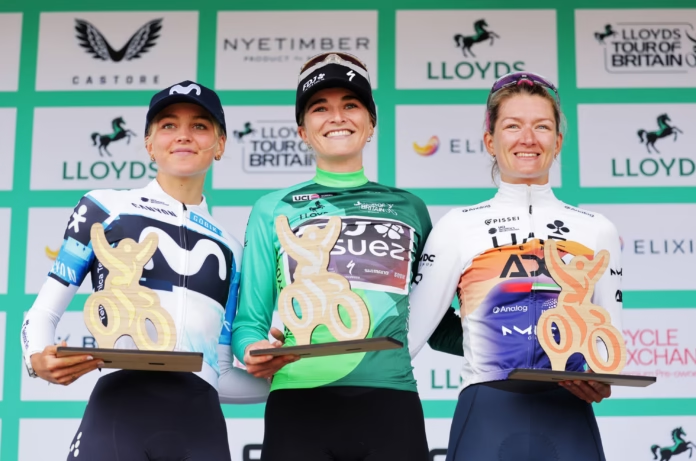
The Tour of Britain Women 2026 will run from Wednesday 19 August to Sunday 23 August, giving Britain’s leading women’s stage race five days of racing for the first time in its current Tour of Britain era. It is a significant step for the event, both symbolically and tactically, with the women’s race now matching the men’s edition in stage count.
The route moves across England and Wales, starting in Cockermouth in Cumbria before heading to Lancashire, North Wales, Mid Wales and Warwickshire. The race begins with a challenging loop through western Cumbria, takes in a likely sprint or reduced sprint finish in Blackpool, then reaches one of the key GC days on the Great Orme in Llandudno. The final two stages through Powys and Warwickshire should then decide whether the race belongs to a pure climber, a punchy all-rounder or a rider who can survive repeated hard days.
The full stage maps, timings, sprint points, climbs and road closure details have not yet been released, so this guide focuses on the confirmed host towns, the likely tactical shape of each stage and where the general classification may be decided. Even without the detailed profiles, the structure already tells us plenty. This is not a flat procession. The 2026 race has variety, geographical spread and a clear mid-race climbing flashpoint.
For wider context, see our Tour of Britain Women to expand to five stages in 2026, 2026 Tour of Britain set for biggest edition yet and women’s cycling route guide hub.
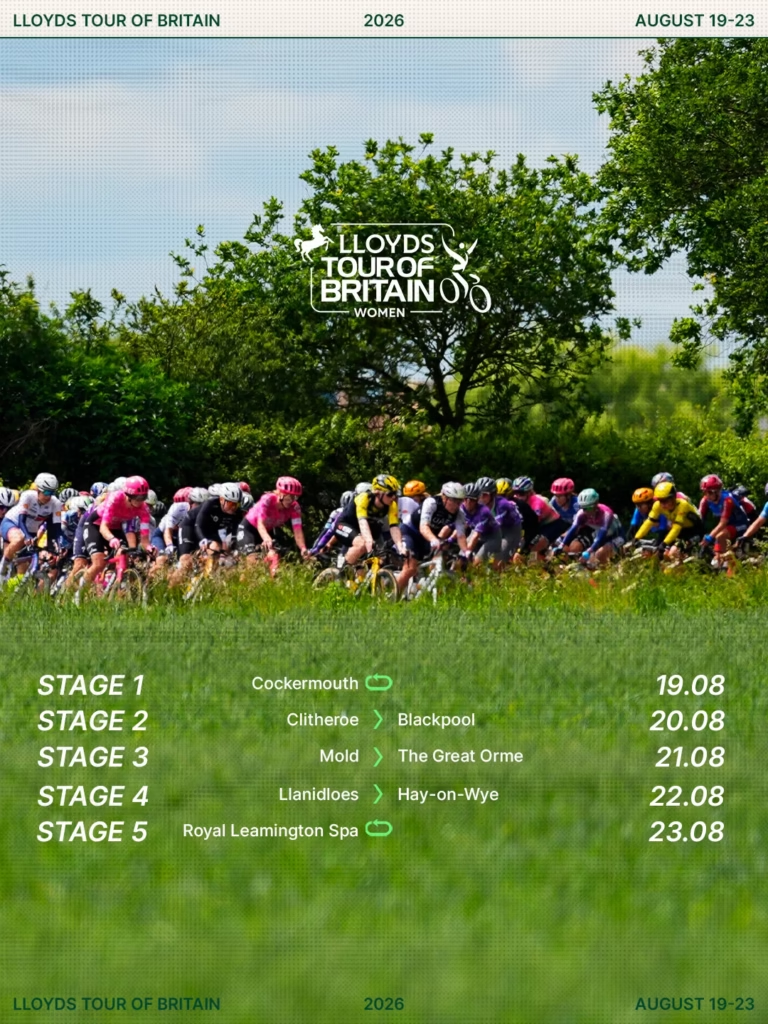
Tour of Britain Women 2026 route overview
| Stage | Date | Route | Likely race type |
|---|---|---|---|
| Stage 1 | Wednesday 19 August | Cockermouth to Cockermouth | Rolling / hilly opener |
| Stage 2 | Thursday 20 August | Clitheroe to Blackpool | Sprint or reduced sprint |
| Stage 3 | Friday 21 August | Mold to The Great Orme, Llandudno | Uphill finish / GC stage |
| Stage 4 | Saturday 22 August | Llanidloes to Hay-on-Wye | Hilly / GC and breakaway stage |
| Stage 5 | Sunday 23 August | Royal Leamington Spa to Royal Leamington Spa | Finale / stage hunters or reduced sprint |
The shape is clear even before the full maps arrive. Stage 1 should test the field immediately in western Cumbria. Stage 2 looks the most obvious day for fast finishers, though Lancashire roads can still make that harder than a simple bunch sprint. Stage 3 is the headline climbing day because of the finish on the Great Orme. Stage 4 through Powys has the feel of a dangerous penultimate day, with terrain that can reward aggressive racing. Stage 5 brings the race to Warwickshire, where the overall winner will be crowned in Royal Leamington Spa.
It is a compact five-day race, but not a simple one. The winner will need more than one good day. Positioning, recovery, stage craft and the ability to handle British roads will matter throughout.
For more race context across the season, see our women’s cycling race hub and guide to the 2026 Women’s WorldTour.
Why the five-stage format matters
The move to five stages changes the sporting feel of the Tour of Britain Women. A four-day race can be decided quickly, especially if one stage creates a clear GC hierarchy. A five-day race gives teams more room to recover, rethink and attack again.
That matters because the 2026 route has different types of stages. A sprinter may look strong in Blackpool, but that does not solve the Great Orme. A climber may gain time in Llandudno, but still has to manage the roads of Mid Wales and Warwickshire. A team that controls too heavily early may pay for it later.
It also gives the race more narrative space. The opening stage can create early tension. The second stage can bring the sprint teams into the race. The third stage can shape the GC. The fourth stage can reopen it. The fifth stage can decide whether the leader’s team is strong enough to finish the job.
For women’s cycling more broadly, that extra day is important. Route design has become one of the key ways stage races create depth, and the Tour of Britain Women now has more room to offer different kinds of racing. For more on that wider trend, see our feature on how race routes are shaping women’s cycling in 2026.
 Photo Credit: Alex Whitehead/SWpix.com
 Stage 1: Cockermouth to Cockermouth
The 2026 Tour of Britain Women begins in Cockermouth, with a start and finish in the historic market town. British Cycling has described the stage as a challenging route through western Cumbria before returning to Cockermouth for the finish.
That wording matters. Western Cumbria is unlikely to offer a completely flat opener. Even without the detailed route map, the terrain points towards a stage that could be awkward from the start. The roads can be rolling, exposed and rhythm-breaking, which is exactly the sort of terrain that can split a nervous peloton early in a stage race.
The first stage is unlikely to decide the whole race, but it can decide who is already under pressure. Riders targeting the general classification will need to stay alert, especially if the route uses narrow lanes, rolling climbs or exposed sections. Teams with ambitions for the overall will not want to spend the first evening chasing lost seconds.
For sprinters, the key question will be how hard the stage becomes before the finish. A flat run-in to Cockermouth could still bring a sprint, but the description of a challenging route suggests the fast finishers may need to survive a selective day first. That could open the door to punchier riders, reduced bunch sprinters or a late attack if the peloton hesitates.
Cockermouth has already hosted the men’s Tour of Britain, including a team time-trial in 2018, but this is the first stage of the modern women’s race in the town. That gives the opening day a clear sense of occasion. The race starts with a new women’s chapter in a region that already has Tour of Britain history.
What Stage 1 means tactically
The first day of a stage race is often more dangerous than it looks. Riders are fresh, teams are nervous and nobody yet knows how the race hierarchy will settle. A rolling Cumbrian opener could make that even more pronounced.
The strongest teams will want to keep their leaders near the front, avoid splits and stop any dangerous breakaway from gaining too much time. Smaller teams may see the same stage differently. If the final route contains enough rolling terrain, Stage 1 could be one of the best opportunities to attack before the GC becomes more controlled.
The finish in Cockermouth will be important. If the final kilometres are technical, positioning will be crucial. If the approach is flatter and more open, sprint teams may still be able to organise. If there is late climbing, then the stage becomes much more suited to punchy riders and classics-style all-rounders.
The safest expectation is an opener that suits strong, alert riders rather than pure specialists. Anyone who wants to win the race overall cannot afford a passive first day.

Stage 2: Clitheroe to Blackpool
Stage 2 takes the race from Clitheroe in the Ribble Valley to Blackpool, bringing Lancashire into the Tour of Britain Women for the first time. On paper, this looks like the clearest sprint opportunity of the race, with the finish in a seaside resort that has a long history with British racing.
Blackpool has hosted several Tour of Britain finishes in the modern era, and its promenade setting naturally points towards a fast finish. The question is how much work the riders have to do before they get there. A start in Clitheroe and a route through the Ribble Valley could add rolling roads before the race reaches the coast.
That makes Stage 2 more interesting than a simple flat transfer. Sprint teams will see the finish as a major chance, but they may need to control a breakaway over terrain that is harder than the final destination suggests. If the wind is up near the coast, positioning could also become important late in the day.
For the pure sprinters, this should be the stage circled most clearly. For the GC riders, it is a day to stay safe, avoid crashes and make sure no splits appear before the finish. For breakaway riders, the best chance may come if the stage proves harder than the sprint teams expect.
Could Stage 2 be a bunch sprint?
A bunch sprint is the most likely broad reading of Stage 2, but it is not guaranteed. The route has not yet been published in full, and Lancashire can offer more difficult roads than the word “Blackpool” might suggest.
If the organisers choose a direct and controlled route into the resort, the sprint teams should have the advantage. The long pull towards the coast could give them enough time to manage the gap, bring the race back together and set up a fast finish.
If the route uses more rolling terrain through the Ribble Valley or takes in exposed roads before Blackpool, the stage could become more complicated. A reduced sprint, a strong breakaway or a late move would then become more realistic.
The stage is also important for points classification riders. A fast finisher who survives Stage 1 and wins in Blackpool could take early control of the points race, especially if the Great Orme and Powys stages later make life harder for pure sprinters.
For wider context on sprint development in the women’s peloton, see our feature on why women’s cycling sprint finishes are getting faster.
Stage 3: Mold to The Great Orme, Llandudno
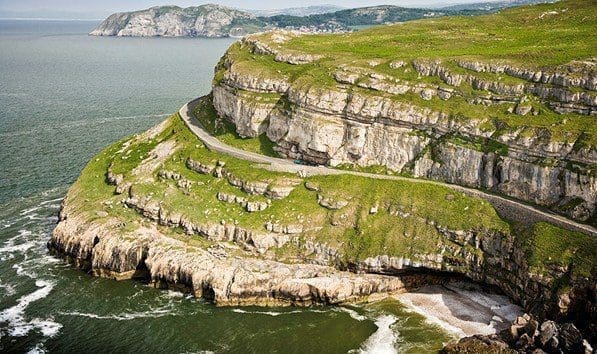
Stage 3 is the headline GC stage on the confirmed route. The race starts in Mold and finishes on the Great Orme in Llandudno, one of the most recognisable climbing finishes in British road racing.
The Great Orme is not a long Alpine climb, but that is not what makes it dangerous. It is steep, exposed and decisive at the end of a stage. The road can break a group quickly, especially if the pace is high before the climb starts. In a five-day race, even gaps of 10, 20 or 30 seconds can matter.
This stage should suit punchy climbers, explosive GC riders and all-rounders who can handle repeated changes of pace. It is less likely to suit pure sprinters unless the route before Llandudno is much easier than expected and the field reaches the climb relatively intact.
The Great Orme also has recent Tour of Britain relevance. Llandudno hosted a stage finish in 2024, when Lotte Kopecky won on the promenade, while the men’s race has also used the Great Orme as a decisive finish. That gives the stage a ready-made sense of importance.
If one day is going to create clear GC gaps, Stage 3 is the obvious candidate.
Why the Great Orme is such a strong finish
The Great Orme works because it is short enough to produce explosive racing and hard enough to punish hesitation. It is the kind of finish where a rider can win through timing, power and positioning rather than only pure climbing endurance.
That makes it especially suited to women’s stage racing. The gaps may not be enormous, but they can be decisive because the race is only five days long. A rider who gains time on the Great Orme could spend the final two stages defending rather than chasing.
The approach will matter. If the stage is controlled until Llandudno, the climb may become a straight fight between the strongest riders. If the route before the finish is already hard, the Great Orme could be the final blow after a day of attrition.
Teams with multiple cards will have options. They can attack before the climb, force rivals to chase, then save their strongest finisher for the final ascent. Teams with one clear leader will need to keep the race tight and make sure that leader begins the climb in the right position.
The Great Orme is the point where the 2026 route stops being a race of possibilities and becomes a race of gaps.
 Photo Credit: Alex Whitehead/SWpix.com
Stage 4: Llanidloes to Hay-on-Wye
Stage 4 takes the race through Mid Wales, from Llanidloes to Hay-on-Wye. British Cycling has described the stage as a challenging and scenic route through Powys, with the general classification battle entering its final stages.
This could be the most tactically complex stage of the race. It comes the day after the Great Orme, which means the GC order may already be established. Riders who lost time in Llandudno will need to attack. Teams defending the lead will need to decide how much control they can afford. Breakaway riders will see opportunity.
Powys is ideal for that kind of racing. The roads can be rolling, narrow, exposed and difficult to organise. Even without a summit finish, this stage could be harder to control than a more obvious mountain stage. The terrain may not produce one single decisive climb, but it can wear down teams and make the final hour unpredictable.
Hay-on-Wye gives the stage a distinctive finish town, and both Llanidloes and Hay-on-Wye are new start and finish hosts for the race. That gives the penultimate day a fresh identity, but the sporting angle is the more important one. This is exactly the kind of stage where the race can be reopened.
Could Stage 4 decide the GC?
Yes. Stage 3 may create the first major selection, but Stage 4 could decide whether that selection holds.
The day after a hard climbing finish is always revealing. Riders who looked strong on the Great Orme may feel the effort in their legs. Teams that spent heavily to set up the stage may have fewer resources to defend. Riders who lost time have a clear incentive to gamble.
That is why Stage 4 should not be treated as a transition day. It may not have the same obvious headline climb as Stage 3, but it has the ingredients for a dangerous penultimate stage. Rolling Welsh roads can make chasing difficult, especially if a strong group gets clear.
The key question will be how large the gaps are after Llandudno. If the race is still tight, teams may race conservatively and wait for the final day. If one rider has a clear lead, rivals may have no choice but to attack in Powys.
This is the stage where team strength could matter most. A leader without enough support may be vulnerable. A team with several strong riders can cover moves, control the road and discourage attacks before they become dangerous.
 Photo Credit: Alex Whitehead/SWpix.com
Stage 5: Royal Leamington Spa to Royal Leamington Spa
The 2026 Tour of Britain Women finishes in Royal Leamington Spa, with a Warwickshire loop starting and ending in the town. It is the first time Warwickshire will host the overall finish of the women’s race, although the county has a long history with the event.
Royal Leamington Spa has previously hosted women’s race finishes, including victories for Chloe Hosking in 2017 and Sarah Roy in 2018. That history points towards a finale that could suit fast finishers, although the final route map will decide how selective the stage becomes.
As the last day of a five-stage race, Stage 5 has two jobs. It must decide the final stage winner and confirm the overall champion. If the GC gaps are wide, the stage may tilt towards sprint teams and breakaway riders. If the gaps are small, every intermediate sprint, bonus second and late attack could matter.
Warwickshire roads can be deceptively tricky. They may not have the same climbing reputation as Wales or Cumbria, but rolling terrain, road furniture and technical town-centre approaches can still make the final stage stressful. A leader’s team will need to stay organised until the race is fully secure.
What kind of rider does the route suit?
The 2026 Tour of Britain Women route looks best suited to a versatile all-rounder rather than a pure climber or pure sprinter. The Great Orme gives climbing ability real value, but the race does not appear to be a mountain-heavy stage race. The winner will probably need to climb sharply, position well, handle rolling roads and stay alert across five days.
A punchy GC rider who can attack on the Great Orme and defend on rolling terrain should be well suited. A classics-style rider with a strong uphill finish may also be dangerous if they can limit losses on Stage 3. A pure sprinter could win stages, especially in Blackpool and possibly Leamington Spa, but winning the overall will be harder unless they can survive the hillier days without losing time.
The route also gives teams with multiple attacking options a real chance. A rider who cannot win on the Great Orme might still move into contention through consistency, bonus seconds and aggressive racing in Powys or Warwickshire.
This is where the five-stage format helps. It does not reduce the race to one climb. It gives the strongest teams time to build pressure. For a broader look at how this fits the season, see our guide to the 2026 Women’s WorldTour.
 Photo Credit: British Cycling via SWpix.com
Where will the general classification be decided?
The Great Orme is the obvious answer, but it may not be the whole answer.
Stage 3 should create the clearest climbing selection. It is the day where the strongest uphill riders can make a direct difference. If one rider is clearly superior there, the rest of the race becomes a defence job.
Stage 4 may be just as important tactically. It comes at the right point in the race for attacks, ambushes and breakaway pressure. If the leader’s team is not strong enough, Powys could become the day where the race changes direction.
Stage 5 then depends on the gaps. If the top of the standings is still close, the Warwickshire finale could become more tense than expected. Bonus seconds, positioning and small splits may matter if the race has not been settled earlier.
The most likely GC pattern is this: Stage 1 filters the contenders, Stage 3 creates the first real hierarchy, Stage 4 tests that hierarchy, and Stage 5 confirms or overturns it.
Best stages for sprinters
Stage 2 into Blackpool is the clearest sprint opportunity. A seaside finish, a major host town and a likely fast final all point towards the sprinters having their best chance there.
Stage 5 in Royal Leamington Spa may also suit fast finishers, depending on the final circuit and the GC situation. If the overall battle is settled, sprint teams may be given more freedom to organise. If the GC is close, the stage could become more nervous and less predictable.
Stage 1 could be possible for a reduced bunch sprint, but the western Cumbria description suggests it may be more selective. Stages 3 and 4 are less likely to suit pure sprinters, though durable fast riders may still survive longer than expected.
The points classification should therefore be shaped by more than raw sprint speed. Riders who can contest Blackpool, survive the Great Orme and still sprint in Leamington Spa will have a stronger hand than those relying on one clean bunch finish. For wider context, see our guide to why women’s cycling sprint finishes are getting faster.
 Photo Credit: Getty
Best stages for attackers
Stage 4 looks the best day for attackers. The terrain through Powys, the timing in the race and the pressure after the Great Orme all make it a natural breakaway or ambush stage.
Stage 1 may also suit early aggression, especially if the route through western Cumbria is rolling and difficult to control. A strong breakaway could test teams before they have fully settled into the race.
Stage 3 could include attacks before the Great Orme, but the final climb may keep teams cautious. Many riders may prefer to save themselves for the uphill finish rather than spend energy too early.
Stage 5 will depend on the GC situation. If the race is close, attacks may come from riders within striking distance. If the GC is settled, breakaway riders may target the stage while sprint teams decide whether they have enough control left.
What the route means for British riders
The Tour of Britain Women is always important for British riders because it gives them a WorldTour stage race on home roads. The 2026 edition spreads that opportunity across Cumbria, Lancashire, Wales and Warwickshire, giving the race a broader domestic footprint.
The route should suit several types of British rider. Climbers and punchy all-rounders will look at the Great Orme. Strong rouleurs and breakaway riders will look at Powys. Fast finishers will look at Blackpool and Leamington Spa. Young riders may see the five-stage format as a chance to learn how to handle repeated WorldTour-level racing.
That development angle matters. The Tour of Britain Women has long been one of the most visible entry points for British fans into elite women’s racing. A five-stage WorldTour race on British roads gives domestic riders, teams and spectators a bigger platform.
For riders likely to be relevant on home roads, see our British riders to watch in women’s cycling 2026. For a broader look at the race’s place in the calendar, see our guide to the most important women’s cycling races explained and our women’s cycling race hub.
Fan guide: best places to watch
The best stage to watch depends on the kind of racing you want.
Cockermouth should offer the atmosphere of an opening stage, with team presentation energy, fresh legs and early race tension. It is likely to be a good option for fans who want the start and finish experience in one place.
Blackpool is the obvious choice for a fast finish and a big crowd setting. The promenade has strong spectator appeal and should be one of the most accessible finishes of the race.
The Great Orme is the best pure racing location. If you want to see the riders under pressure, Stage 3 is the one to target. The climb should create the most visible selection of the race.
Llanidloes to Hay-on-Wye may be the best stage for fans who want a more traditional roadside experience in difficult terrain. It could also be the best day for those who enjoy tactical racing rather than a straightforward finish.
Royal Leamington Spa is the best choice for the final-day atmosphere. It will crown the overall winner and should bring the biggest sense of closure to the week.
For home viewing around the wider women’s calendar, see our women’s cycling TV guide hub.
-
 Photo Credit: Olly Hassell/SWPix.com
 -
 Photo Credit: Getty

What still needs to be confirmed
The major host towns are now known, but the detailed race route still needs to be published.
The missing information includes full stage maps, distances, start and finish times, categorised climbs, intermediate sprints, feed zones, road closures, spectator points and broadcast details. These will matter because they can change how each stage is interpreted.
For example, Stage 2 looks like a sprint stage from the host towns alone, but the detailed route could make it harder. Stage 4 looks dangerous through Powys, but the exact climbs and final kilometres will decide whether it is a GC stage or a breakaway day. Stage 5 could be a sprint, a reduced sprint or a tactical GC finish depending on the Warwickshire loop.
Until those details are released, the safest reading is based on geography and race structure rather than exact stage profiles.
Tour of Britain Women 2026 route verdict
The Tour of Britain Women 2026 route looks like a strong step forward for the race. The extra stage gives the event more room to breathe, while the host towns create a varied course across England and Wales.
The Great Orme gives the route a clear headline climb. Powys gives it a dangerous penultimate day. Blackpool and Leamington Spa offer likely chances for fast finishers. Cockermouth gives the race a testing opener rather than a soft start.
That balance should make the race difficult to control. It is not designed only for climbers, sprinters or breakaway riders. It asks for versatility, team depth and good race management across five days.
The likely winner will be a rider who can handle the Great Orme, stay alert through Mid Wales and still have enough support to finish the job in Warwickshire. The route does not need huge mountains to be decisive. It has enough variety to make every day matter.
For more women’s cycling coverage, visit our women’s cycling hub, women’s cycling race hub and women’s cycling route guide hub.

