The Tre Valli Varesine Women returns on Tuesday 6 October 2026 with the same basic formula that produced an aggressive race last year: an opening run from Busto Arsizio, followed by six laps of a demanding circuit through Varese and a finish in Via Sacco.
The organisers describe the race as 137km, while the Italian federation’s technical listing gives a more precise distance of 133.86km. Whichever figure is used, almost three-quarters of the race comes once the peloton reaches Varese. Each lap takes the riders over Montello before dropping towards Lake Varese and climbing back towards the city on the Ronchi.
There is no long mountain and no single climb severe enough to guarantee a selection on its own. Instead, the difficulty comes from repeating the same short climbs, technical descents and changes of direction until the group begins to break apart.
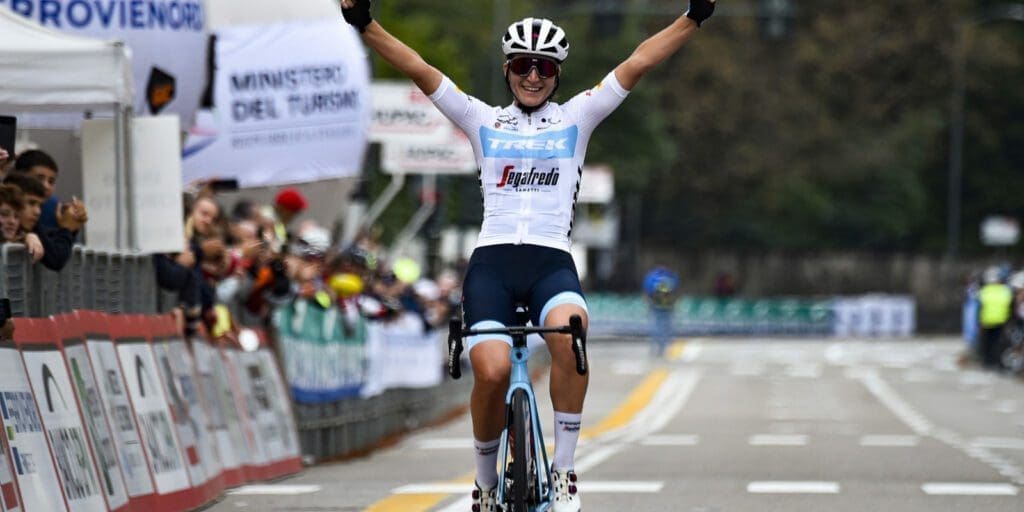
That formula worked particularly well in 2025. Elisa Longo Borghini and Demi Vollering finally escaped together on the last ascent of Montello before Longo Borghini won the two-rider sprint in Via Sacco. ProCyclingUK’s 2025 Tre Valli Varesine Women race report shows how the circuit gradually reduced the field before the decisive attack.

Tre Valli Varesine Women 2026 route at a glance
Date: Tuesday 6 October 2026
Start: Museo del Tessile, Busto Arsizio
Finish: Via Sacco, Varese
Distance: 133.86km on the FCI technical listing, rounded to 137km in organiser material
Classification: UCI 1.Pro
Start time: 09:15 local time
Expected finish: around 12:00-12:30 local time
Final section: six laps of the Varese circuit
Key climbs: Montello and Ronchi
Defending champion: Elisa Longo Borghini
The race starts from Via Volta beside the Museo del Tessile before travelling north towards Varese. Around 40km of the route is completed before the repeated city circuit begins.
For an introduction to the race itself, its place on the Italian autumn calendar and the riders who tend to succeed here, see ProCyclingUK’s beginner’s guide to Tre Valli Varesine Women 2026.
Previous winners
2025 – Elisa Longo Borghini
2024 – Cédrine Kerbaol
2023 – Liane Lippert
Longo Borghini is the only rider to have won the women’s race twice, taking her first victory in 2022 before returning to the top step last season. The history of Tre Valli Varesine Women covers the development of a race which only began in 2021 but has already progressed into the UCI Women’s ProSeries.
 Photo Credit: Getty
The opening 40km from Busto Arsizio
The opening section gives teams time to establish the shape of the race before the repeated climbing begins.
From Busto Arsizio, the route heads north through the province towards Varese. Compared with the circuit that follows, these roads offer much more scope for an early break to form without immediately putting the favourites under pressure.
A small group getting away here should not worry the main teams unless it contains somebody capable of surviving the Varese circuit.
The bigger concern is positioning.
Once the race approaches the city, the character changes quickly. The roads become more technical, the climbs start arriving repeatedly and moving from the back of the peloton becomes increasingly expensive.
Teams with a genuine contender will want to reach the first passage through Via Sacco with several riders still available around their leader.
Six laps around Varese decide the race
After reaching the finish area for the first time, the riders begin six laps of a circuit of roughly 16km.
The loop starts in central Varese before heading towards Via Montello. From there it drops through the western side of the city towards Schiranna and Lake Varese, before turning uphill again for the return towards the centre.
It is a route without much dead road.
The climbs are relatively short, but the sections between them include descents, corners and repeated changes of direction. Riders who lose ten or 15 positions can spend a surprising amount of energy correcting the mistake before the next acceleration.
By the fourth or fifth lap, that accumulation usually begins to show.
Montello is the obvious place to attack
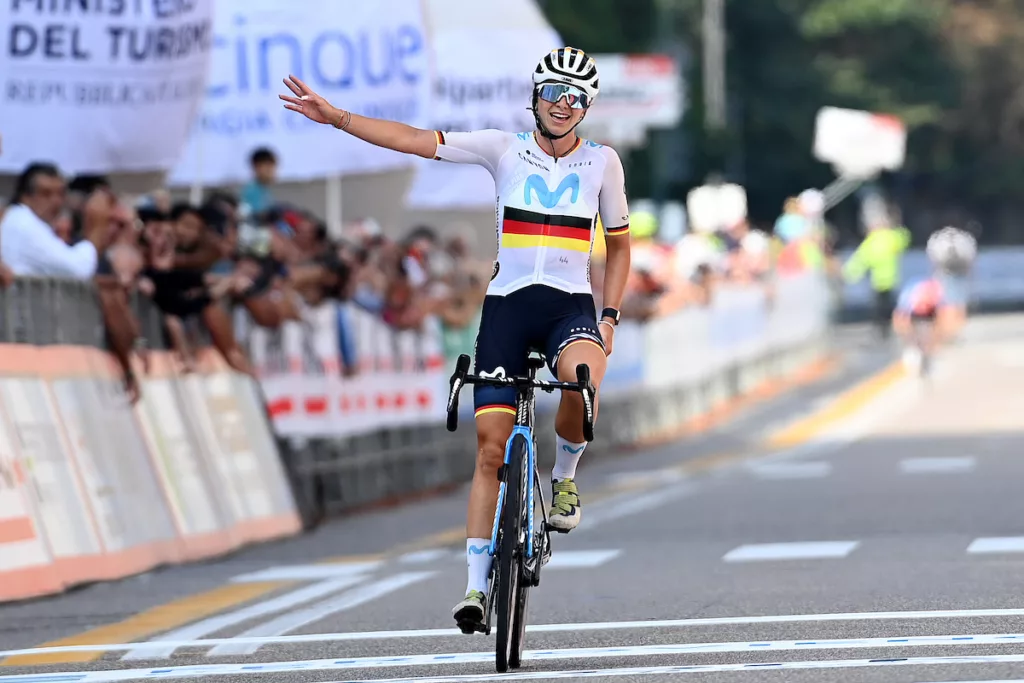
Montello provides the sharpest climbing effort on each circuit.
Depending on exactly where the climb is measured from, the main uphill section is a little over a kilometre at roughly 6-7%, with sections approaching 10%. The wider approach can be treated as a longer climb at a slightly lower average.
The important feature is not the precise average gradient. It is the way the road encourages an acceleration.
The climb is short enough for punchier riders to attack hard rather than settle into a steady climbing rhythm. On the early laps that can simply stretch the peloton. Late in the race, the same acceleration can create a gap which is difficult to close on the descent.
The six passages also make it an attritional climb. A rider who handles Montello comfortably the first three times can still be exposed once the pace rises on laps five and six.
That was exactly where the winning move formed last year.
Vollering attacked on the final ascent, Longo Borghini went with her and the rest of the contenders could not make contact again before the finish.
The descent towards Schiranna keeps the pressure on
The road after Montello is important because there is no simple descent followed by a long period of recovery.
The course heads through the Campigli area and drops towards the lower part of Varese before reaching Schiranna and the lakeside.
A small gap over Montello can therefore be carried into a fast section where hesitation in the chase becomes costly.
The opposite is also true. A lone attacker who has used too much energy on the climb can quickly find herself exposed if several teams organise behind.
That gives teams with numbers an advantage. Rather than committing their strongest rider immediately, they can send somebody clear and force their rivals to decide whether to chase before the road turns uphill again.
Ronchi provides the second test on every lap
The return from Lake Varese brings the riders back towards the centre on the Ronchi side of the circuit.
It is a different climb from Montello. The ascent is longer, roughly 2km, and generally sits around 5% before reaching steeper sections which move into double figures.
That makes it harder to attack explosively from bottom to top, but particularly effective at punishing riders who have already gone too deep on Montello.
The approach from the lakeside also means the speed changes abruptly. Riders come from relatively quick roads into a sustained climb back towards the higher part of Varese.
On the early circuits it is likely to be ridden as part of the general rhythm of the race.
On the final lap, it becomes a second chance.
Anyone who misses the decisive attack on Montello can still try to close the gap or launch a counter-move on Ronchi. An attacker already clear has to judge how much energy to spend defending the advantage before the flatter run into Via Sacco.
Why the two climbs work so well together
Neither Montello nor Ronchi would make Tre Valli Varesine Women especially selective if ridden once.
Six repetitions change the race.
Montello repeatedly asks for acceleration. The descent demands concentration and positioning. Ronchi then requires another sustained effort before the riders return towards the finish.
There is enough time between the climbs for small groups to reorganise, but not enough for riders repeatedly dropped from the back to recover comfortably.
The result tends to be gradual elimination rather than one enormous split.
That suits riders who can repeat hard efforts for several hours: Classics specialists with good climbing legs, punchy stage racers and climbers who retain enough speed to win from a reduced group.
The recent winners reflect that range. Longo Borghini, Kerbaol and Lippert have very different strengths, but all are comfortable attacking rather than waiting for a conventional bunch finish.
The final lap begins before Montello
Positioning for the last circuit is likely to be almost as important as the climb itself.
A large group crossing Via Sacco together has only a limited amount of road before Montello. Riders caught too far back risk being forced to respond after the strongest contenders have already accelerated.
The final approach is therefore likely to become increasingly nervous even if nobody has escaped.
Teams with several riders left can make that difficult for isolated favourites. One rider can attack before Montello, another can follow moves on the climb and the leader can wait for the closing kilometres.
A rider without teammates has to decide which moves are worth following.
That is where a circuit race can become more tactically complicated than its profile suggests.
The final Montello was decisive in 2025
The 2025 edition is the clearest guide to how the closing lap might unfold.
The race had already been whittled down by repeated attacks when Vollering accelerated on Montello. Longo Borghini was able to follow, while the group behind could no longer respond quickly enough.
The pair then had to manage the remaining kilometres rather than simply sprint from the summit.
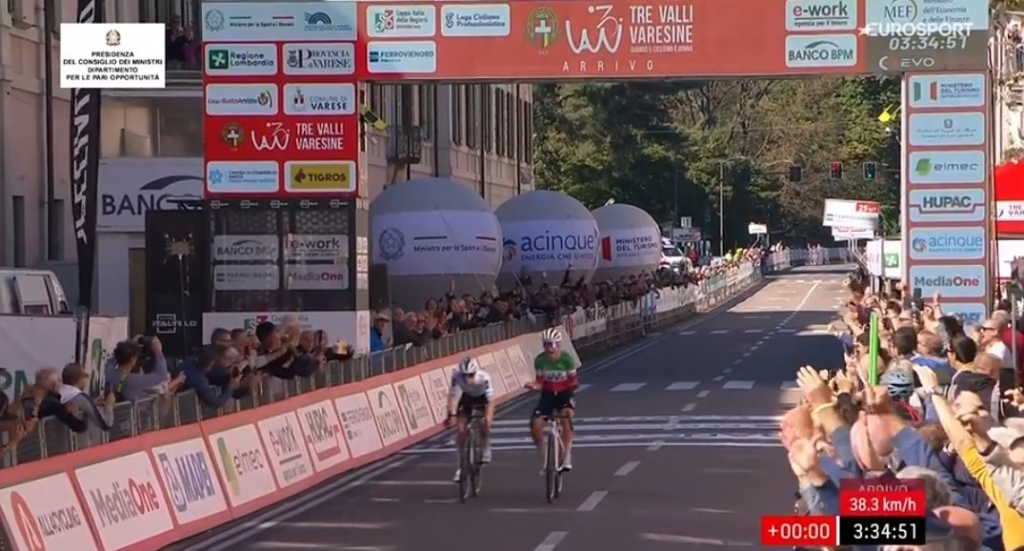
Vollering did much of the work while Longo Borghini waited, knowing she had the stronger finish. Once they reached Via Sacco together, the Italian used that advantage to win.
It was a good example of why the final Montello does not settle every part of the race.
Creating the winning group and actually winning from it are two different jobs.
Ronchi can still change the race after Montello
A rider who survives Montello with the leaders cannot assume the hardest work is finished.
Ronchi comes late enough for tired legs to turn small differences into meaningful gaps. It is also long enough for somebody to make a more sustained move rather than relying entirely on acceleration.
An isolated leader may try to defend whatever advantage she has already created. A small group can use the climb to remove faster riders before the finish. Chasers have one final opportunity to bring an attack back.
If several favourites crest Ronchi together, the balance then moves towards the riders with the better sprint.
Via Sacco means the sprinters cannot be dismissed
The finish itself is one reason Tre Valli Varesine Women remains open to more than pure climbers.
There is no summit finish after the final climbing. Riders return towards central Varese and finish on Via Sacco, leaving enough road for a small group to look at one another and think about the sprint.
That changes how the strongest climbers have to race.
Anyone who does not trust her finish needs to create separation before reaching Via Sacco. Riders with more speed can afford to defend and let others make the harder attacks.
Longo Borghini exploited that situation perfectly against Vollering last year.
If a group of five or ten reaches the closing streets together in 2026, the tactical battle could be completely different from a race decided by a pair of climbers.
Bad weather would make the Varese circuit much harder
October weather has already played a major part in the short history of the women’s race.
The 2024 edition was hit by exceptionally heavy rain. The women’s route was shortened and the wet roads made every descent, corner and braking zone more difficult.
Cédrine Kerbaol eventually escaped to win alone, with the race becoming as much about handling and committing in the conditions as pure climbing strength. The 2024 Tre Valli Varesine Women race report covers a day when the same roads produced a very different contest.
The men’s race later that afternoon was abandoned because conditions deteriorated further.
A dry 2026 edition should favour repeated attacking and small-group racing. Heavy rain would place far more emphasis on the descents towards the lake and the ability to stay near the front without taking unnecessary risks.
What will decide Tre Valli Varesine Women 2026?
The route gives riders six opportunities to test one another on the same roads, but the final two laps should be where those efforts begin to count.
An early break can survive into Varese, but holding off a peloton containing several strong Classics teams through six circuits is a much harder task. The favourites are more likely to begin exposing one another as fatigue builds on Montello.
The penultimate lap offers the first realistic opportunity for a longer-range winning move. Waiting until the final Montello is safer, but increases the chance of taking several quick finishers into the closing kilometres.
Then there is Ronchi, where anyone who has misjudged the first attack gets one final chance to alter the race.
Tre Valli Varesine Women does not need a major mountain to create separation. Six repetitions of Montello, the drop to Lake Varese and the climb back into town provide enough opportunities.
The rider who wins in Via Sacco will need more than one hard acceleration. She will need to keep producing them after more than 130 kilometres of a race designed to make each lap feel a little harder than the one before.