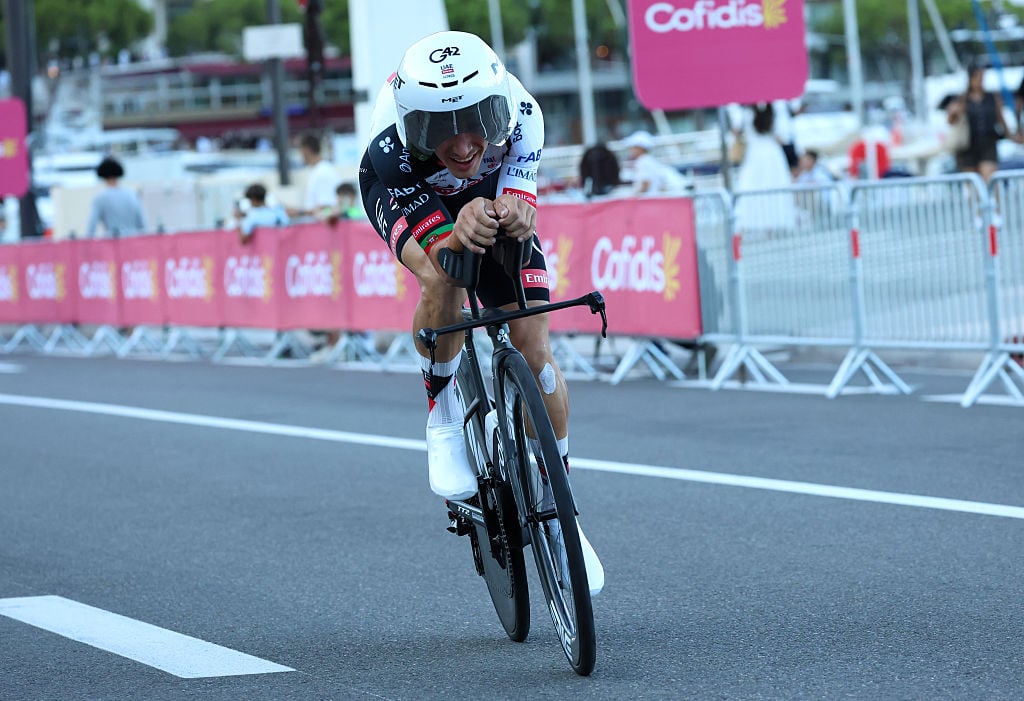
Tadej Pogačar won stage 1 of the 2026 Vuelta a España in Monaco, beating Ethan Hayter by just 0.09 seconds in a dramatic opening individual time-trial.
The UAE Team Emirates-XRG rider started as the overwhelming favourite for the Vuelta and immediately took the first red jersey, edging Hayter by the smallest possible margin after a short, technical course through the streets of Monaco. Josh Tarling also delivered a strong ride after briefly holding the fastest time, but Pogačar and Hayter ultimately turned the final minutes of the stage into a duel for red.
Primož Roglič, another former Vuelta winner and one of the obvious reference points for the general classification, finished 24th at 22 seconds. On a course too short to create huge gaps, that was still enough to put him immediately on the back foot against Pogačar.
A short Monaco time-trial with no room for error
The 2026 Vuelta began with a short individual time-trial in Monaco, a stage that looked modest on distance but awkward in execution.
The route was flat enough not to create major climbing gaps, but it was technical enough to reward confidence, braking skill and precision through corners. Monaco’s tight roads, direction changes and high-speed sections meant the stage was not simply about holding power for 10 minutes. Riders had to accelerate repeatedly, stay clean through the turns and avoid losing rhythm in the second half of the course.
That made it a dangerous opener for the general classification riders. A pure climber could survive without losing minutes, but a small mistake could cost 10 or 15 seconds almost instantly. For Pogačar, it was an opportunity to take control early. For Roglič, Richard Carapaz, Enric Mas, Oscar Onley and the other GC contenders, it was a day to limit damage before the road stages began.
It became clear very quickly that seconds would matter.
Early riders keep changing the target
The first hour of racing was busy, with the benchmark changing several times as riders settled into the demands of the course.
Diego Uriarte was the first rider down the start ramp, but his time did not survive for long. Andreas Leknessund then took over, before Mathias Norsgaard bettered him by a single second. Jordan Labrosse produced the first major step forward, going 16 seconds quicker than Norsgaard and putting down a more serious marker.
That still did not hold. Sander De Pestel moved into the lead, before Matthew Brennan, riding his first Grand Tour stage, produced an excellent time to go fastest by 2 seconds. It was an impressive ride from a rider more widely expected to feature in sprint finishes later in the race than in an opening time-trial.
The repeated changes told the story of the course. There was no single obvious rhythm. Some riders started quickly and faded, others found time in the more technical second half, and the leaderboard kept shifting as riders worked out where the stage could be won.
Decathlon riders surprise the favourites
One of the early themes was the strength of Decathlon CMA CGM.
Labrosse had already gone fastest earlier in the day, but the team continued to produce unexpected time-trial performances. Léo Bisiaux later set a new best time after recovering from a deficit at the intermediate check, using a strong second half to edge ahead.
Oscar Chamberlain then went even quicker. The 21-year-old, making his Grand Tour debut, posted a time that briefly put him on top and underlined the depth of young talent in the field.
Those rides mattered because they kept raising the standard before the big-name specialists had even finished. By the time the later starters reached the course, the target had become much more serious than a routine early benchmark.
It also meant the GC riders had a meaningful comparison. The stage may have been short, but riders who were not fully committed or who mishandled the technical sections were immediately punished.
GC riders begin to reveal form
The opening time-trial was never going to decide the Vuelta, but it gave an early look at form among the general classification riders.
Carapaz produced a solid ride, limiting his losses well enough on a course that was never likely to suit him perfectly. João Almeida also posted a respectable time, a useful sign after a season in which his form has not always been straightforward.
Mas lost 29 seconds, a result he will probably accept given his long-standing weakness against the clock. Sepp Kuss also gave away time but did not appear to completely soft-pedal the effort, leaving his exact GC intentions still open after comments before the race suggested stage wins may be more important to him than another overall campaign.
Onley and Gall both lost time, with Gall limiting the damage slightly better than might have been expected given his usual difficulty in time-trials. Mattias Skjelmose and Tobias Halland Johannessen were also among the riders whose early times gave the first glimpse of where the podium fight might sit behind Pogačar.
The gaps were not decisive, but the hierarchy had already begun to take shape.
Tarling takes the hot seat
Tarling then gave the stage its emotional and sporting centre.
The British time-trial specialist started after a difficult week following the death of his younger brother Finlay, and produced a strong ride in his honour. He was fastest at the intermediate check by a second and then reached the finish just ahead of Callum Thornley to take the provisional lead.
It was not a dominant margin, but it was enough to put Tarling in the hot seat with several major riders still to come. Given the circumstances, it was a performance with obvious emotional weight as well as sporting quality.
For a while, it looked as though Tarling might hold on for a podium or even something bigger. The late starters still included Wout van Aert, Hayter, Pogačar and Roglič, but Tarling had delivered the kind of time that forced them to go almost perfectly.
Hayter smashes the benchmark
Hayter was the first late rider to truly break the race open.
The British rider went through the intermediate check 3 seconds faster than Tarling and carried that speed to the finish, where he beat Tarling’s time by 4 seconds. That was a serious difference on such a short course and immediately made Hayter the rider to beat.
The performance was built on more than raw power. Hayter handled the second half well and did not lose momentum through the technical sections, an important detail on a course where several riders had faded after strong starts.
Once Hayter crossed the line, the stage looked close to being his. Only a handful of riders still had a realistic chance of beating him, and the time he had posted was clearly strong enough to put major pressure on Pogačar.
Then the Slovenian rolled down the start ramp.
Van Aert cannot match the final pace
Van Aert was among the last major threats to Hayter’s time, but he could not quite find the required speed.
The Belgian went through the intermediate check only fifth fastest, leaving himself too much to do in the closing kilometres. He improved enough to finish seventh on the stage, but it was not the ride needed to challenge for the first red jersey.
Mads Pedersen also faded in the second half, finishing outside the fight for the win after earlier looking capable of a stronger result. The technical course punished anyone who could not sustain speed and rhythm all the way to the finish.
That left Pogačar as the final major danger to Hayter. He had been second fastest at the intermediate check, 2 seconds down, which meant he needed a sharper second half to overturn the British rider’s advantage.
He found it by almost nothing.
Pogačar wins by 0.09 seconds
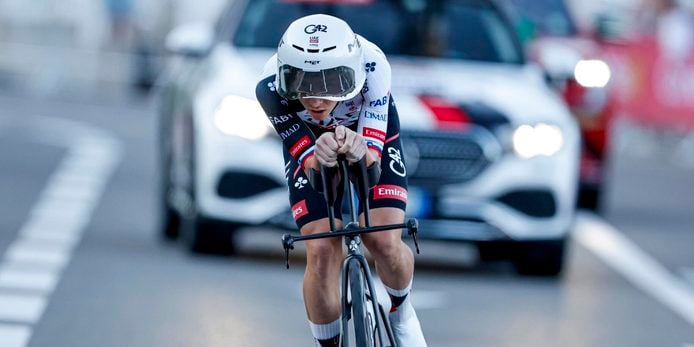
Pogačar produced a remarkable final section to beat Hayter by 0.09 seconds.
The winning margin could barely have been smaller. Hayter had done almost everything right and was beaten by less than a tenth of a second after the opening time-trial. On a technical route, that is a difference of one corner, one pedal stroke or one bike throw.
For Pogačar, it was the perfect start. He came to the Vuelta trying to complete the Grand Tour set and began by taking the first stage, the first red jersey and an immediate psychological advantage over every GC rival.
It was not a crushing performance in terms of time gaps. It did not need to be. The symbolism was more important: on day one, in a discipline that was short enough to open the door to specialists, Pogačar still found a way to win.
Hayter denied by the narrowest margin
Hayter’s second place will be difficult to process because he was so close to one of the biggest results of his career.
He had beaten Tarling clearly, handled the pressure of the late start order and looked set to take both the stage and the red jersey. Losing by 0.09 seconds is not a normal defeat. It is the kind of margin that makes every micro-decision on the course feel decisive.
Still, the ride was excellent. Hayter beat several elite time-trial riders and finished ahead of riders who had been much more heavily tipped for the stage. If the race offers him further opportunities, this performance suggests he has arrived in strong form.
For British cycling, it was also a striking opening day. Tarling briefly led, Hayter came within a fraction of victory, and the stage was shaped heavily by British riders before Pogačar delivered the final blow.
Roglič already loses 22 seconds
The most notable GC loss belonged to Roglič.
The Red Bull-Bora-Hansgrohe rider finished 24th at 22 seconds, a gap that is not catastrophic but is significant on the opening day. Over a three-week Vuelta, 22 seconds can be recovered, but losing that amount on a short time-trial immediately gives Pogačar the upper hand.
Roglič has won this race four times and knows better than anyone how quickly a Vuelta can change. There will be much harder terrain ahead, and the race will not be decided by one Monaco time-trial. Even so, this was not the start he wanted.
The difference between Pogačar and Roglič is now already visible on the road and in the classification. Pogačar has the red jersey and momentum. Roglič has work to do.
Pogačar starts as he means to continue
Pogačar’s victory also gave UAE Team Emirates-XRG control from the very first stage.
That matters because this Vuelta begins with a clear central narrative: whether Pogačar can complete his set of Grand Tour victories and add the Spanish title to his palmarès. The opening day did not answer the bigger three-week question, but it did show that he has arrived ready to impose himself immediately.
He did not need to win by a large margin. On a course this short and technical, even taking seconds from most of his rivals was enough. Beating Hayter by less than a tenth of a second simply gave the day a sharper edge.
For the rest of the field, the problem is familiar. Pogačar has already won, already taken the leader’s jersey, and already forced everyone else into reaction mode.
Monaco gives the Vuelta an immediate headline
Opening a Grand Tour with a short time-trial can sometimes feel like a controlled introduction. This one did not.
The stage produced repeated lead changes, surprise performances from young riders, an emotional ride from Tarling, an outstanding time from Hayter and then the narrowest possible Pogačar victory at the end. It gave the Vuelta an immediate headline and put the race’s dominant favourite into red after one day.
The GC gaps remain manageable for most of the contenders. Roglič at 22 seconds, Mas at 29 seconds and several other names in that range are not out of the race. But Pogačar has already done what he so often does: turn the first meaningful test into a win.
The Vuelta now moves on with the Slovenian already leading, Hayter left wondering how 0.09 seconds got away, and Roglič needing to respond before the race reaches its first major mountain tests.
Vuelta a España 2026 stage 1 result
| Position | Rider | Team | Time/gap |
|---|---|---|---|
| 1 | Tadej Pogačar | UAE Team Emirates-XRG | 10:57 |
| 2 | Ethan Hayter | Soudal Quick-Step | same time |
| 3 | Joshua Tarling | Netcompany INEOS | +0:04 |
| 4 | Callum Thornley | Red Bull-BORA-hansgrohe | +0:05 |
| 5 | Christophe Laporte | Team Visma | Lease a Bike | +0:06 |
| 6 | Léo Bisiaux | Decathlon CMA CGM | +0:08 |
| 7 | Oscar Chamberlain | Decathlon CMA CGM | +0:09 |
| 8 | Wout van Aert | Team Visma | Lease a Bike | +0:09 |
| 9 | Finn Fisher-Black | Red Bull-BORA-hansgrohe | +0:10 |
| 10 | Arthur Kluckers | Tudor Pro Cycling Team | +0:11 |
Main photo credit: Cor Vos