
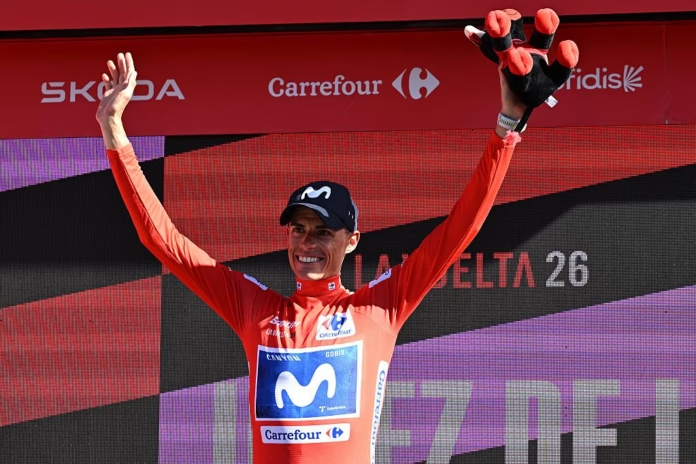
The 2026 Vuelta a España reaches its final mountain stage on Saturday with the hardest climbing day still to come. Stage 20 takes the peloton 186.8km from La Calahorra to the new summit finish at Collado del Alguacil, packing almost 4,850 metres of climbing into a route that becomes increasingly severe as it approaches the Sierra Nevada.
There is no significant general classification terrain left after it. Sunday’s 112km finale around Granada is officially a flat stage, leaving Collado del Alguacil as the final realistic opportunity to overturn the race for the red jersey.
Enric Mas began Friday’s Stage 19 to Peñas Blancas with 1:37 over Primož Roglič, 3:01 over Felix Gall and 5:17 over Richard Carapaz. The exact numbers for Saturday will depend on what happens on Peñas Blancas, but the basic tactical picture is already clear. Anyone who still wants to take the Vuelta from Mas is running out of road.
The 2026 Vuelta route has been building towards this stage from the beginning. Two ascents of Puerto de El Purche, the newly introduced Puerto de El Duque and an 8.3km finishing climb averaging 9.8% create several places to attack rather than one obvious final launch point.

Vuelta a España Stage 20 at a glance
- Date: Saturday 12 September 2026
- Start: La Calahorra
- Finish: Collado del Alguacil
- Distance: 186.8km
- Stage type: Mountain
- Elevation gain: approximately 4,850 metres
- Neutralised start: 12:30 CEST / 11:30 BST
- Racing start: approximately 12:36 CEST / 11:36 BST
- Expected finish: 17:16-17:47 CEST / 16:16-16:47 BST
- Puerto de Los Blancares: 7.7km at 3.7%, category three
- Puerto de El Purche: 8.2km at 8.1%, category one
- Puerto de El Purche: 8.2km at 8.1%, category one
- Puerto de El Duque: 7.4km at 8.3%, category one
- Collado del Alguacil: 8.3km at 9.8%, hors catégorie
UK viewers can follow the stage live on TNT Sports and HBO Max, with the wider broadcast options covered in our guide to watching the Vuelta a España 2026 in the UK.
Stage 20 is much more than the final climb
Collado del Alguacil is severe enough to decide the Vuelta on its own, but reducing Stage 20 to the final 8.3km misses what makes the route so difficult.
The opening 80km are relatively restrained by comparison with what follows. Puerto de Los Blancares comes after 50.7km and climbs for 7.7km at 3.7%, unlikely to trouble the GC favourites but useful terrain for establishing a strong breakaway.
The race changes once it reaches Monachil.
Puerto de El Purche is climbed for the first time after 86.1km, with the summit coming at kilometre 94.3. It is 8.2km at 8.1%, long and steep enough for a serious team to begin removing domestiques even if none of the leaders attacks.
The riders then descend towards Granada, loop back through Huétor Vega and return to Monachil to climb exactly the same mountain again.
The second summit of El Purche comes after 125.5km.
That repetition is one of the most important features of the stage. A GC contender does not necessarily need to attack on the first ascent for it to matter. Riding El Purche hard once reduces the size of the peloton. Doing it again half an hour later asks riders who were already close to their limit to repeat the effort.
By the time the race reaches the final two climbs, team support could be significantly reduced.
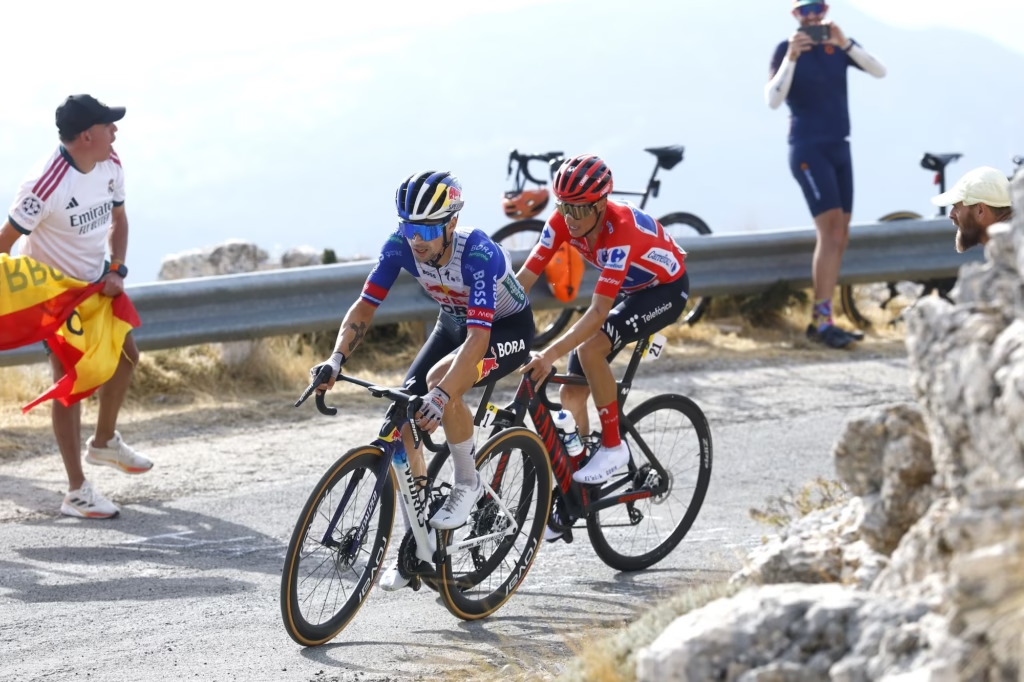
Why Roglič cannot simply wait for Collado del Alguacil
The Jerez time trial changed the situation without changing the leader.
Roglič took 33 seconds from Mas over 32.1km, moving back ahead of Gall into second overall, but Mas produced a much stronger ride than the Slovenian needed. Rather than cutting a 2:10 deficit towards half a minute, Roglič began Friday still 1:37 behind.
It left him needing the mountains to provide something the time trial did not.
That makes his approach to Stage 20 dependent on how much time remains after Peñas Blancas, but there is a point beyond which waiting for the bottom of the final climb becomes extremely difficult to justify.
Even on an ascent averaging almost 10%, taking more than a minute from a rider of Mas’s climbing level is a major task. Mas has already been stronger than Roglič at Alto de Aitana, Calar Alto and Sierra de La Pandera during this Vuelta.
A short attack with two kilometres remaining will not be enough if the gap remains anything close to its current size.
Red Bull-Bora-Hansgrohe therefore have an incentive to use El Purche and Puerto de El Duque to make the stage harder than Movistar want it to be.
The two climbs of El Purche are about taking Movistar away from Mas
The first passage of El Purche begins with more than 100km still to race.
That is too far from the finish for the obvious GC move, but it is not too early for Red Bull to start changing the shape of the group.
Roglič’s best scenario is not necessarily attacking personally on the first ascent. It is reaching the second half of the stage with Mas isolated or close to it.
Movistar have repeatedly been able to support their leader deep into difficult mountain stages. Raúl García Pierna and Iván Romeo have been particularly useful when the race becomes tactical rather than simply a contest between leaders.
Allow Mas to reach Collado del Alguacil with several teammates and the task becomes much simpler. Movistar can set the pace, cover dangerous moves and let the red jersey concentrate almost entirely on Roglič.
El Purche provides the terrain to prevent that.
The first ascent can remove the weaker domestiques. The second can force the stronger ones to work. By Puerto de El Duque, the race could be reduced to leaders and their final mountain helpers.
That is where Roglič needs it to be.
Puerto de El Duque could decide whether anyone dares to attack early
Puerto de El Duque replaced the originally planned Alto de Hazallanas after landslides caused by severe weather in February damaged the access road.
The replacement has not made the stage meaningfully easier.
El Duque begins with 38.8km remaining and climbs for 7.4km at an average of 8.3%, reaching its summit 31.4km from the finish. It is a substantial climb in its own right and arrives after both passages of El Purche.
For riders trying to dislodge Mas, this is probably the most important tactical point of the stage.
Waiting means accepting that the entire Vuelta could come down to the final eight kilometres.
Attacking on El Duque creates another half-hour of racing in which a gap can grow, alliances can form and Movistar can be forced to chase.
The difficulty is what happens after the summit.
There is still a long descent and valley section before the final ascent. A lone rider could spend too much energy defending a small advantage before reaching Collado del Alguacil.
That makes teammates ahead valuable. Red Bull could try to put a climber into the early break, giving Roglič somebody to use if he attacks on El Duque. Decathlon CMA CGM have the same reason to think about Felix Gall.
An attack here needs more than climbing strength. It needs a plan for the next 20 kilometres.

Collado del Alguacil is unlike anything else in the final week
The final climb begins with 8.3km remaining at Güéjar Sierra and rises 816 metres to an altitude of 1,884 metres.
Its average gradient is 9.8%.
There are sections reaching around 20%.
It has never previously been used as a summit finish at the Vuelta, giving the race a completely new climb for its final mountain confrontation.
The first part is particularly important. Steep ramps arrive almost immediately, removing much of the opportunity for weaker riders to find a comfortable tempo behind a large group.
That makes Collado del Alguacil very different from Peñas Blancas.
Peñas Blancas is a long climb where sustained pacing and accumulated fatigue can produce gaps. Collado del Alguacil is shorter, steeper and much more violent. Drafting matters less once the gradient reaches double figures and changes in pace become considerably harder to absorb.
A rider who goes over his limit can lose substantial time quickly.
After nearly three weeks of racing, that is exactly the sort of finish where the existing hierarchy can suddenly become less reliable.
Mas does not need to race for the stage win
Mas has spent much of the Vuelta creating advantages. Stage 20 is more likely to be about deciding which attacks are worth answering.
That distinction matters.
If somebody several minutes down on GC attacks on the second El Purche, Movistar do not necessarily need to respond immediately. If Gall moves and Roglič follows, Mas can assess whether his closest rival is actually gaining anything before committing.
Roglič is the reference point.
Mas does not need to beat him to the summit. If the gap going into the stage remains substantial, he can afford to concede some time.
That gives Movistar tactical flexibility that Red Bull simply do not have.
Roglič needs something to happen. Mas mainly needs to prevent it becoming too big.
The danger for the race leader comes if he begins trying to respond to every move rather than riding according to the overall classification. A succession of accelerations on El Purche and El Duque could become much more damaging than one controlled effort on the final climb.
Movistar’s job is to keep the race as simple as possible.
Everyone trying to beat Mas needs the opposite.
 Photo Credit: Getty
Felix Gall may be the rider who makes the race difficult
Gall’s GC position gives him a different calculation from both Mas and Roglič.
He began Stage 19 at 3:01, with Roglič only 1:24 ahead of him after the Jerez time trial. That leaves second place far more attainable than the red jersey and gives Decathlon CMA CGM a genuine reason to attack.
Gall has already shown that he can distance Roglič uphill. He moved ahead of him on general classification after La Pandera before the time trial reversed their positions.
Saturday’s terrain moves the advantage back towards the Austrian.
An 8.3km climb at almost 10% is considerably closer to Gall’s ideal conditions than 32 kilometres of flat time trialling.
He also does not have to carry the responsibility of being the first rider to attack Mas.
If Gall moves on El Duque, Roglič has a decision to make. Let him go and second place becomes vulnerable. Follow and Roglič may end up spending energy responding to Gall rather than executing his own attack on Mas.
For Mas, that competition between his nearest rivals could be extremely useful.
Richard Carapaz has licence to disrupt the expected script
Carapaz began Friday fourth overall at 5:17.
That is a large enough deficit that a normal attack does not immediately threaten Mas’s red jersey, but small enough that neither Gall nor Roglič can ignore him indefinitely.
That makes Carapaz dangerous in a different way.
He does not need to wait for the final climb.
A move on the second ascent of El Purche or El Duque could force Decathlon to protect Gall’s podium position and make Red Bull decide whether Carapaz is gaining too much ground.
Movistar may be able to leave that responsibility to others.
This is where Stage 20 has the potential to become more complicated than a straightforward Mas-versus-Roglič contest. Gall wants second and still has an outside route towards red. Carapaz has a podium position to attack. Oscar Onley and Jakob Omrzel are separated by less than a minute further down the classification.
Several races are taking place inside the same GC group.
The more of them that begin before Collado del Alguacil, the harder it becomes for Movistar to dictate a controlled pace.
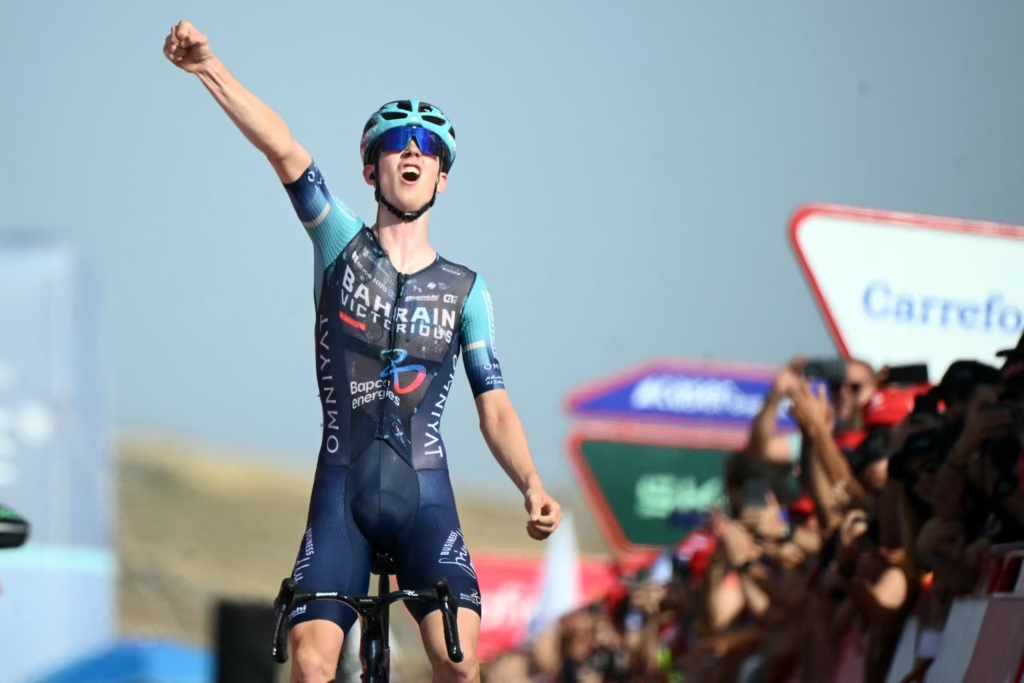
Oscar Onley and Jakob Omrzel have their own battle
Onley entered Stage 19 fifth overall at 6:03, with Omrzel sixth at 7:00.
That gap leaves the white jersey contest close enough to influence the final mountain stage independently of the fight for red.
Onley has handled the sustained mountain stages impressively throughout the race, but Stage 20 presents a different type of test. The decisive question is unlikely to be whether he can climb at 10% for a few kilometres. It is whether he can still do it after nearly 4,000 metres of climbing have already accumulated during the stage.
Omrzel has little reason to settle for sixth if he remains within striking distance.
An attack from Bahrain Victorious could therefore begin even if the top three are watching one another.
That matters because every acceleration makes the race more expensive.
The breakaway needs a large advantage before El Duque
The early terrain gives climbers and strong breakaway riders a genuine opportunity to establish a useful lead.
Whether they are allowed enough depends on the GC teams.
Movistar have almost no reason to chase purely for the stage victory. A breakaway collecting the stage and bonus seconds would remove one variable from the fight for red.
Red Bull may see things differently.
If Roglič needs to gain significant time, a hard race throughout the stage is useful. Allowing 15 riders to disappear eight minutes up the road while the peloton rides steadily towards the first El Purche would make the day considerably easier for Mas.
Decathlon may also want the stage kept within reach for Gall.
The escape therefore needs to build its advantage early and retain enough of it through the two climbs of El Purche. Once the GC group begins racing seriously, the final 60km offer very little opportunity to stop losing time.
-
 Photo Credit: Getty
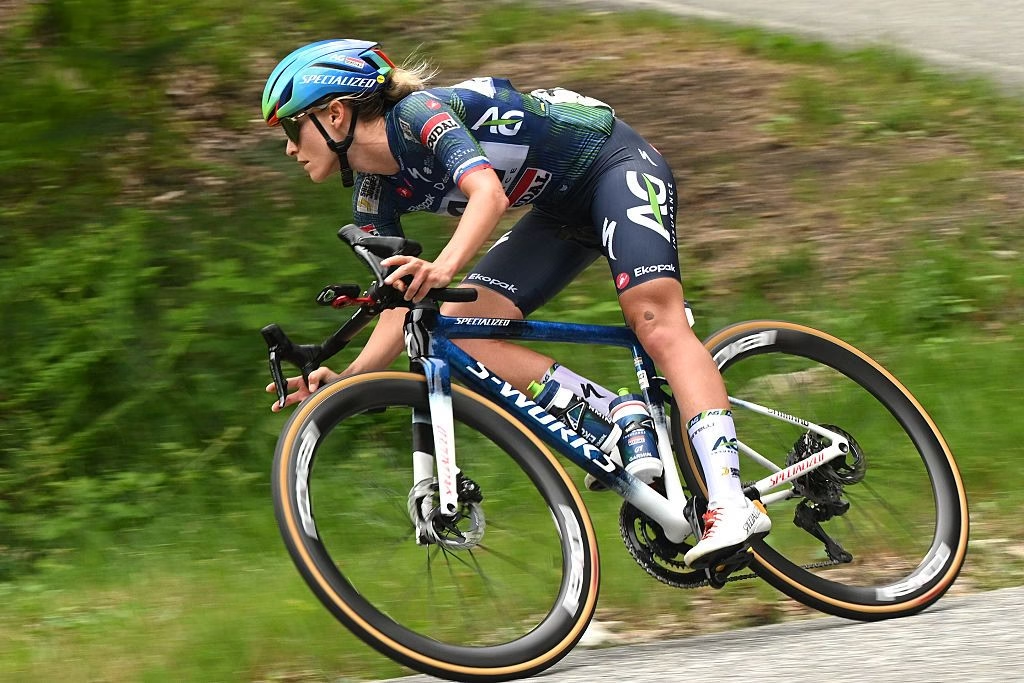
Who are the Stage 20 favourites?
The exact hierarchy depends heavily on what Stage 19 takes out of the main contenders, but the route strongly favours the riders who have already been fighting at the front of the Vuelta.
Felix Gall is particularly well suited to the final climb. The steeper the race becomes, the more dangerous he is, and his need to recover time on Roglič gives him reason to attack rather than simply follow.
Enric Mas has been the strongest and most consistent GC climber across much of the race. His main objective is the red jersey, which could make him conservative, but if he reaches the final kilometres with the favourites together there is no reason he cannot win the stage as well.
Primož Roglič is difficult to assess purely as a stage contender because winning by a few seconds may be of little value to him. If his GC deficit remains significant, the Slovenian needs to race much more aggressively than a rider simply targeting the stage victory would.
Richard Carapaz has freedom to attack earlier and a route demanding enough to reward it. His podium ambitions may require movement before Collado del Alguacil.
The strongest breakaway riders remain a threat, particularly if Movistar are content to concede the stage, but they need enough time before the GC fight starts on the second half of the course.
Stage 20 prediction
Prediction: Felix Gall
The stage is almost designed around Gall’s strengths. Repeated climbing, very little respite during the decisive half of the race and a final 8.3km at 9.8% remove many of the advantages Roglič normally possesses elsewhere.
Gall also has something concrete to gain. He came out of the Jerez time trial behind Roglič but close enough that one major mountain performance can reverse that result.
Mas may ultimately be the strongest rider on Collado del Alguacil, but he has no requirement to prove it. Protecting the red jersey matters more than chasing Gall if an attack does not endanger the overall lead.
Roglič’s task is harder.
The Stage 18 time trial was supposed to give him the leverage for the final weekend. Instead, Mas limited his loss to 33 seconds and carried a large advantage back into the mountains.
Whatever remains after Peñas Blancas, Saturday is the point where calculation disappears.
There is no later climb to save energy for and no second time trial to recover lost seconds.
Once the race turns onto El Purche for the first time, every rider still trying to change the Vuelta knows exactly how much road remains.

