

Primož Roglič does not necessarily need to take the red jersey from Enric Mas in Thursday’s Vuelta a España time trial. He does, however, need to change the arithmetic of the race.
Roglič starts the 32.1km individual time trial from El Puerto de Santa María to Jerez de la Frontera third overall, 2:10 behind Mas and only four seconds behind Felix Gall. Those gaps survived Stage 17 into Sevilla unchanged, bringing the Vuelta to the point around which much of the final week has been built.
Mas has accumulated his advantage in the mountains. Roglič now gets the long, flat time trial that should suit him considerably better. Gall then gets another two mountain finishes on Peñas Blancas and Collado del Alguacil.
As our state of the race analysis heading into the final week set out, Roglič had the time trial, Gall had the mountains and Mas needed to build enough of an advantage to cover both.
Mas has built 2:10 over Roglič. Thursday tells us whether that is enough.
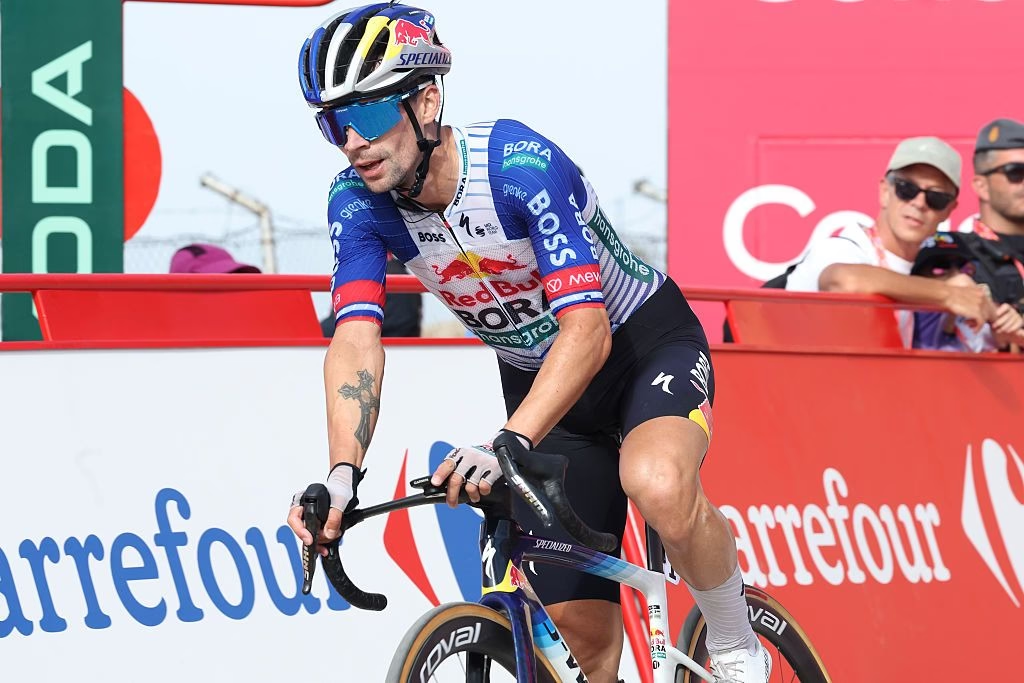 Photo Credit: Getty
Roglič does not need all 2:10 tomorrow
The obvious number is 2:10. Take that much from Mas and Roglič draws level on accumulated time. Take more and he leaves Jerez in the red jersey.
But that should not be the only measure of a successful time trial.
There are still two serious mountain stages afterwards. Friday ends with 18.7km at 6.5% to Peñas Blancas before Saturday brings the decisive final mountain stage to Collado del Alguacil. Roglič’s immediate objective is therefore to get close enough to Mas that one attack, one difficult spell or one tactical mistake can decide the Vuelta.
That makes around 90 seconds a much more useful target.
If Roglič takes a minute and a half from Mas, the gap falls from 2:10 to only 40 seconds. The red jersey stays with Movistar, but the nature of the final two mountain stages changes completely.
Mas would no longer have enough time to absorb a bad moment. Roglič would no longer need a collapse from the race leader. He would need one genuinely successful attack.
What different Roglič gains would mean
| Roglič’s gain on Mas | Mas’s remaining lead | What it means for the Vuelta |
|---|---|---|
| 30 seconds | 1:40 | Mas remains firmly in control and Roglič needs a major mountain turnaround |
| 60 seconds | 1:10 | The race remains open, but Mas can still afford to defend |
| 90 seconds | 0:40 | Roglič has a realistic route to red on either remaining mountain stage |
| 2 minutes | 0:10 | The Vuelta is effectively reset before Peñas Blancas |
| More than 2:10 | Roglič leads | Roglič takes red but then has to defend it in the mountains |
The important range is between one minute and 90 seconds.
A minute would be a significant gain, but it would still leave Roglič 1:10 behind a rider who has repeatedly been stronger than him in the mountains during this race. Ninety seconds makes the gap small enough for the final climbs to become direct opportunities rather than stages where Roglič needs several things to go wrong for Mas.
Anything approaching two minutes would transform the race entirely.
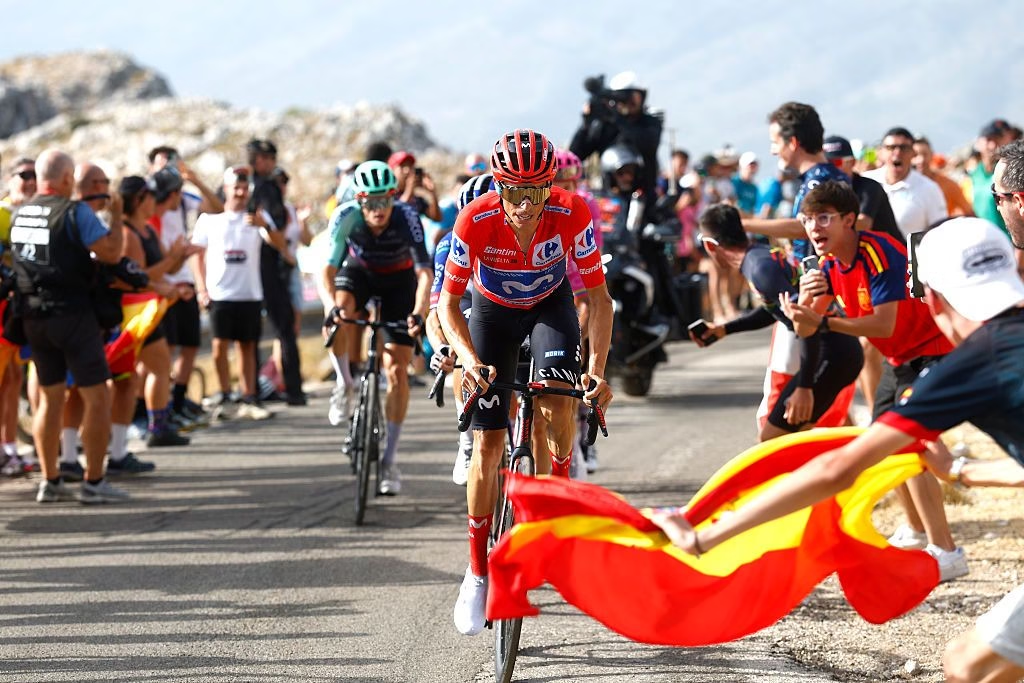 Photo Credit: Getty
Mas built the 2:10 advantage specifically for Jerez
The current gap makes more sense when viewed as something Mas has deliberately accumulated rather than one large gain on a single stage.
When Tadej Pogačar crashed out on Stage 8, Mas inherited the red jersey with a one-minute advantage over Roglič. The following day on Alto de Aitana was the first indication that he intended to build rather than merely defend that cushion.
Mas won Stage 9 on Alto de Aitana, with Oscar Onley the only rider able to follow his decisive attack. Roglič lost another 12 seconds on the road, while Gall conceded 18. Bonus seconds increased Mas’s overall lead over Roglič to 1:18 going into the first rest day.
Calar Alto changed the calculation again.
Gall attacked first on the final climb, but Mas responded before riding away from Gall, Roglič and Richard Carapaz. While Jakob Omrzel won the stage from the breakaway, Mas gained another 27 seconds on his principal rivals.
Roglič was then dropped again on Sierra de La Pandera. Mas and Gall reached the finish together, 25 seconds ahead of Roglič, which put Gall into second overall by four seconds and increased Roglič’s deficit to its current 2:10.
Since Aitana alone, Mas has therefore added another 52 seconds to his advantage over Roglič on Calar Alto and La Pandera.
Those seconds are his protection against Thursday.
The recent time-trial evidence points towards a big Roglič gain, but not necessarily 2:10
There is no need to go far back through their careers to find examples of Roglič taking substantial time from Mas against the clock.
At the end of the 2024 Vuelta, the final 24.6km time trial in Madrid saw Roglič finish in 26:59. Mas took 28:01, a difference of 1:02 over a course more than seven kilometres shorter than Thursday’s test.
A repeat of that sort of margin in Jerez would leave Mas approximately 1:08 ahead.
That would make the final weekend more interesting, but Roglič would still have substantial work left.
The more dramatic comparison comes from the 2021 Vuelta. Roglič won the 33.8km final time trial to Santiago de Compostela in 44:02, while Mas finished ninth, 2:04 behind. Thursday’s 32.1km distance is remarkably similar.
If Roglič reproduced that difference, Mas would retain the race lead by only six seconds.
That does not mean a two-minute swing should be expected. Roglič was Olympic time-trial champion in 2021 and operating at perhaps the strongest level of his career against the clock. He is now 36, and this Vuelta has already shown that the balance between him and Mas is different from previous editions.
Their first time-trial comparison this year reinforces the point. In Monaco, Roglič gained only seven seconds on Mas over 9.4km.
The Stage 18 route to Jerez should suit Roglič much better. It is longer, flatter and offers far more opportunity to settle into a sustained aerodynamic effort. Even so, assuming that Mas automatically loses two minutes because similar gaps existed several years ago would ignore how strongly he is riding now.
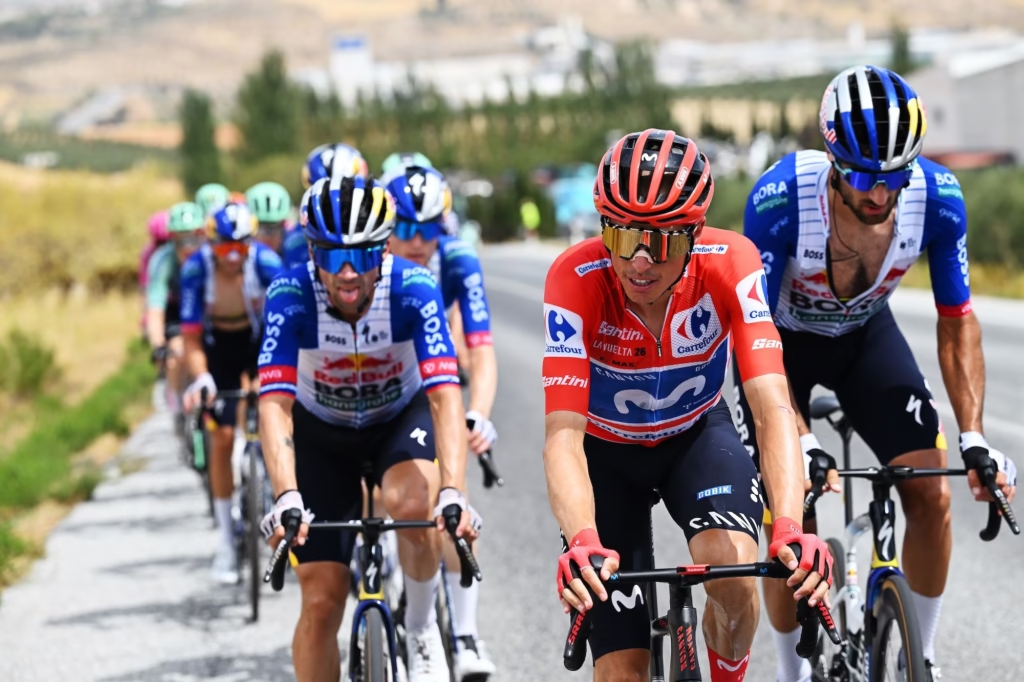 Photo Credit: Getty
Less than a minute leaves Roglič with a mountain problem
Suppose Roglič takes 45 seconds.
His deficit becomes 1:25.
On paper, that is a sizeable time-trial gain. In terms of winning this particular Vuelta, it may not be enough.
Roglič would then need to find 85 seconds on Peñas Blancas and Collado del Alguacil against a rider who has repeatedly taken time from him uphill.
Mas gained 12 seconds on the road at Aitana. He took another 27 at Calar Alto. Mas and Gall then gained 25 seconds on Roglič at La Pandera.
Nothing in the race since Pogačar’s departure has shown Roglič capable of taking more than a minute back from Mas on a mountain finish. That does not make it impossible. Third-week fatigue can change the balance quickly, and Roglič’s Grand Tour career contains enough late-race recoveries to prevent any certainty.
It would, however, require something we have not yet seen in the 2026 Vuelta.
A 30 or 40-second gain on Thursday would therefore feel more like a victory for Mas than Roglič. Movistar would have passed the discipline they have spent two weeks preparing for while keeping most of their advantage intact.
Ninety seconds would make one mountain attack enough
At 40 seconds, the situation changes.
Roglič would no longer need to systematically ride Mas off his wheel for several minutes. He could win the Vuelta through one successful move.
That matters because Friday’s stage to Peñas Blancas offers 210.8km of attrition before the final 18.7km climb at 6.5%. It is not brutally steep, but its length allows a rider who is beginning to struggle to lose time steadily.
Saturday provides an even bigger opportunity.
The 2026 Vuelta route finishes its real GC racing with 186.8km to Collado del Alguacil. The stage includes two ascents of El Purche, Puerto de El Duque and finally 8.3km at 9.8% to the finish.
The last climb alone is hard enough to produce substantial gaps. Coming after almost three weeks of racing, Thursday’s time trial and Friday’s Peñas Blancas finish makes it considerably more dangerous.
Forty seconds can disappear there.
Seventy or 80 seconds is a much bigger ask.
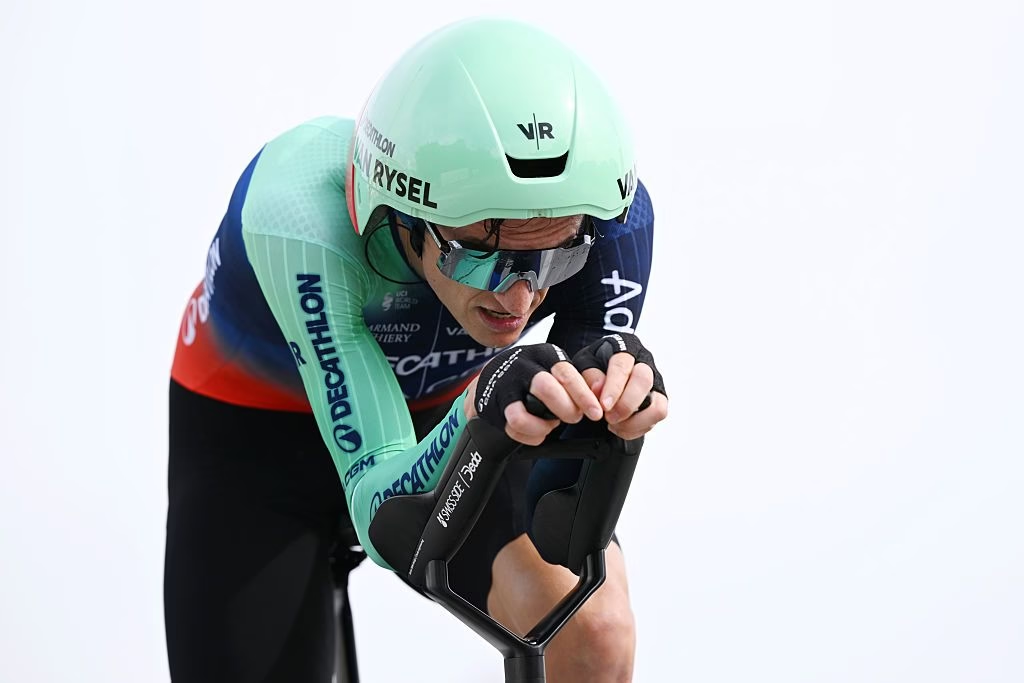 Photo Credit: Getty
Roglič also needs to put Gall behind him
Mas is not the only calculation Roglič has to make.
Gall starts Thursday four seconds ahead of him in second overall. Under normal circumstances, Roglič should erase that almost immediately and establish a meaningful advantage over the Austrian.
How meaningful matters.
Gall has been climbing better than Roglič through the second week. His repeated attacks did not initially produce the gains Decathlon CMA CGM wanted, but La Pandera finally did. Gall stayed with Mas while Roglič was distanced.
Thursday should reverse their positions. Friday and Saturday could reverse them again.
If Gall loses only a minute or so to Roglič in Jerez, he remains dangerous. Peñas Blancas and particularly Collado del Alguacil are far better suited to recovering that deficit than Thursday’s flat roads are to defending it.
Roglič therefore needs two things from Stage 18: a large gain on Mas and enough separation from Gall that the final mountains do not become a three-way fight in which both of his rivals are better suited to the terrain.
-
 Photo Credit: A.S.O./Billy Ceusters
Taking red in Jerez would not mean the Vuelta is won
The most dramatic scenario is Roglič taking the full 2:10 and leaving Jerez in red.
That would be a huge result, but it would not settle the Vuelta.
The jersey would change the responsibilities of the race. Red Bull-Bora-Hansgrohe would suddenly have to defend through two mountain stages, while Movistar would be freed to attack. Gall would have little reason to wait either.
Roglič would also be defending against riders who have already dropped him uphill.
A lead of 10 or 20 seconds after the time trial could therefore produce the most aggressive possible version of the final weekend. Mas would no longer need to think primarily about protecting time. One attack could put him back into red.
There is even an argument that Roglič does not need the burden of the jersey on Thursday if he can finish very close to it.
Being 20 or 30 seconds behind Mas would still leave the four-time winner with a straightforward objective in the mountains without forcing Red Bull to control every dangerous move from the start of Friday’s 210.8km stage.
So how much time does Roglič really need?
Around one minute keeps Roglič firmly in the race. Around 90 seconds gives him the result he really needs.
A minute would reduce Mas’s advantage to 1:10, enough to make Friday and Saturday relevant but still leaving Roglič requiring a major climbing performance.
Ninety seconds leaves only 40.
At that point, Roglič does not need Mas to collapse. He needs to create one gap over two summit finishes.
Take two minutes and the Vuelta is effectively restarted.
Take the full 2:10 and Roglič gets the red jersey, although he immediately inherits the problem of defending it against Mas and Gall on terrain where both have looked stronger.
The scenario Mas wants is the opposite. If he reaches Jerez having lost no more than 30 or 40 seconds, his second-week strategy will have worked almost perfectly. He would have accumulated time at Aitana, Calar Alto and La Pandera, allowed Roglič his strongest remaining stage and still arrived at the final mountain weekend with more than 90 seconds in hand.
That is what Thursday really measures.
Roglič does not have to win the Vuelta in the time trial. He has to take enough time to give himself a realistic chance to win it in the mountains.

