
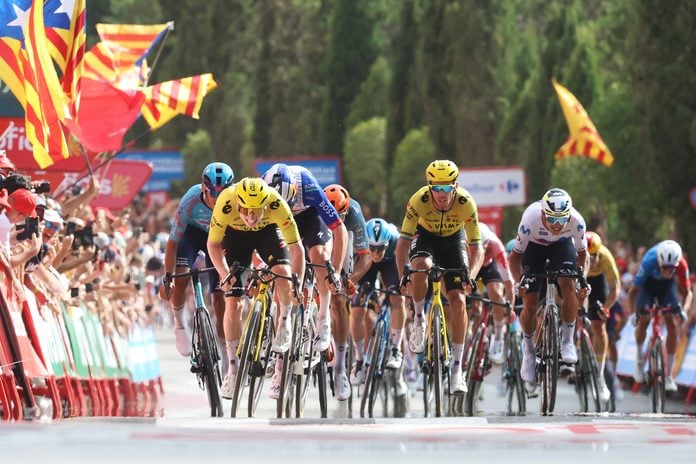
Matthew Brennan took his second stage victory of the 2026 Vuelta a España, winning stage 5 in Roquetes after another superb Team Visma | Lease a Bike lead-out.
The British rider came through a nervous, windy and punchy day in Tarragona before finishing the job in a reduced sprint. Jordi Meeus finished second for Red Bull-Bora-Hansgrohe, with Vincenzo Albanese third for EF Education-EasyPost.
Alessandro Romele was fourth for XDS Astana Team, ahead of Axel Laurance of Netcompany Ineos Cycling Team and Orluis Aular of Movistar. Christophe Laporte finished seventh after delivering the final lead-out for Brennan, with Alberto Dainese, Vito Braet and David González López completing the top 10.
Tadej Pogačar finished safely in the front group to retain the red jersey. After his 50-kilometre solo win in Andorra on stage 4, the UAE Team Emirates-XRG rider still leads the general classification by 3:21 over Primož Roglič, with Enric Mas third at 3:32.
A windy Tarragona stage with a late sting
Stage 5 took the race from Falset on the Costa Daurada to Roquetes in Terres de l’Ebre, covering 173.4 kilometres through the province of Tarragona.
On paper, it looked like one of the first real chances for the fast men. By Vuelta standards, the stage was not mountainous, but it was not straightforward either. The first half carried the threat of crosswinds, especially around the Ebro, before the final section added rolling roads and the category three Puerto de Paüls.
That made it a stage for sprinters with depth. Brennan, Meeus, Laurance, Aular, Dainese and Kaden Groves all had reasons to believe they could survive to the finish, but the route also gave puncheurs and GC teams a reason to keep the race hard.
For Pogačar, the priority was simpler. After demolishing the race in Andorra, he did not need to attack. He needed to stay safe, avoid splits, and keep UAE Team Emirates-XRG out of trouble on a day where the wind and final corners could easily have created unnecessary drama.
Dversnes starts the early move
The first attack came from Fredrik Dversnes of Uno-X Mobility, who went clear in the opening kilometres.
He was soon joined by Walter Calzoni of Pinarello-Q36.5, Stefan Küng of Tudor Pro Cycling Team, Mattia Gaffuri of Team Picnic PostNL and Diego Uriarte of Equipo Kern Pharma. It was a powerful enough move to give the peloton something to manage, but not one that was ever allowed significant freedom.
The gap moved out beyond 2 minutes, but the bunch kept the break under control. Küng eventually sat up and returned to the peloton, leaving four riders ahead as Netcompany Ineos Cycling Team and others began to reduce the advantage.
The pace stayed high. The race covered more than 40 kilometres in the opening hour, and the bunch never looked willing to let the break settle into a comfortable long-distance lead.
Crosswinds split the bunch
The stage changed as the race approached the exposed roads around the Ebro.
Netcompany Ineos Cycling Team and Lidl-Trek were both active on the front, with Pogačar positioned high in the bunch and the GC contenders alert to the danger. The peloton became lined out, then split into several groups as the pace lifted through the wind.
Mads Pedersen was briefly seen driving the front for Lidl-Trek, with Mattias Skjelmose tucked behind him. That made the intention clear: this was not only about the stage win, but about keeping a GC rider safe and trying to put others under pressure.
The four-man breakaway was caught with around 99 kilometres remaining, swallowed up as the crosswind pressure increased. For a few minutes, it looked as though the stage might turn into a GC ambush rather than a sprint day.
But the wind was not quite strong enough, or the commitment not quite complete enough. The splits behind began to close, the pace eased, and the stragglers returned to the peloton.
Hayter attacks for the points
Once the bunch came back together, Ethan Hayter went on the attack again.
The Soudal Quick-Step rider has been one of the most aggressive riders of the opening week. He lost the stage 1 time-trial to Pogačar by just 0.09 seconds, went up the road on stage 2 to chase bonus seconds, and was again in the break on the cancelled stage 3 before the hailstorm stopped the race.
On stage 5, his target was the intermediate sprint at Tivenys. He attacked with around 75 kilometres remaining and opened a gap as Team Visma | Lease a Bike controlled the peloton behind.
Hayter took the maximum 20 points at the sprint, with Van Aert second and Bruno Armirail third. That strengthened his position in the points competition, even if Pogačar still held the formal lead while wearing red.
Hayter was caught soon afterwards, but again he had made the race respond to him rather than simply waiting in the bunch.
Team Visma | Lease a Bike take control
After Hayter was brought back, Team Visma | Lease a Bike settled into the clearest control role.
That made sense. Brennan had already won stage 2 in Manosque with a powerful uphill sprint, and the finish in Roquetes looked like another stage that sat on the edge between sprint and puncheur territory. Team Visma | Lease a Bike also had the riders to control it: Van Aert, Laporte, Armirail, Ben Tulett and Jørgen Nordhagen all gave Brennan high-quality support.
The team’s plan became more obvious as the day went on. Van Aert could follow attacks, Laporte could guide Brennan through the technical finale, and the rest of the team could keep the bunch moving through the dangerous parts of the route.
Brennan had spoken before the stage about knowing he was among the favourites after his earlier win. Team Visma | Lease a Bike rode like a team that believed it too.
Kron tries to break the pattern
Andreas Kron attacked with 44 kilometres remaining, trying to disrupt the expected sprint before the final climb.
The Uno-X Mobility rider briefly opened a gap that reached around 40 seconds. It was a dangerous move because Kron has the right profile for this kind of stage: strong enough on rolling terrain, punchy enough to survive the final climbs, and fast enough to make a small group nervous if he reached the final kilometres.
For a while, the bunch hesitated behind him. Kaden Groves was distanced around the same period, although it was not immediately clear whether that was through the climb, positioning or a mechanical issue. Either way, Alpecin-Premier Tech’s expected sprint option had to chase rather than prepare smoothly for the finale.
Kron’s move did not last. As the road tilted down and the pace in the peloton increased, his advantage evaporated. Netcompany Ineos Cycling Team, Lidl-Trek and UAE Team Emirates-XRG moved back towards the front, and the race came together before the Puerto de Paüls.
UAE lead over Puerto de Paüls
The category three Puerto de Paüls was the last categorised climb of the stage and the most obvious place to thin the sprint field.
The climb was not long, but at around 4 kilometres and a little over 7 per cent, it was hard enough to hurt the pure sprinters. The lower section was the steepest, and the fight for position before the climb was almost as important as the climb itself.
UAE Team Emirates-XRG moved up with Pogačar, Jay Vine and Pavel Sivakov all prominent. Their objective was not necessarily to win the stage, but to keep the red jersey safe and reduce the chaos around him before the descent and final run-in.
The pace did damage. Pedersen was distanced on the climb after spending energy earlier in the crosswinds, while the front peloton was reduced to around 40 to 60 riders depending on the phase of the climb and descent.
Sivakov led over the summit, ahead of Harold Tejada and Vine. Pogačar was exactly where he needed to be: near the front, out of trouble and surrounded by enough team presence to manage the risk.
Azparren tries to use the twisting roads
After the climb, the stage was still not fully settled.
Xabier Mikel Azparren attacked for Pinarello-Q36.5 with around 15 kilometres remaining, using the twisting roads and downhill sections to open a small gap. It was the kind of move that can cause real trouble after a climb, especially when sprint teams are trying to reorganise and GC teams are thinking about safety.
Van Aert reacted immediately. That was part of Team Visma | Lease a Bike’s strength on the day. Brennan could sit behind while Van Aert policed the late moves, ensuring that no dangerous attack went clear without one of the strongest riders in the race attached to it.
Tejada then counter-attacked and joined Azparren with 12 kilometres to go, while Laporte followed for Team Visma | Lease a Bike. The move was quickly brought back, but it showed how difficult the finale was to control.
This was not a clean sprint stage. It was a sprint stage that had to be forced back into shape.
Visma set up the final 10 kilometres
Once the wave of attacks had been neutralised, Team Visma | Lease a Bike moved back into control.
Nordhagen and Tulett drove the bunch into the final 10 kilometres, with Tulett doing a long pull on his 25th birthday. UAE Team Emirates-XRG sat near the front to keep Pogačar out of danger, while Uno-X Mobility and Movistar also tried to take position as the speed increased.
The final approach was technical, with multiple bends and two crucial right-hand corners before the finishing straight. That made lead-out timing even more important than usual. Getting boxed in or losing a wheel through one of the corners could end a rider’s chance before the sprint even opened.
Team Visma | Lease a Bike handled that pressure better than anyone. Van Aert took over in the final kilometre with Laporte and Brennan on his wheel, giving the British rider the kind of support most sprinters can only dream of.
Van Aert and Laporte deliver Brennan
The lead-out was almost textbook.
Van Aert drove into the final 600 metres, stringing out the group and keeping Brennan at the front. Laporte then took over through the final corner, guiding him onto the finishing straight in the best possible position.
There was still a small moment of danger. Brennan later said he briefly lost the wheel at the last corner, with the painted road surface slightly slippery, but he stayed upright and stayed close enough to launch.
Meeus was on Brennan’s wheel, waiting for the sprint. Albanese and the other fast finishers were still in contention, but Team Visma | Lease a Bike had dictated the shape of the final kilometre.
Once Brennan opened his sprint, the result was clear.
Brennan makes it two from two
Brennan hit the front and powered away for his second Vuelta stage victory.
The finish was emphatic. Meeus tried to come around but could not match the British rider’s acceleration. Albanese took third, with Romele and Laurance rounding out the top five.
For Brennan, it was a remarkable continuation of his Grand Tour debut. He had already won the first road stage in Manosque, beating Pau Miquel and Pogačar on a rising finish. In Roquetes, he proved it was not a one-off.
This was his second sprint opportunity of the race, and his second win. The terrain was different, the finale was more technical, and the lead-out was more structured, but the end result was the same: Brennan was the fastest rider in the group that survived.
At 21, he is already riding this Vuelta like a finished WorldTour sprinter-puncheur rather than a debutant.
Pogačar keeps red without stress
Pogačar finished safely in the bunch and retained the red jersey.
After the drama of his 50-kilometre solo victory in Andorra, stage 5 was a very different test. It was about risk management rather than attack. Crosswinds, road furniture, late climbs and a technical sprint finish all posed danger, but UAE Team Emirates-XRG kept him near the front and out of trouble.
The general classification did not change at the top. Pogačar still leads Roglič by 3:21, with Mas third at 3:32, Kuss fourth at 3:44 and Onley fifth at 3:45.
Carapaz remains sixth at 3:50, with Gall seventh at 3:57, Skjelmose and Widar both at 4:06, and Vine 10th at 4:11.
After the time Pogačar gained in Andorra, this was exactly the sort of stage he needed: controlled, safe and uneventful in GC terms.
Meeus and Albanese take sprint podiums
Meeus’ second place was a strong result for Red Bull-Bora-Hansgrohe on a stage that required more than just flat speed.
He survived the wind, the late climb and the technical finish, then found Brennan’s wheel in the final kilometre. That was the right place to be, but Brennan simply had too much speed once the sprint opened.
Albanese also rode well to take third for EF Education-EasyPost. The Italian is well suited to these awkward finishes, where positioning, climbing resistance and sprint timing all matter. He did not have the final acceleration to challenge Brennan, but he beat several fast riders who had come through the same selection.
Romele’s fourth place was another good result for XDS Astana Team, while Laurance backed up Netcompany Ineos Cycling Team’s earlier work with fifth. Aular, Laporte, Dainese, Braet and González López completed a top 10 that reflected the nature of the day: sprinters, puncheurs and durable fast men rather than pure flat finishers.
Hayter keeps animating the race
Hayter did not contest the stage finish, but his intermediate sprint move continued one of the themes of the opening week.
He has raced aggressively since Monaco. He came within 0.09 seconds of taking the first red jersey, used the breakaway on stage 2 to chase bonuses, went up the road again on the cancelled stage 3, and then attacked again on stage 5 to take the intermediate points.
That gives his Vuelta a clear identity. Even when the GC door has closed for now, he has kept finding ways to influence the race. The points classification is complicated by Pogačar’s early dominance, but Hayter has made sure he remains visible and relevant.
The question is how long that energy lasts across three weeks. For now, he is one of the riders most willing to race rather than wait.
-
 Photo Credit: Getty
 -
 Photo Credit: Cs-wolves / Wikimedia Commons, CC BY-SA 4.0

Brennan becomes Visma’s clearest stage weapon
Team Visma | Lease a Bike came into the Vuelta with several attacking options, but Brennan has very quickly become their most reliable finishing weapon.
Van Aert could have had his own ambitions on a day like this. Instead, he committed fully to the lead-out and then said afterwards that with Brennan in a group like that, he was the best card to play. That is significant. It shows not only Brennan’s speed, but the trust he has already earned from one of the best all-round riders in the world.
Laporte’s role was just as important. He delivered Brennan through the final corner, managed the slippery surface and then still finished seventh despite sitting up after his work was done.
Brennan praised the support afterwards, saying that with riders like Van Aert, Laporte, Steven Kruijswijk and Armirail around him, he had the confidence to try to achieve more.
That confidence is now turning into wins.
A day of control after Andorra
Stage 5 was always likely to feel different after Pogačar’s Andorran demolition.
The GC riders had been hammered the previous day, the race had a red jersey with more than 3 minutes of breathing room, and the route gave the fast men just enough of a chance to keep the race under control. Even so, it was not a quiet day.
The wind split the bunch, Hayter attacked, Kron tried to go long, Puerto de Paüls thinned the sprinters, Azparren and Tejada attacked late, and the final corners created a real test of positioning.
What made the result look simple was Team Visma | Lease a Bike’s execution. They managed the chaos better than everyone else, used Van Aert and Laporte perfectly, and delivered Brennan into the exact place he needed to be.
The Vuelta now has two clear early stories. Pogačar is already controlling the general classification. Brennan is rapidly becoming the breakout stage winner of the race.
Vuelta a España 2026 stage 5 result
| Position | Rider | Team | Time/gap |
|---|---|---|---|
| 1 | Matthew Brennan | Team Visma | Lease a Bike | 3:47:02 |
| 2 | Jordi Meeus | Red Bull-BORA-hansgrohe | same time |
| 3 | Vincenzo Albanese | EF Education-EasyPost | same time |
| 4 | Alessandro Romele | XDS Astana Team | same time |
| 5 | Axel Laurance | Netcompany INEOS | same time |
| 6 | Orluis Aular | Movistar Team | same time |
| 7 | Christophe Laporte | Team Visma | Lease a Bike | same time |
| 8 | Alberto Dainese | Soudal Quick-Step | same time |
| 9 | Vito Braet | Lotto-Intermarché | same time |
| 10 | David González | Pinarello-Q36.5 Pro Cycling Team | same time |
Main photo credit: Getty

