
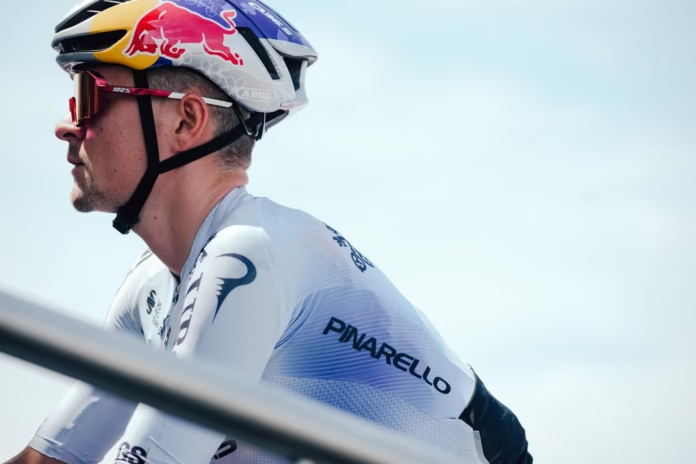
Tom Pidcock started Stage 13 of the Tour de France in tenth place, 11:49 behind Tadej Pogačar. He finished the day fourth overall, only nine seconds away from the podium.
For anyone watching the general classification rather than the tactical battle on the road, the obvious question was simple: why did the peloton allow one of the Tour’s strongest riders to gain more than seven minutes?
The answer is not that the leading teams forgot Pidcock was in the breakaway. They calculated that he was not an immediate threat to the yellow jersey, expected another team to take responsibility and became trapped by the conflicting interests inside a large escape group.
By the time Pidcock’s move became genuinely dangerous to the podium contenders, bringing it back required a major commitment that nobody wanted to make alone.
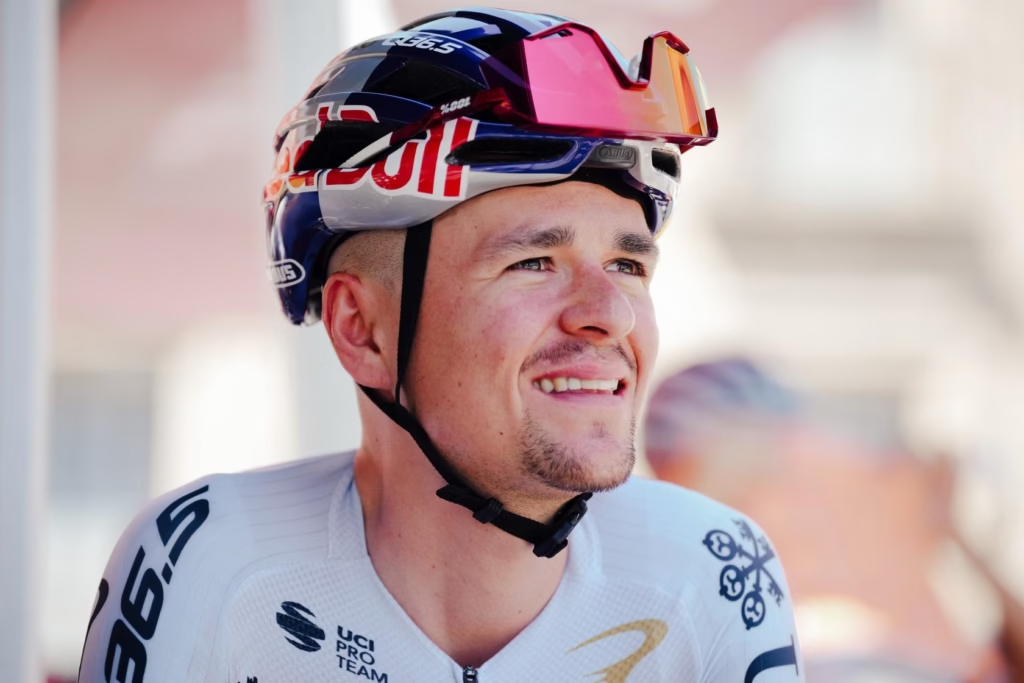 Photo Credit: A.S.O./Thomas Maheux
How much time did Pidcock gain on Stage 13?
Pidcock began the stage 11:49 behind Pogačar and more than seven minutes behind Remco Evenepoel, who occupied third place.
The British rider finished two seconds behind Mauro Schmid in Belfort. The yellow jersey group arrived 7:32 after the stage winner, meaning Pidcock gained approximately seven and a half minutes on most of his general classification rivals.
That moved him from tenth to fourth overall:
- Tadej Pogačar
- Jonas Vingegaard at 3:36
- Remco Evenepoel at 4:06
- Tom Pidcock at 4:15
- Juan Ayuso at 4:22
- Paul Seixas at 4:35
- Florian Lipowitz at 4:44
Pidcock is now only nine seconds behind Evenepoel and 39 seconds behind Vingegaard. Before the stage, he had been 7:43 behind Evenepoel.
It was a dramatic change, but it happened gradually rather than through one sudden mistake. The Stage 13 route to Belfort had already been identified as one of the Tour’s strongest opportunities for a large breakaway.
Pidcock started far enough behind Pogačar
The first calculation belonged to UAE Team Emirates-XRG.
A yellow jersey team does not automatically chase every highly ranked rider who enters a breakaway. Its first question is whether that rider threatens the race lead.
Pidcock began the day almost 12 minutes behind Pogačar. UAE could therefore allow the break a considerable advantage without placing yellow in immediate danger.
Even after Pidcock gained more than seven minutes, he remained 4:15 behind Pogačar. UAE had protected the jersey while avoiding a long and expensive chase before two major mountain stages.
That distinction matters. Pidcock was dangerous to the riders competing for third, fourth and fifth, but he was not yet dangerous to Pogačar.
From UAE’s perspective, forcing another team to work was entirely logical. Pogačar retained his 3:36 lead over Vingegaard while preserving energy for Le Markstein and Plateau de Solaison.
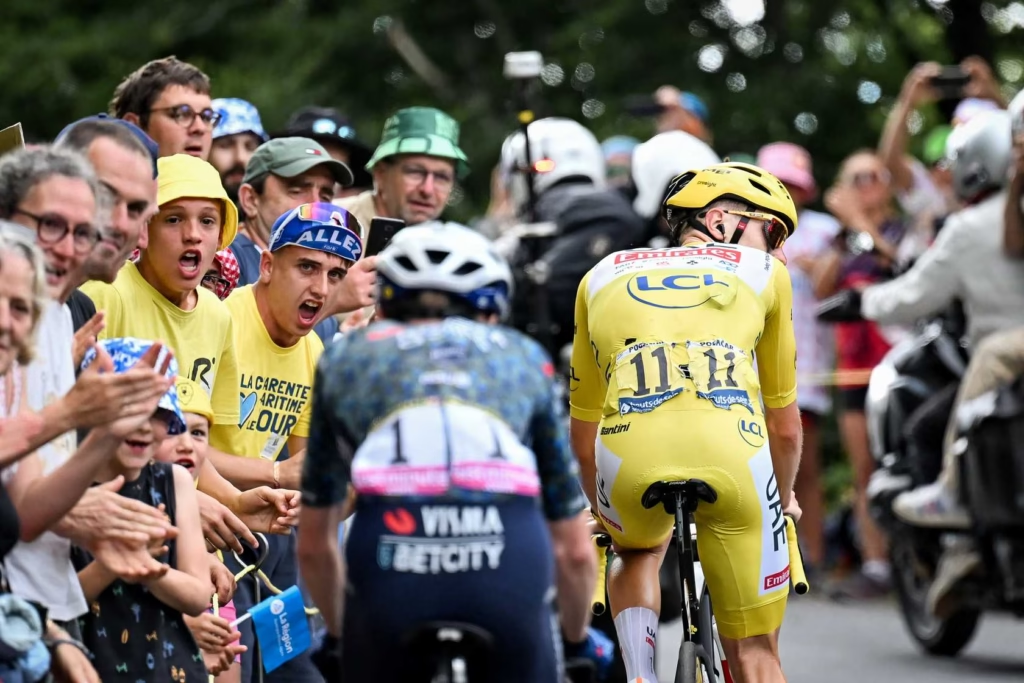
UAE also had riders in the breakaway
UAE had another reason not to close the move immediately.
Brandon McNulty and Tim Wellens were among the riders involved at the front during the stage. That gave UAE possible stage-winning options and removed some of the incentive to spend the day chasing its own riders.
This is one of the complications created by a large breakaway. It was not simply Pidcock riding away while every major team sat behind him.
The move contained riders representing several powerful squads, many of which had their own ambitions for the stage. A team contributing to the chase might have been helping to eliminate its own chance of victory.
UAE could monitor Pidcock’s virtual position without closing the entire break. As long as he remained safely behind Pogačar, there was little reason for the yellow jersey team to solve another squad’s problem.
The situation was a textbook example of how a Tour de France breakaway works. Riders at the front may share the workload while pursuing completely different individual and team objectives.
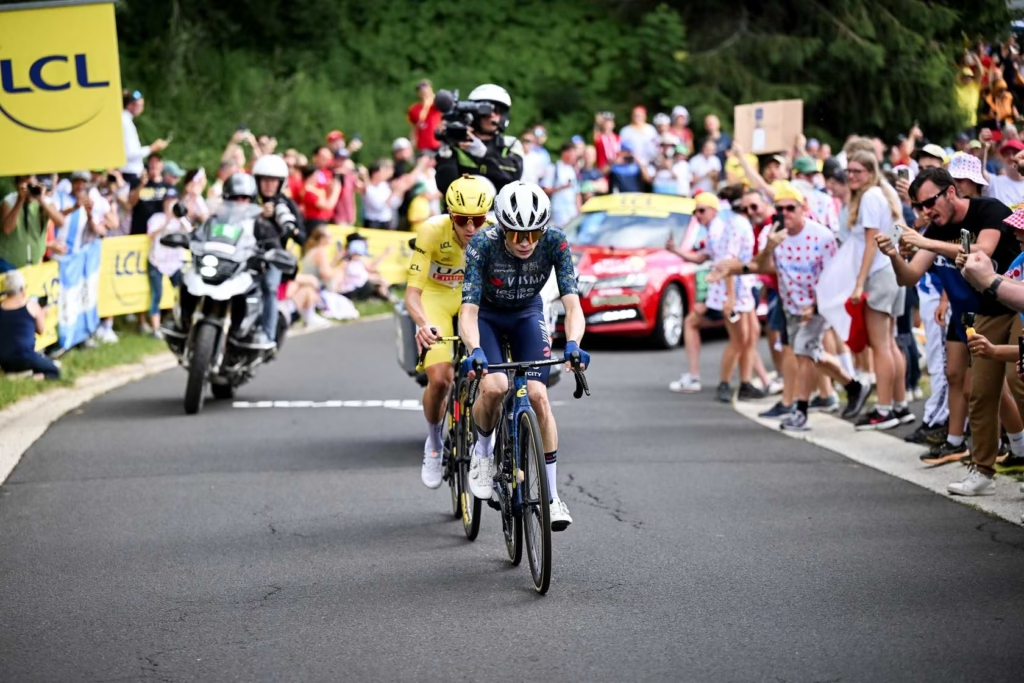 Photo Credit: A.S.O./Billy Ceusters
Visma’s priority remains Pogačar
Visma-Lease a Bike had more reason than UAE to be uncomfortable. Pidcock ended the day only 39 seconds behind Jonas Vingegaard.
However, Visma’s central objective is not simply defending second place. It is finding a way to defeat Pogačar.
Using several riders to control a long, aggressive stage would have cost energy before Le Markstein and Plateau de Solaison. It might also have helped Pogačar by making the race easier for UAE without reducing the yellow jersey’s advantage.
Visma therefore faced an awkward choice.
Chasing Pidcock would protect Vingegaard’s advantage over fourth place, but it would do nothing to reduce his 3:36 deficit to Pogačar. Refusing to chase conserved resources for the mountain stages where Vingegaard could attack yellow.
That does not mean Visma regarded Pidcock as harmless. It means the team’s principal battle was still ahead rather than behind.
Stage 14 is one of the best remaining opportunities for a long-range GC attack, with the Col du Haag arriving shortly before the finish at Le Markstein.
Red Bull-Bora-Hansgrohe had the most to lose
The greatest responsibility arguably belonged to Red Bull-Bora-Hansgrohe.
Evenepoel began and finished the day third overall, but his advantage over Pidcock fell from 7:43 to nine seconds. Florian Lipowitz was also pushed down the standings, leaving two Red Bull riders directly affected by the breakaway’s advantage.
In hindsight, Red Bull had the clearest reason to control the gap.
The difficulty is that this was not obvious from the opening kilometres. Pidcock initially needed to gain almost eight minutes merely to reach Evenepoel. A breakaway can hold a large advantage during the middle of a stage before losing several minutes when the GC teams begin racing behind.
Red Bull also had Maxim Van Gils represented near the front, preserving an opportunity to contest the stage. Ordering a full chase would have meant abandoning that option and asking the team to spend heavily for a defensive objective.
When the break’s advantage continued to grow, the calculation changed. By then, however, bringing Pidcock back required sustained cooperation from teams with different priorities.
Ayuso, Seixas and Lipowitz were caught in the same problem
Pidcock did not only threaten Evenepoel.
Juan Ayuso, Paul Seixas and Lipowitz all began the day ahead of him and finished behind him. Lidl-Trek, Decathlon CMA CGM and Red Bull-Bora-Hansgrohe therefore shared an interest in limiting his gain.
In theory, those teams could have combined to control the gap.
In practice, shared responsibility often becomes no responsibility.
Each squad had an incentive to wait for somebody else to begin chasing. Nobody wanted to commit several riders while rivals sat in the wheels and received the same benefit for free.
This created a familiar tactical stalemate:
- UAE protected yellow but did not need to defend third place
- Visma saved energy for its battle with Pogačar
- Red Bull waited for help because two of its riders were affected
- Lidl-Trek and Decathlon hoped Red Bull would protect Evenepoel
- teams with riders in the break did not want to help close it
The gap could continue growing while those calculations were being made.
The Tour de France 2026 team-by-team guide showed how differently the major squads entered the race. Some were built around yellow, others around podium positions, stage wins or breakaways. Stage 13 exposed the conflict between those objectives.
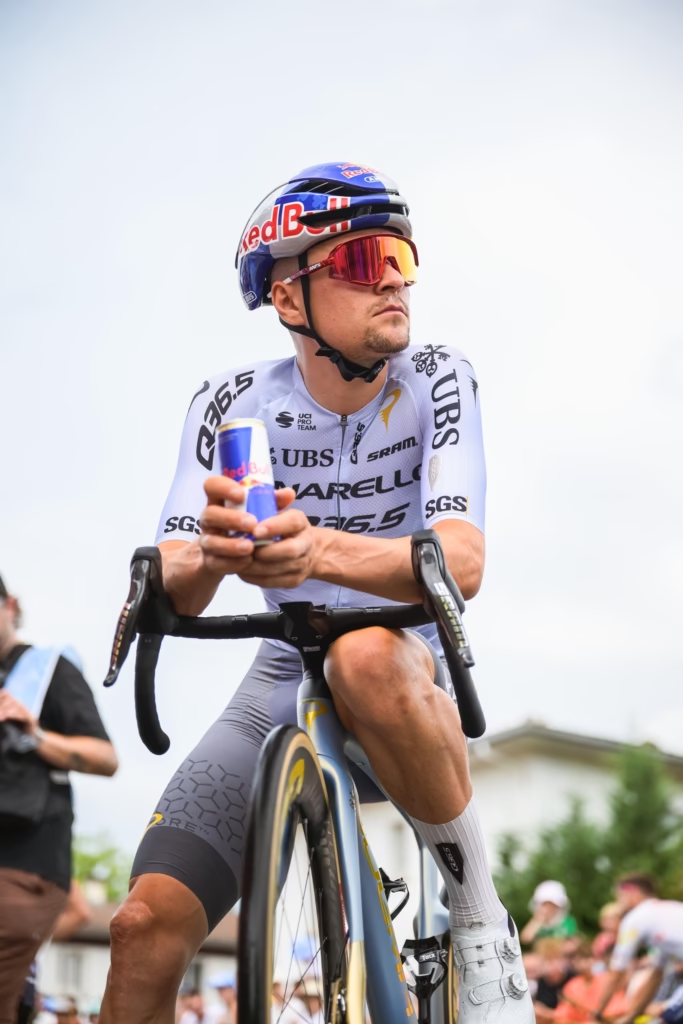
A large breakaway is harder to control
The size and quality of the move also mattered.
A group of 37 riders eventually established itself at the front, containing Pidcock, Schmid, McNulty, Wellens, Ben Healy and several other strong riders.
This was not a small group of opportunists that one team could comfortably hold at three minutes.
A breakaway of that size contains enough riders to share the workload while forcing the peloton to use several domestiques. It also represents so many teams that cooperation behind becomes much harder.
Pidcock was able to benefit from riders who were working for completely different objectives. Some wanted the stage victory. Others were chasing mountains points, exposure or a chance to move higher in the secondary GC positions.
They did not need to be helping Pidcock deliberately. Every turn taken at the front increased his opportunity to gain time.
Pidcock had been listed among the Tour de France breakaway specialists to watch precisely because he combines climbing ability, endurance and a fast finish. Those qualities made him unusually dangerous once he received freedom.
Why did the chase not begin earlier?
The peloton could not know with certainty that Pidcock would remain at the front until Belfort.
Stage 13 included the Ballon d’Alsace and a fast run towards the finish. Pidcock might have been dropped, attacked repeatedly or forced to spend too much energy following moves. The break might also have lost several minutes naturally once its riders began racing against one another.
That encouraged the GC teams to wait.
Early in the stage, an 11-minute deficit made Pidcock look manageable. Later, a seven-minute virtual gain made him dangerous. The transition between those two positions happened while the teams were still deciding who should respond.
Once the gap had grown, the peloton faced a much more expensive chase. One team would have needed to place several riders on the front and maintain a high speed for an extended period.
Nobody wanted to pay that full cost before the Tour’s hardest remaining mountain sequence.
The next two days take the race through the Vosges and Jura, a block covered in our Tour de France 2026 Vosges and Jura guide. Stage 14 alone contains 3,800 metres of climbing across 155.3km.
-
 Photo Credit: Unipublic/Cxcling/Aritz Arambarri
 -
 Photo Credit: Cor Vos
Did the peloton make a mistake?
For UAE, probably not.
Pogačar retained the yellow jersey with exactly the same advantage over Vingegaard. His team avoided unnecessary work and allowed riders such as McNulty and Wellens to pursue the stage.
For Visma, the decision is more debatable, but its Tour remains centred on attacking Pogačar rather than protecting second place.
For Red Bull-Bora-Hansgrohe, Lidl-Trek and Decathlon, Stage 13 looks more costly. Their riders lost positions or saw their podium margins dramatically reduced.
Red Bull faces the most immediate consequence. Evenepoel now has Pidcock nine seconds behind him heading into the mountains, while Lipowitz has dropped to seventh despite remaining only 38 seconds away from third.
The teams did not deliberately give Pidcock a place in the podium battle. They each made a defensible individual calculation that produced a damaging collective result.
Pidcock began the Tour as a rider caught between stage hunting and general classification ambitions. The question was examined before the race in Tom Pidcock at the Tour de France 2026: stage hunter or GC outsider?. Stage 13 showed how quickly those two objectives can merge.
Pidcock will not receive the same freedom again
The biggest change is what happens next.
Pidcock was allowed into the Stage 13 break because he began almost 12 minutes behind Pogačar and nearly eight minutes away from the podium. After Belfort, those margins no longer exist.
Evenepoel, Ayuso, Seixas and Lipowitz cannot allow him into another major move. Visma must also consider that Pidcock is now within one attack of Vingegaard.
His freedom has disappeared.
That could change how Pidcock approaches the rest of the Tour. He can no longer ride as a pure stage hunter because every attack now carries consequences for the podium battle.
The next examination comes on roads that feature prominently in the Tour de France 2026 mountain stages ranked by difficulty. Pidcock must now prove that the position gained tactically in Belfort can be defended through direct climbing battles.
He exploited the narrow point between being too dangerous for ordinary breakaway riders and not yet dangerous enough for the yellow jersey team. UAE could afford to let him go, while the teams that could not afford it failed to organise a chase.
That is how a rider can gain more than seven minutes without anybody making one obvious tactical error.
The peloton did not ignore Tom Pidcock. It waited for somebody else to stop him.

