
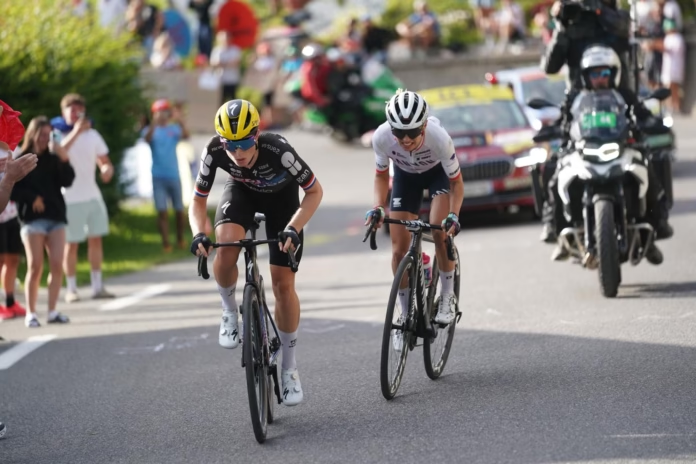
The Tour de France Femmes is nine stages long because the modern women’s Tour has been built as a shorter, standalone Women’s WorldTour stage race rather than as a direct copy of the men’s three-week Tour de France.
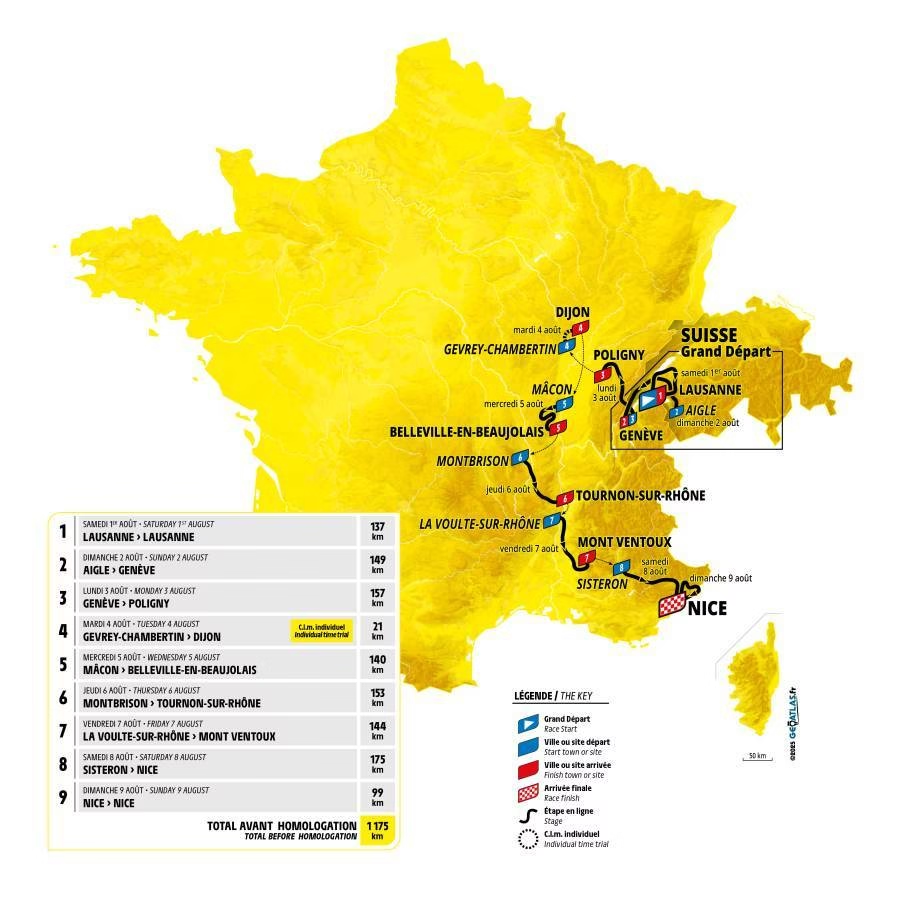
The 2026 edition runs from 1-9 August, covering 1,175km across Switzerland and France, with three flat stages, three hilly stages, two mountain stages and one individual time-trial. For the full route breakdown, see our Tour de France Femmes 2026 route guide.
That does not mean the race is light, easy or a token version of the men’s event. It means the women’s Tour has a different structure, shaped by the current women’s calendar, team budgets, broadcast growth, UCI regulations and the still-developing economics of women’s professional cycling.
Quick answer: why is the Tour de France Femmes only nine stages?
The Tour de France Femmes is nine stages because it is part of the UCI Women’s WorldTour and has grown gradually since its modern launch in 2022. It started with eight stages, expanded to nine stages in 2025, and remains shorter than the men’s Tour because the women’s race is still developing commercially, logistically and structurally.
| Question | Answer |
|---|---|
| How long is the Tour de France Femmes 2026? | 9 stages |
| When does it take place? | 1-9 August 2026 |
| Does it have a rest day? | No |
| Why no rest day? | It runs for fewer than 10 competition days |
| Is it the same format as the men’s Tour? | No |
| Could it expand in future? | Yes, but only if the calendar, teams, logistics and funding can support it |
| Is nine stages still hard? | Very much so, especially with Ventoux and a final mountain stage in Nice |
It is not a smaller version of the men’s Tour
The most common misunderstanding is to judge the Tour de France Femmes only against the men’s Tour de France.
The men’s race is a 21-stage Grand Tour with two rest days, a three-week structure and more than a century of institutional weight behind it. Its format is the result of history, tradition, commercial scale and a long-established professional system. For comparison, our guide to Tour de France 2026 rest days explains how the men’s race is built around its longer three-week rhythm.
The women’s Tour de France Femmes, by contrast, is still a young race in its modern form. It launched in 2022 with eight stages and has been rebuilt carefully after earlier women’s Tour-style races disappeared or changed identity across previous decades. The present race has to grow in a way that is credible, sustainable and attractive to teams, broadcasters, sponsors and host towns.
That is why nine stages matters. It is not the final answer to what the women’s Tour can become, but it is a clear step beyond the original eight-stage format.
The race has already expanded
The modern Tour de France Femmes began with eight stages in 2022. That format gave the race enough space for sprint stages, hilly stages, mountain stages and a proper general classification battle, without immediately asking teams and organisers to absorb the cost and complexity of a two-week or three-week event.
The next major shift came in 2025, when the race expanded to nine stages. That made it the longest edition of the modern Tour de France Femmes and gave organisers an extra day to shape the race more fully.
The 2026 edition keeps that nine-stage format. It is not a retreat. It is consolidation. The route starts in Lausanne, moves through Switzerland and France, includes a 21km time-trial, reaches Mont Ventoux, then finishes with a mountain stage around Nice. That is a serious race design, even without a second week.
For more detail on the distance, stage types and overall structure, see our guide to how long the Tour de France Femmes 2026 is.
UCI rules shape the race format
The Tour de France Femmes sits inside the UCI Women’s WorldTour calendar. That matters because race format is not simply a free choice by the organiser.
The women’s calendar has its own race categories, stage limits, team structures and competitive demands. That helps explain why the Tour de France Femmes has a different rhythm from the men’s race. It is not just a men’s Grand Tour cut down to size. It is a race built within the current framework of women’s professional road racing.
That distinction is important for newer fans. Women’s cycling has its own calendar logic, with major one-day Classics, week-long stage races, Grand Tour-style races and national championships all competing for space. Our guide to the 2026 Women’s WorldTour explains how those events fit together across the season.
Why there is no rest day
The 2026 Tour de France Femmes has no rest day because it runs for nine consecutive stages.
That makes the race shorter, but also more compressed. Riders cannot rely on a full day off to recover after the opening block or reset before the mountains. The race asks for repeated effort from day one to day nine.
In the 2026 route, that matters. The riders face early pressure in Switzerland, a hilly stage into France, a mid-race individual time-trial, two difficult hilly stages, Mont Ventoux, then a long 175km stage to Nice before the final mountain day. There is very little dead space.
For viewers, that makes the race easier to follow. Every day matters. There is no pause in the story, and there are fewer stages where the race can simply drift.
Nine stages changes the tactics
A nine-stage race produces a different tactical logic from a 21-stage Tour.
In the men’s Tour, a rider can sometimes recover from a poor day if it happens early enough. Teams have time to change plans, build into form, move riders into breakaways and manage long-term fatigue across three weeks.
In the Tour de France Femmes, the race is more immediate. A bad split on stage 1, a poor time-trial on stage 4 or a weak day on Mont Ventoux can have a much sharper impact because there are fewer opportunities to recover the situation.
That tends to make the racing intense. Every stage has value. Sprint teams have fewer chances. Breakaway riders cannot waste opportunities. GC teams have to be alert from the first weekend, rather than waiting for a final-week mountain showdown.
The result is not a lesser race. It is a different kind of race.
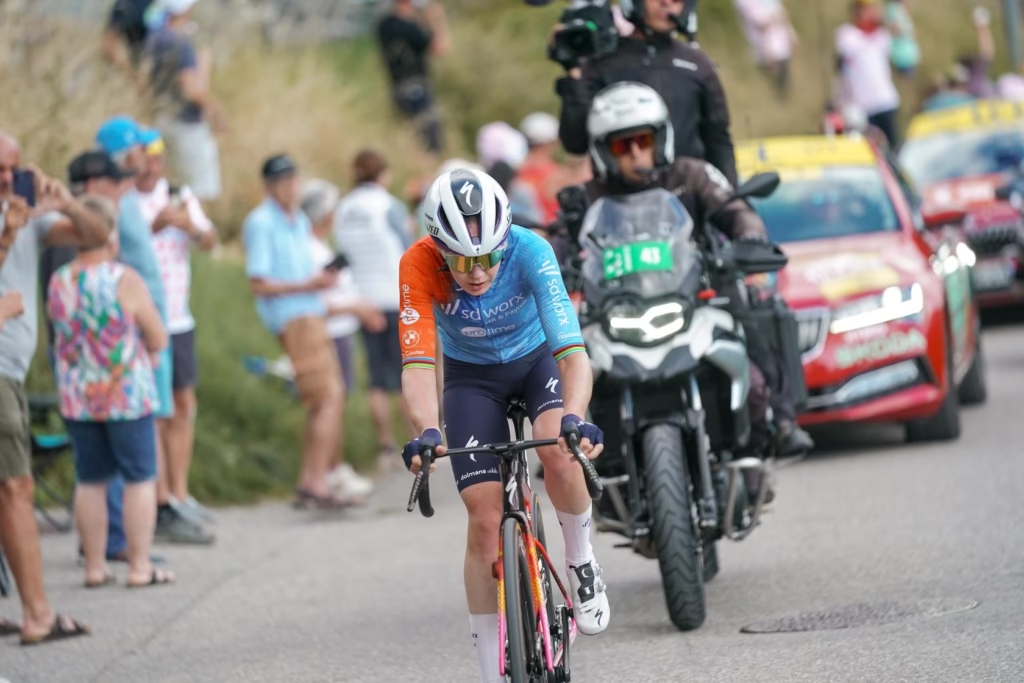 Photo Credit: A.S.O./Thomas Maheux
The women’s calendar is still part of the answer
The women’s professional calendar has grown quickly, but it is still not built around three-week stage racing in the way the men’s calendar is.
Teams have smaller rosters, fewer staff, lower budgets and less historic depth than men’s WorldTour teams. A longer Tour would not simply mean adding extra stages. It would mean more hotel nights, more staff, more vehicles, more broadcast production, more host-town funding, more recovery demands and more riders capable of absorbing that load.
That is why expansion has to be careful. A 12-stage or 15-stage Tour might sound attractive, but the wider system has to be ready for it. Otherwise, the race risks becoming financially or physically unsustainable for the teams it is supposed to elevate.
Women’s cycling has earned bigger races. The challenge is making sure those races are built on foundations strong enough to last.
Broadcast and sponsorship still matter
The Tour de France Femmes exists in a modern sports market. Its future length is not decided only by sporting ambition. It also depends on broadcast value, sponsor confidence and host-city demand.
The men’s Tour is a global commercial machine. It has decades of television habits, roadside culture, sponsor visibility and municipal investment behind it. The women’s Tour is building those habits in real time.
That is why the nine-stage format makes sense at this point. It gives broadcasters a compact, high-value product. It gives sponsors a major international platform. It gives host towns a race that is prestigious but still realistic to stage. It also gives the sporting side enough terrain to create a credible winner.
UK viewers planning around the race can use our guide on how to watch Tour de France Femmes 2026 in the UK for broadcast and streaming details.

Does nine stages make it a real Grand Tour?
This is where language matters.
Many fans, riders and journalists refer to the Tour de France Femmes, Giro d’Italia Women and La Vuelta Femenina as the women’s Grand Tours because they are the most prestigious stage races in the women’s calendar. That description makes sense culturally.
Structurally, though, they are not identical to the men’s Grand Tours. They are shorter, they sit within a different regulatory and commercial framework, and they reflect the current shape of women’s racing rather than the inherited structure of men’s cycling.
That does not make the Tour de France Femmes less important. It makes it part of a different development path.
The race has already built a strong modern identity, with champions who have won in very different ways. Our Tour de France Femmes winners list looks at every winner so far and how each edition was decided.
Would a longer Tour de France Femmes be better?
Not automatically.
A longer race could allow more variety: more mountains, more transitional stages, more sprint chances, more time-trial kilometres and a broader geographical story. It could also help the race feel closer in scale to the men’s Tour.
But length alone does not guarantee quality. A well-designed nine-stage race can be more compelling than a stretched-out race without the team depth, broadcast coverage or route balance to support it.
The better question is not simply “why is it only nine stages?” It is: what would extra stages add?
If future expansion gives the race more tactical range, better geography and stronger storytelling, it would be a positive step. If it simply adds distance without improving the sporting product, it would not necessarily help.
The 2026 route shows what nine stages can do
The 2026 Tour de France Femmes is a good example of how much can fit into nine days.
The race starts abroad in Switzerland, enters France on stage 3, includes a 21km individual time-trial on stage 4, builds through hilly terrain, climbs Mont Ventoux on stage 7, then finishes with a mountain stage around Nice on stage 9.
That is a complete sporting structure. It has early tension, a GC checkpoint, climbing fatigue, a famous summit finish and a final-day mountain test.
The format may be shorter than the men’s race, but it is not underpowered. For newer viewers, our beginner’s guide to Tour de France Femmes 2026 explains the race format, jerseys, route and likely storylines in more detail.
-
 Photo Credit: Cor Vos

So why is the Tour de France Femmes only nine stages?
The simple answer is that the race is still growing.
The more accurate answer is that nine stages currently sits at the meeting point between sporting ambition and practical reality. It is long enough to create a serious general classification race, varied enough to showcase different rider types, compact enough to work within the current women’s calendar, and commercially realistic enough for organisers, broadcasters and teams.
The direction of travel is clear. The Tour de France Femmes began with eight stages. It has moved to nine. Its routes are becoming more ambitious, its climbs more iconic and its place in the season more established.
The race probably will continue to evolve. For now, nine stages is not a weakness. It is the current shape of a race still building the scale it deserves.
Tour de France Femmes format FAQs
How many stages are in the Tour de France Femmes 2026?
There are nine stages in the 2026 Tour de France Femmes.
Why is the Tour de France Femmes shorter than the men’s Tour?
It is shorter because it is a newer race in its modern form, built within the current women’s WorldTour structure, with different team, calendar, broadcast and commercial conditions from the men’s three-week Tour.
Does the Tour de France Femmes have rest days?
No. The 2026 Tour de France Femmes has no rest days because it runs for nine consecutive stages.
Could the Tour de France Femmes become longer?
Yes. The race has already grown from eight to nine stages. Further expansion is possible, but it would depend on the calendar, team resources, sponsor support, broadcast coverage and UCI approval.
Is the Tour de France Femmes a Grand Tour?
It is often described as one of the women’s Grand Tours because of its prestige, but it is not the same format as the men’s 21-stage Grand Tours.
Is nine stages enough for a proper GC race?
Yes. Nine stages can still produce a serious general classification battle, especially when the route includes hilly stages, a time-trial, major climbs and no rest day.

