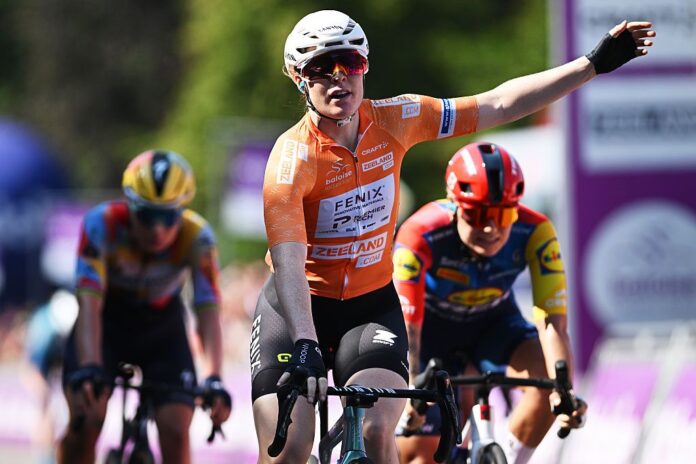
Charlotte Kool won the 2026 GP Lucien Van Impe, sprinting to victory in Erpe-Mere after Fenix-Premier Tech controlled a wet, windy and aggressive finale in Belgium.
The Dutch sprinter beat Lucinda Brand of Lidl-Trek and Babette van der Wolf of EF Education-Oatly, taking a much-needed win after a difficult Tour de France Femmes and a race that was far harder to control than a simple sprint result suggests.
Kool’s team had to work deep into the finale, bringing back a late move from Loes Adegeest before setting up the sprint on the slightly rising finish. After a day of repeated attacks, crosswind splits and heavy rain, Kool had the fastest finish and the clearest reward.
A race stepping up in status
The GP Lucien Van Impe has quickly become a useful part of the late-summer women’s calendar, and the 2026 edition carried extra weight after its move to Women Elite 1.Pro level.
The race covered 140.1 kilometres, starting and finishing in Erpe-Mere, with just under 1,000 metres of climbing. It was not a pure climber’s course, but the route had enough Flemish texture to make the race awkward: rolling roads, exposed sections, short climbs and a false-flat finish.
The riders first tackled a longer loop to the south-west, including La Houppe, Leberg and Hostellerie, before returning to Erpe-Mere for five undulating local laps of 12.5 kilometres.
That structure gave the sprinters a route to victory, but only if their teams could keep control. The climbs were not decisive on their own, but the repeated changes in pace, wind and rain meant the race could easily have slipped away from a team waiting too long.
Attacks from the start
The opening kilometres were full of attacks, but no early move was allowed to build a proper lead.
That set the tone for the whole race. The peloton was restless, with several teams trying to create pressure before Fenix-Premier Tech could settle into a predictable chase. Yet each move was brought back before it became fully established.
The strongest teams knew the danger. A race like this can look manageable until one well-balanced group gets away on the rolling roads and suddenly becomes difficult to control. That was especially true with the weather worsening and the finish circuits still to come.
Kool’s team therefore had to remain alert rather than simply wait for the final kilometres.
Rain and crosswinds split the bunch
The race became more complicated once heavy rain and crosswinds hit the peloton.
The conditions briefly split the bunch, creating the kind of nervousness that often defines Belgian one-day races. Wet roads made positioning more important, while the wind turned exposed sections into danger points where any rider too far back risked being caught behind a split.
Even then, the attacks continued. The peloton did not settle into a simple chase-and-sprint rhythm. Instead, the rain made the race more aggressive, with riders trying to exploit every moment of hesitation.
For the sprint teams, that created a difficult balance. Chase too hard too early and they risked running out of riders. Wait too long and a strong late move could take the race away.
The finishing laps keep the pressure high
Once the race reached the local laps around Erpe-Mere, the pattern tightened. The bunch was still together enough for a sprint to remain likely, but the road and weather meant the race never became comfortable.
The repeated laps gave riders several chances to attack and made the final hour harder than the raw climbing total suggested. The course did not need a major climb to create selection. The combination of rain, corners, small rises and constant accelerations was enough.
Kool had to survive that phase before she could sprint. That was the key difference between this win and a routine bunch finish. Fenix-Premier Tech were not simply saving her for the last 200 metres. They were managing a race that kept threatening to break open.
Adegeest threatens late
The most dangerous late move came from Loes Adegeest.
The Lidl-Trek rider attacked late and forced Fenix-Premier Tech to commit to the chase. It was a well-timed move, especially with the race already stretched and the weather making any pursuit more awkward.
Adegeest is strong enough to make that kind of attack stick if the bunch hesitates, and with Brand still waiting behind, Lidl-Trek had more than one way to play the finale. If Adegeest stayed away, they had a chance to win from the move. If she was caught, Brand still had a sprint.
Fenix-Premier Tech could not allow the move to drift. They brought it back and reset the race for Kool.
Fenix-Premier Tech finish the job
The chase of Adegeest was the decisive piece of team work. Once the late move was closed, Fenix-Premier Tech had put Kool back into the scenario she wanted: a sprint from a reduced and tired bunch on a finish that rewarded power.
The finale was still not easy. The finish in Erpe-Mere rose slightly, meaning riders had to judge their effort carefully rather than simply launch on a flat boulevard. After 140 kilometres in wet, windy conditions, that final drag could punish anyone who went too early.
Kool handled it best. She opened her sprint at the right moment and had enough speed to hold off Brand and Van der Wolf.
It was a clean finish to a messy race.
Kool returns to winning ways
For Kool, this was an important victory.
She had won a stage at the Baloise Ladies Tour in July, but her Tour de France Femmes had ended in disappointment after she finished outside the time limit on the Mont Ventoux stage. A win in Belgium so soon afterwards gives her a strong reset and a reminder of the sprint level she can still produce when she reaches the final in position.
The result also suits her profile. This was not a pan-flat sprint against a fresh peloton. It was a hard, wet, wind-hit race where attacks kept coming and the bunch had to be controlled late. Kool still had the speed at the end.
That makes the win more valuable than the basic result line suggests.
Brand and Van der Wolf complete the podium
Brand finished second for Lidl-Trek after the team had animated the late race through Adegeest. It was a strong result, but also a sign of what might have been. Lidl-Trek had the tactical depth to threaten the sprint, but once the race came back together, Kool proved too fast.
Van der Wolf’s third place was another good result for EF Education-Oatly, especially in a race where positioning and resilience mattered as much as sprint speed. Surviving the rain, the crosswinds and the late attacking phase was a serious test before the finish even began.
The podium reflected the kind of riders who could thrive in the conditions: a pure sprinter who had survived the race, a Classics-style rider with a fast finish, and a young rider able to hold position through a difficult finale.
A race won by control as much as speed
Kool’s sprint was the headline, but the race was won through control before it was won through speed.
Fenix-Premier Tech had to manage the early attacks, stay alert when the crosswinds and rain split the race, and then close the most dangerous late move before Kool could finish it off. In a 1.Pro race with eight WorldTeams on the start line, that was not straightforward.
The GP Lucien Van Impe has already shown in its short women’s history that it can be won in different ways. Lorena Wiebes won from a sprint in 2025, Evy Kuijpers had shown the race could reward a more selective scenario in 2024, and the 2026 edition again sat between those two possibilities.
In Erpe-Mere, the sprinter won, but only after the race had forced her team to earn it.
GP Lucien Van Impe 2026 result
| Position | Rider | Team | Time/gap |
|---|---|---|---|
| 1 | Charlotte Kool | Fenix-Premier Tech | 3:31:19 |
| 2 | Lucinda Brand | Lidl-Trek | same time |
| 3 | Babette van der Wolf | EF Education-Oatly | same time |
| 4 | Lily Williams | Human Powered Health | same time |
| 5 | Emma Jeffers | Liv AlUla Jayco Women’s Continental Team | same time |
| 6 | Lonneke Uneken | VolkerWessels Cycling Team | same time |
| 7 | Alison Jackson | St Michel-Preference Home-Auber93 | same time |
| 8 | Linda Zanetti | Uno-X Mobility | same time |
| 9 | Nicole Steigenga | AG Insurance-Soudal Team | same time |
| 10 | Florien Bolks | VolkerWessels Cycling Team | same time |