

The Tour de France Femmes 2026 will be the longest edition of the modern race so far, covering 1,175km across nine stages from Switzerland to the south of France.
The race runs from Saturday 1 August to Sunday 9 August 2026, beginning with a Grand Départ in Lausanne and finishing in Nice. It is the fifth edition of the modern Tour de France Femmes avec Zwift and the second to start outside France, after the 2024 Grand Départ in Rotterdam.
The length matters because this is not simply a longer route for the sake of it. The 2026 race has a more demanding structure than previous editions, with 18,795m of total climbing, three mountain ranges, a mid-race individual time trial, a summit finish on Mont Ventoux and a final mountain stage around Nice.
For new fans, the simple answer is this: the Tour de France Femmes 2026 is a nine-day, nine-stage race covering 1,175km, with no rest day, one individual time trial, two mountain stages and a final weekend that should decide the yellow jersey.
For wider race context, see our Tour de France Femmes hub, Tour de France Femmes 2026 route guide and beginner’s guide to Tour de France Femmes 2026.
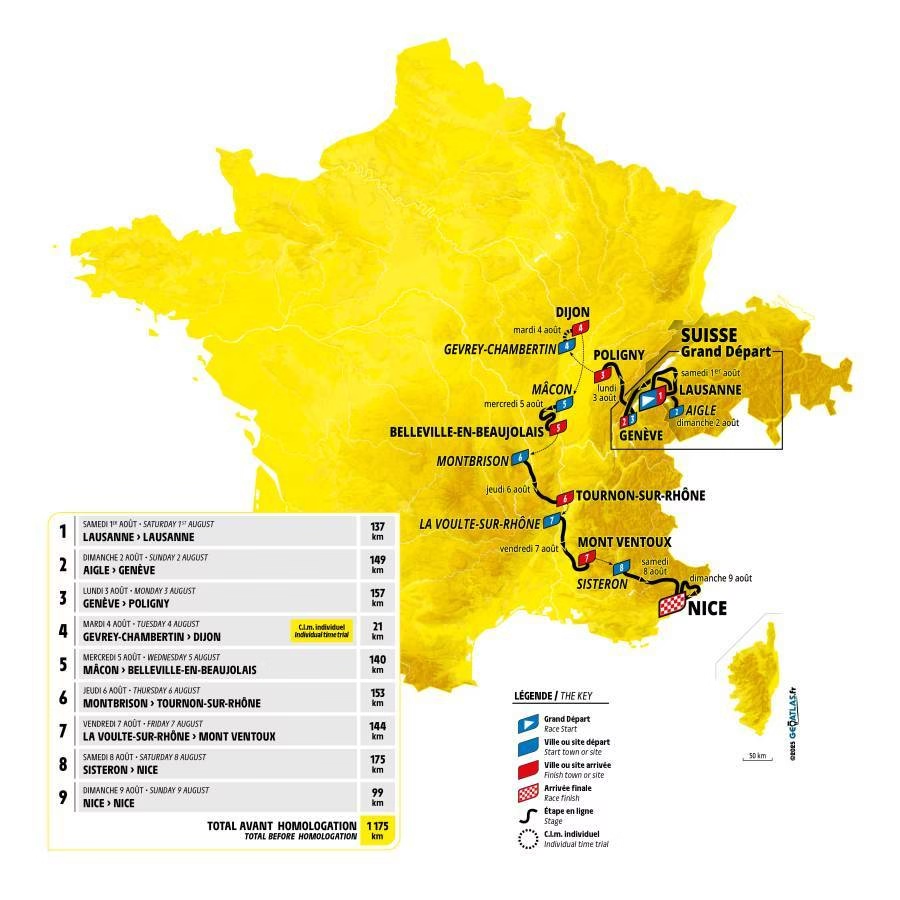
Quick answer: how long is the Tour de France Femmes 2026?
The Tour de France Femmes 2026 is 1,175km long. It runs over nine stages from 1-9 August, starting in Lausanne, Switzerland, and finishing in Nice, France. The race includes three flat stages, three hilly stages, two mountain stages and one 21km individual time trial.
| Detail | Tour de France Femmes 2026 |
|---|---|
| Dates | 1-9 August 2026 |
| Total distance | 1,175km |
| Stages | 9 |
| Days of racing | 9 |
| Rest days | None |
| Countries | Switzerland and France |
| Stage types | 3 flat, 3 hilly, 2 mountain, 1 individual time trial |
| Total climbing | 18,795m |
| Teams | 22 |
| Riders | 154 |
| Riders per team | 7 |
| Longest stage | Stage 8, Sisteron to Nice, 175km |
| Time trial | Stage 4, Gevrey-Chambertin to Dijon, 21km |
| Highest point | Mont Ventoux, 1,910m |
Full Tour de France Femmes 2026 stage list
| Stage | Date | Route | Distance | Type |
|---|---|---|---|---|
| 1 | Saturday 1 August | Lausanne to Lausanne | 137km | Flat |
| 2 | Sunday 2 August | Aigle to Genève | 149km | Flat |
| 3 | Monday 3 August | Genève to Poligny | 157km | Hilly |
| 4 | Tuesday 4 August | Gevrey-Chambertin to Dijon | 21km | Individual time trial |
| 5 | Wednesday 5 August | Mâcon to Belleville-en-Beaujolais | 140km | Hilly |
| 6 | Thursday 6 August | Montbrison to Tournon-sur-Rhône | 153km | Hilly |
| 7 | Friday 7 August | La Voulte-sur-Rhône to Mont Ventoux | 144km | Mountain |
| 8 | Saturday 8 August | Sisteron to Nice | 175km | Flat |
| 9 | Sunday 9 August | Nice to Nice | 99km | Mountain |
The official total is 1,175km, which makes it a record-length edition of the modern Tour de France Femmes. For a fuller stage-by-stage breakdown, use our Tour de France Femmes 2026 route guide.
How many stages are there?
There are nine stages in the 2026 Tour de France Femmes.
That makes it one stage longer than the original modern editions of the race, which used an eight-stage format from 2022 to 2024. The race moved to nine stages in 2025 and keeps that format in 2026.
The extra length gives the race more room to breathe. A nine-stage route can include a proper opening weekend, a mid-race time trial, transition days, a major mountain summit finish and a final-day showdown. It is still much shorter than the men’s Tour de France, but it is now long enough to feel like a complete stage race rather than a compressed showcase.
The modern race has quickly built its own history, from Annemiek van Vleuten’s 2022 win to Pauline Ferrand-Prévot’s dominant 2025 performance. That wider story is covered in our Tour de France Femmes winners list and our complete history of Tour de France Femmes.
How many days does the race last?
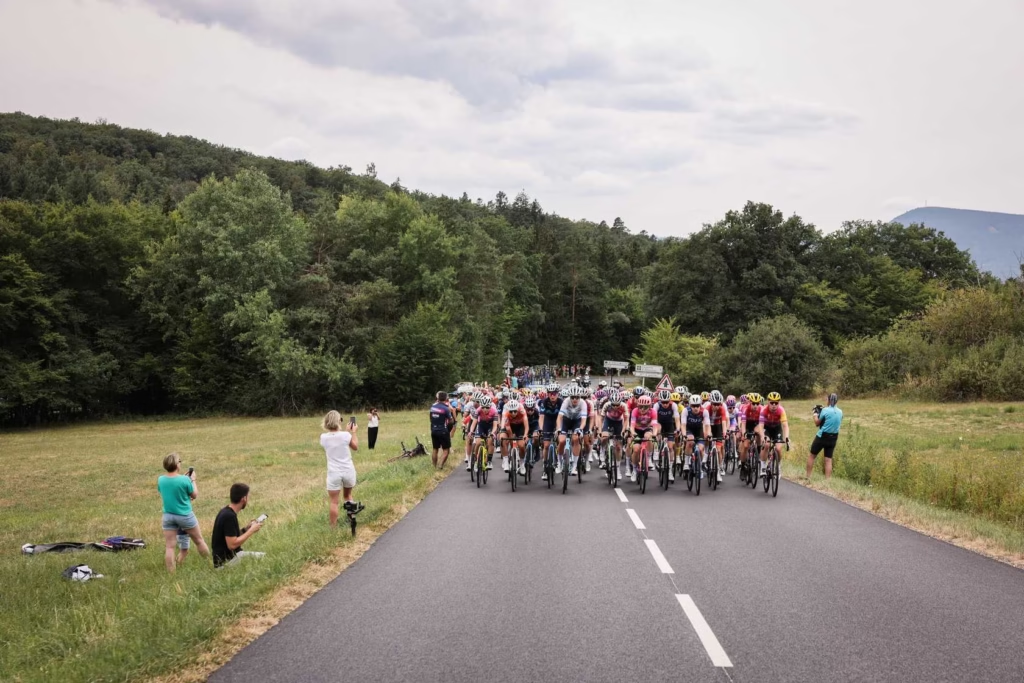
The Tour de France Femmes 2026 lasts nine days.
It starts on Saturday 1 August and finishes on Sunday 9 August. There are no rest days, so the riders race every day from the opening stage in Lausanne to the final stage in Nice.
That makes recovery a major part of the race. In a three-week Grand Tour, riders at least have scheduled rest days. In the Tour de France Femmes, the race is shorter, but the intensity is relentless. A rider who has a bad day has very little time to recover. A crash, illness, poor time trial or weak mountain stage can be difficult to repair before the next major test arrives.
For newer viewers, that is one of the easiest ways to understand the race. It is shorter than the men’s Tour, but it is not easier in rhythm. It is compact, intense and unforgiving.
How far is the average stage?
The average stage length is about 130.6km.
That figure comes from the total distance of 1,175km divided across nine stages. But the race is not evenly distributed. Stage 4 is only 21km because it is an individual time trial, while stage 8 from Sisteron to Nice is 175km, the longest road stage of the race.
| Measure | Distance |
|---|---|
| Total race distance | 1,175km |
| Number of stages | 9 |
| Average stage distance | 130.6km |
| Shortest stage | 21km, stage 4 time trial |
| Longest stage | 175km, stage 8 |
That variation is important. The 2026 race is not just long overall. It changes rhythm from day to day. Riders need to handle short intensity, long endurance, hilly terrain, mountain climbing and time-trial pacing.
What is the race format?
The Tour de France Femmes 2026 is a stage race. That means the overall winner is the rider with the lowest cumulative time across all nine stages.
Each day has its own stage winner, but the yellow jersey is decided by total time. If a rider loses 30 seconds on one stage, that time is added to her overall total. If she gains time in the mountains or time trial, she can move up the general classification.
The race also has other classifications, including points, mountains, youth and team competitions. But the main race is the general classification, which rewards the rider who completes the full route in the fastest total time.
The 2026 format is built to test several different skills:
| Skill | Where it matters |
|---|---|
| Sprinting | Stages 1, 2 and 8 |
| Punchy climbing | Stages 3, 5 and 6 |
| Time trialling | Stage 4 |
| High-mountain climbing | Stage 7 to Mont Ventoux |
| Recovery | Every day, because there is no rest day |
| Tactical control | The rolling and hilly stages |
| Final-day resilience | Stage 9 around Nice |
For a broader explanation of the classifications that run alongside GC, see our guide to what the jerseys mean in women’s stage races.
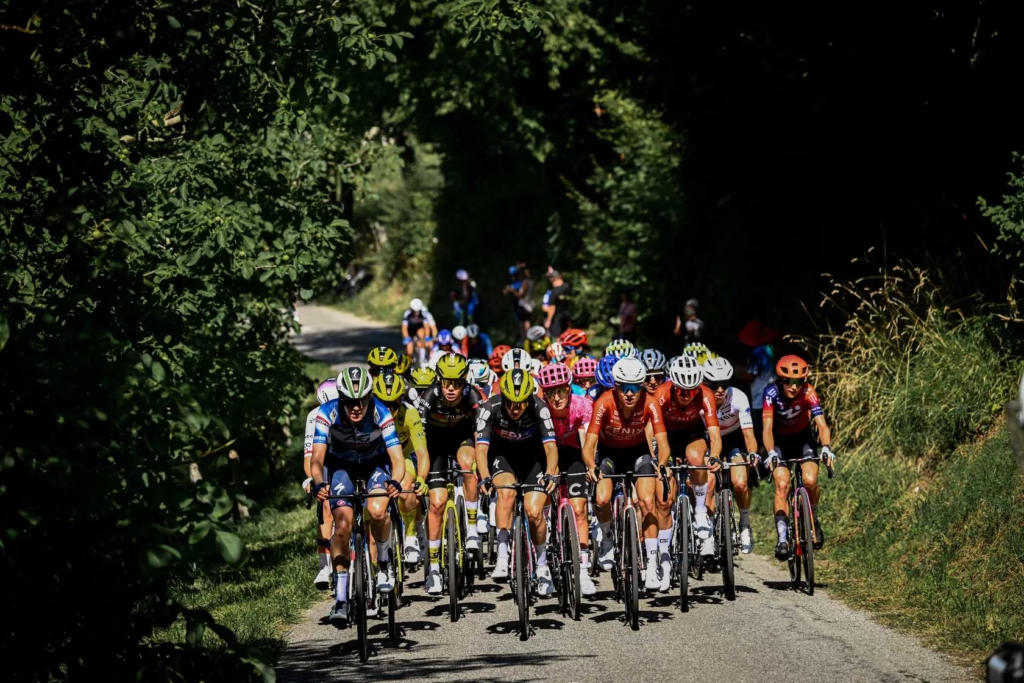 Photo Credit: A.S.O./Pauline Ballet
Why the 2026 distance matters
The 1,175km distance matters because it shows how the Tour de France Femmes is continuing to grow.
The modern race began in 2022 as an eight-stage event and has gradually expanded in difficulty, prestige and route ambition. The 2026 edition is not only longer, it also carries more climbing than any previous edition of the modern race.
That means the winner will need to be complete. The route is not designed for one type of rider. A pure climber may gain time on Mont Ventoux, but must survive the time trial. A time trial specialist may gain time in Dijon, but must handle Ventoux and the Nice finale. A puncheur may thrive on the hilly stages, but still needs to limit losses in the mountains.
The length also affects team tactics. With 22 teams of seven riders, every team has to balance stage ambitions with support work. Sprinters need lead-outs, climbers need protection, GC riders need positioning, and domestiques have to survive repeated hard days without the safety net of a rest day.
For season context, the Tour sits inside the top tier of the women’s road calendar. Our explainer on what the Women’s WorldTour is sets out how races such as the Tour de France Femmes fit into the wider structure of the sport.
The race starts in Switzerland
The 2026 Tour de France Femmes begins in Switzerland, with stages in Lausanne, Aigle and Geneva before the race enters France.
Stage 1 is a 137km loop around Lausanne. It is officially listed as flat, but the finish has enough bite to make it more than a routine bunch sprint. Stage 2 runs from Aigle to Geneva over 149km and looks like the clearest early opportunity for sprinters. Stage 3 starts in Geneva and finishes in Poligny, taking the race into France on a 157km hilly stage.
This opening structure gives the race a varied start. It is not a gentle rollout before the serious stages. The first three days include positioning pressure, hilly terrain, sprint opportunities and the first chances for the general classification riders to lose time if they are badly placed.
That Swiss start also gives the race a very different opening identity from recent French Grand Départs. For the bigger race overview, see our beginner’s guide to Tour de France Femmes 2026.
 Photo Credit: ASO-Thomas Maheux
The time trial comes early
Stage 4 is a 21km individual time trial from Gevrey-Chambertin to Dijon.
That is a key part of the 2026 format. A time trial forces riders to race alone against the clock, without teammates to draft behind or protect them. It rewards pacing, aerodynamics, power and control.
Because it comes on stage 4, it can reshape the race before the biggest climbs arrive. Strong time triallists could gain important seconds or even minutes before the route turns towards the harder hilly and mountain stages. Climbers who are weaker against the clock may have to attack later in the race to recover lost time.
A 21km time trial is long enough to matter without completely deciding the race on its own. It sets up the second half rather than closing the contest down.
That same balance between time trialling and climbing is visible in other major women’s stage races. The Giro d’Italia Women 2026 full route guide shows how an uphill time trial changes the shape of a GC battle in a different way.
The hilly middle of the race
Stages 5 and 6 are both hilly road stages.
Stage 5 runs 140km from Mâcon to Belleville-en-Beaujolais. Stage 6 covers 153km from Montbrison to Tournon-sur-Rhône. These stages may not have the headline status of Mont Ventoux, but they are important because they come after the time trial and before the biggest mountain stage.
This is where the race can become awkward. Hilly stages are hard to control, especially when teams are already tired. Breakaways can go clear, GC riders can be put under pressure, and the race can split if the pace is high on repeated climbs.
For beginners, these stages are worth watching because they often reveal who is really comfortable. The mountains get the attention, but a rider can lose the Tour on a hilly transition day if she is badly positioned or isolated from her teammates.
The changing shape of women’s race routes in 2026 is part of a wider trend, explored in our feature on how race routes are shaping women’s cycling in 2026.
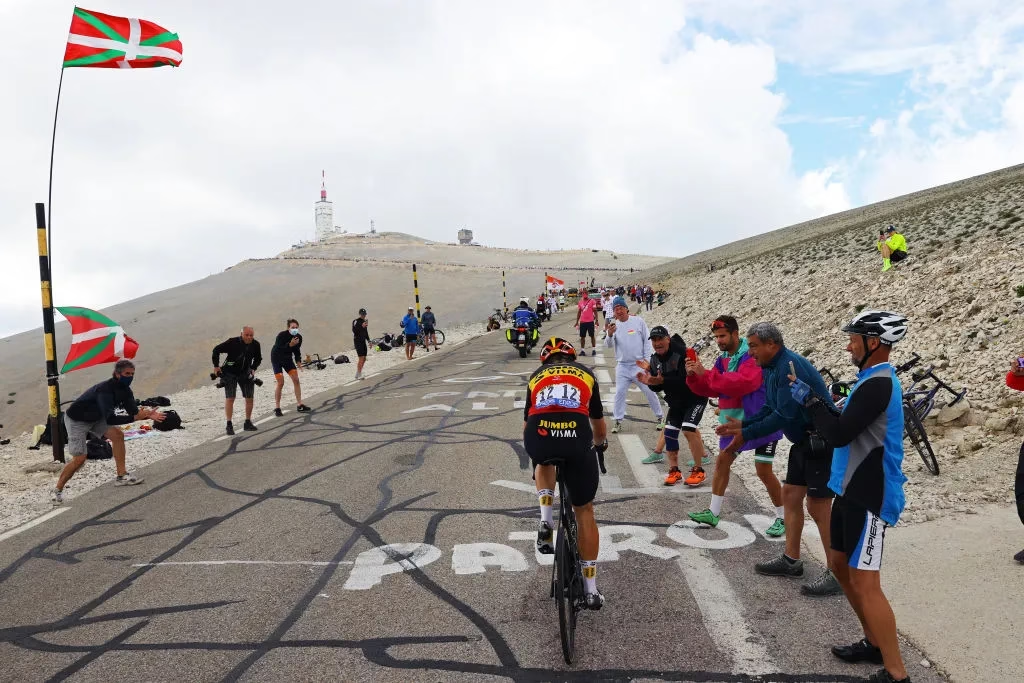
Mont Ventoux is the headline climb
Stage 7 is the queen stage of the 2026 Tour de France Femmes. It runs 144km from La Voulte-sur-Rhône to Mont Ventoux.
Mont Ventoux is the highest point of the race at 1,910m and is one of cycling’s most famous climbs. The stage also has the toughest climbing total of the 2026 race, with 3,565m of vertical gain.
This is the stage most likely to create the biggest general classification gaps. Ventoux is long, exposed and psychologically difficult. It is not just about steep gradients. It is about pacing, heat, wind, fatigue and the final kilometres above the tree line.
By the time the riders reach Ventoux, they will already have completed six days of racing. That makes the climb even more important. It will not only test who is the best climber. It will test who has recovered best, eaten properly, avoided crashes and managed effort across the whole week.
The route announcement made Ventoux the obvious headline of the race, and our earlier feature on the Mont Ventoux and Swiss Grand Départ route reveal explains why that climb carries so much symbolic weight.
Why stage 8 is the longest day
Stage 8 from Sisteron to Nice is the longest stage of the race at 175km.
It is officially listed as flat, but the distance itself makes it significant. Coming the day after Mont Ventoux, a 175km stage can be draining even if the profile is not classified as mountainous.
This could be a stage for sprinters, but it will not be easy. Some fast riders may already be tired from the mountains, and GC teams may want a controlled day before the final stage in Nice. Breakaway riders may also see an opportunity if the peloton is fatigued.
For the overall contenders, stage 8 is about recovery and risk management. The aim is to avoid crashes, splits and unnecessary stress before the final mountain stage.
The race finishes with a mountain stage in Nice
The 2026 Tour de France Femmes ends with a 99km mountain stage from Nice to Nice.
That final-day format is important. The race does not end with a ceremonial stage or a routine sprint. It ends with a mountain stage, which means the yellow jersey may still be under pressure on the final day.
This gives the 2026 race a stronger competitive shape. Even if Mont Ventoux creates time gaps on stage 7, stage 9 gives rivals one last chance to attack. A short mountain stage can be especially dangerous because there is less room for patience. Teams may attack early, riders may take risks, and the final podium may still change.
The Nice finish also links the race to one of cycling’s best-known coastal cycling regions. It gives the Tour a clear destination after starting in Switzerland and travelling through eastern and southern France.
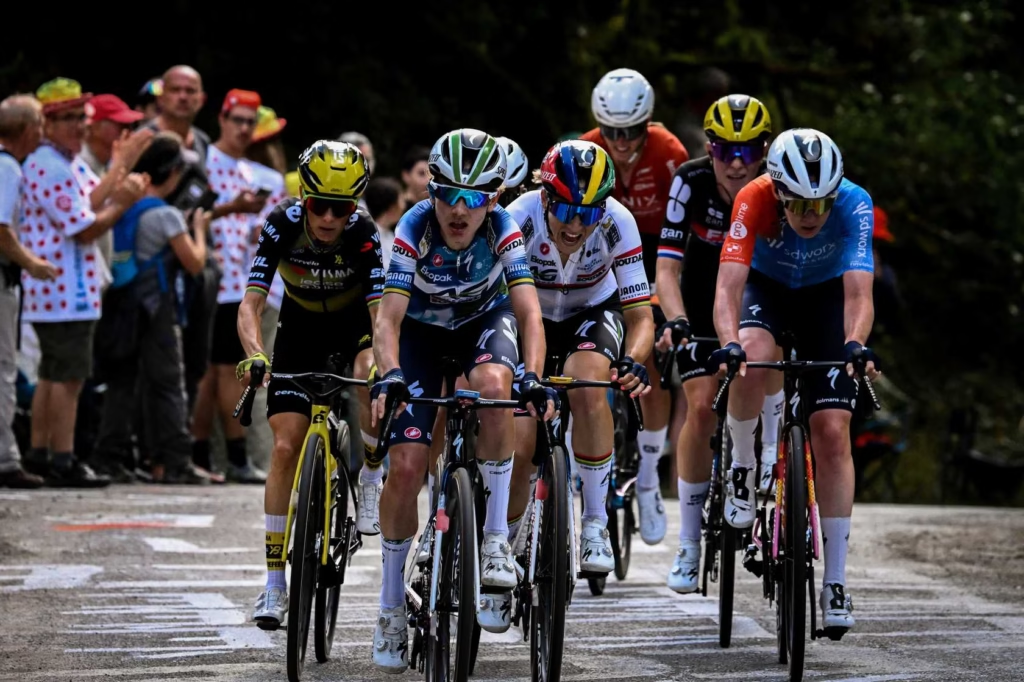 Photo Credit: A.S.O./Pauline Ballet
Is the 2026 Tour de France Femmes harder than previous editions?
On paper, yes.
The 2026 route is the longest modern edition so far and has the most total climbing. The combination of 1,175km, 18,795m of elevation gain, a 21km time trial, Mont Ventoux and a mountain finale in Nice makes it a demanding route.
It is not only the amount of climbing that matters. It is where the difficulty sits. The time trial comes early enough to force climbers onto the attack later. Ventoux comes late enough to punish accumulated fatigue. The final mountain stage means the race can still change on the last day.
That makes the 2026 edition a serious test of depth. The strongest rider over one climb may not necessarily win. The winner will need to be consistent across the whole route.
Who does the format suit?
The 2026 Tour de France Femmes format suits a complete stage racer.
The ideal winner needs to climb well, time trial strongly, handle hilly terrain, recover day after day and stay tactically alert. A rider who is brilliant in the mountains but loses too much time in the time trial may struggle. A rider who is excellent against the clock but weaker on Ventoux may also be exposed.
The route looks especially suited to riders who can limit losses everywhere and choose the right moment to attack. It is not a route with only one decisive day. Stage 4, stage 7 and stage 9 all have clear GC importance, while stages 3, 5 and 6 could also create problems.
For sprinters, the race is more limited. There are three flat stages, but not all of them are guaranteed straightforward bunch finishes. Fast riders may target stages 1, 2 and 8, but the overall shape of the race leans towards climbers, puncheurs and general classification contenders.
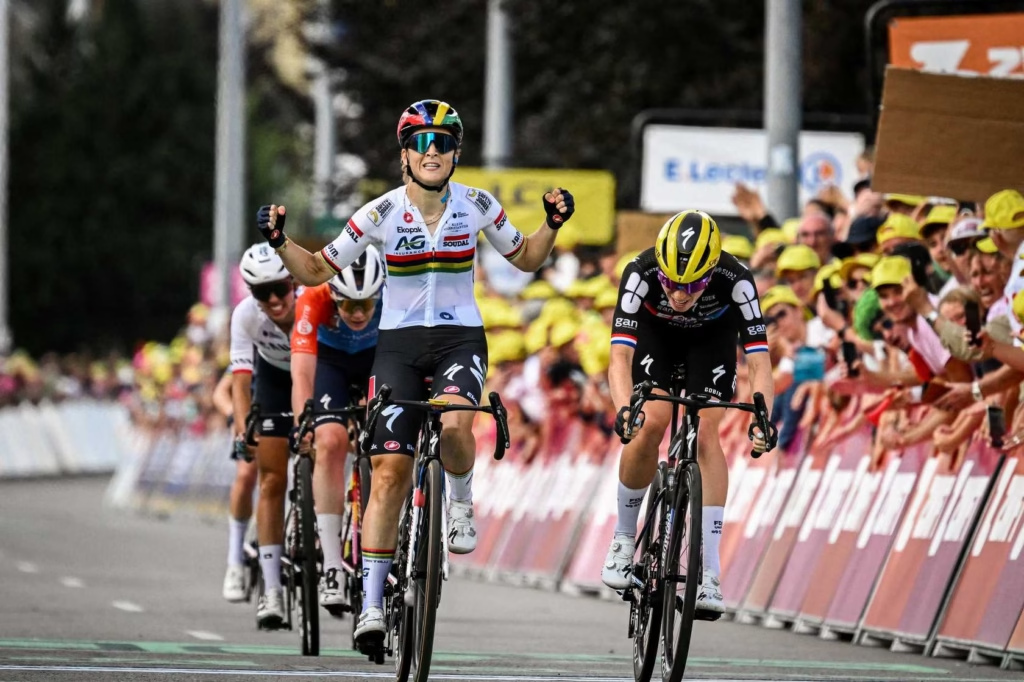
That is why the route should produce a winner in the same mould as the recent champions: not just the best climber or the strongest time triallist, but the rider who can survive every type of pressure. The full list of modern champions is covered in our Tour de France Femmes winners list.
How does the race compare with the men’s Tour?
The Tour de France Femmes is much shorter than the men’s Tour de France, but the comparison is not especially useful unless the format is understood properly.
The men’s Tour lasts three weeks and has 21 stages. The women’s race lasts nine days and has nine stages. But the women’s race is not supposed to be a shortened copy with the same rhythm. It has its own format, calendar slot and sporting identity.
The shorter format makes the racing more concentrated. There is less time to recover, fewer quiet days and more pressure on every stage. In the 2026 edition, there is also no rest day, so the riders have to manage fatigue continuously.
For viewers, that makes the race easier to follow. Every stage matters. There are fewer days where the GC feels frozen, and the format is compact enough for new fans to watch the whole race from start to finish.
For comparison with the men’s race structure, see our beginner’s guide to Men’s Tour de France 2026 and the Tour de France 2026 full route guide.
How does it compare with the Giro and Vuelta?
The Tour de France Femmes is one of the three major women’s stage races, alongside the Giro d’Italia Women and La Vuelta Femenina.
In 2026, the Tour and Giro both use nine-stage formats, but the routes ask different questions. The Giro leans into an uphill time trial, Alpine climbing and a final stage that is not ceremonial. La Vuelta Femenina has its own spring position and Spanish climbing identity. The Tour sits later in the summer and has the biggest global profile, with Ventoux and Nice giving the 2026 edition a clear final-weekend focus.
For more comparison, see our beginner’s guide to Giro d’Italia Women 2026, Giro d’Italia Women 2026 full route guide, beginner’s guide to La Vuelta Femenina 2026 and La Vuelta Femenina 2026 full route guide.
Best stages to watch
| Stage | Why it matters |
|---|---|
| Stage 1 | Opening day in Lausanne and first yellow jersey |
| Stage 4 | The 21km time trial can reshape the GC |
| Stage 5 | Hilly Beaujolais terrain could be unpredictable |
| Stage 6 | A final hilly test before Ventoux |
| Stage 7 | Mont Ventoux summit finish and likely queen stage |
| Stage 8 | Longest stage at 175km |
| Stage 9 | Final mountain stage around Nice |
The key GC days are stage 4, stage 7 and stage 9. The most important sprint opportunities are likely to come on stages 1, 2 and 8, though none should be treated as completely simple.
How to watch the race
UK viewers should plan around live coverage on TNT Sports and streaming through HBO Max, with final daily timings to be checked closer to each stage.
Because the race is only nine days long, it is one of the easiest major stage races to follow from start to finish. The opening weekend in Switzerland, the Dijon time trial, Mont Ventoux and the final stage in Nice are the obvious anchor points.
For full broadcast information, see our guide on how to watch Tour de France Femmes 2026 in the UK and the wider Women’s Cycling TV Guide Hub.
-
 Photo Credit: quentinphotographiebe
 -
 Photo Credit: Getty


FAQs: Tour de France Femmes 2026 distance and format
How long is the Tour de France Femmes 2026?
The Tour de France Femmes 2026 is 1,175km long.
How many stages are in the Tour de France Femmes 2026?
There are nine stages in the 2026 race.
When does the Tour de France Femmes 2026 start and finish?
The race starts on Saturday 1 August 2026 and finishes on Sunday 9 August 2026.
Where does the Tour de France Femmes 2026 start?
The race starts in Lausanne, Switzerland.
Where does the Tour de France Femmes 2026 finish?
The race finishes in Nice, France.
Does the Tour de France Femmes 2026 have a time trial?
Yes. Stage 4 is a 21km individual time trial from Gevrey-Chambertin to Dijon.
What is the longest stage of the Tour de France Femmes 2026?
Stage 8 from Sisteron to Nice is the longest stage at 175km.
What is the shortest stage?
Stage 4 is the shortest stage at 21km, because it is an individual time trial.
How much climbing is in the 2026 race?
The 2026 Tour de France Femmes has 18,795m of total climbing.
What is the highest point of the race?
Mont Ventoux is the highest point of the race at 1,910m.
How many teams and riders start the race?
The race is set to start with 22 teams of seven riders, making 154 riders in total.
Are there rest days?
No. The Tour de France Femmes 2026 has nine consecutive days of racing and no rest day.
Final word
The Tour de France Femmes 2026 is 1,175km long, spread across nine stages from Lausanne to Nice.
That makes it the longest edition of the modern race so far, but the distance is only part of the story. The format is what makes it especially demanding. There are three flat stages, three hilly stages, two mountain stages and one individual time trial, with no rest day and a record 18,795m of climbing.
The race begins in Switzerland, crosses into France, tests the riders against the clock in Dijon, builds through hilly terrain, reaches its highest point on Mont Ventoux and then finishes with a mountain stage around Nice.
For new fans, that makes the 2026 Tour de France Femmes easy to understand but hard to predict. It is short enough to follow every day, long enough to reward consistency, and difficult enough that the strongest rider will need to be good at almost everything.

