
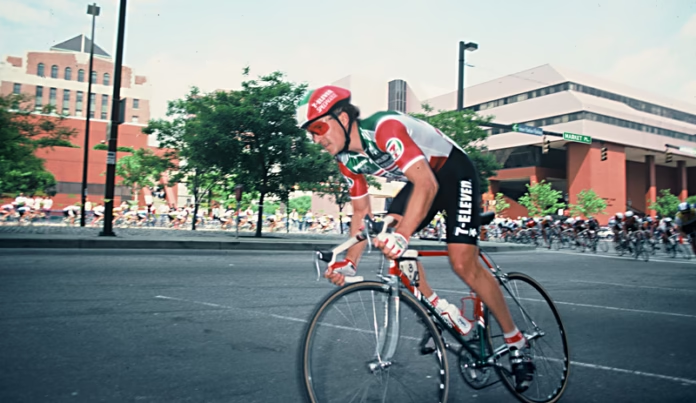
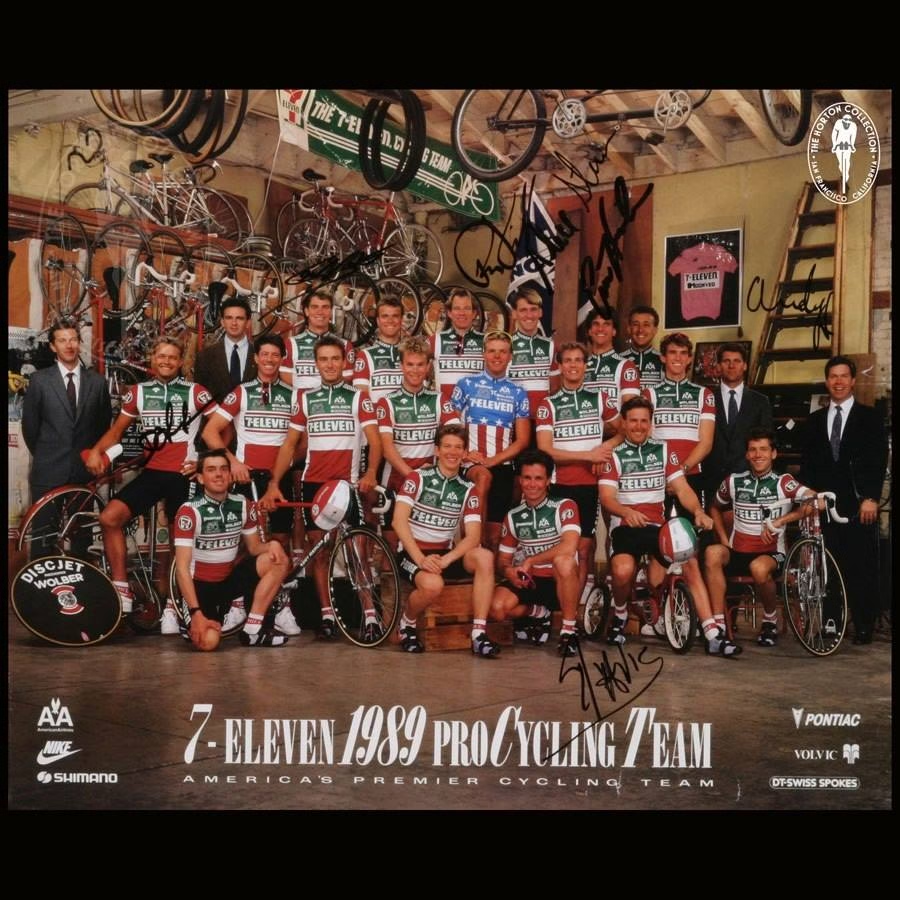
7-Eleven did not arrive in European cycling quietly. It arrived brightly, awkwardly, ambitiously and unmistakably American. The kit looked like a convenience-store sign had been dropped into the old world of Belgian kermesses, Italian stage races, French hierarchy and sponsor traditions that had been built over generations. The riders spoke a different racing language, carried a different cultural energy and, at first, were often treated as outsiders who had not yet earned the right to be taken seriously.
That changed quickly. What began as a US amateur project in 1981 became a professional team capable of winning Giro d’Italia stages, riding the Tour de France, putting a North American rider into the yellow jersey and, most famously, winning the 1988 Giro d’Italia with Andy Hampsten. 7-Eleven did not simply become the first great American trade team in European road racing. It helped prove that an American squad could learn the sport’s hardest lessons and still impose itself on the biggest races.
The team’s history sits at a crucial point in cycling’s wider internationalisation. Greg LeMond showed that an American rider could win the Tour de France, but 7-Eleven showed something slightly different: that an American team could enter the European system and survive. Individual talent can be absorbed by existing structures. A whole team had to build its own credibility, one race, one mistake and one result at a time.
For a wider view of the teams, riders and races that shaped the sport, ProCyclingUK’s men’s cycling history hub brings together the wider context around Grand Tours, landmark squads and the riders who pushed the peloton into new eras.
Where did the 7-Eleven cycling team come from?
The team was founded in 1981 by Jim Ochowicz, a former US Olympic cyclist who understood both the limitations and the untapped potential of American road racing. At the start, 7-Eleven was not a polished European-style professional outfit. It was an amateur team backed by the Southland Corporation, owner of the 7-Eleven convenience-store chain, with Schwinn also part of the early project.
That first identity mattered. The team was rooted in the post-Olympic American racing scene, a world shaped by criteriums, national-team programmes, track talent and riders who had not grown up inside the European club and development system. Names such as Eric Heiden, Ron Kiefel, Davis Phinney, Tom Schuler and Alex Stieda brought athletic ability, but the European pro peloton was a different environment entirely.
The American racing model produced riders who were powerful, aggressive and often tactically raw by European standards. They knew how to race hard, but Europe asked different questions. Positioning was more ruthless. Road furniture, crosswinds, race etiquette, team hierarchy and the sheer depth of the field punished every small mistake. 7-Eleven had to learn those lessons in public.
Turning professional and stepping into Europe
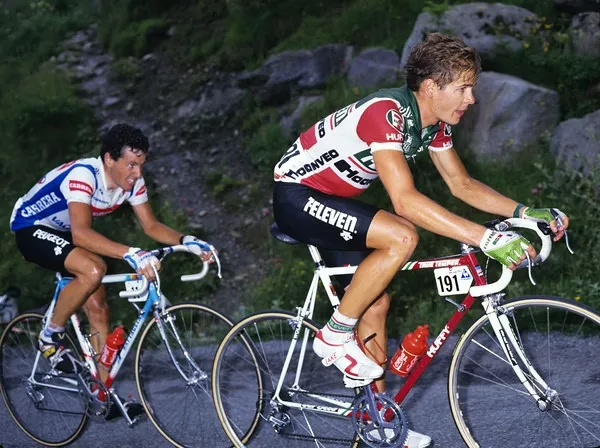
The major shift came in 1985, when 7-Eleven became a professional team. That was the moment the project stopped being only a domestic American story and became a direct challenge to Europe’s racing order. Ochowicz brought in Mike Neel as directeur sportif in Europe, giving the team someone who understood the terrain, customs and rhythm of the European calendar.
The invitation to the 1985 Giro d’Italia was the team’s first great opening. It was also a risk. A Grand Tour could expose 7-Eleven as underprepared, out of depth and culturally distant from the sport’s centre. Instead, it gave the team the breakthrough it needed.
Ron Kiefel won stage 15, becoming one of the first American riders to win a Grand Tour stage. Andy Hampsten, added to the team for the Giro, won stage 20. Those victories changed the conversation immediately. The Americans were still learning, still rough around the edges, but they were no longer just a curiosity. They had won inside one of Europe’s three great stage races.
That 1985 Giro did more than give 7-Eleven results. It gave the team legitimacy. In European cycling, invitations and reputation often feed each other. A team needs chances to prove itself, but it often needs proof before being given those chances. The Giro stage wins helped 7-Eleven break through that loop. ProCyclingUK’s brief history of the Men’s Giro d’Italia places Hampsten’s later victory in the wider story of the race and its defining mountain moments.
The 1986 Tour de France changed the team’s status
7-Eleven’s 1986 Tour de France debut remains one of the defining moments in American cycling history. The team became the first US-registered squad to ride the Tour, entering a race still deeply European in culture and control. LeMond was there too, riding for La Vie Claire and fighting his own internal battle with Bernard Hinault, but 7-Eleven’s presence gave the Tour a different kind of American storyline.
The team did not wait quietly at the back. Alex Stieda attacked on stage 1 and collected enough time bonuses to become the first North American rider to wear the yellow jersey. It was chaotic, improbable and slightly outrageous, which made it perfect 7-Eleven history. The same rider also briefly held other classification jerseys, turning the team’s Tour debut into a visual shock for the race.
The glory came with immediate punishment. The afternoon team time trial exposed just how unforgiving the Tour could be. Stieda was exhausted after his morning effort, the team suffered crashes and punctures, and the defence of yellow quickly became a fight for survival. That contrast summed up the early 7-Eleven experience: bold enough to take the race on, inexperienced enough to be punished brutally for it.
Still, the point had been made. 7-Eleven had not entered the Tour simply to complete it. The team had attacked, worn yellow and forced the race to notice. In a sport where status was guarded carefully, that mattered almost as much as the result sheet.
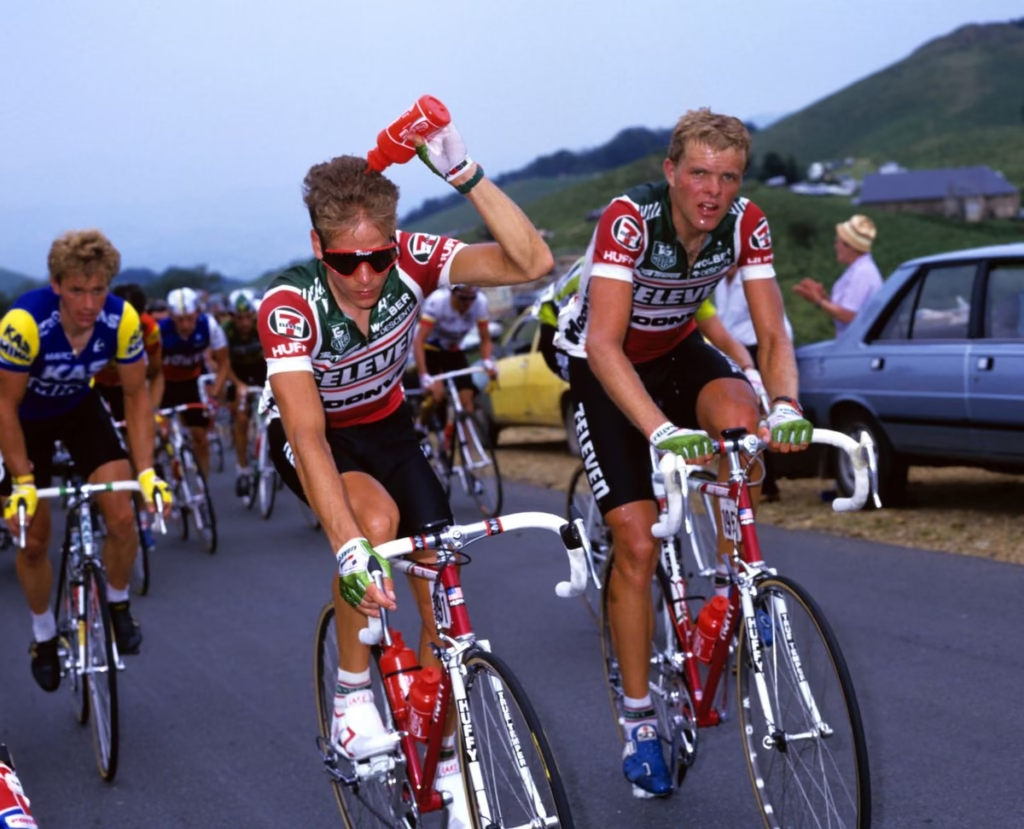 Photo Credit: BettiniPhoto
Davis Phinney, Tour stage wins and growing credibility
Davis Phinney gave 7-Eleven another major Tour breakthrough by winning stage 3 in 1986. That victory was important because it showed the team could do more than animate the race with a surprise move. It could win at the Tour de France on merit.
Phinney was central to the team’s identity. He brought sprint speed, confidence and a kind of American racing directness that suited 7-Eleven’s public image. He was not a rider built to blend into the background. His success helped give the team a recognisable competitive edge in races where outright GC success was not yet realistic.
More Tour stage wins followed in later years, including victories for Phinney, Dag Otto Lauritzen and Jeff Pierce. Each one pushed 7-Eleven further away from novelty status. The team was still learning, but it had become a legitimate part of the European peloton, capable of winning in the sport’s most visible race.
That progress was not smooth. 7-Eleven made tactical mistakes, suffered from inexperience and sometimes looked like a team trying to decode a culture while racing inside it. But that was also part of the fascination. The team did not arrive fully formed. It grew through impact.
Andy Hampsten & the 1988 Giro d’Italia
The defining achievement of the 7-Eleven era came at the 1988 Giro d’Italia. Andy Hampsten’s overall victory remains one of the most important results in American cycling history. He became the first American, and the first non-European, to win the Giro d’Italia, doing so in one of the most memorable editions of the race.
The stage over the Gavia Pass has become almost mythic, and with reason. Snow, freezing rain and brutal conditions turned the day into one of the most severe tests in modern Grand Tour history. Hampsten did not win the stage, but he rode himself into the maglia rosa and into cycling history. It was a performance built on endurance, cold-weather resilience and the kind of calm suffering that suited him perfectly.
Hampsten’s victory was not a one-day accident. He had already proved his quality with climbing performances and stage-race results, but the 1988 Giro made him the centre of 7-Eleven’s greatest triumph. The team had gone from outsider curiosity to Grand Tour winner in only a few years.
There was symbolism in that victory, but it was also simply a racing achievement of enormous weight. Winning the Giro required tactical maturity, team support, climbing strength and psychological resilience. For 7-Eleven, it was proof that the American project had not only entered European cycling. It had learned enough to beat Europe on one of its own grandest stages.
Why Hampsten’s Giro mattered beyond America
Hampsten’s 1988 Giro win is often framed as an American milestone, which it was. But its meaning was broader than nationality. It showed that the European peloton was no longer quite as closed as it had once seemed. Riders and teams from outside cycling’s traditional centres could adapt, compete and win.
That did not mean the old order disappeared. European teams still dominated the calendar, controlled much of the race culture and held most of the institutional power. But 7-Eleven had created a new reference point. An American team had won a Grand Tour, and it had done so with a rider whose style was based less on spectacle than on intelligence, endurance and composure.
The win also changed how American riders were viewed. They were no longer only fast criterium racers, Olympic converts or Tour de France novelties. They could be climbers, stage racers and Grand Tour winners. That broadened the imagined future for US cycling.
A team of personalities as much as results
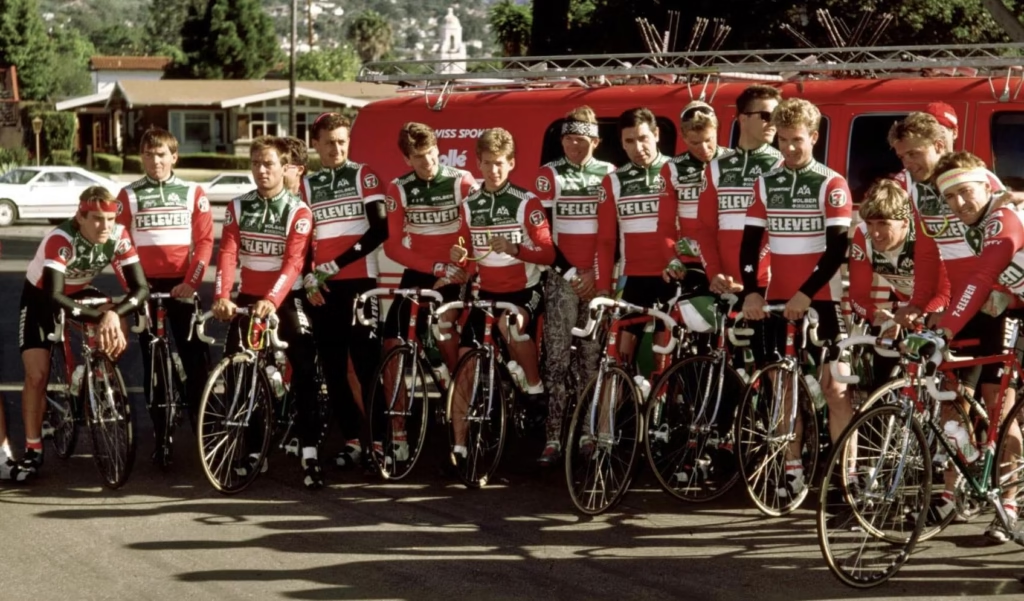
Part of 7-Eleven’s legacy comes from the riders themselves. The team had a cast that felt different from the more established European squads. Hampsten was the thoughtful climber. Phinney was the fast, confident finisher. Kiefel was one of the breakthrough figures. Bob Roll became one of the sport’s great storytellers. Alex Stieda carried the memory of that first yellow jersey. Eric Heiden brought Olympic stardom from speed skating into cycling’s strange new American experiment.
The team’s personality mattered because it made 7-Eleven visible. The kit helped, of course. The red, green and orange colours were unlike anything else in the peloton. But the riders also carried a different tone. They looked like a group learning Europe together, sometimes naively, often bravely, and gradually with more authority.
That made them easy to romanticise later, but the nostalgia should not obscure the achievement. 7-Eleven’s riders were not simply charming outsiders. They won stages, took jerseys, fought through Grand Tours and built a structure that became a proper professional team.
How 7-Eleven forced its way into Europe
The phrase “forced its way in” fits because 7-Eleven did not inherit a place in European cycling. It had to earn one. The team did it through a mixture of sponsorship ambition, rider development, opportunistic racing and results that organisers could not ignore.
The 1985 Giro stage wins opened the door. The 1986 Tour debut made the team visible. Stieda’s yellow jersey made it historic. Phinney’s Tour stage win proved it could win on the biggest stage. Hampsten’s 1988 Giro victory elevated it into something far more serious.
There was also a cultural forcing of the door. 7-Eleven brought American commercial clarity into a sport built around older European sponsorship traditions. A convenience-store chain backing a cycling team felt unusual, but it also showed how road racing could be marketed differently. The team’s presence suggested that cycling could expand beyond its traditional borders without losing its racing intensity.
The move towards Motorola
The 7-Eleven name lasted through 1990, before the team moved into its Motorola era from 1991. That transition did not erase the identity built in the 1980s. It extended it. The same broad structure continued under a new sponsor, and the team remained one of the most important American-linked squads in the European peloton.
The Motorola years brought another generation of storylines, most obviously through Lance Armstrong’s early professional career before everything that later came to define and distort his legacy. George Hincapie also turned professional with Motorola in 1994, a point explored in ProCyclingUK’s profile of George Hincapie and the hard-work culture of the European peloton. But the foundation belonged to 7-Eleven. The team had created the pathway, the credibility and the model that made the Motorola continuation possible.
By the time the original structure finally ended in 1996, it had lasted far longer than many might have expected when Ochowicz first built an amateur team at the start of the 1980s. Its lifespan covered the emergence of modern American road racing, the globalisation of the peloton and the growing commercial pull of cycling beyond Europe.
What was 7-Eleven’s legacy?
7-Eleven’s legacy is not only that it won. It changed what seemed possible. Before the team, American riders could break through individually, but an American squad entering Europe’s biggest races still felt like an outsider project. After 7-Eleven, the idea had been proven.
The team helped create a pathway for US riders to race seriously in Europe without disappearing entirely into European structures. It showed sponsors that an American-backed cycling team could gain global visibility. It gave fans in the United States a trade team to follow rather than only individual riders scattered across foreign squads.
It also influenced how later English-speaking and non-traditional cycling nations thought about entering the sport’s top level. The line from 7-Eleven to later US-backed teams is not always direct, but the precedent is obvious. Teams such as Motorola, US Postal, BMC Racing Team, Garmin and others existed in a world that 7-Eleven had helped open.
That wider team-history thread can also be seen in European projects from different traditions, from the Spanish control of Team Banesto to the Grand Tour ambition of ONCE. 7-Eleven’s place in that landscape is different, but just as important: it was the American squad that proved the old map was no longer fixed.
-
 Photo Credit: Canyon SRAM (supplied media release)
 -
 Photo Credit: Park Tool


Why the story still feels important
The 7-Eleven story still resonates because it sits at the point where cycling’s map began to widen. It is a story about ambition, but also about friction. The team did not stroll into Europe and receive acceptance. It was doubted, tested, mocked at times and punished by races it did not yet fully understand.
That is what makes the success more meaningful. The victories were not decorative. They were proof of adaptation. 7-Eleven learned how to race the Giro, how to survive the Tour, how to manage European roads and how to build credibility in a sport that rarely gives it away cheaply.
The team’s brightest moments still stand clearly: Kiefel and Hampsten winning Giro stages in 1985, Stieda wearing yellow in 1986, Phinney winning at the Tour, and Hampsten conquering the 1988 Giro. Those moments turned a bright American experiment into a serious European force.
7-Eleven team history verdict
7-Eleven was not the most polished team Europe had ever seen, and that was part of its appeal. It was bold, imperfect, ambitious and visibly different. It arrived with riders who had to learn quickly, a sponsor that looked unlike the old cycling establishment and a manager determined to make American road racing matter on the other side of the Atlantic.
Within a few years, the team had gone from outsider to Grand Tour winner. That journey is why 7-Eleven remains one of the most important teams in American cycling history. It did not just win races. It forced open a door that had been almost entirely European, then proved that once inside, it could compete with the best.

