
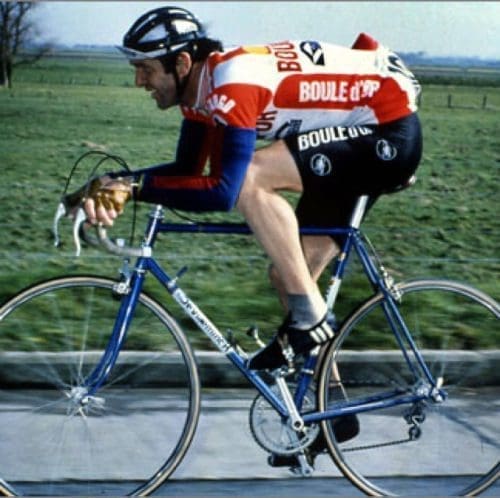
Roger de Vlaeminck belongs in the very top bracket of Spring Classics riders. Describing him as a cobbles specialist is fair up to a point, but it still misses part of the picture. He could win on pavé, he could win on rolling terrain, he could win in Italy, and he could do it while racing directly against Eddy Merckx in one of the strongest eras the sport has known. Few riders have put together a one-day record as broad or as deep.
Rider history
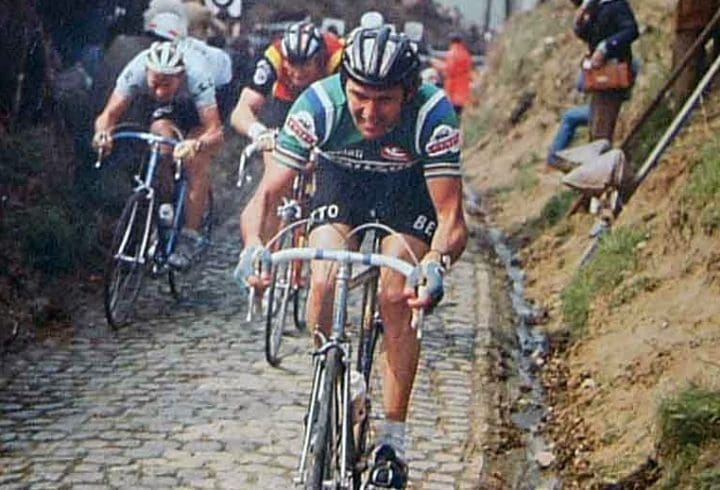
De Vlaeminck made an immediate impact as a professional. He won Omloop Het Nieuwsblad, then still known as Omloop Het Volk, in his first professional race in 1969. A year later, he had already added Liège-Bastogne-Liège, which showed early on that he was not limited to one type of race. He had the aggression, versatility and technical skill to be dangerous across the full spread of the Spring Classics.
What followed was one of the most complete Monument collections in cycling history. De Vlaeminck became one of the few riders to win all five of cycling’s Monuments. Liège-Bastogne-Liège came in 1970, Paris-Roubaix in 1972, Milan-San Remo in 1973, Il Lombardia in 1974 and finally the Tour of Flanders in 1977. Across his career, he finished with 11 Monument victories, which places him among the greatest one-day racers the sport has produced.
Paris-Roubaix is still the race most closely associated with his name. He won it four times, in 1972, 1974, 1975 and 1977, and added several other podium finishes besides. That record helped earn him the nickname Mr Paris-Roubaix, and it was no empty label. His cyclo-cross background gave him exceptional balance and control on difficult surfaces, while his toughness and sprint made him one of the hardest riders to beat once the race had been reduced to a small group.
His achievements were never confined to the cobbled Monuments alone. De Vlaeminck won Tirreno-Adriatico six years in a row from 1972 to 1977, an extraordinary sequence that still stands out as one of the race’s defining records. He also won the points classification at the Giro d’Italia three times and collected 22 stage wins there. Add in a Tour de France stage and a Vuelta stage, the latter coming in his final season in 1984, and the breadth of his record becomes even clearer. He was not simply a specialist, he was one of the most complete one-day riders of his generation.
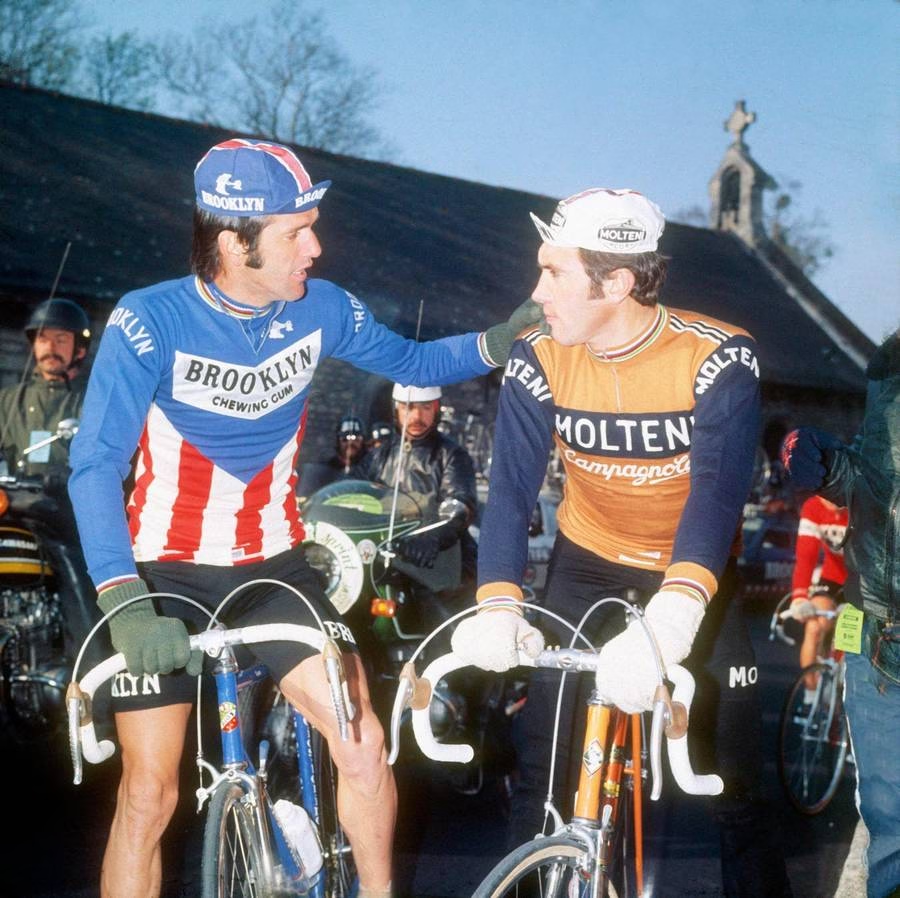
A large part of what makes De Vlaeminck’s palmarès so impressive is the era in which he built it. His career ran alongside Merckx’s, and their rivalry shaped much of 1970s Classics racing. Even with Eddy Merckx setting such extraordinary standards, De Vlaeminck still managed to win a Monument in every season of the 1970s apart from 1971. That alone says plenty about his level. He was not thriving in a weak period, he was winning in one of the sport’s most competitive decades.
Greatest race victory
1975 Paris-Roubaix
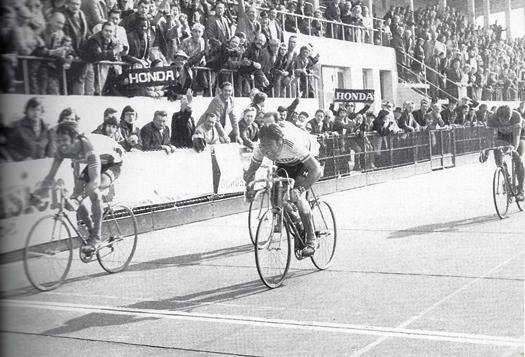
If one race best captures De Vlaeminck’s stature, it is probably the 1975 Paris-Roubaix. By then, he had already won the race twice, but this edition added extra weight because of the rival he beat and the way the finale unfolded.
The decisive move brought together De Vlaeminck, Eddy Merckx and André Dierickx before the race narrowed towards a direct duel between the two great Belgian rivals. Merckx punctured with around 8 kilometres remaining, got back in contact and attacked almost immediately once he returned. That sequence gave the finale its shape. De Vlaeminck was the first to answer and, from that point on, the race became a test of nerve as much as strength.
Once they reached the Roubaix velodrome, Merckx launched his sprint from distance. It was a bold move, but the effort of chasing back had clearly cost him. De Vlaeminck stayed composed, held his line and came around late to beat him on the finish. It was a narrow victory, but one earned against the strongest possible benchmark.
That is what makes the 1975 edition stand out so clearly. It was his third Paris-Roubaix victory, it came against Merckx in direct combat, and it reinforced everything that defined De Vlaeminck as a rider. He could handle the hardest roads, absorb the most violent attacks and still have enough left to win the sprint that followed. There are few better summaries of his greatness than that.
Spring Classics palmarès
Monuments
Tour of Flanders
1977
Liège-Bastogne-Liège
1970
Paris-Roubaix
1972, 1974, 1975, 1977
Milan-San Remo
1973, 1978, 1979
Il Lombardia
1974, 1976
Classics
La Flèche Wallonne
1971
Gent-Wevelgem
1967, 1970, 1973
E3 Harelbeke
1971
Scheldeprijs
1970
Omloop Het Nieuwsblad
1969, 1979
-
 Photo Credit: Flavia Ossola
Brabantse Pijl
1981
Kuurne-Brussels-Kuurne
1970, 1971

