Mountain biking’s audience is still growing in 2026. The WHOOP UCI Mountain Bike World Series reached record television, streaming, social and on-site figures in 2025, and viewing has continued to climb this season. The harder question is whether those extra viewers are actually becoming riders.
There are signs that some are. Retailers have reported bursts of mountain-bike demand around major events, e-MTB sales are growing in value and the Bicycle Association has made mountain biking and off-road leisure cycling a specific industry focus. But broadcast growth and participation are not the same metric, so it is worth separating what the numbers genuinely show from what the industry hopes they mean.
Mountain bike viewing has grown sharply
The strongest evidence is on the media side. The 2025 WHOOP UCI Mountain Bike World Series generated more than 87 million cumulative views across Warner Bros. Discovery channels and platforms. Official social accounts added more than 250,000 followers to reach 1.25 million, while the series website recorded five million page views, up 233% from 2024.
Race attendance grew as well. Around 440,000 spectators attended World Series rounds during 2025, with more than 100,000 visiting the Haute-Savoie weekends alone.

The 2026 audience is still increasing
The growth did not stop at the end of 2025. During the 2026 World Series, average HBO Max views per round have been reported as 45% higher than in 2025, with watch hours up 46%. Total streaming views were already close to the previous full-season figure with three rounds still remaining.
The series’ social reach passed 280 million during 2026, with nearly 200 million video views and more than 130,000 new followers generated during the season to that point. YouTube highlights have also set new records, including more than 330,000 views for the elite men’s cross-country highlights from Nové Město.
Those numbers show that mountain bike racing has a much larger digital audience than it did a few years ago. They do not, by themselves, tell us how many viewers bought a bike or started riding trails.
What happened after the Paris Olympics?
One useful case study came from Paul’s Cycles around the Paris 2024 Olympics. The retailer reported a 245% increase in mountain-bike revenue during the Olympic mountain-bike finals weekend and a 77% increase in UK Google search interest for “mountain biking” at the same time.
Across a longer period, Paul’s also reported a 191% year-on-year increase in MTB sales and a 366% increase in traffic to its mountain-bike pages. Those are figures from one retailer rather than a national participation survey, so they should not be treated as proof that British mountain biking suddenly doubled. They do show that major racing moments can produce a measurable spike in shopping and search behaviour.
E-MTBs are becoming part of the growth story
Electric mountain bikes have become particularly important because they expand what a mountain bike can do for riders who are less interested in earning every climb. They can also help mixed-ability groups ride together and make repeated trail-centre laps realistic without uplift.
The UK market data supports that shift. The Bicycle Association reported that e-bike market value increased 10% in 2025 even though e-bike unit volumes rose only 2%, with higher-value categories including e-MTBs contributing to the difference.
That does not mean every high-powered electric machine seen on a trail is legally an e-bike. Our updated guide to off-road e-bikes and UK e-MTB rules explains the 250W and 15.5mph EAPC limits and where compliant bikes can be ridden.

The industry now treats off-road cycling as a growth opportunity
In April 2026, the Bicycle Association held a dedicated industry session on “Working in partnership to grow Mountain Biking & Off-Road Leisure Cycling”. That is a useful signal in itself: the trade body sees off-road riding as a participation and market-growth area worth organising around rather than a niche enthusiast category.
The timing also makes sense. The wider UK cycling market returned to growth in 2025 after four years of decline, with mechanical-bike volumes up 6%. Mountain biking does not need to carry the whole recovery, but it sits in a part of the market where recreational riding, family cycling and higher-value e-bikes can overlap.
Our analysis of the UK bike industry’s post-pandemic recovery looks at those wider market numbers in more detail.
Why mountain biking converts well from watching to doing
Mountain biking has one advantage over many spectator sports: the recreational version does not have to resemble elite racing very closely. A new rider does not need to attack a World Cup downhill course or race cross-country laps to feel that they are participating in the same broad sport.
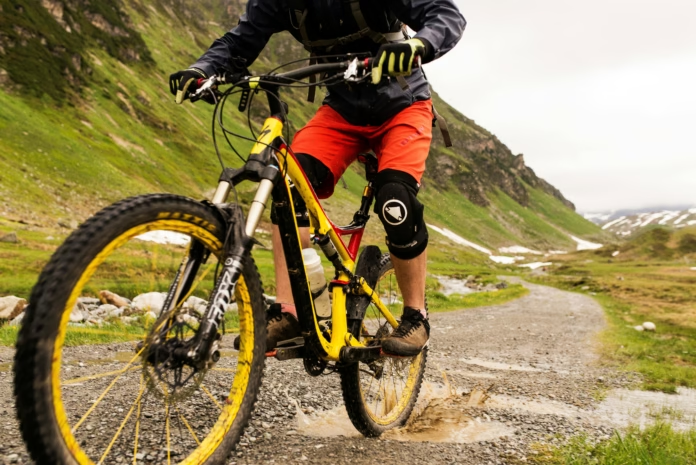
Forestry centres, blue trails, gravel forest roads and local bridleways provide much lower entry points. A rider can begin on an inexpensive hardtail, develop skills gradually and still recognise the same basic ingredients seen in elite racing: line choice, climbing, descending and bike handling.
Trail access can become the limiting factor
Growing interest only helps participation if people have somewhere suitable to ride. Purpose-built trails need maintenance, informal trails can create land-management problems, and access rules vary around the UK.
Forestry England manages more than 2,500km of cycling trails across its estate, ranging from family routes to black and downhill trails. That type of graded network matters because it gives new riders a visible progression from easy routes into more technical riding.
Local route quality matters as much as famous trail centres. Our refreshed guide to cycling around Guisborough and the North York Moors, for example, now distinguishes properly between Forestry England’s moderate Blue Lake trail, National Cycle Network routes and the harder 60km gravel option from town.
Does watching racing really create new riders?
There is not enough national data to claim a simple cause-and-effect relationship. Record World Cup viewing does not automatically mean record participation, and retailer sales can move because of weather, discounting, economic conditions and product cycles as well as sporting inspiration.
What we can say is that the sport has a much larger audience, live attendance is growing, mountain-bike content is reaching more people and there are examples of major events producing immediate increases in search and purchasing behaviour.
The next step is whether the industry can keep those people riding after the first purchase. Accessible trails, good entry-level bikes, clubs, coaching and clear legal access matter more to long-term participation than another viral downhill clip.
Mountain biking’s growth is no longer just an on-screen story
The evidence in 2026 points to genuine momentum, but the strongest claim is not that every new viewer becomes a rider. It is that mountain biking now has a larger funnel: more people see the sport, more attend events, more search for bikes and the cycling industry is actively trying to turn that interest into off-road participation.
Whether that becomes a lasting participation boom will depend less on broadcast numbers and more on what happens when a first-time rider looks for a bike, a local trail and a group to ride with.