
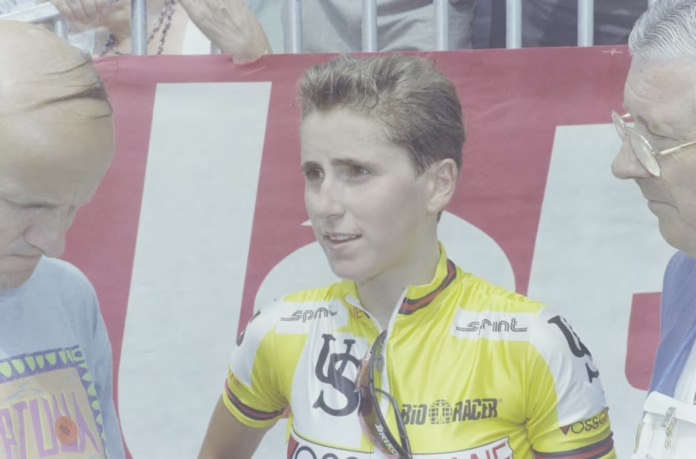
Heidi Van de Vijver belongs to the generation that carried women’s road racing through the early 1990s, when the international calendar was growing but still lacked the scale and visibility of the modern Women’s WorldTour. Her record stands up without exaggeration: she was a stage-race winner, a two-time Belgian road champion, a three-time national time trial champion and a regular presence near the front of the biggest stage races of her era.
Born in Bornem on 31 December 1969, Van de Vijver developed into one of Belgium’s most dependable all-round riders. She was capable over long stage races, strong against the clock and durable enough to remain competitive across more than a decade of international racing. Her career is a useful reminder that Belgian women’s cycling had genuine depth well before the recent professional boom.
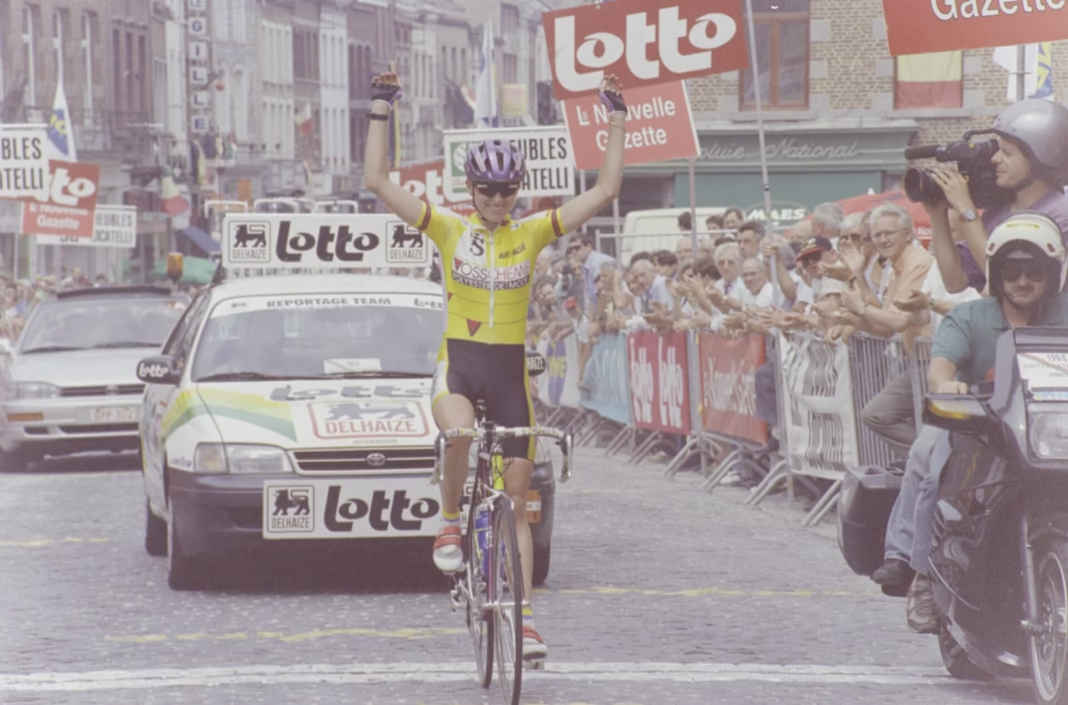
Winning the Tour de la CEE féminin
The clearest high point of Van de Vijver’s career came in 1993 at the Tour de la CEE féminin, one of the major women’s stage races of the period and a direct descendant of the Tour de France Féminin. Van de Vijver had already finished second overall in 1992 behind Leontien van Moorsel, but returned a year later to win the general classification.
The victory was not an isolated result. She also finished third in the 1992 and 1993 editions of the Tour cycliste féminin, another major French stage race, and later took third overall at the Tour de l’Aude in both 1997 and 1999. That consistency across different events is central to understanding her as a rider. She was not simply a one-day specialist who happened to survive longer races. She repeatedly placed highly in events where form had to be carried across several days.
Belgian titles and time trial strength
Van de Vijver won the Belgian road race championship in 1994 at Binche and again in 1998. The 1994 victory gave her the national champion’s jersey at a point when she was already established internationally following the previous year’s Tour de la CEE win.
Her national record became even broader at the turn of the century. She won the Belgian individual time trial title in 1999, 2000 and 2001, underlining how complete her skill set had become. Those three consecutive championships help explain why she remained competitive deep into her career even as the women’s peloton became more specialised.
A rider built for stage racing
Van de Vijver’s strongest results suggest a rider who managed effort exceptionally well. She could climb well enough to stay involved when a stage race became selective, limit losses in time trials and still place strongly when the race returned to flatter terrain. That balance mattered in an era when women’s stage races were often less predictable, with fewer specialised support structures and a smaller margin for recovery.
Her career overlapped with riders such as Jeannie Longo, Leontien van Moorsel and Catherine Marsal, all major figures of the period. Against that level of opposition, Van de Vijver repeatedly found her way onto final podiums and into championship selections. She finished tenth in the World Championship road race in 1991 and eighth in the Olympic road race at Sydney 2000, results separated by almost a decade.
Longevity in a changing peloton
That Olympic result in 2000 is particularly revealing. Van de Vijver had already been an international rider for more than a decade by then, yet still finished inside the top ten at the Games. She continued racing into the early 2000s, with strong one-day and stage-race results still appearing late in her career.
Her longevity also gives her a distinctive place in the wider history of the sport. Van de Vijver raced through a period in which women’s professional cycling gradually became more organised, more international and more demanding. She was successful before that transition had fully taken hold and remained competitive while it was happening.
From rider to team management
After retiring, Van de Vijver remained involved in cycling through team management and sports-director roles. That continuation matters because it links two generations of Belgian and international women’s racing. Her experience was formed in a much leaner version of the sport, but it remained relevant as teams became more professional and better resourced.
For anyone exploring the development of the women’s peloton, her career sits naturally within our women’s cycling history hub. Van de Vijver is not a forgotten world champion, as she has sometimes been inaccurately described. Her real record is more interesting: a major stage-race winner, five-time Belgian champion across road and time trial, Olympic top-ten finisher and one of the most consistent Belgian women of her generation.

