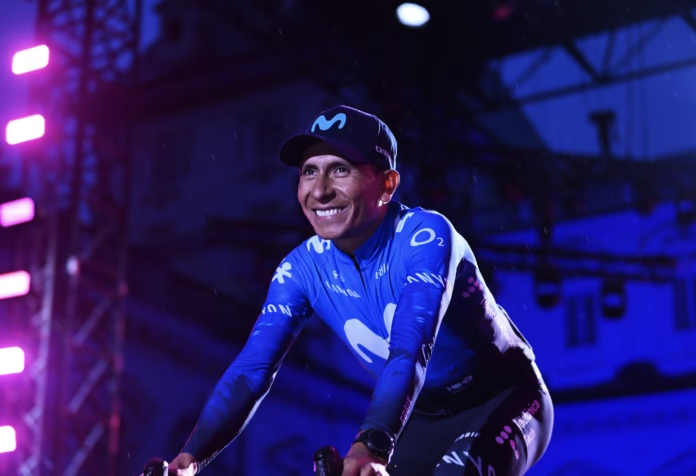
Nairo Quintana will roll away from Ferrara on Saturday knowing that, for the first time in more than 15 years, there is no next race to prepare for. The 2026 Giro dell’Emilia will be the final professional start of a career that took him from the mountains of Boyacá to victories at the Giro d’Italia and Vuelta a España, three Tour de France podiums and a place among the defining climbers of his generation.
There is an obvious symmetry to the choice of farewell. Fourteen years ago, in his first season with Movistar, Quintana won the Giro dell’Emilia on the climb to San Luca. It was not his first professional victory, but it was one of the first occasions on which European cycling saw the compact Colombian climber arrive at the sharp end of a major one-day race and simply ride away from established names.
He returns to San Luca at 36 with a very different place in the sport. Quintana is no longer the unknown rider waiting for the road to rise. He is the first Colombian and first South American to have won the Giro, a Vuelta winner, twice runner-up at the Tour and a rider whose best years were spent trying to break the control of Chris Froome and Team Sky in July.
His retirement was announced in March during the Volta a Catalunya. At the time, the Vuelta a España appeared likely to provide the final goodbye. Instead, the circle closes in Bologna, at the same race where his first Movistar season ended with a win.
From Boyacá to the Tour de l’Avenir
Quintana’s story was always inseparable from Boyacá. He grew up in Cómbita, at altitude, in a family for whom cycling was part transport, part necessity and eventually a way into competition. The image of the slight Colombian climber shaped by high roads became familiar once he reached Europe, but there was substance behind the mythology. Long climbs, thin air and repeated days on difficult terrain genuinely suited the physiology and riding style that later defined him.
The first major international sign came at the 2010 Tour de l’Avenir. Quintana won the overall and the final two mountain stages, immediately putting himself on the list of riders European teams expected to see again. A season with Colombia es Pasión followed before Movistar signed him for 2012.
That first year in blue and green was unusually productive for a 22-year-old climber finding his way around the WorldTour. He won the Vuelta a Murcia, the Route du Sud, a mountain stage at the Critérium du Dauphiné and then Giro dell’Emilia. San Luca, with its steep ramps and repeated changes of gradient, offered an early glimpse of the acceleration that would soon be used on much bigger stages.
The 2013 Tour changed everything
Quintana’s first Tour de France in 2013 moved him from promising climber to global star. He arrived as part of a Movistar team that also included Alejandro Valverde, but by the final week it was clear that the Colombian had become one of the strongest riders in the race.
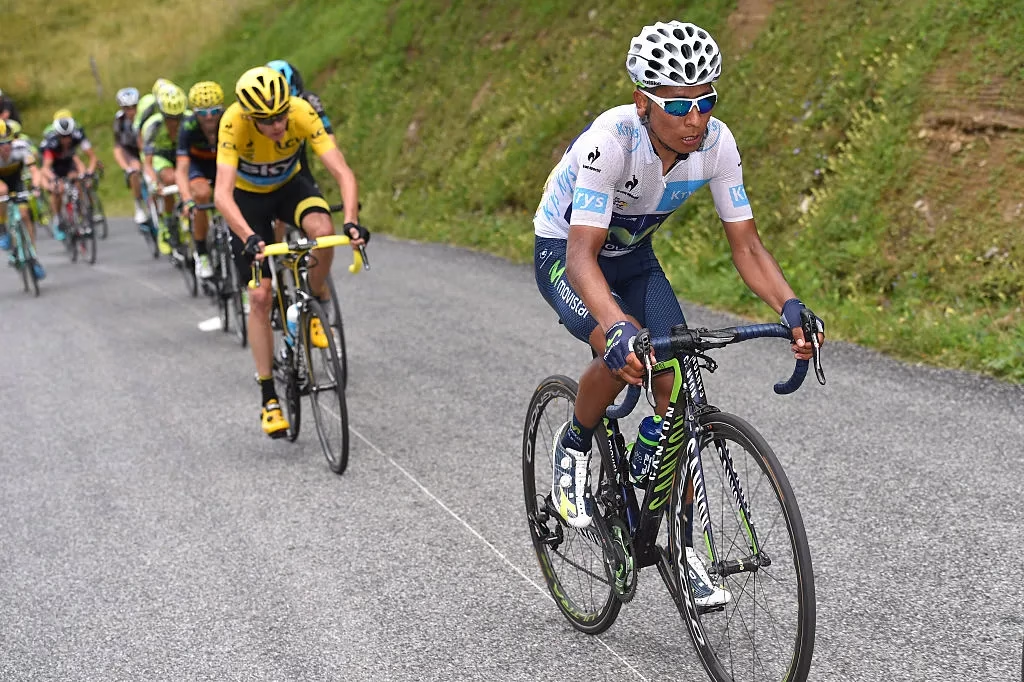
The stage to Annecy-Semnoz provided the clearest statement. Quintana attacked on the final climb, won the stage and secured both the mountains classification and the white jersey. He finished second overall behind Froome, at 23 years old, and became the only rider to win the Tour’s young rider and mountains classifications in the same edition.
That Tour established the pattern that would define much of the next three seasons. Froome and Sky had the stronger time trial package and the deeper train, while Quintana’s route to victory depended on creating enough difference in the mountains to compensate. On his best days he was capable of doing exactly that. The problem was finding enough of those days, and finding them early enough, to overturn the time already lost elsewhere.
He remains part of ProCyclingUK’s discussion of the greatest Tour de France climbers because his record in the high mountains was not built around one edition. For several years, any Tour summit finish that became a direct contest among the general classification riders was likely to bring Quintana into view.
Pink in 2014 and the breakthrough Grand Tour win
Movistar kept Quintana away from the Tour in 2014 and sent him to the Giro d’Italia instead. It proved the right decision. After a difficult opening half of the race, he came alive in the final week and took control on one of the most debated days in modern Giro history.
Stage 16 crossed the Gavia and Stelvio in rain and snow before finishing at Val Martello. Confusion over whether the Stelvio descent had been neutralised became the story of the day, but Quintana was already committed by the time the race reached the final climb. He went clear, won the stage and took the pink jersey from Rigoberto Urán.
He then strengthened his position in the mountain time trial to Monte Grappa and carried pink into Trieste. The victory made him the first Colombian and first South American winner of the Giro d’Italia. It also changed the scale of expectation around him. He was no longer simply the climber most likely to trouble Froome. He was a Grand Tour winner expected to challenge for the Tour itself.
The Tour that never quite became his
The 2015 Tour was probably Quintana’s closest opportunity to win yellow. He lost time during the opening week, particularly before the race reached his preferred terrain, then spent the Alps trying to undo the damage. By the final weekend he was climbing better than Froome and cut deeply into the deficit on La Toussuire and Alpe d’Huez.
He finished second overall by 1 minute 12 seconds. That margin is part of why the race still follows his career around. Quintana looked capable of taking more time in the final mountains, but the opportunities ran out. Whether Movistar could have raced more aggressively earlier became a recurring argument around his Tour campaigns.
That criticism was sometimes too simple. Grand Tours in the Sky era were difficult to destabilise because Froome’s team could set a pace that removed many of the obvious launch points for attacks. Quintana was also not a rider who could manufacture time on flat terrain or in long time trials. His advantage had to be created uphill, which made every missed opportunity in the mountains more expensive.
He returned to the Tour podium in 2016, finishing third behind Froome and Romain Bardet. By then the sense that yellow might remain out of reach was growing, but the season would still produce perhaps the most tactically complete Grand Tour victory of his career.
The 2016 Vuelta showed another side of Quintana
Quintana’s Vuelta a España win was not simply a three-week climbing contest. He took the red jersey after winning at Lagos de Covadonga, then helped turn stage 15 to Formigal into one of the defining ambushes of the decade.
Alberto Contador attacked almost from the start. Quintana recognised the opportunity and joined him with Movistar teammates, while Froome and much of Team Sky were caught behind. The gap expanded through the stage and Froome lost more than two and a half minutes by the finish. It was the sort of move riders and teams often talk about attempting but rarely execute against the race favourite.
Froome took substantial time back in the final individual time trial, but Quintana defended the lead on the final mountain stage and rode into Madrid as winner. The history of the Vuelta a España contains many mountain champions, but Quintana’s 2016 win stands out because the decisive blow came through positioning and tactical awareness as much as climbing strength.
That season was the high point of his consistency. He won the Volta a Catalunya and Tour de Romandie as well as the Vuelta, finished third at the Tour and remained capable of winning almost any stage race whose decisive days were built around long climbs.
The last years at the very top
Quintana began 2017 by winning Tirreno-Adriatico for the second time and then returned to the Giro. His attack on Blockhaus was one of the purest climbing performances of his career, but Tom Dumoulin’s time trial strength changed the balance of the race. Quintana eventually finished second in Milan, only 31 seconds behind the Dutchman.
From there, the Grand Tour results became less consistent. Movistar’s leadership structure also became more complicated as Mikel Landa joined Valverde and Quintana. The much-discussed three-leader approach at the 2018 Tour never produced the result the team wanted, although Quintana still delivered one of that race’s biggest mountain wins on the Col du Portet.
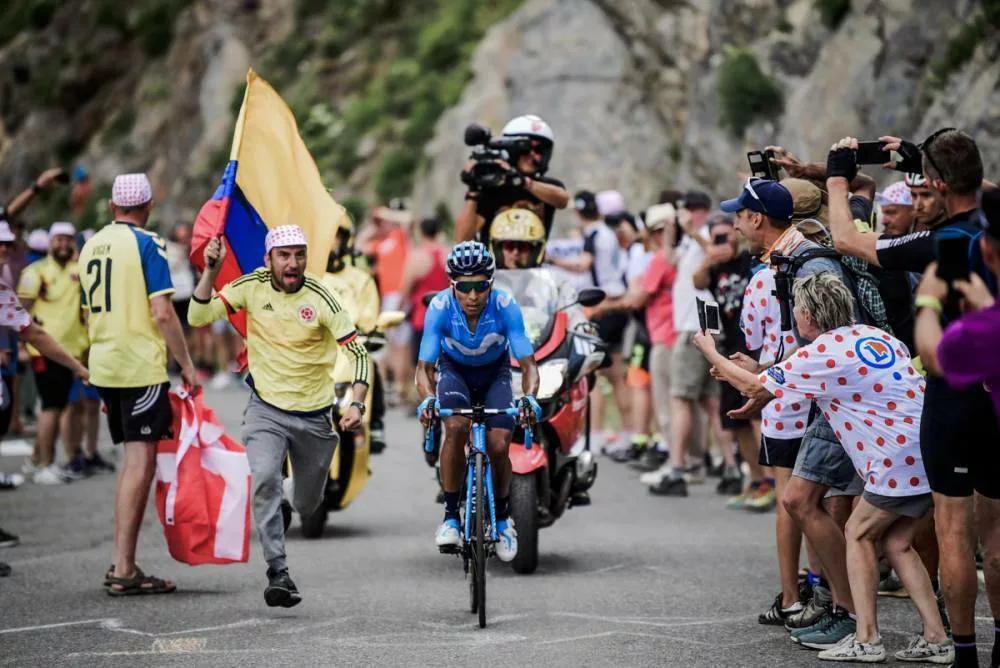
His final Tour with Movistar in 2019 told a similar story. Quintana was no longer in genuine contention for the overall win by the final week, but on the stage over the Galibier to Valloire he went into the break and produced the old climbing acceleration to take another Tour stage victory. It was a reminder that even when the GC ambitions had slipped, the ability that made him famous had not disappeared.
Arkéa brought a revival, then the most difficult year
Quintana left Movistar for Arkéa-Samsic in 2020 and immediately looked refreshed. He won the Tour de la Provence and Tour des Alpes-Maritimes et du Var, attacking with the freedom of a rider no longer carrying the expectations that had followed every Movistar Tour campaign.
Injuries interrupted that first season and the following years were uneven, but there were still signs of a high level. He won the Tour de la Provence and Tour des Alpes-Maritimes et du Var again in 2022 and crossed the line in Paris sixth overall at the Tour.
That result was later removed after two in-competition samples showed tramadol. The UCI had banned tramadol under its medical rules, and the Court of Arbitration for Sport later upheld the disqualification. Importantly, under the rules in force at the time it was a medical-rule infringement rather than an anti-doping rule violation. ProCyclingUK covered the CAS decision on Quintana’s 2022 Tour disqualification when the appeal was rejected.
The episode effectively ended his first post-Movistar chapter. He left Arkéa and spent 2023 without a professional team, an unusual position for a rider with two Grand Tour victories and multiple Tour podiums. For a time it appeared that his career might simply stop there.
The Movistar return gave the career another ending
Instead, Movistar brought Quintana back for 2024. The expectations were different. He was no longer being asked to arrive at the Tour as a potential winner. His value came from experience, climbing support and the possibility that the right mountain stage could still turn into a personal opportunity.
The 2024 Giro provided exactly that. On the enormous stage to Livigno, Quintana spent the day in the breakaway and looked on course for one of the most emotional victories of his career before Tadej Pogačar caught him late. Quintana finished second, 29 seconds behind, but the ride mattered for reasons beyond the result. Ten years after winning the Giro, he was again one of the strongest climbers on its hardest stage. Our report from that 2024 Giro stage captured how close he came.
Movistar retained him through 2025 and into 2026. By then retirement was approaching, but he still found one more overall victory. At the Vuelta a Asturias in April, Quintana won stage two and defended the lead to take the race for a third time. It was his first victory in four years and an unexpectedly fitting final addition to the palmarès.
 Photo Credit: Getty
What made Nairo Quintana different
At his peak, Quintana was an unusually economical climber. He rarely looked dramatic on the bike. His upper body stayed quiet, his cadence remained controlled and then, often without much warning, a gap appeared behind him. The acceleration was more damaging because there was so little visual preparation for it.
His limitations were just as clear. Long time trials rarely helped him, exposed flat stages could become dangerous and he sometimes needed a race to be made hard by others before his strongest weapon could decide it. Those weaknesses shaped the Tour de France years and explain why his two Grand Tour victories came in races where the mountain balance gave him more room to impose himself.
There was also a recurring tension between patience and aggression. Quintana could wait longer than supporters wanted, especially when chasing Froome at the Tour, yet the career contains several examples of exactly the opposite: the 2016 Formigal ambush, his Stelvio move at the 2014 Giro, Blockhaus in 2017 and attacks from distance when his GC position no longer demanded caution.
That contradiction is part of why his career remains interesting. He was neither the permanently attacking climber of romantic memory nor the conservative rider he was sometimes reduced to during the most controlled Tour years. Quintana raced according to circumstance, and the teams, courses and rivals around him often determined which version appeared.
A career that changed what Colombian riders could expect
Colombia already had a deep Grand Tour history before Quintana. Luis Herrera had won the 1987 Vuelta and riders such as Fabio Parra had shown that Colombian climbers could contend in Europe. Quintana’s importance came in bringing that tradition back to the centre of the sport during a different era.
His 2013 Tour podium arrived 25 years after Parra’s third place in 1988. A year later he won the Giro. By 2016 he had added the Vuelta and three Tour podiums, meaning Colombian supporters could approach a Grand Tour expecting one of their riders to fight for overall victory rather than simply hunt mountain stages.
Egan Bernal eventually achieved what Quintana could not by becoming Colombia’s first Tour de France winner in 2019. That does not reduce Quintana’s role in the years before it. He helped normalise Colombian riders as leaders of the biggest European teams and as genuine three-week contenders across the calendar.
More than 50 professional victories tell part of the story. The more useful summary is the range of them: the Giro and Vuelta, Tour stages, two Tirreno-Adriatico titles, the Volta a Catalunya, Tour de Romandie, Itzulia Basque Country, Vuelta a Burgos and the race to which he now returns for the last time.
One final climb to San Luca
Saturday’s Giro dell’Emilia is not designed as a ceremonial farewell. The men race 197.9km from Ferrara to Bologna and finish with the familiar repeated ascents towards the Sanctuary of San Luca. The field includes riders arriving with very different ambitions, including new world champion Brandon McNulty, who will make his first start in the rainbow jersey.
For Quintana, the result is almost secondary. He won here in 2012 when San Luca represented possibility: another steep road on which an emerging climber could show that he belonged in Europe. He returns after a career in which the Giro dell’Emilia victory became a footnote only because so much larger followed.
There will be no Tour to prepare for after Bologna, no next Giro mountain stage and no autumn programme to extend the season. Quintana will climb San Luca in a Movistar jersey one final time, 14 years after doing so as one of cycling’s newest prospects.
Between those two rides sit a Giro d’Italia, a Vuelta a España, three Tour de France podiums and a career that helped move Colombian cycling back to the centre of the Grand Tour conversation. That is a substantial distance to cover before ending where it began.
-
 Photo Credit: David Pintens / BELGA MAG/AFP via Getty Images
 -
Photo Credit: BELGA MAG/AFP via Getty Images