
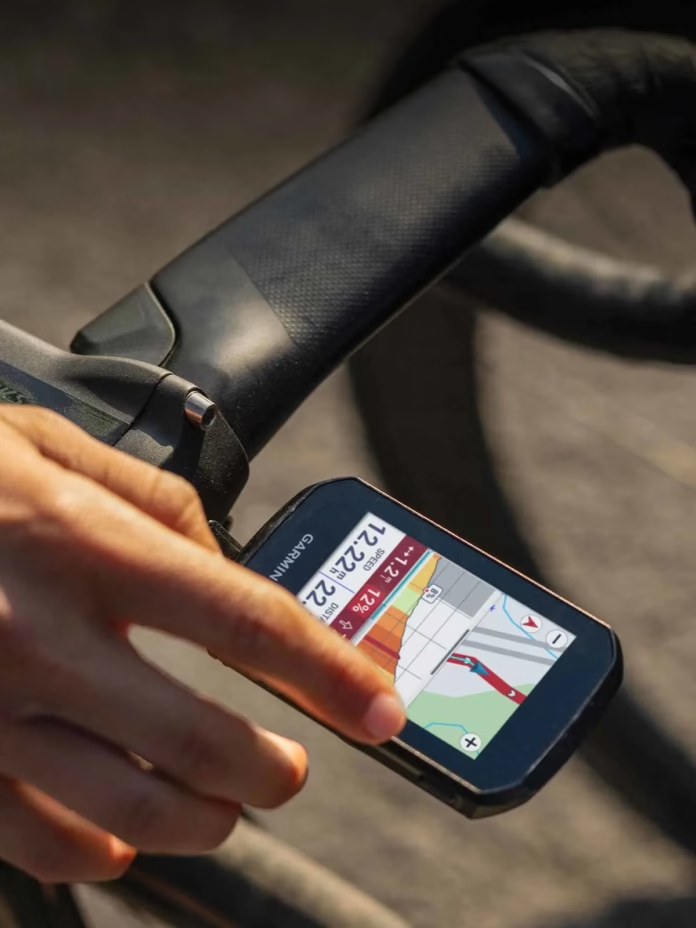
The Garmin Edge 850 is probably the easiest model in Garmin’s current range to recommend to a serious road cyclist, but it comes with one important qualification.
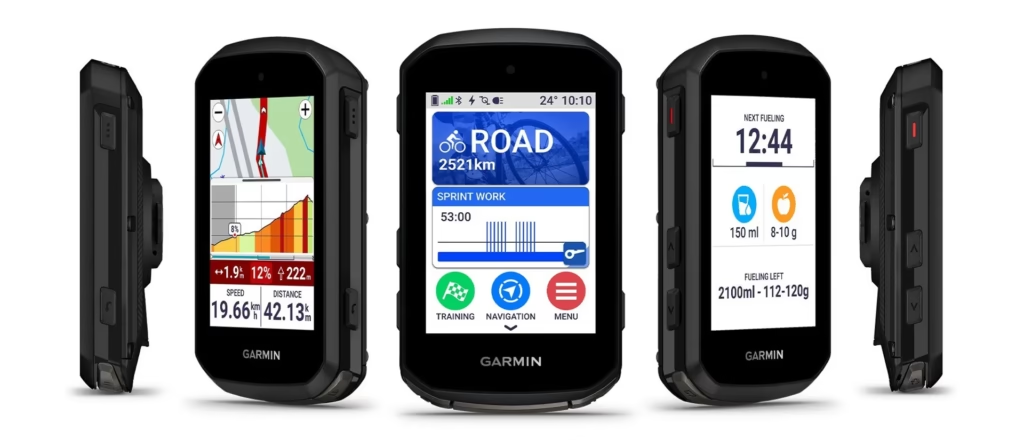
It combines the brighter, sharper interface introduced with the Edge 1050 with the smaller format that made the Edge 840 such a good everyday computer. You get a 2.7-inch colour touchscreen, physical buttons, multi-band GNSS, full mapping, Garmin’s extensive training tools, 64GB of storage and several newer features including Garmin Pay, a built-in speaker and smarter fuelling guidance.
For riders who train with power, regularly load routes and want one computer to handle almost everything, it is an extremely complete package.
The compromise is battery life.
Garmin quotes up to 12 hours in demanding use and 36 hours in battery-saver mode, which is a noticeable backwards step from the Edge 840 generation. For normal club rides, training sessions and most sportives, that is unlikely to cause a problem. Riders doing very long audax events, multi-day trips or ultra-distance racing have more reason to hesitate.
At £469.99, the Edge 850 also sits firmly in premium territory. It is considerably more expensive than increasingly capable alternatives from iGPSPORT and Magene, while Garmin’s own Edge 550 offers much of the same underlying performance for less if you can live without a touchscreen.
For the rider who wants Garmin’s full training and navigation experience without moving to the much larger Edge 1050, however, the 850 hits a particularly useful middle ground.
Check the latest Garmin Edge 850 price on Amazon
Garmin Edge 850 specifications
| Feature | Garmin Edge 850 |
|---|---|
| Display | 2.7-inch colour touchscreen |
| Resolution | 420 x 600 pixels |
| Controls | Touchscreen and physical buttons |
| Dimensions | 54.6 x 92.2 x 16.8mm |
| Weight | 113g |
| Storage | 64GB |
| GPS | Multi-band GNSS |
| Battery life | Up to 12 hours in demanding use |
| Battery saver | Up to 36 hours |
| Connectivity | ANT+, Bluetooth and Wi-Fi |
| Waterproofing | IPX7 |
| Speaker | Yes |
| Garmin Pay | Yes |
| Charging | USB-C |
| Mapping | Full colour maps and turn-by-turn navigation |
The Edge 850 replaces the Edge 840 as Garmin’s premium compact touchscreen computer, sitting above the button-only Edge 550 and below the larger Edge 1050.
That position makes sense once you start using it.
The new screen is the biggest everyday improvement
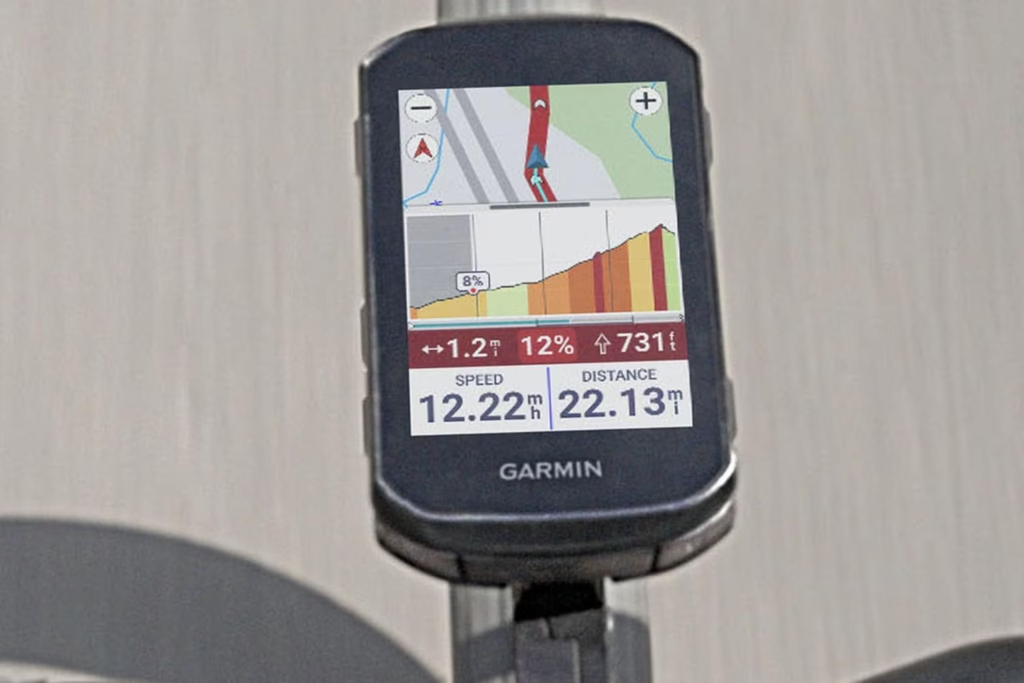
The 2.7-inch display is only slightly larger than the 2.6-inch screen on the Edge 840, but the difference is much greater than that number suggests.
Resolution jumps from 246 x 322 pixels on the 840 to 420 x 600 on the Edge 850. The result is noticeably sharper mapping, cleaner text and a much more modern-looking interface.
This matters more on a bike computer than it might sound.
Most interactions happen quickly, often while travelling at 30km/h or more. Being able to recognise the next junction, read a climb profile or pick out the right data field immediately is more useful than simply having another line on the specification sheet.
The brighter display also works well in changeable light. It remains easy to read when moving between open roads and tree cover, while the improved resolution makes detailed maps easier to interpret without needing a physically enormous head unit.
That was one of the few areas where the older Garmin Edge 840 Solar had begun to look dated. It remained an excellent computer, but its display could not match the vivid screens appearing on newer rivals.
The Edge 850 fixes that.
Touchscreen and buttons remains the right combination
Garmin has resisted making the Edge 850 touchscreen-only, which is a good decision.
Scrolling around a map or changing settings is much quicker by touch. Moving between data pages in heavy rain, wearing winter gloves or rattling across poor road surfaces is often easier with a physical button.
The 850 lets you use whichever makes more sense.
That sounds obvious, but several bike computers still force riders into one control method. Garmin’s hybrid approach is particularly useful in Britain, where a ride that begins with dry hands can easily end with soaked gloves.
The buttons themselves are easy to find without looking down, while the touchscreen is responsive enough that there is rarely a need to jab repeatedly at the same option.
Once the data screens and ride profiles are configured, most journeys require very little interaction anyway.
Navigation is still one of Garmin’s biggest advantages
If navigation is important, the Edge 850 makes a strong case for paying Garmin money.
Routes load quickly, maps redraw smoothly and turn notifications arrive with enough warning to be useful rather than merely confirming that you have just missed the road.
Multi-band GNSS gives the computer excellent positional accuracy, particularly around buildings, dense tree cover and more complicated terrain.
Garmin has also added 5Hz GPS recording support, allowing substantially more frequent position sampling in situations where accuracy matters. It is particularly relevant for mountain biking and fast technical riding, although ordinary road cyclists are unlikely to need it enabled for every journey.
The underlying advantage remains the maturity of Garmin’s navigation platform.
Going off route is where cheaper computers often reveal themselves. A loaded GPX can be perfectly easy to follow until you miss a junction, deliberately divert for food or discover the planned road is closed.
The Edge 850 handles those situations with considerably more confidence.
That difference was also apparent when comparing Garmin with the much cheaper iGPSPORT BiNavi. The BiNavi is impressive when following a prepared route, but Garmin retains an advantage once navigation becomes less predictable.
See the Garmin Edge 850 on Amazon
On-device route creation makes more sense than it sounds
The Edge 850 can also create courses directly on the device.
This is not how I would plan most rides. Building a complicated 100km route remains quicker on a phone or computer where there is more screen space.
It becomes much more useful halfway through a ride.
If plans change, you need to reach a station, decide to head somewhere for food or simply want another way home, being able to create the route without going through a phone app reduces the amount of stopping and fiddling required.
Garmin Pay fits into a similar category.
It is hardly a reason to spend nearly £470 on a bike computer, but being able to pay for an emergency drink or café stop from the Edge can be useful if a phone or wallet has been left behind.
These are small additions individually. Collectively, they make the 850 feel less dependent on getting a phone out whenever the ride changes.
The Edge 850 remains strongest as a training computer
Garmin’s biggest advantage over simpler GPS units is everything that happens once sensors are connected.
Pair the Edge 850 with a power meter and heart-rate monitor and it becomes a much deeper training device.
Structured workouts can be pushed to the unit, Garmin Cycling Coach can adapt training according to your goals and the computer tracks metrics including training load, cycling ability, stamina and recovery.
ClimbPro remains one of Garmin’s most useful ride features.
On a loaded route, upcoming climbs are identified automatically and displayed with distance, elevation and gradient information. Free-ride ClimbPro also allows the computer to recognise climbs when you are not following a course.
For unfamiliar terrain, it is difficult to go back once you are used to it.
Knowing that a climb has another 1.8km at six per cent before easing is much more useful for pacing than simply seeing the current gradient.
Smart fuelling alerts are more useful than generic reminders
The Edge 850 also develops Garmin’s nutrition and hydration features.
Rather than simply producing a recurring reminder to eat or drink, the newer smart fuelling system can use ride demands and environmental information to provide more specific recommendations.
Like several of Garmin’s advanced training features, the most useful version depends on having compatible sensors and giving the platform enough information to work with.
This is not a replacement for understanding your own fuelling strategy.
For long events, however, anything that reduces the chance of reaching hour four before remembering you have barely eaten is useful.
The weather overlays follow the same philosophy. When connected to a compatible phone, weather information can be shown over the route to give a clearer indication of what conditions lie ahead.
Again, it is not revolutionary.
It is useful.
That distinction applies to many of the Edge 850’s best features.
The built-in speaker is surprisingly worthwhile
Garmin has brought the speaker from the Edge 1050 down to the 850.
It enables clearer audible navigation and alerts rather than relying entirely on the familiar Garmin beeps.
There is also a digital bike bell.
The bell will not replace a genuinely loud physical bell for commuting through a busy city, but it is useful on shared paths and quieter situations where you simply need to make someone aware that a bike is approaching.
Garmin has also developed the speaker through software updates, including a double-tap shortcut for activating the virtual bell.
It is another feature that initially sounds like specification-padding but becomes more useful once the computer is being used regularly.
Garmin’s training ecosystem can still feel overwhelming
The downside of having almost everything available is finding everything.
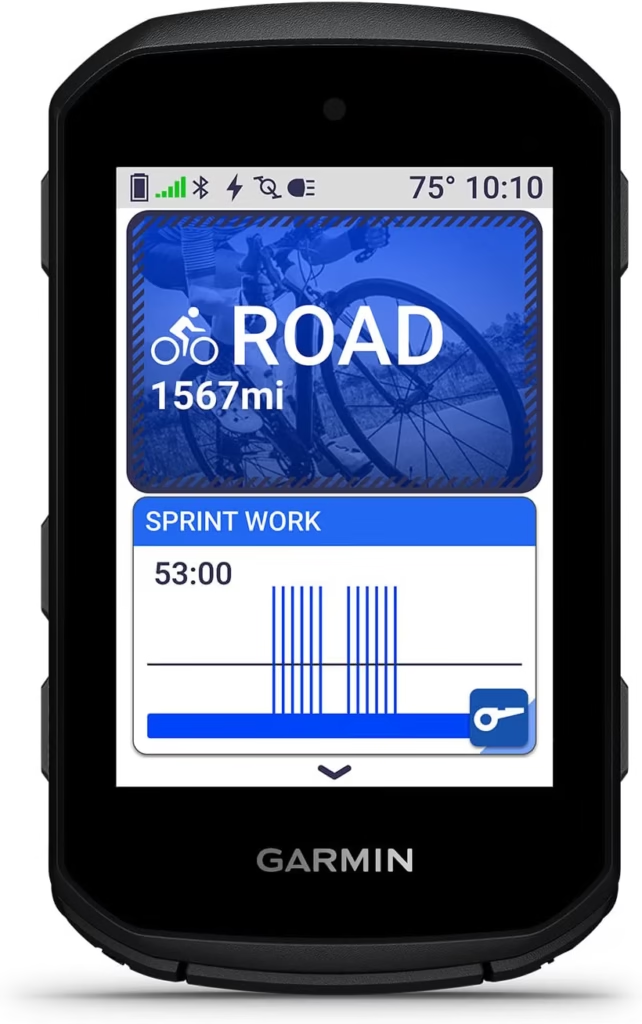
Garmin’s interface has improved considerably, but the Edge 850 is still capable of burying riders in options.
There are activity profiles, data screens, sensor settings, training pages, navigation settings, Connect IQ applications, safety features, workout tools and several different layers of performance analysis.
Anyone coming from a very simple Wahoo or entry-level computer may find the initial setup unnecessarily dense.
The answer is to configure it properly once.
Remove data pages you never look at. Switch off notifications you do not want. Build separate profiles for road, gravel and indoor riding if necessary.
Once that work is done, the Edge 850 becomes much simpler.
The problem is that Garmin still expects the owner to do some of that housekeeping themselves.
Battery life is the Edge 850’s biggest weakness
The major backwards step from the Edge 840 is battery endurance.
Garmin quotes up to 12 hours in demanding use for the Edge 850 and up to 36 hours in battery-saver mode.
The older Edge 840 was rated for up to 26 hours under normal use, while the Solar version could stretch considerably further in the right conditions.
That difference cannot simply be ignored.
The new high-resolution display requires more energy. Garmin has clearly prioritised screen quality and faster hardware over maximum runtime.
For most road cyclists, 12 hours is still enough.
A three-hour club run barely touches the battery. A six-hour sportive is comfortable. Even a very long summer ride should normally finish with capacity remaining.
The concern begins with ultra-distance events, very long audaxes and multi-day riding where charging opportunities are less predictable.
Those riders may actually be better served by keeping an Edge 840, looking at Garmin’s longer-duration options or carrying external power.
This is the clearest reason why the Edge 850 cannot be described as an unconditional upgrade.
It is also heavier than the Edge 840
The other consequence of the redesign is weight.
The Edge 850 weighs 113g, compared with around 85g for the standard Edge 840.
Nobody is losing a race because their bike computer weighs another 28g, but the difference is noticeable when comparing two supposedly compact units.
The 850 is also slightly taller.
It still looks neat on a normal out-front mount and remains substantially less imposing than Garmin’s largest computers, but anyone expecting the old 840 form factor with a better screen should know that the 850 has grown.
For me, the display improvement justifies it.
Not everyone will agree.
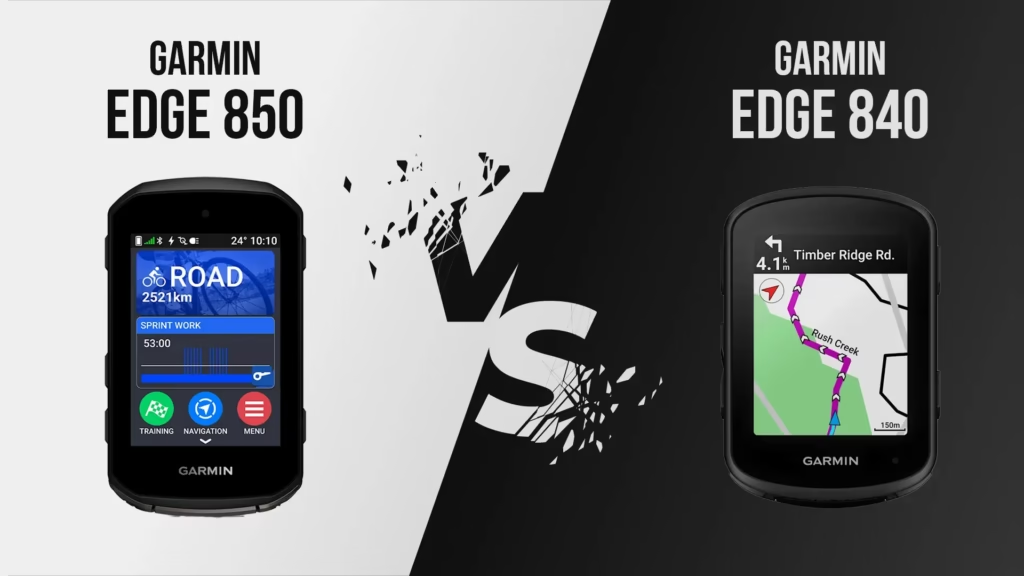
Edge 850 versus Edge 840 Solar
The comparison with the Edge 840 Solar is more complicated than newer automatically meaning better.
The Edge 850 has:
- A much sharper and brighter screen
- Faster map drawing
- 64GB rather than 32GB of storage
- A built-in speaker
- Garmin Pay
- On-device course creation
- Newer training and fuelling functions
- 5Hz GPS support
The Edge 840 Solar has:
- Considerably better battery endurance
- Solar charging
- Lower weight
- A smaller body
- Most of Garmin’s core navigation and training features already present
If I were buying from scratch for normal road riding, I would take the Edge 850.
If I already owned a perfectly functioning Edge 840, particularly the Solar version, the upgrade is much harder to justify.
The 850 is better to look at and more pleasant to use.
It does not make the 840 obsolete.
Edge 850 versus Edge 550
The Edge 550 is arguably the more interesting internal comparison for anyone worried about value.
It shares the same basic generation of hardware, the same 2.7-inch display size and many of the same navigation and training functions.
The difference is that the Edge 550 uses physical buttons only.
It also loses some of the 850-specific extras, including Garmin Pay and on-device course creation.
At £379.99, that represents a saving of around £90.
For riders who rarely touch the screen while moving and are happy to plan routes elsewhere, the 550 may be the more rational purchase.
The touchscreen is what makes the Edge 850 easier to live with, particularly when viewing and moving around maps.
Whether that convenience is worth £90 is a much more useful buying question than simply asking which model has the longer feature list.
Check the current Garmin Edge 850 price and availability on Amazon
The cheaper competition is becoming difficult to ignore
Garmin no longer has the premium cycling-computer market to itself.
The iGPSPORT BiNavi offers a large colour screen, mapping and strong battery life for considerably less money.
The Magene C606 also provides colour navigation, sensor support and a touchscreen at a much lower price.
Go further down and the Magene C506 demonstrates just how much functionality is now available around the £100 mark.
That makes £469.99 harder to dismiss as simply what a good bike computer costs.
You are paying for Garmin’s ecosystem, navigation maturity, training analysis, integration and long-term software support as much as the hardware itself.
For someone who only wants a colour map, speed, heart rate and a Strava upload at the end, there are much cheaper ways to get them.
Who should buy the Garmin Edge 850?
The Edge 850 makes most sense for a rider who will genuinely use both sides of its personality.
That means somebody who trains with heart rate or power but also rides unfamiliar routes.
A rider who wants ClimbPro and structured workouts during the week, then full navigation for a six-hour weekend ride.
A cyclist already using Garmin Connect, Varia radar, Garmin watches or other parts of the ecosystem.
It is particularly well suited to:
- Regular road training
- Racing and structured workouts
- Sportives and gran fondos
- Club riders exploring unfamiliar routes
- Gravel riding
- Riders using power meters
- Anyone wanting serious navigation without an oversized computer
If you are still deciding whether this level of computer is necessary at all, our guide to whether cycling computers are worth it is a better starting point.
Who should look elsewhere?
Ultra-distance riders should consider the battery limitation carefully.
Occasional cyclists probably do not need anything this expensive.
Anyone who primarily records rides and follows simple GPX routes can save hundreds of pounds by choosing one of the increasingly good budget alternatives.
Existing Edge 840 owners should also resist assuming an upgrade is necessary.
The new display is excellent, but the basic cycling experience was already extremely strong on the previous generation.
-
 Photo Credit: Unipublic/Naike Ereñozaga


Garmin Edge 850 pros and cons
Pros
- Excellent high-resolution 2.7-inch display
- Among the best navigation available on a cycling computer
- Fast and accurate multi-band GNSS
- Touchscreen and physical controls
- Deep power and heart-rate training features
- ClimbPro remains excellent
- 64GB storage
- Useful built-in speaker and digital bell
- Garmin Pay and on-device route creation
- Excellent sensor and Varia integration
Cons
- £469.99 is expensive
- Battery life is substantially shorter than the Edge 840 generation
- Heavier than the Edge 840
- Garmin’s menus remain complicated
- Many riders will never use much of the training functionality
- Cheaper rivals now cover the basic navigation experience very well
Verdict: is the Edge 850 Garmin’s best all-round bike computer?
For most serious road cyclists, I think it is.
The Edge 1050 gives you more screen space. Older Garmin models offer longer battery life. The Edge 550 provides much of the same experience for less money.
The Edge 850 is the one that balances those competing priorities most successfully.
The screen is large enough for proper mapping without taking over the handlebars. Navigation is excellent. Training support goes far beyond what most riders will ever exhaust, while physical buttons prevent the touchscreen becoming a liability when the weather deteriorates.
The significant weakness is battery life.
Dropping to 12 hours under demanding use feels like an unusual compromise for a new generation of premium bike computer, particularly when endurance was one of the strengths of the Edge 840.
If your rides regularly extend beyond that territory, it matters.
For everybody else, the Edge 850 is arguably Garmin’s strongest current combination of size, mapping, training and everyday usability.
It is expensive because Garmin knows exactly how difficult it is to leave its ecosystem once everything works together.
Annoyingly for the competition, the Edge 850 gives riders plenty of reason to stay.
Grade: 4.5/5

