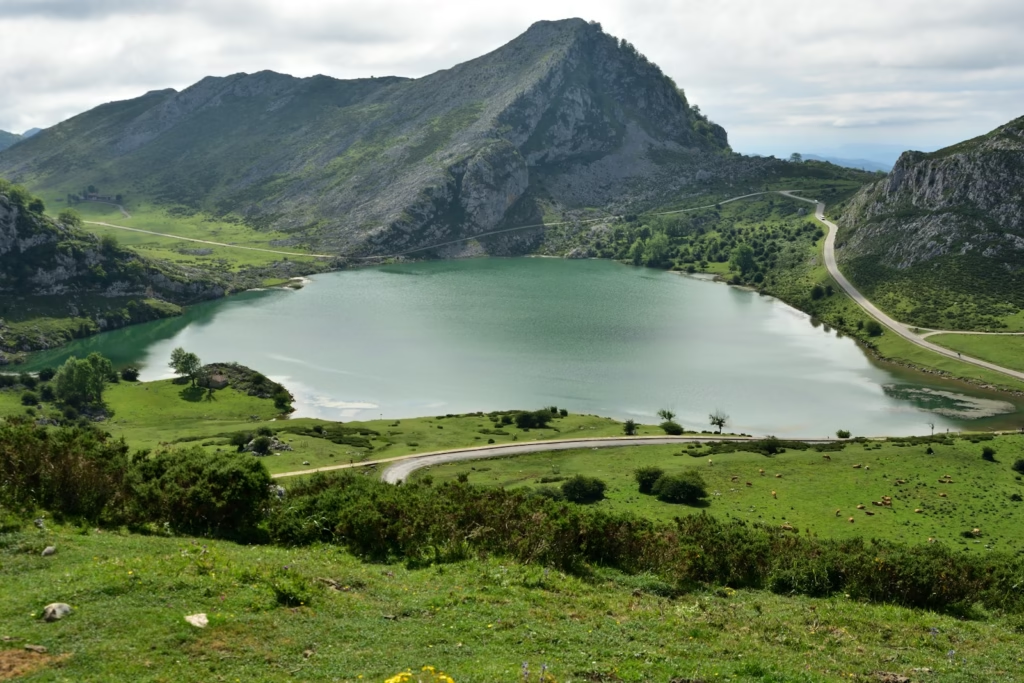
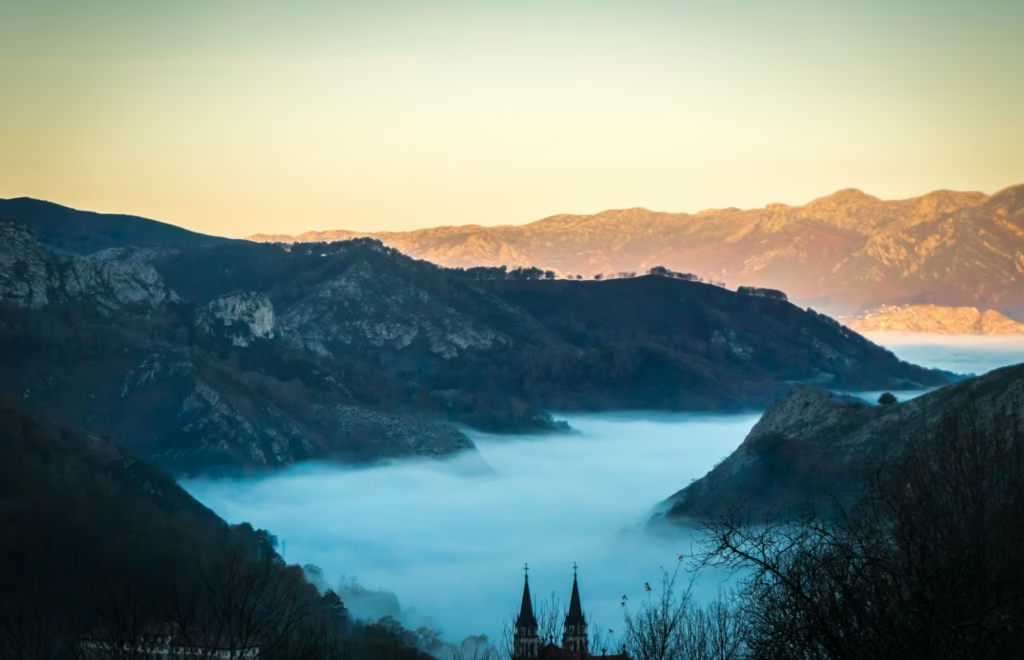
Asturias and Cantabria feel different from the Spain many cyclists first imagine. This is not the dry heat of Andalucía, the wide Pyrenean drama of Catalonia, or the volcanic black roads of the Canaries. This is green Spain: damp stone walls, mist sitting low in the valley, cattle bells in the fields, eucalyptus and chestnut woods, cider poured from height, mountain roads that climb suddenly out of sea-level villages, and the Picos de Europa rising like a wall behind it all.
For a cyclist, the area around Lagos de Covadonga is the natural centre of gravity. The climb is one of the defining roads of the Vuelta a España, but the wider region deserves more than one summit photograph. Base yourself around Cangas de Onís, Arriondas, Ribadesella, Llanes or just over the Cantabrian side near Potes, and the riding opens into a web of valleys, gorges, coastal roads and mountain passes.
It is a place of contrasts. You can begin the morning beside the Sella river, with damp air hanging above the water, climb through Covadonga’s wooded sanctuary road, fight through the brutal ramps towards the lakes, then finish the day eating fabada or cheese-heavy mountain food while clouds gather around the peaks. The roads are beautiful, but they are rarely decorative. They have weight, weather and texture.
For more destination inspiration across Europe and beyond, the wider ProCyclingUK travel section brings together guides to cycling regions where landscape, riding culture and road character shape the experience as much as the climbs themselves.
Why the Lagos de Covadonga area works so well for cycling
The main appeal of this part of northern Spain is density. The coast, the Picos de Europa, river valleys and major climbs sit close together, which means a ride can change character several times in a single morning. You are never just doing one type of cycling.
Around Cangas de Onís and Arriondas, the roads roll through green farmland, orchards and small villages. Head north and you can reach the coast around Ribadesella or Llanes, where the riding becomes brighter, saltier and more open. Turn south or east and the land rises quickly into the Picos, where roads narrow, gradients sharpen and the weather becomes part of the day.
That variety is useful. Lagos de Covadonga is the headline climb, but not every ride has to be a full Vuelta tribute. You can build gentler recovery loops along river roads, ride to the coast for a rolling day, or cross into Cantabria for longer mountain routes around Liébana, Potes and the approaches to San Glorio.
The region also has atmosphere in abundance. Asturias and Cantabria are not polished cycling resorts. The roads feel lived in. You pass tractors, dogs, stone barns, roadside fountains, damp woodland and villages where life seems to move around the weather rather than the clock. That gives the riding a particular kind of honesty. The climbs are famous because of racing, but the place itself feels older and more grounded than the race caravan.
Lagos de Covadonga: the climb that defines the region
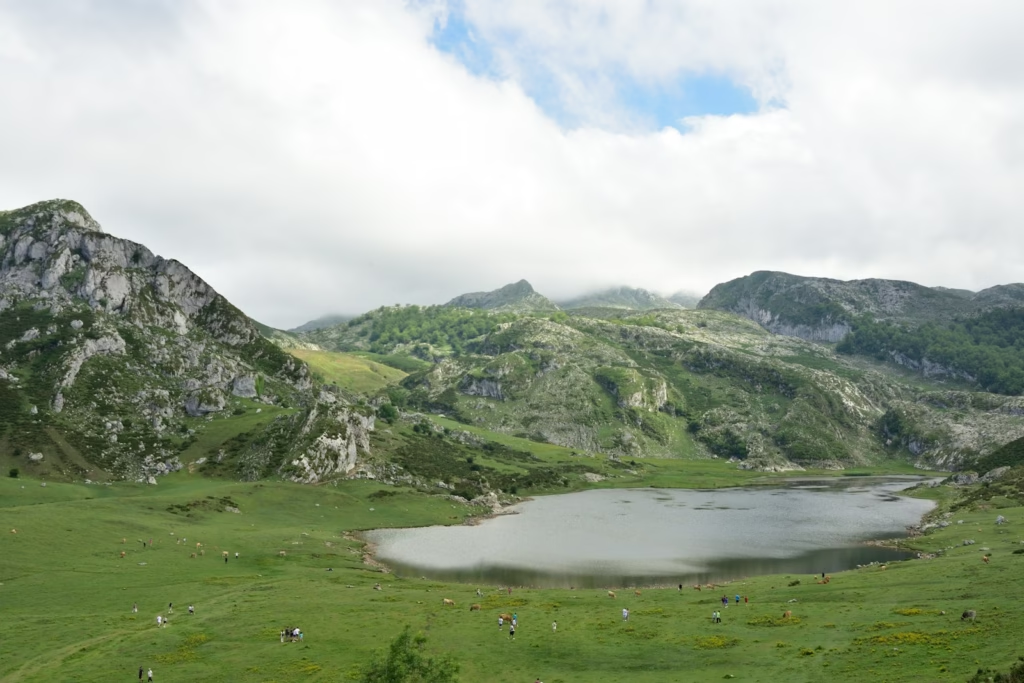
Lagos de Covadonga is the climb everyone comes for, and it deserves that status. From Covadonga itself, the climb is around 12-14km depending on the exact measuring point, with an average gradient just above 7 per cent and long stretches far harder than that number suggests. From Cangas de Onís, the full ride up to the lakes feels much longer, because the approach gradually pulls you towards the sanctuary before the real climbing begins.
The road changes in stages. The first part out of Cangas de Onís is scenic rather than savage, passing through the valley towards Covadonga. There is a sense of anticipation here. The traffic can be noticeable in busy periods, but the surroundings already begin to narrow. Trees close in. The air becomes cooler. The mountains start to look less like scenery and more like a wall.
After Covadonga, the climb reveals itself properly. The famous ramps are not a myth. Sections such as La Huesera bite hard, with gradients that can reach into the teens and force even strong riders into survival mode. The road pitches, eases, turns, opens, then kicks again. It is irregular enough to make rhythm difficult, which is part of why the climb has such a sharp racing identity.
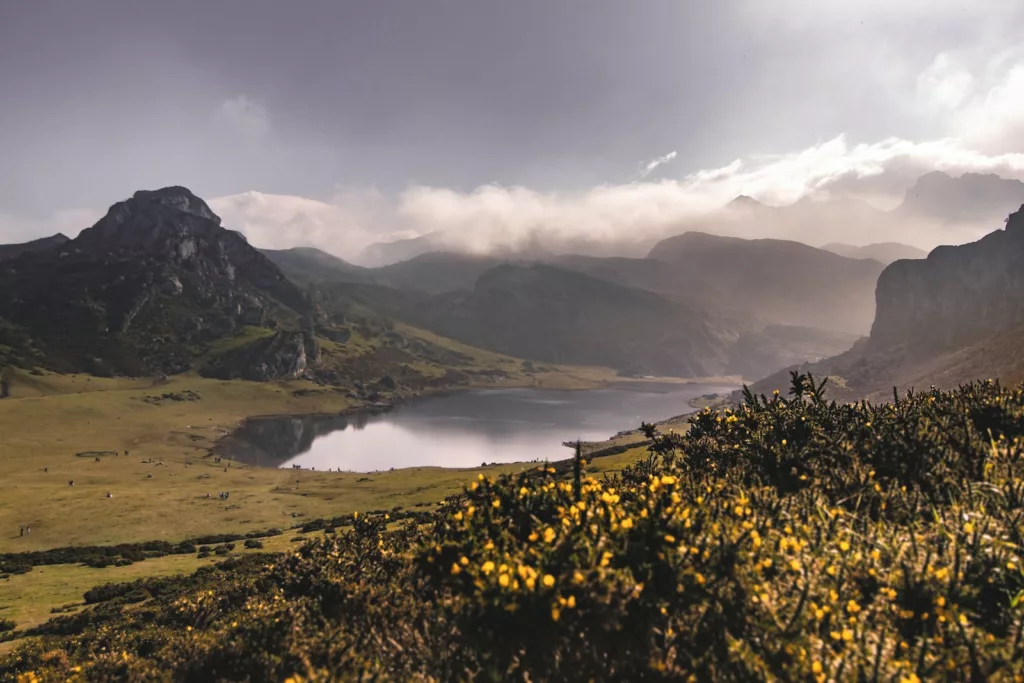
Then comes the upper road, and the effort begins to feel more exposed. The trees thin, the views widen, and the lakes sit high in the landscape like a reward after punishment. On a clear day, the final kilometres are astonishing. On a misty day, they can feel almost otherworldly, with cattle appearing out of cloud and the road disappearing into grey.
Lagos is not just hard. It is theatrical. It has the natural drama of a Grand Tour summit, but also the spiritual weight of Covadonga below and the wildness of the Picos above. That combination is why it stays with riders.
The Vuelta a España history gives Lagos extra weight
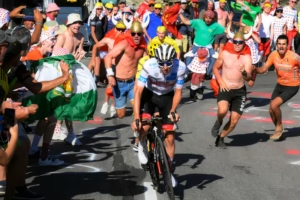
Lagos de Covadonga is one of the Vuelta a España’s great climbs, first used by the race in the 1980s and returning often enough to become part of Spanish cycling’s mountain vocabulary. It is a climb associated with big GC days, sudden collapses and images of riders fighting through mist, rain or thick crowds towards the lakes.
For visiting cyclists, that race history changes the ride. You do not need to be chasing a time to feel it. There is a moment on the steepest ramps where you understand why the climb works on television: the gradient is severe, the road is narrow enough to feel intimate, and the mountain never gives riders a simple way to hide.
The professional context can also be humbling. Watching the Vuelta makes Lagos look dramatic. Riding it makes it feel more complicated. The average gradient does not explain the changes of rhythm. The distance does not explain the psychological effect of the steeper ramps. The profile does not explain how weather can shift the climb from beautiful to bleak in minutes.
That is what makes it a proper cycling landmark. It is not famous because a race used it once. It is famous because it repeatedly produces the kind of effort and uncertainty that stage racing needs.
Mirador del Fito: views, rhythm and the road between coast and mountains
Mirador del Fito is one of the most rewarding climbs near the Lagos area because it gives a different kind of riding experience. It rises between the coast and the interior, linking the greener, lower roads around Arriondas and Colunga with a viewpoint that can look out towards both the Picos de Europa and the Cantabrian Sea.
This is not Lagos in miniature. It is less brutal, more rhythmic and more open in feel. The gradients can still test the legs, especially if ridden hard, but the climb’s appeal is its flow. It allows you to settle, look around, and feel the geography changing beneath you. Sea air, forest, pasture and mountain views all sit close together.
From the top, the view can be spectacular. On a clear day, the coastline appears in one direction and the Picos rise in the other, giving a rare sense of being suspended between two cycling worlds. That is the beauty of Asturias. You can ride a mountain climb without ever feeling fully detached from the ocean.
Fito also works well as part of a loop. From Cangas de Onís or Arriondas, it can be linked with coastal roads, valley roads and gentler sections that make the day feel varied rather than simply punishing. It is the kind of climb that lets you enjoy the region rather than just endure it.
The coastal roads around Ribadesella and Llanes
The coast gives Asturias and eastern Cantabria a completely different cycling rhythm. Around Ribadesella, Llanes and the villages between them, the roads roll rather than climb for long periods, but they are rarely flat in the simple sense. They rise and fall constantly, passing beaches, cliffs, estuaries, old fishing settlements and green fields running almost to the sea.
This is where the region becomes softer, at least briefly. The air smells of salt and wet grass. The light changes with the cloud. Stone houses sit behind hydrangeas, and the sea appears suddenly between hedges or over the top of a rise. On a warm day, it can feel idyllic. On a wet day, it feels properly Atlantic.
For cyclists, the coastal roads are useful as a counterweight to Lagos and the Picos. They give the legs a different kind of work: shorter climbs, rolling effort, constant changes in speed and a more relaxed atmosphere. They are not easy if the wind is up, but they are less mentally severe than the big mountain roads.
A ride from Cangas de Onís or Arriondas towards Ribadesella, then along parts of the coast before looping back inland, makes a superb day. It lets you see why this part of Spain is so distinctive. The mountains are always nearby, but the sea keeps pulling the mood in another direction.
Cantabria and the Liébana valley: Potes, San Glorio and deeper mountain roads
Crossing into Cantabria changes the tone again. The Liébana valley around Potes is one of the most beautiful inland riding areas in northern Spain, enclosed by the Picos and connected by roads that feel more remote than their map distance suggests.
Potes is a natural base for riders who want access to bigger Cantabrian climbs and longer mountain days. The road towards Puerto de San Glorio is one of the obvious tests, a long and sustained ascent that can be extended towards Collado de Llesba for even bigger views. It is a different type of climb from Lagos. Where Lagos is irregular and dramatic, San Glorio is more prolonged, more expansive and more about endurance.
The riding around Potes also has a slower, deeper atmosphere. The valley feels enclosed, but not claustrophobic. The stone villages, mountain shadows and local food give it a strong identity. After a long ride, dishes built around cocido lebaniego, local cheeses and mountain produce feel exactly right. This is food for riders who have spent hours climbing through damp air and cool valleys.
Cantabria’s side roads are often the hidden pleasure. Collado de Ozalba, Collado de Carmona and the roads around Puentenansa can be linked into rolling, green, hard-but-not-extreme rides that show another face of the region. Not every climb needs to be famous. Some of the best days are made from quiet roads where the scenery changes slowly and the traffic barely registers.
The Cares and Cabrales side: dramatic roads without needing a summit finish
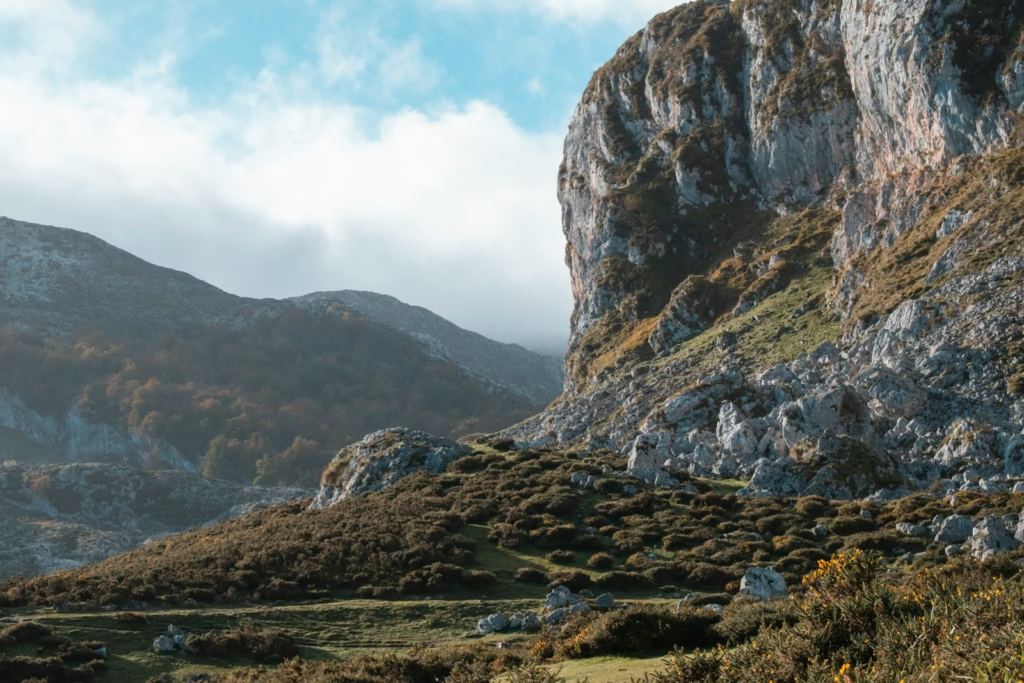
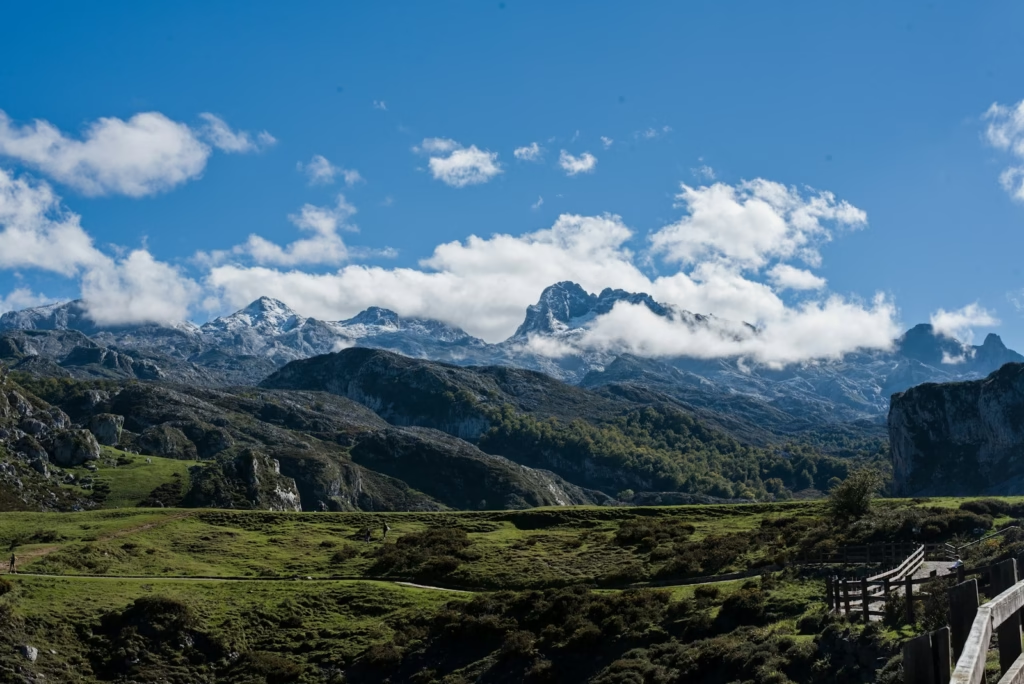
East of Cangas de Onís and south of Llanes, the roads towards Cabrales, Arenas de Cabrales and the Cares gorge area bring another kind of drama. This is Picos country with sharper edges: limestone walls, narrow valleys, mountain rivers and roads that seem to press themselves into the landscape.
The riding here can be stunning, but it needs respect. Some roads are narrow, traffic can appear suddenly, and weather can turn quickly. The reward is a sense of proximity to the mountains that few areas can match. You do not just look at the Picos from a distance. You ride beneath them, through the valleys they create.
A route towards Arenas de Cabrales can be used as a mountainous but not necessarily summit-focused day. The roads rise and fall, the valley closes in, and the effort builds through repetition rather than one headline climb. It is ideal for riders who want atmosphere as much as altitude.
There is also a cultural reward. Cabrales cheese, mountain bars, stone villages and the sound of water running beside the road give the area a distinctive flavour. It is rugged, damp, green and deeply northern. Even without riding all the way to a famous summit, the day feels full.
The roads: green, narrow, beautiful and sometimes unforgiving
The roads in Asturias and Cantabria are part of the experience. They are often beautiful, but not always easy. Surfaces vary. Main roads can be smooth and fast, while smaller lanes may be rougher, damp under trees or narrowed by stone walls and vegetation. Descents require attention, especially after rain.
That is one reason the region rewards confident handling. The gradients are only one part of the difficulty. The real challenge is the whole package: steep ramps, changing surfaces, wet corners, livestock, tourist traffic near Covadonga, and weather that can shift from warm sun to low cloud in the space of one climb.
Cyclists used to dry alpine roads may need a day to adjust. Braking points can change in the wet. The shade under trees can keep sections damp long after the rain has stopped. Cattle grids and animals are not unusual in higher areas. None of this should put riders off, but it does require a different mindset.
The reward is that the roads feel alive. They are not sterile training strips. They belong to the villages, farms, valleys and mountains around them. Riding here is not just about collecting climbs. It is about moving through a landscape that is still very much itself.
The atmosphere: cider, mist, cowbells and mountain weather
Asturias and Cantabria have a particular emotional texture. They are green because they are wet. They are dramatic because the mountains rise so quickly from the sea. They are welcoming, but not polished in the way some resort cycling areas can be.
In Asturias, cider culture is part of the landscape. Sidrerías, local food, the smell of grilled meat, fabada, seafood and cheese give the towns a strong post-ride identity. In Cantabria, mountain stews, local cheeses and the slower rhythm of inland valleys shape the experience differently. Both regions feel generous after a hard ride.
The weather gives the riding much of its character. Mist can soften the mountains in the morning. Rain can make a climb feel severe. A sudden clearing can reveal views that were hidden minutes earlier. The best days here often have movement in them: cloud lifting off the Picos, sunlight breaking across wet fields, wind coming off the sea, the smell of damp leaves rising from the road.
That makes the region memorable. Some cycling destinations are built around perfect blue-sky days. Asturias and Cantabria are built around atmosphere. The conditions are part of the story, not an interruption to it.
When to ride in Asturias and Cantabria
The best time to ride the Lagos de Covadonga area is usually late spring through early autumn. May, June, September and early October can be particularly good, with milder temperatures, green landscapes and less intense summer tourist traffic.
July and August bring warmer weather and longer days, but they also bring more visitors, especially around Covadonga, the lakes and the coast. Access to Lagos de Covadonga can be restricted for private vehicles during busy periods, with shuttle arrangements often used for general visitors, so cyclists should always check the current access rules before planning a ride to the lakes.
Rain is possible in any month. That is not a minor detail. It shapes clothing, descending confidence and route choice. Even in summer, riders should carry a lightweight waterproof or gilet if climbing into the Picos. The weather at the lakes or on high Cantabrian roads can feel very different from the valley below.
Winter riding is possible on lower roads, but the bigger climbs and mountain weather become more unpredictable. For a first cycling trip to the region, late spring or early autumn gives the best balance of road access, atmosphere and manageable conditions.
Where to base yourself
Cangas de Onís is the most practical base for Lagos de Covadonga. It has accommodation, food, bike-friendly services and direct access to the road towards Covadonga. It also works well for routes towards Arriondas, Ribadesella, Mirador del Fito and the eastern Picos.
Arriondas is slightly more river-focused and useful for riders who want access to both the Sella valley and the roads towards the coast. Ribadesella and Llanes are better for riders who want to mix coastal riding with inland climbs, though Lagos becomes a longer day from either.
On the Cantabrian side, Potes is the obvious base. It is beautiful, atmospheric and surrounded by mountain roads. It works especially well for riders who want San Glorio, the Liébana valley, Fuente Dé and quieter Cantabrian climbs.
A two-base trip can work brilliantly: a few days around Cangas de Onís for Lagos, Fito and the Asturian coast, then a few days around Potes for Cantabria’s deeper mountain roads. That gives the region room to breathe and avoids reducing the whole trip to one famous climb.


Practical information
Location
The Lagos de Covadonga area sits in eastern Asturias, close to Cangas de Onís and the Picos de Europa. Cantabria lies just to the east, with Potes and the Liébana valley forming one of the best inland cycling bases.
The nearest useful airports are Asturias Airport for the western side, Santander for Cantabria and Bilbao for a wider range of international connections. A car is helpful for a cycling trip because it makes transfers between bases, villages and route starts much easier.
Riding
The riding is hilly to mountainous. Lagos de Covadonga is the headline climb, but Mirador del Fito, the Cabrales roads, Potes, San Glorio, Collado de Carmona and the coastal rollers all add variety.
Compact gearing is strongly recommended. Even if the average gradients look manageable, the steep ramps on Lagos and the repeated climbing elsewhere make low gears valuable. Good tyres and confident descending skills also matter because roads can be damp, shaded or uneven.
When to go
May, June, September and early October are usually the most attractive months for road cycling. July and August are warmer and busier, especially around Covadonga and the coast.
Weather can change quickly. Carry layers, check mountain forecasts and do not assume that conditions in Cangas de Onís or Potes will match conditions at the top of a climb.
Accommodation
Cangas de Onís is the best all-round base for Lagos de Covadonga. Potes is ideal for the Cantabrian side and longer mountain rides. Ribadesella or Llanes work well for riders who want a coastal base with access to inland climbs.
Look for accommodation with secure bike storage, flexible breakfast and space to dry kit. This is a green, wet region, and the ability to dry shoes, gloves and jackets can make a big difference on a multi-day trip.
Why Asturias and Cantabria deserve a place on your riding list
Asturias and Cantabria deserve a place on a cyclist’s riding list because they offer something deeper than a catalogue of climbs. Lagos de Covadonga is reason enough to go, but it is not the whole story. The wider region gives you coastal roads, green valleys, hidden passes, mountain villages, Vuelta history, rough weather and food that feels made for tired legs.
The riding is not always easy. The roads can be steep, damp and narrow. The weather can change without warning. The climbs ask for patience, and the descents ask for respect. But that is what gives the region its force. Nothing feels flattened or simplified for visiting cyclists.
The best days here stay in the memory through detail: the sound of cowbells above Covadonga, the smell of wet woodland on the lower slopes, the first view of the lakes through mist, the sea flashing below Mirador del Fito, the heavy quiet of the Liébana valley, the taste of cider or stew after a cold descent.
Lagos de Covadonga may be the name that brings riders here, but Asturias and Cantabria are what make them want to stay. Together they form one of northern Spain’s great cycling landscapes: green, severe, generous, unpredictable and full of roads that feel like they have been waiting for the bike.