

The Tour de France Femmes 2026 runs from Saturday 1 August to Sunday 9 August 2026, with nine consecutive stages from Lausanne in Switzerland to Nice in the south of France. There is no rest day in the 2026 race, which means riders face a compact and demanding nine-day block that includes flat stages, hilly stages, a 21km individual time trial, Mont Ventoux and a final mountain stage around Nice.
The fifth modern edition of the race covers 1,175km, making it the longest Tour de France Femmes route so far. It starts with a Swiss Grand Départ, enters France on stage 3, and then works south through Burgundy, the Rhône corridor, Mont Ventoux and the Côte d’Azur. For a fuller stage-by-stage breakdown, see our Tour de France Femmes 2026 route guide.

Quick answer: when is the Tour de France Femmes 2026?
| Detail | Tour de France Femmes 2026 |
|---|---|
| Race dates | Saturday 1 August to Sunday 9 August 2026 |
| Number of stages | 9 |
| Rest days | None |
| Total distance | 1,175km |
| Start | Lausanne, Switzerland |
| Finish | Nice, France |
| Countries visited | Switzerland and France |
| Stage types | 3 flat, 3 hilly, 2 mountain, 1 individual time trial |
| Time trial | Stage 4, Gevrey-Chambertin to Dijon, 21km |
| Biggest mountain finish | Stage 7, Mont Ventoux |
| Final stage | Nice to Nice, 99km |
Full Tour de France Femmes 2026 stage calendar
| Stage | Date | Route | Distance | Stage type |
|---|---|---|---|---|
| 1 | Saturday 1 August | Lausanne to Lausanne | 137km | Flat |
| 2 | Sunday 2 August | Aigle to Genève | 149km | Flat |
| 3 | Monday 3 August | Genève to Poligny | 157km | Hilly |
| 4 | Tuesday 4 August | Gevrey-Chambertin to Dijon | 21km | Individual time trial |
| 5 | Wednesday 5 August | Mâcon to Belleville-en-Beaujolais | 140km | Hilly |
| 6 | Thursday 6 August | Montbrison to Tournon-sur-Rhône | 153km | Hilly |
| 7 | Friday 7 August | La Voulte-sur-Rhône to Mont Ventoux | 144km | Mountain |
| 8 | Saturday 8 August | Sisteron to Nice | 175km | Flat |
| 9 | Sunday 9 August | Nice to Nice | 99km | Mountain |
 Photo Credit: A.S.O./Pauline Ballet
Are there rest days in the Tour de France Femmes 2026?
There are no rest days in the Tour de France Femmes 2026.
That is one of the key differences between the women’s Tour and the men’s Tour de France. The men’s race runs for three weeks and includes scheduled rest days. The Tour de France Femmes is shorter, but it is also more compressed. Every mistake carries weight because there is no full day to reset.
For the riders, that changes the rhythm of the race. Recovery has to happen overnight, on transfers, in hotels and on the bike itself. Teams cannot simply aim to survive one block and then rebuild on a rest day. They need to manage energy from the opening weekend in Switzerland all the way to the final mountain stage in Nice.
For more detail on the race format, see our guide to how long the Tour de France Femmes 2026 is.
Opening weekend: Switzerland gives the race a fast start
The 2026 race begins with two stages in Switzerland. Stage 1 starts and finishes in Lausanne, giving the race a proper city-based Grand Départ before stage 2 runs from Aigle to Genève.
On paper, both opening stages are listed as flat. In practice, the Swiss terrain should make the start more selective than a simple sprint parade. Lausanne’s road layout, changes in elevation and positioning battles will all matter, especially with the yellow jersey available from day one.
Stage 2 from Aigle to Genève gives the sprinters another likely chance, but it also brings another nervous day. Early Tour stages are rarely calm. Teams want to protect leaders, sprinters want control, breakaway riders want television time and GC riders want to avoid the kind of crash or split that can ruin a race before it has properly started.
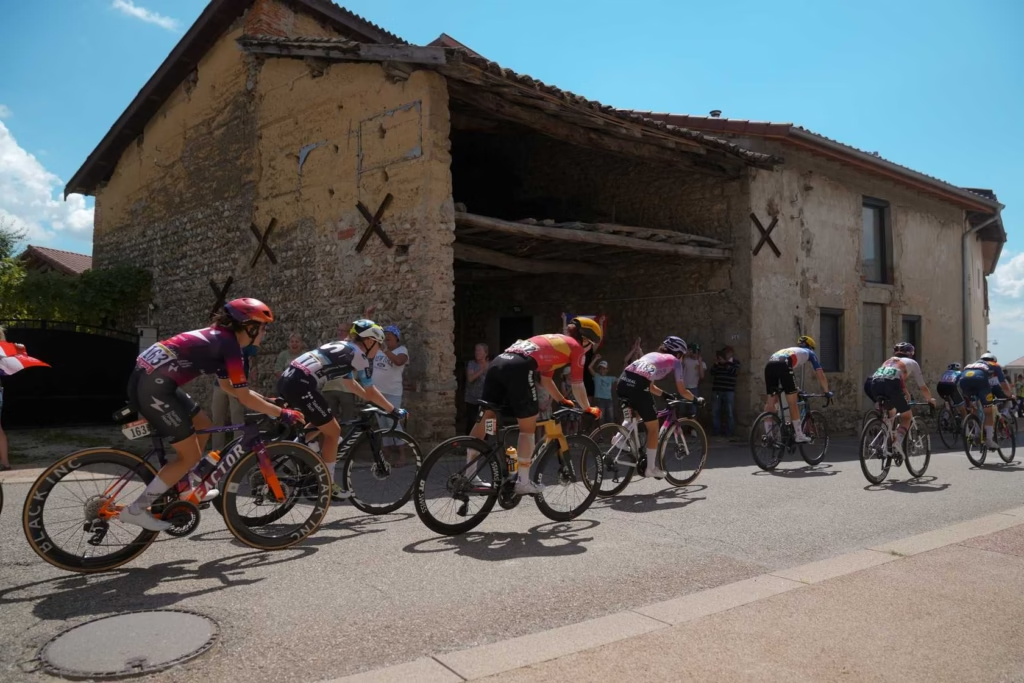 Photo Credit: A.S.O./Thomas Maheux
Stage 3 takes the race into France
Stage 3 moves from Genève to Poligny and brings the race into France. It is the first hilly stage of the 2026 Tour de France Femmes and could be one of the first days where the general classification starts to stretch.
This is the type of stage that can produce several races at once. Breakaway riders will see an opportunity. Punchier riders will look at the finish and sense a chance. GC teams will need to decide whether to conserve energy or take control early.
It may not be the decisive day of the Tour, but it should start to show which teams are comfortable managing a varied route.
Stage 4: Dijon time trial creates the first major GC checkpoint
The 21km individual time trial from Gevrey-Chambertin to Dijon is the first obvious general classification test of the race.
A mid-race time trial changes the logic of the whole route. Climbers cannot simply wait for Mont Ventoux. They may need to limit their losses against stronger time-triallists before the road rises again. Likewise, riders who are strong against the clock have a clear chance to build a buffer before the final mountain stages.
The distance is long enough to matter, but short enough to keep the race open. That makes stage 4 one of the most important days on the calendar.
 Photo Credit: A.S.O./Pauline Ballet
Stages 5 and 6 build pressure before Mont Ventoux
After the time trial, the race does not immediately calm down. Stage 5 from Mâcon to Belleville-en-Beaujolais and stage 6 from Montbrison to Tournon-sur-Rhône are both hilly stages. These are exactly the kind of days where fatigue begins to become visible.
The Tour will be past halfway by this point, but the hardest climbing will still be ahead. That creates a tactical tension. Some GC teams may want to ride defensively and keep their leaders fresh for Ventoux. Stage hunters, meanwhile, will sense a valuable window before the race turns sharply towards the high mountains.
Stage 6 could be particularly open. It comes one day before Mont Ventoux, which may make the main favourites cautious. That often gives attackers more room.
Stage 7: Mont Ventoux is the queen stage
Stage 7 from La Voulte-sur-Rhône to Mont Ventoux is the queen stage of the 2026 Tour de France Femmes.
This is the day that will dominate much of the pre-race conversation. Ventoux is not just a famous climb. It is a climb with its own mythology, and its place in the 2026 route gives the women’s Tour a major summit finish with instant recognition.
The GC riders will not be able to hide. The time trial will already have created gaps, the hilly stages will have drained energy, and the final climb will demand sustained power, pacing and nerve. Pure climbers who have lost time in Dijon may have to attack. Stronger all-rounders will need to defend under pressure.
The race may not be completely decided on Ventoux, but it should reveal the strongest riders in the field.
Stage 8: the longest stage comes after Ventoux
Stage 8 from Sisteron to Nice is listed as flat, but its position makes it far more complicated than that.
At 175km, it is the longest stage of the race. It also comes the day after Mont Ventoux. That combination could make it difficult for sprint teams to control, especially if their lead-out riders and domestiques have been emptied by the mountains.
The stage may still finish in a sprint, but it has classic late-race danger written through it. A strong breakaway could take advantage of tired legs, while GC teams may be reluctant to spend too much energy before the final day.

Stage 9: Nice hosts the final mountain showdown
The Tour de France Femmes 2026 ends with a 99km mountain stage from Nice to Nice.
That is a sharp final-day design. It is short, mountainous and placed after eight consecutive days of racing. By that point, there will be nowhere left to save energy. Riders who still need time will have to attack. Riders defending the yellow jersey will need team-mates, discipline and calm.
A final stage around Nice also gives the race a very different ending from a ceremonial finish. The 2026 Tour de France Femmes should remain competitive all the way to the final day.
Why the 2026 calendar matters
The 2026 Tour de France Femmes calendar is important because it gives the race a clear structure.
The opening weekend in Switzerland should create early tension. Stage 3 starts the transition into harder terrain. Stage 4 gives the time-triallists a major opportunity. Stages 5 and 6 keep the pressure high before Mont Ventoux. Stage 7 is the headline mountain stage. Stage 8 adds distance and fatigue. Stage 9 gives the race a final mountain test rather than a procession.
That balance makes the 2026 edition feel complete. It is not simply a race waiting for one climb. It asks different questions across nine days, with no rest day to soften the impact.
For newer viewers, our beginner’s guide to Tour de France Femmes 2026 explains the race format, jerseys and key storylines. UK viewers can also use our guide on how to watch Tour de France Femmes 2026 in the UK to plan around the main GC days.
-
 Photo Credit: Luc Claessen/Getty Images
 -
 Photo Credit: Telenet Superprestige
 -
 Photo Credit: Nieuwsblad



Tour de France Femmes 2026 FAQs
When does the Tour de France Femmes 2026 start?
The Tour de France Femmes 2026 starts on Saturday 1 August 2026 in Lausanne, Switzerland.
When does the Tour de France Femmes 2026 finish?
The race finishes on Sunday 9 August 2026 in Nice, France.
How many stages are there?
There are nine stages in the 2026 Tour de France Femmes.
Does the Tour de France Femmes 2026 have a rest day?
No. The 2026 race has no rest day. It runs for nine consecutive days from Saturday 1 August to Sunday 9 August.
What is the time trial stage?
Stage 4 is a 21km individual time trial from Gevrey-Chambertin to Dijon on Tuesday 4 August.
What is the queen stage?
Stage 7 from La Voulte-sur-Rhône to Mont Ventoux is the queen stage and the main summit finish of the race.
What is the longest stage?
Stage 8 from Sisteron to Nice is the longest stage at 175km.
Where does the race finish?
The race finishes in Nice with a 99km mountain stage starting and finishing in the city.

