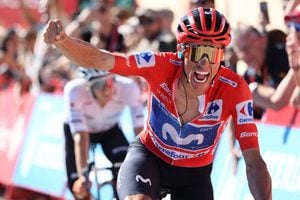
Mauro Schmid won stage 13 of the 2026 Tour de France in Belfort, beating Harold Tejada in a two-up sprint after a huge breakaway dominated the longest stage of this year’s race. The Jayco AlUla rider timed his finish better than Tejada after the pair had attacked from the reduced lead group inside the final 20 kilometres.
Tom Pidcock finished third at 2 seconds, having been one of the strongest riders on the Ballon d’Alsace and the biggest general classification mover of the day. Maxim Van Gils was fourth for Red Bull-Bora-Hansgrohe, with Brandon McNulty fifth for UAE Team Emirates-XRG.
The peloton finished 7:32 down after Bahrain Victorious, Red Bull-Bora-Hansgrohe and Lidl-Trek worked to limit the damage. Pidcock still climbed to fourth overall, 4:15 behind Tadej Pogačar, turning a breakaway stage into a major GC gain even without taking the win.
A breakaway day with GC consequences
Stage 13 from Dole to Belfort was the longest stage of the 2026 Tour de France at 205.8 kilometres, but it was also unusually shaped. The first 150 kilometres were mostly flat, while the decisive climbing came late through the Col des Croix and the category 1 Ballon d’Alsace.
That made the stage ideal for a large breakaway, but not a simple one. Riders needed the engine to survive a high-speed start, the climbing ability to stay in contention on the Ballon d’Alsace, and the tactical sharpness to finish the job in Belfort.
The day began with 171 riders after three non-starters following the previous day’s crash in Chalon-sur-Saône: Fernando Gaviria, Jenno Berckmoes and Frits Biesterbos. Gaviria’s withdrawal was the most notable after he broke his collarbone in the sprint crash on stage 12.
Pogačar began the day still in yellow, with Jonas Vingegaard second at 3:36 and Remco Evenepoel third at 4:06. On paper, the stage was not expected to create a direct GC fight between the biggest names, but Pidcock’s presence in the break changed that calculation completely.
A fierce fight to make the move
The race began at full speed. Simone Velasco was the first rider to attack, and he was soon followed by a wave of moves involving some of the peloton’s strongest rouleurs and stage hunters.
Kasper Asgreen, Michal Kwiatkowski, Louis Vervaeke, Georg Zimmermann and Alex Kirsch formed an early five-rider move, but they were never given much room. Behind them, the attacks kept coming. Mads Pedersen tried repeatedly, Julian Alaphilippe was active, Jonas Abrahamsen moved, and UAE Team Emirates-XRG used Nils Politt and Florian Vermeersch to mark dangerous counters.
That early control from UAE made sense. A small, harmless break would have given Pogačar’s team an easier day. Instead, so many teams wanted the move that the peloton kept splitting, regrouping and splitting again.
After around 27 kilometres, the early attackers were caught. Ben Healy countered, with Romain Grégoire and Kévin Vauquelin among those responding. Then a much larger group began to form, and suddenly the stage had its defining move.
A giant break takes shape
The first major selection contained 37 riders, including Pidcock, McNulty, Healy, Schmid, Philipsen, Vauquelin, Van Gils, Mohorič, Wellens, Grégoire, Alaphilippe and Jordan Jegat. It was a breakaway full of stage winners, rouleurs, puncheurs and climbers, but also a move that immediately created tactical problems behind.
Lidl-Trek had missed it with Pedersen, while Alpecin-Premier Tech had Jasper Philipsen in the move. That mattered because the intermediate sprint in Mélisey still offered points, and Philipsen had a chance to take a serious bite out of Pedersen’s green jersey lead.
Lidl-Trek tried to chase, but the gap grew to around 30 seconds and then a minute. Pedersen was briefly trapped behind, then attacked again as another chase group formed. That second group included Pedersen, Biniam Girmay, Ben O’Connor, Asgreen, Josh Tarling, Michael Matthews, Luke Plapp, Magnus Cort, Abrahamsen and others.
After a long chase, the two groups eventually came together with just over 90 kilometres remaining, creating a massive front group of 57 riders. More than a third of the peloton was now ahead of the bunch.
Philipsen wins the intermediate sprint
With the groups merged, the first major contest was the intermediate sprint in Mélisey. Pedersen, Girmay and Philipsen were all present, making it a direct green jersey confrontation inside the breakaway rather than in the peloton.
Philipsen was led out well by his Alpecin-Premier Tech teammate Edward Planckaert and won the sprint, taking 25 points. Pedersen was second for 20 points, with Girmay third for 16. That tightened the points classification, although Pedersen still retained control of the green jersey.
The updated situation after the sprint had Pedersen on 377 points, Philipsen on 336 and Girmay on 333. Merlier, absent from the break, lost ground in a competition that has increasingly favoured riders able to survive harder terrain as well as contest bunch finishes.
The sprint also underlined the weird nature of the stage. It was not a sprint day, yet three of the biggest fast men in the race were at the front. It was not an obvious GC day, yet Pidcock was moving virtually past several riders in the overall standings. It was not a normal mountain day, yet the Ballon d’Alsace was waiting to reduce the giant escape.
Pidcock becomes the GC threat
Once the gap to the peloton reached around 7 minutes, Pidcock became the central problem for the bunch. He had started the day 10th overall, 11:49 behind Pogačar, but more importantly he was close enough to threaten the riders between third and ninth.
Bahrain Victorious began to work in defence of Lenny Martinez’s ninth place. Red Bull-Bora-Hansgrohe also had reason to limit the gap, with Evenepoel and Lipowitz protecting podium and top-six positions. Lidl-Trek were later involved too, with Ayuso and Skjelmose needing to avoid unnecessary losses.
The yellow jersey itself was not under serious threat. Even with the break more than 8 minutes ahead, Pogačar had enough of a cushion. But Pidcock’s move was reshaping the top 10, and at one stage he was virtually on the podium.
That gave the stage a double race. At the front, 57 riders were fighting for a stage win. Behind, several GC teams were trying to stop Pidcock climbing too far.
Pinarello-Q36.5 work for Pidcock
As the route finally began to climb, Pinarello-Q36.5 took responsibility at the front of the break. Xandro Meurisse and Quinten Hermans worked for Pidcock on the Col des Croix, a 5.1-kilometre category 3 climb at 4.8 per cent.
The pace immediately thinned the lead group. Fred Wright, Tom Van Asbroeck, Thibault Guernalec, John Degenkolb, Josh Tarling and Alaphilippe were among those distanced as the break began to split under pressure.
Healy attacked near the summit, but Hermans controlled the move and then took the 2 KOM points over the top, with Pidcock taking the remaining point. That kept the group together enough for the bigger battle still to come.
Behind, the peloton was still more than 7:30 back, with Bahrain Victorious controlling and the gap threatening to put Pidcock into a much stronger GC position.
Ballon d’Alsace breaks the break
The Ballon d’Alsace was the decisive climb. At 8.9 kilometres at 6.9 per cent, it was long and hard enough to strip the massive break down to its strongest climbers and punchers. It also carried historical weight as the first major mountain pass ever climbed in the Tour de France, back in 1905.
Rick Pluimers accelerated at the bottom, but the serious moves came as the climb settled in. Vauquelin lifted the pace, Jegat attacked, and Pidcock was forced to respond. Marc Hirschi briefly went clear, then Lars Craps opened a gap, with Nicolas Breuillard and Hirschi chasing.
Jayco AlUla had numbers, with Ben O’Connor, Plapp and Schmid in the front group. Their strength gave them options, while UAE also had Wellens and McNulty. Red Bull had Van Gils, Netcompany INEOS had Vauquelin, and TotalEnergies had Jegat and Braz Afonso.
Healy was dropped, while Mohorič, Ion Izagirre, Bennett, O’Connor and Wellens also lost contact at different points. The front became more selective with every acceleration.
Pidcock takes the summit points
Van Gils made one of the sharpest attacks on the Ballon d’Alsace, opening a gap with his trademark punch. Pidcock dragged a small group back to him, with Jegat, Vauquelin, Braz Afonso and others still in contention.
Plapp then attacked, forcing another response. By the final kilometre of the climb, the strongest riders were grouped together: Pidcock, Plapp, Schmid, McNulty, Van Gils, Vauquelin, Tejada, Jegat and Braz Afonso. Wellens was chasing behind.
Pidcock accelerated near the top, was brought back, then went again to take the KOM points at the summit. He earned 10 points for first over the Ballon d’Alsace and was later named the most combative rider of the day.
But the summit was only part of the stage. The finish in Belfort still lay around 30 kilometres away, and the descent was not technical enough for Pidcock to turn his handling into a decisive gap. That left a tactical finale between several riders with different strengths and teammates.
Schmid and Tejada make the winning move
By the descent, 10 riders had come together at the front: Pidcock, Plapp, Schmid, McNulty, Wellens, Vauquelin, Tejada, Van Gils, Jegat and Braz Afonso. The Matthews group, including riders who had been distanced on the climb, hovered around 30 seconds behind.
With Jayco AlUla holding Schmid and Plapp in the lead group, and Matthews chasing behind, the Australian team had options. UAE had McNulty and Wellens. Everyone knew that waiting could bring more riders back, but nobody wanted to tow Pidcock or Van Gils into the finish either.
Wellens attacked first as the road flattened after the descent, but the group came back together. Then, with around 16 kilometres to go, Schmid and Tejada made the move that mattered.
The pair quickly opened 10 seconds. Behind them, hesitation took over. Riders looked at one another, attacks came and went, but no organised chase formed. With 10 kilometres remaining, Schmid and Tejada still had 10 seconds. By 6.5 kilometres, the gap was up to 20.
That was the race-winning moment. The chasing group had enough strength, but not enough unity.
Schmid edges Tejada in Belfort
Inside the final kilometres, the leading pair began to think about the sprint. Tejada led under the flamme rouge, while Schmid stopped contributing and prepared for the finish.
The run-in through Belfort was not overly technical, but there was one important 90-degree right-hand turn around 420 metres from the line before a short final straight. That made positioning critical for the two leaders.
Tejada opened the sprint and looked briefly as though he might hold it. Schmid, though, fought back and edged past him on the line to take the stage. It was a narrow victory, but a deserved one after Jayco AlUla had been present and active throughout the decisive final hour.
Pidcock won the sprint for third, 2 seconds behind, ahead of Van Gils and McNulty. Vauquelin, Jegat, Braz Afonso and Wellens followed, with Plapp 10th at 11 seconds.
For Schmid, it was a first Tour de France stage win and a breakthrough moment for Jayco AlUla in this race. For Tejada and XDS Astana, it was agonisingly close, but still a major result after a day when the breakaway riders finally got the freedom they had been searching for.
Pidcock gains without winning
Pidcock did not win the stage, but he may still have been the day’s biggest overall winner. His third place, time gain and position in the break lifted him to fourth overall, 4:15 behind Pogačar.
That changes the shape of his Tour. He had repeatedly said that stage wins were the main target, but also that he would see what was possible on GC. By taking the breakaway chance and forcing other teams to chase, he moved himself from the edge of the top 10 into the podium conversation.
It was not a free gift. Pidcock had to survive a brutal 205.8-kilometre stage, fight through the fastest first half of the race, use his teammates on the Col des Croix, then respond repeatedly on the Ballon d’Alsace. He also took the mountain points at the summit and the combativity award.
The frustration is that he was not in the winning move. When Schmid and Tejada went, the chase group had the firepower to bring them back, but no rider wanted to be the one to do the work for everyone else. Pidcock had to settle for third, but his GC leap made the day worthwhile.
GC teams limit the damage
The peloton eventually finished 7:32 behind Schmid, with Bahrain Victorious, Red Bull-Bora-Hansgrohe and Lidl-Trek among the teams doing the late damage control.
Bahrain Victorious had worked because Martinez was under pressure from Pidcock’s presence up the road. Red Bull-Bora-Hansgrohe had podium interests through Evenepoel and Lipowitz. Lidl-Trek had Ayuso and Skjelmose to protect, especially once Pidcock became a realistic threat to several riders ahead of him.
Pogačar remained safely in yellow. The stage was never really about his lead, because Pidcock had started too far back to put the maillot jaune in danger. But it was about the shape behind him, and that changed significantly.
Pidcock’s move to fourth means the fight for the podium now has another serious rider involved. Evenepoel, Vingegaard, Ayuso, Lipowitz, Skjelmose and Seixas will all have to account for him in the days ahead.
A breakaway finally gets its reward
This was the kind of stage many teams had been waiting for. After several days where sprint teams or UAE’s control had kept breaks on a short leash, stage 13 finally allowed the attackers to go all the way.
The scale of the break made it almost impossible to control once it formed. There were stage winners, classics riders, climbers, sprinters, GC outsiders, team classification interests and green jersey contenders all in the same moving race. That made the first 100 kilometres furious and the final 50 genuinely tactical.
Philipsen used it to take points. Pedersen defended green from the front. Pidcock used it to jump GC places. Jayco AlUla used it perfectly, first by placing numbers in the move, then by playing Schmid at the right moment.
Schmid’s win was not just about sprinting faster than Tejada. It was about being in the right group, surviving the Ballon d’Alsace, recognising the hesitation behind and committing at exactly the right time.
After the sprinters had their run and Pogačar had dominated the Massif Central, the breakaway got its day in Belfort.
Tour de France 2026 stage 13 result
Results powered by FirstCycling.com
Main photo credit: ASO