
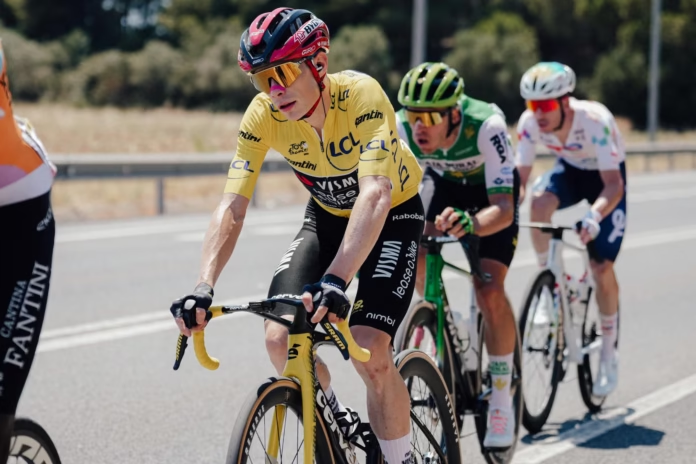
Tour de France stage 13 takes place on Friday 17 July, with a 205.8km route from Dole to Belfort that should produce one of the most aggressive breakaway battles of the race.
UK television coverage begins at 11:45 BST, with the riders scheduled to leave Dole in the neutralised start at 12:00 BST.
The stage is expected to finish in Belfort at approximately 16:46 BST, although the official range extends to around 17:12 BST if the race follows the slowest timetable.
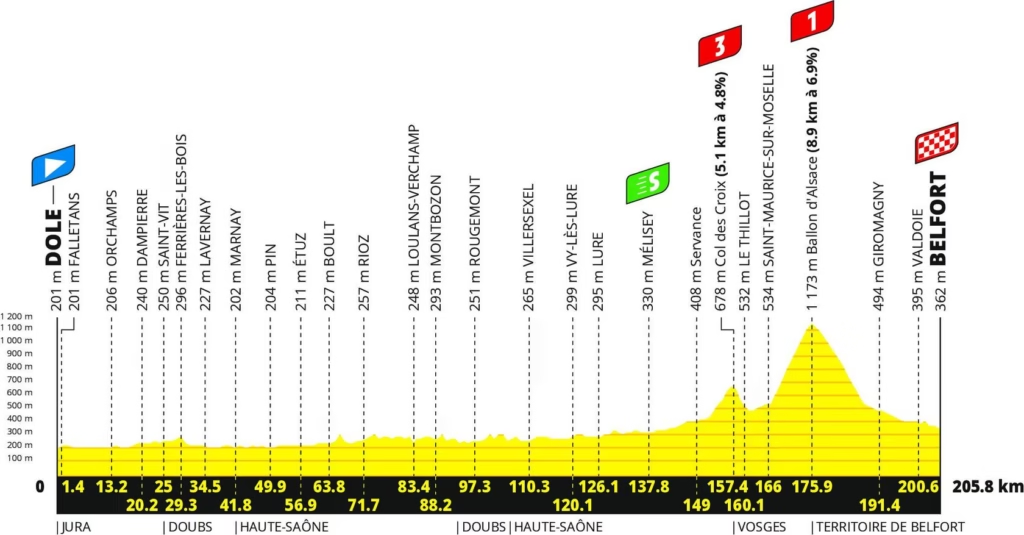
The most important racing should begin after the intermediate sprint in Mélisey. The Col des Croix and Ballon d’Alsace are both packed into the final 50km, with the category-one Ballon d’Alsace summit arriving 29.9km from the finish.
Viewers who only want the decisive part of the stage should aim to tune in by 15:30 BST.
The full route, tactical picture and leading breakaway contenders are covered in our Tour de France 2026 stage 13 preview.
Tour de France stage 13 start and finish times
| Detail | UK time |
|---|---|
| TNT Sports and HBO Max coverage begins | 11:45 BST |
| Neutralised start in Dole | 12:00 BST |
| Expected racing start | Shortly after 12:00 BST |
| Intermediate sprint in Mélisey | 15:12-15:28 BST |
| Col des Croix summit | 15:41-16:00 BST |
| Ballon d’Alsace summit | 16:12-16:36 BST |
| Expected finish in Belfort | 16:46-17:12 BST |
| Free highlights on 5 | Evening programme |
All times are estimates apart from the scheduled start and broadcast window.
The stage can run earlier or later depending on the speed of the opening breakaway battle, the size of the escape, wind conditions and how aggressively the final climbs are raced.
What time does Tour de France stage 13 start?
The neutralised start in Dole is scheduled for 12:00 BST, which is 13:00 local time in France.
The riders will roll through the start town together before the race director signals the official start on the road outside Dole.
The opening part of the stage is rolling rather than mountainous, which could encourage attacks immediately after the flag drops.
Stage 13 is one of the best remaining opportunities for teams without a stage victory. A large number of riders may therefore attempt to join the breakaway, potentially keeping the opening hour fast and difficult to control.
The wider daily schedule for the race is available in our Tour de France 2026 TV schedule and start times.
What time is stage 13 on television in the UK?
Live UK coverage begins at 11:45 BST on TNT Sports and HBO Max.
That gives the broadcast enough time to introduce the route, explain the general classification situation and show the riders leaving Dole.
Every kilometre should be available live.
TNT Sports is the main linear television option, while HBO Max provides the full live stream for viewers watching on a smart television, computer, tablet or mobile device.
UK viewers no longer have full live Tour coverage through ITV4 or ITVX. The domestic live rights moved to TNT Sports and HBO Max for 2026.
Our guide to why the Tour de France is no longer live on ITV explains the change and the remaining free-to-air options.
Can you watch stage 13 free in the UK?
There is no full free-to-air live broadcast of stage 13 in the UK.
Daily highlights are available on 5, giving viewers a free evening summary of the breakaway, final climbs and stage result.
Selected stages of the Tour are also available through S4C and BBC iPlayer, but stage 13 is not one of the main Welsh-language live broadcasts currently listed.
Anyone wanting to watch the breakaway form and the full approach to the Ballon d’Alsace will need TNT Sports or HBO Max.
The free highlights should still include:
- The fight to enter the breakaway
- The intermediate sprint in Mélisey
- The Col des Croix
- The decisive attacks on the Ballon d’Alsace
- The descent towards Belfort
- The stage winner
- Any changes to the general classification
Best time to tune in for Tour de France stage 13
Stage 13 is unusually long, so the best viewing time depends on how much of the tactical build-up you want to see.
Watch from 11:45 BST for the full stage
Viewers watching from the beginning should see the complete fight to form the breakaway.
That may be one of the most important parts of the stage.
Teams know the yellow jersey squad has little reason to chase riders who are already well behind in the general classification. Reaching the correct escape could therefore be almost as important as being strongest on the final climb.
The breakaway fight may last for 30 minutes, an hour or even longer if several powerful combinations are repeatedly closed down.
Our explainer on what a breakaway is in the Tour de France covers why some groups receive freedom while others are chased immediately.
Watch from 14:45 BST for the intermediate sprint
The intermediate sprint in Mélisey is expected between approximately 15:12 and 15:28 BST.
Mads Pedersen may attempt to collect further green jersey points before the difficult climbing begins.
The exact scenario depends on the breakaway.
If the escape contains enough riders to take all the leading points, the main green jersey contenders may choose not to chase. If only a small group is ahead, Pedersen and his rivals could still contest the remaining positions from the peloton.
Mélisey also marks the transition towards the decisive part of the route.
The road becomes progressively harder after the sprint, with the Col des Croix beginning the final selection.
Watch from 15:30 BST for the final climbs
Viewers primarily interested in the stage victory should be watching by 15:30 BST.
The category-three Col des Croix is expected to be crested between 15:41 and 16:00 BST.
It is 5.2km long at an average gradient of 4.8%.
Those numbers are not difficult enough to trouble the Tour’s leading climbers, but they can split a tired breakaway after more than 150km of racing.
The Col des Croix should reveal which attackers still have the strength to challenge on the Ballon d’Alsace.
Fast finishers such as Mathieu van der Poel and Michael Matthews need to survive without using too much energy. Climbers and aggressive stage hunters are likely to increase the pace in an attempt to remove them.
Watch from 16:00 BST for the Ballon d’Alsace
The Ballon d’Alsace is the key climb of stage 13.
Its summit is expected between 16:12 and 16:36 BST, depending on the speed of the stage.
The category-one ascent is 8.8km long at an average gradient of 6.9%.
It is steady rather than brutally steep, but it comes after around 175km of racing.
That combination should be enough to expose riders who have spent too much energy reaching or controlling the breakaway.
The summit is 29.9km from the finish, meaning the first rider over the top is not guaranteed to win.
A strong climber can create a gap on the ascent, but the long descent and run towards Belfort give powerful riders an opportunity to return.
The Ballon d’Alsace also appears during a wider eastern block that may shape the race before the Alps. Our Tour de France 2026 Vosges and Jura guide looks at how stages 13, 14 and 15 connect.
What time will stage 13 finish?
The expected finish in Belfort is 16:46 BST.
That time is based on the fastest official schedule.
The medium timetable produces an estimated finish at approximately 16:59 BST, while the slowest scenario moves the arrival towards 17:12 BST.
The riders could finish outside that range if the stage is raced at an unexpectedly high or low speed.
A prolonged battle to form the breakaway could make the opening hour extremely fast. Once the group escapes, the peloton may reduce its speed and allow the advantage to grow.
The closing climbs could then produce another sharp increase in pace.
Viewers should avoid waiting until the exact published finish time.
Watching from 16:15 BST should ensure the Ballon d’Alsace and most of the descent are included.
Tour de France stage 13 key race times
| Race point | Distance from finish | Expected UK time |
|---|---|---|
| Neutralised start in Dole | 205.8km | 12:00 BST |
| Intermediate sprint in Mélisey | 68km | 15:12-15:28 BST |
| Col des Croix | 48.4km | 15:41-16:00 BST |
| Foot of Ballon d’Alsace | Around 39.8km | 15:51-16:11 BST |
| Ballon d’Alsace summit | 29.9km | 16:12-16:36 BST |
| Lepuix | 15.8km | 16:27-16:52 BST |
| Belfort finish | 0km | 16:46-17:12 BST |
These times are based on the official Tour speed schedules converted from local French time to BST.
What should viewers expect from stage 13?
Stage 13 should be a breakaway day.
The stage is 205.8km long, making it the only route of the 2026 Tour to exceed 200km.
It also comes immediately before harder mountain stages to Le Markstein and Plateau de Solaison.
UAE Team Emirates-XRG has little reason to control the entire stage for Tadej Pogačar when riders far behind on GC enter the escape.
Other leading teams may reach the same conclusion.
That leaves teams searching for stage wins with a strong incentive to attack from the start.
The most likely scenario is:
- A prolonged battle to form the breakaway.
- A large group eventually gaining several minutes.
- The intermediate sprint being won from the escape.
- The Col des Croix reducing the number of contenders.
- Attacks on the Ballon d’Alsace.
- A solo rider or small group descending towards Belfort.
- The GC favourites finishing together behind.
The route ranks among the best Tour de France 2026 stages for breakaways.
Could the general classification change?
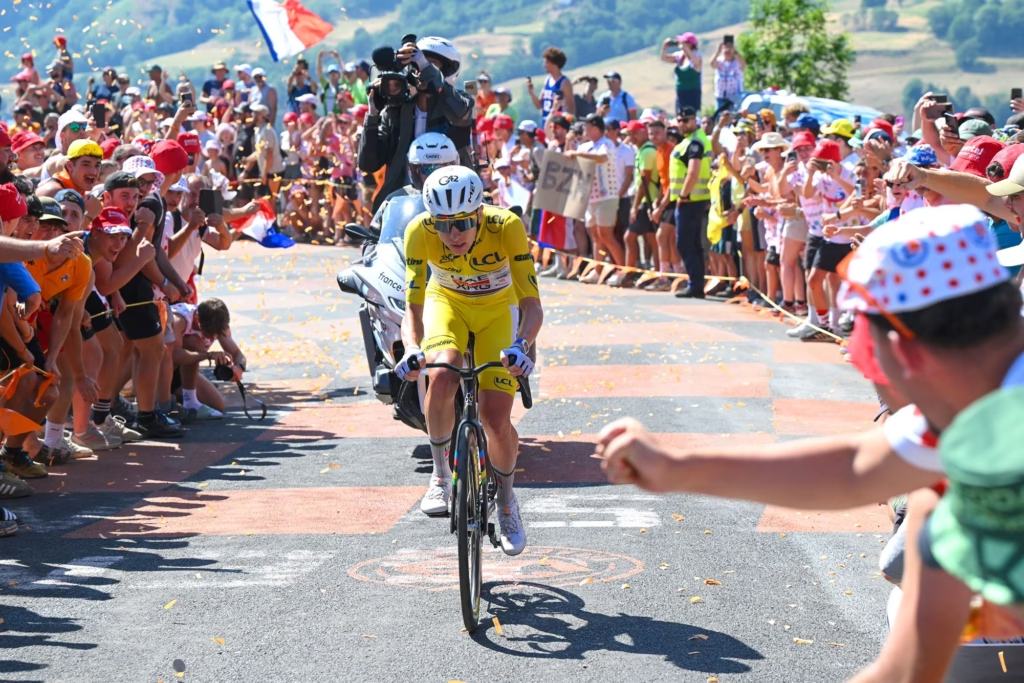
Major gaps between Pogačar, Jonas Vingegaard and Remco Evenepoel are possible but not expected.
The Ballon d’Alsace is difficult enough to test tired riders, but the summit arrives almost 30km from the finish.
An attack requires a long commitment through the descent and the roads towards Belfort.
The stronger opportunity for GC attacks comes on stage 14, when the race finishes at Le Markstein after the Col du Haag.
Stage 13 still contains risks.
A rider who is badly positioned at the foot of the Ballon d’Alsace could lose contact. Mechanical trouble or a gap on the descent may also become difficult to close.
The yellow jersey group therefore cannot treat the stage as a complete transition day.
Our guide to the best Tour de France 2026 stages for GC attacks explains why the following two stages carry greater overall importance.
Who should viewers watch in the breakaway?
Ben Healy, Matej Mohorič, Mathieu van der Poel, Marc Hirschi and Michael Storer are among the riders best suited to the stage.
Healy can create separation on the Ballon d’Alsace but needs to avoid bringing faster riders to Belfort.
Mohorič has the strongest descending route to victory. He can remain close on the climb, attack near the summit and use the downhill roads to increase a gap.
Van der Poel is the rider nobody wants to take to a reduced sprint. His rivals must make the Ballon d’Alsace hard enough to remove him.
Hirschi combines climbing, descending and a quick finish, while Storer is among the strongest specialist climbers likely to receive breakaway freedom.
The race’s wider attacking field is covered in our guide to the Tour de France 2026 breakaway specialists.
How to watch stage 13 in the United States
US viewers can watch stage 13 live on Peacock.
NBC Sports also carries Tour de France coverage, but Peacock is the main streaming platform showing every stage.
The neutralised start is scheduled for:
- 07:00 EDT
- 06:00 CDT
- 05:00 MDT
- 04:00 PDT
The expected finish is approximately:
- 11:46 EDT
- 10:46 CDT
- 09:46 MDT
- 08:46 PDT
The Ballon d’Alsace should begin affecting the race shortly after 11:00 EDT.
Viewers interested mainly in the final climb should aim to be watching by 11:00 EDT or 08:00 PDT.
How to watch stage 13 in Canada
Canadian viewers can watch the Tour de France through FloBikes and the FloSports app.
Stage 13 begins at:
- 07:00 EDT
- 06:00 CDT
- 05:00 MDT
- 04:00 PDT
The expected finish is around 11:46 EDT, with a possible later arrival if the race follows the slower timetable.
FloBikes is the Canadian rights holder. Peacock’s US coverage is not normally available as the domestic Canadian option.
How to watch stage 13 in Australia
Australian viewers can watch stage 13 live and free through SBS and SBS On Demand.
The neutralised start is scheduled for:
- 21:00 AEST
- 20:30 ACST
- 19:00 AWST
The expected finish is approximately:
- 01:46 AEST on Saturday
- 01:16 ACST
- 23:46 AWST on Friday
The Ballon d’Alsace should be reached shortly after 01:00 AEST.
SBS On Demand also provides replays for viewers who do not want to stay awake through the early hours.
How to watch stage 13 in Europe
France Télévisions provides free live coverage in France.
Eurosport and HBO Max are also available across several European territories, depending on national rights and subscriptions.
Other major options include:
| Country | Broadcaster or platform |
|---|---|
| France | France Télévisions, Eurosport and HBO Max |
| Belgium | RTBF and VRT/Sporza |
| Netherlands | NOS, Eurosport and HBO Max |
| Italy | Rai and Eurosport |
| Spain | RTVE and Eurosport |
| Germany | ARD, ZDF and Eurosport |
| Denmark | TV 2 |
| Norway | TV 2 |
| Switzerland | SRG SSR services |
Availability can differ between live television, streaming and highlights.
For a fuller international breakdown, use our Tour de France 2026 live stream guide by country.
-
 Photo Credit: A.S.O./Gaëtan Flamme
Is Tour de France stage 13 worth watching live?
Yes, particularly from the Col des Croix onwards.
The stage is not expected to produce the largest GC battle of the week, but it has the ingredients for an unpredictable stage win:
- A long distance
- A large breakaway
- Teams desperate for a victory
- A sustained category-one climb
- A technical descent
- A finish far enough from the summit to encourage tactical racing
The outcome may not be obvious at the top of the Ballon d’Alsace.
A climber could lead over the summit only to be caught by stronger descenders and rouleurs before Belfort.
That uncertainty makes the final hour particularly valuable.
Tour de France stage 13 viewing summary
Stage 13 begins in Dole at 12:00 BST, with UK live coverage starting at 11:45 BST on TNT Sports and HBO Max.
The intermediate sprint in Mélisey is expected between 15:12 and 15:28 BST.
The Col des Croix should be reached between 15:41 and 16:00 BST, followed by the Ballon d’Alsace summit between 16:12 and 16:36 BST.
The finish in Belfort is expected at approximately 16:46 BST, with a slower scenario pushing the arrival towards 17:12 BST.
Viewers who want the full fight for the breakaway should watch from the start.
Those interested mainly in the stage-winning battle should tune in by 15:30 BST.
The essential final-hour window begins at 16:00 BST, when the breakaway reaches the Ballon d’Alsace and the stage begins its decisive run towards Belfort.

