
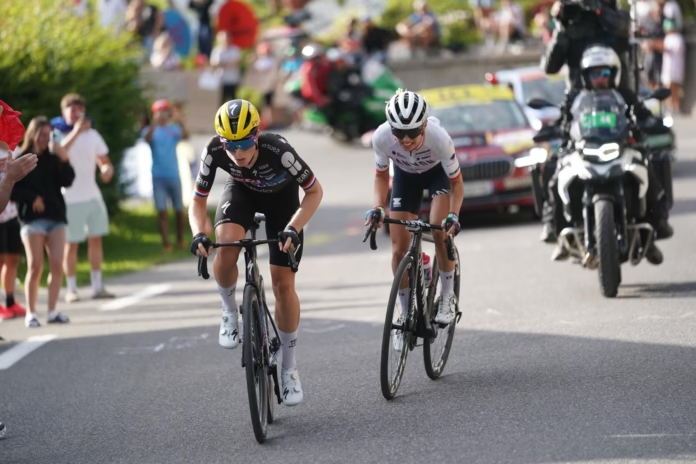
Kasia Niewiadoma-Phinney and Demi Vollering arrive at the final stage of the Tour de France Femmes separated by seconds again.
In 2024, Niewiadoma-Phinney survived one of the most dramatic final stages in Tour history to beat Vollering by four seconds.
Two years later, their roles are reversed.
Vollering starts the final stage of the 2026 Tour in yellow, with Niewiadoma-Phinney only eight seconds behind.
The similarity is obvious: the same two riders, another mountain finale and a Tour which can still be decided by a handful of seconds.
But the circumstances are very different.

What happened between Niewiadoma and Vollering in 2024?
The four-second margin is the part everybody remembers.
What is sometimes forgotten is that Vollering began the final stage of the 2024 Tour 1:15 behind Niewiadoma-Phinney.
She was only eighth overall after losing significant time when she crashed on Stage 5.
Niewiadoma-Phinney took yellow the following day and entered the final mountain stage with 27 seconds over Puck Pieterse and 37 over Cédrine Kerbaol.
Vollering therefore needed something exceptional.
She produced it.
On the Col du Glandon, Vollering attacked with Pauliena Rooijakkers and immediately began dismantling Niewiadoma-Phinney’s advantage.
By Alpe d’Huez, the Tour was being calculated virtually kilometre by kilometre.
Vollering won the stage.
Niewiadoma-Phinney finished 1:01 behind.
After every second was added up, Niewiadoma-Phinney had held on to yellow by four seconds.
Our 2024 Alpe d’Huez race report covers how close she came to losing the Tour, while Vollering’s four-second heartbreak looks at the same finale from the other side.
It remains the closest winning margin in the history of the modern Tour de France Femmes.

The 2026 finale starts much closer
This time there is no 1:15 deficit to recover.
Niewiadoma-Phinney begins Stage 9 only eight seconds behind Vollering.
That makes the starting position considerably more dangerous for the yellow jersey than the one Niewiadoma-Phinney faced two years ago.
In 2024, Vollering needed to produce a huge mountain performance just to get herself into contention.
In 2026, one successful acceleration could be enough for Niewiadoma-Phinney to take the Tour.
The Stage 9 finale around Nice contains four ascents of the Col d’Èze, with the harder version saved for the final lap.
Niewiadoma-Phinney has several opportunities to find those seconds.
This time Vollering is defending
That is perhaps the most interesting reversal.
On Alpe d’Huez in 2024, Vollering had no reason to calculate.
She had to attack.
Niewiadoma-Phinney was the rider trying to survive.
Today Vollering has the simpler tactical job.
She does not need to drop Niewiadoma-Phinney.
She does not need to win the stage.
She needs to make sure Niewiadoma-Phinney cannot overturn eight seconds through road time and bonuses.
Niewiadoma-Phinney has inherited Vollering’s 2024 role: she has to change the race.
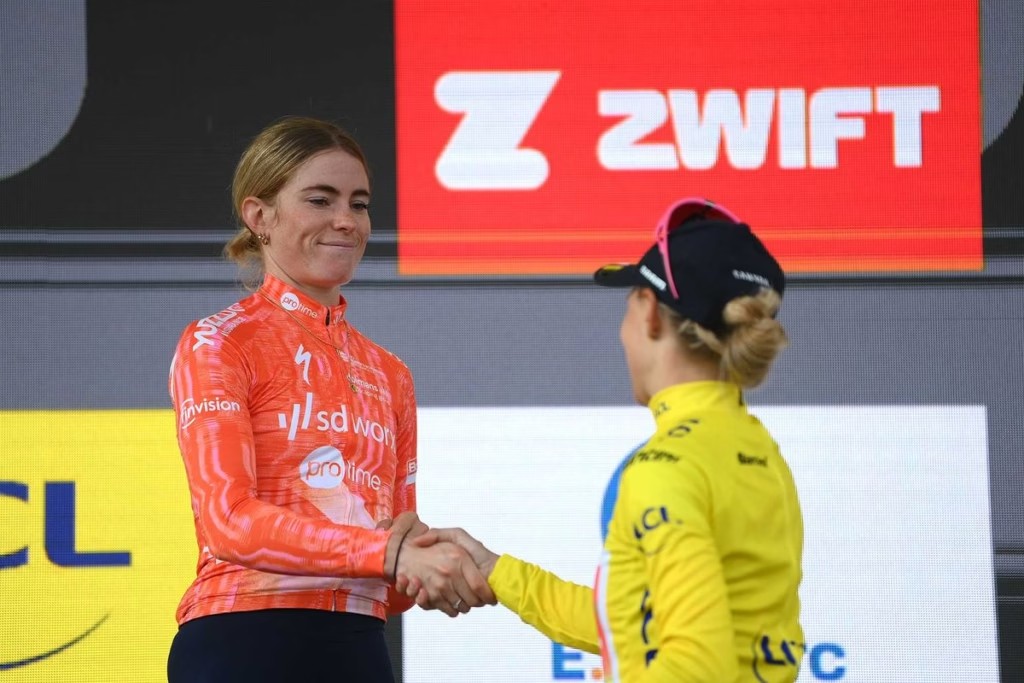
Niewiadoma-Phinney is much closer than Vollering was in 2024
This is where the comparison becomes particularly striking.
Vollering took 1:11 out of Niewiadoma-Phinney on the final stage in 2024 and still lost the Tour.
Niewiadoma-Phinney requires nothing remotely comparable today.
If the bonus situation does not help her, nine seconds on the road would be enough to overturn Vollering’s advantage.
She may need less if she takes a larger finishing bonus.
That makes the final Col d’Èze a very different proposition from Alpe d’Huez.
Niewiadoma-Phinney does not need to destroy Vollering.
She only needs to crack the door open.
The routes demand different kinds of attack
The 2024 finale was a classic Alpine mountain stage.
The riders tackled the Col du Glandon before finishing at Alpe d’Huez.
That gave Vollering a long, sustained climbing environment in which to use her strength.
Stage 9 in 2026 is only 99.2 kilometres.
Instead of two enormous Alpine climbs, the riders repeatedly climb the Col d’Èze around Nice.
The first three ascents are 7.7km at 5.9%.
The final lap introduces the harder approach through the Chemin du Vinaigrier before the decisive 6km climb at 7.6%.
That makes Sunday’s race less about one enormous climbing performance and more about repeated attacks, positioning, team tactics and recovery.
That arguably suits Niewiadoma-Phinney better than a simple uphill duel.
Her 2026 Tour profile highlighted exactly that ability to exploit races which become tactically complicated rather than simply waiting for the longest climb.
 Photo Credit: Getty
2024 was about Vollering’s strength against Niewiadoma’s resistance
The final stage two years ago became increasingly straightforward.
Vollering was taking time uphill.
Niewiadoma-Phinney had to limit her losses.
The Tour was eventually decided by how slowly the gap grew rather than whether Niewiadoma-Phinney could close it.
2026 should be much more complicated.
Canyon SRAM can use Antonia Niedermaier.
Movistar still have Marlen Reusser at 1:12.
Elisa Longo Borghini remains close enough to the podium to attack.
FDJ United-Suez have to decide which moves actually require Vollering’s attention.
Niewiadoma-Phinney can therefore try to create a race in which Vollering has to make several decisions rather than simply measure one climbing effort.
Both Tours were shaped by unexpected time losses
There is another parallel.
Neither rivalry reached its final stage by following the obvious script.
In 2024, Vollering’s crash changed the entire Tour.
She lost 1:47 on Stage 5 after going down while wearing yellow, turning a race she appeared to control into a pursuit.
In 2026, the swings have come through racing rather than a major crash.
Niewiadoma-Phinney began Mont Ventoux 1:05 behind Vollering, attacked from distance and ended Stage 7 15 seconds ahead.
The full transformation came in her Stage 7 victory on Mont Ventoux.
Twenty-four hours later, Vollering attacked into Nice, gained 17 seconds on the road and turned that deficit into an eight-second lead.
The Stage 8 race report completes the reversal.
Yellow has effectively moved back and forth between them through two completely different tactical performances.
 Photo Credit: Getty
Ventoux was Niewiadoma-Phinney’s 2026 statement
If Alpe d’Huez is the defining image of their 2024 rivalry, Mont Ventoux may become the equivalent from 2026.
Niewiadoma-Phinney attacked with more than nine kilometres remaining while Vollering and Reusser watched one another behind.
She committed fully and took enough time to transform the GC.
It was not simply a demonstration of climbing strength.
It was a tactical attack launched at precisely the moment her rivals were least willing to cooperate.
That is important going into Sunday.
Niewiadoma-Phinney probably does not beat Vollering by waiting for the Dutch rider to dictate the final climb.
Her best opportunity is to create another situation Vollering does not want.
Stage 8 showed Vollering has learned the same lesson
There is symmetry here too.
On Ventoux, Vollering waited.
On Stage 8, she did not.
FDJ United-Suez made the final kilometres harder than expected and Vollering attacked above Nice rather than treating the day as a transition towards Sunday.
The result was yellow.
It also showed that Vollering understands how dangerous Niewiadoma-Phinney becomes when a Tour is reduced to tactical hesitation.
Sunday therefore starts with both riders having already won a major battle this week through aggression.
Niewiadoma-Phinney on Ventoux.
Vollering into Nice.
One more decides the Tour.

The psychological positions are reversed
Niewiadoma-Phinney knows exactly what it feels like to protect a tiny Tour advantage under pressure from Vollering.
She survived it in 2024.
Vollering knows exactly what it feels like to attack the final stage knowing anything less than a major effort means defeat.
She came four seconds short.
Now each has the other’s job.
That experience matters.
Vollering knows eight seconds are not comfortable because she almost overturned a much larger deficit herself.
Niewiadoma-Phinney knows a Tour can be saved even when the numbers appear to be moving against you.
Neither rider needs reminding how quickly seconds disappear on a final mountain stage.
There is one crucial difference: Niewiadoma-Phinney cannot simply win the sprint
The finish bonuses add another complication.
There are ten seconds for the Stage 9 winner, six for second and four for third.
At first glance, that appears to give Niewiadoma-Phinney an obvious route to yellow.
But if she wins and Vollering finishes second on the same time, the net gain is only four seconds.
Vollering still wins the Tour.
Even first against third produces only a six-second swing.
So Niewiadoma-Phinney probably needs to physically distance Vollering somewhere unless other riders remove the yellow jersey from the bonus positions.
The precise permutations are covered in our explainer on how the Tour de France Femmes 2026 can be won today.
In 2024, the calculation was about limiting a huge road gap.
In 2026, it could come down to a gap of a few seconds plus the exact order in which the leading riders cross the finish.
-
 Photo Credit: Getty

Could they produce another four-second finish?
They could.
Eight seconds is the smallest gap between first and second going into a final stage in the modern race’s history.
That means Niewiadoma-Phinney’s four-second victory from 2024 is very much within reach again.
Vollering could retain yellow by only a second or two.
Niewiadoma-Phinney could overturn the classification and win by an equally small margin.
The broader Tour de France Femmes winners list shows just how unusual the 2024 margin already was compared with the other modern editions.
Now the same two riders are threatening to do it again.
2024 and 2026: the rivalry in numbers
| 2024 final stage | 2026 final stage | |
|---|---|---|
| Rider in yellow | Niewiadoma-Phinney | Vollering |
| Vollering gap | +1:15 | Leader |
| Niewiadoma-Phinney gap | Leader | +0:08 |
| Final-stage terrain | Glandon + Alpe d’Huez | Four Col d’Èze ascents |
| Rider who must attack | Vollering | Niewiadoma-Phinney |
| Final winning margin | 4 seconds | To be decided |
The numbers explain why the comparison works without the two races being identical.
In 2024, Vollering was trying to produce a miracle.
In 2026, Niewiadoma-Phinney only needs seconds.
But the central question is exactly the same.
Can the rider chasing yellow take enough time from the other before the Tour runs out of road?
Two years ago, Vollering came four seconds short.
Today Niewiadoma-Phinney gets her turn.

