
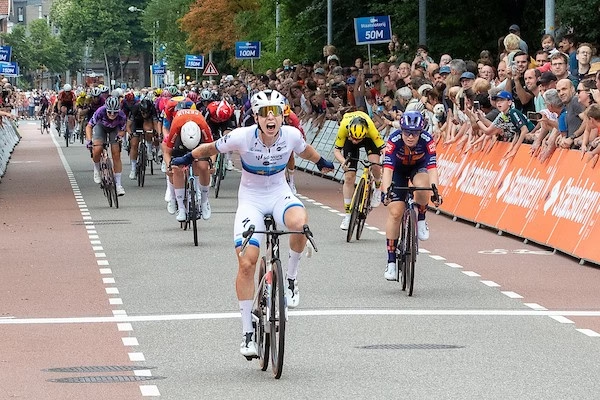
The GP Lucien Van Impe steps up another level in 2026, with the East Flanders one-day race promoted to UCI 1.Pro status for the first time.
Taking place on Thursday 20 August, the race starts and finishes in Erpe-Mere over 140.1km, with around 944 metres of climbing. That gives a good indication of the character of the day. This is not a mountainous race despite carrying the name of one of Belgium’s greatest climbers, but neither is it a straightforward flat sprint event.
Instead, GP Lucien Van Impe is built around the short rises, repeated accelerations and local circuits typical of Belgian one-day racing. The 2026 route again sits in the awkward middle ground where the sprinters can survive, but only if their teams prevent the repeated climbs and attacks from turning the final hour into something more selective.
For a wider introduction to the event, its history and current status, see our beginner’s guide to GP Lucien Van Impe 2026.
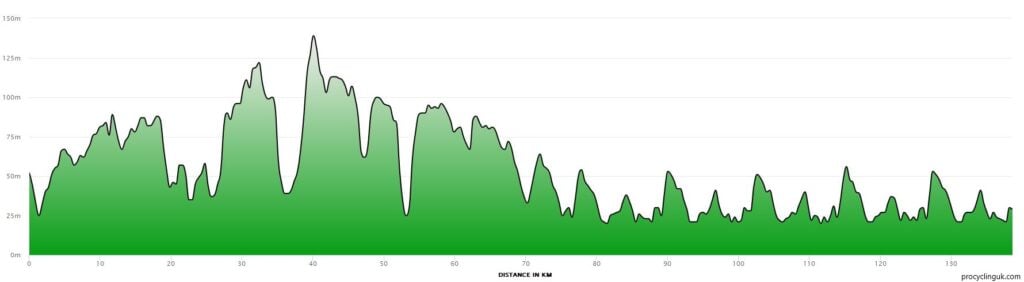
GP Lucien Van Impe 2026 route at a glance
| Detail | GP Lucien Van Impe 2026 |
|---|---|
| Date | Thursday 20 August 2026 |
| Start | Erpe-Mere |
| Finish | Erpe-Mere |
| Distance | 140.1km |
| Elevation gain | Around 944m |
| UCI classification | 1.Pro |
| Race character | Rolling/hilly one-day race |
| Finish character | False flat |
| Likely winning scenario | Reduced sprint or small late group |
The race’s promotion is significant. GP Lucien Van Impe only joined the UCI calendar in 2024 at 1.2 level, stepped up to 1.1 in 2025 and has now reached the Women’s ProSeries.
That rapid rise means the 2026 edition should bring the strongest field in the race’s short international history.
A Belgian circuit race rather than a climber’s Classic
The character of the course is slightly at odds with the rider whose name it carries.
Lucien Van Impe won the Tour de France in 1976 and built his reputation on the longest climbs of the Alps and Pyrenees. His namesake race around Erpe-Mere is very different.
There are no long ascents where a pure climber can simply ride the field off the wheel. The total elevation of around 944 metres spread across 140.1km tells most of the story. The difficulty comes through accumulation rather than one defining climb.
Repeated rises, narrow roads, positioning battles and constant changes of pace gradually make the race harder, particularly once the riders return towards Erpe-Mere and begin repeating the local sections.
That difference between the race and its namesake is part of what makes the event distinctive. Van Impe’s place among the great Tour climbers is covered in our ranking of the greatest Tour de France climbers, but his home race rewards a much broader type of rider.
The first half should favour an early breakaway
The opening phase of GP Lucien Van Impe is the most obvious opportunity for a breakaway to establish itself.
With no major climb forcing an immediate selection, the smaller teams have every reason to send riders up the road before the stronger squads begin controlling the race. A team arriving with a recognised sprinter can afford to let a modest group build an advantage, provided there is nobody sufficiently dangerous in the move to force an early chase.
That does not necessarily make the opening kilometres easy.
At only 140.1km, the race is short enough that there is less room than usual to recover from a tactical mistake. A group which gains several minutes can become difficult to bring back if the peloton waits too long, particularly once the repeated late circuits begin consuming domestiques.
The stronger teams therefore need to control without using too much energy before the more selective sections arrive.
The Erpe-Mere circuits are where the race should tighten
The decisive part of GP Lucien Van Impe comes once the race begins repeating the roads around Erpe-Mere.
None of the individual rises is severe enough to frighten a WorldTour-level rider, but repetition changes their effect. Every ramp requires another acceleration, another fight for position and another effort to regain speed over the top.
That matters particularly for the sprinters.
A fast rider does not necessarily need completely flat roads to survive. Lorena Wiebes demonstrated exactly that in 2025, staying with the front through the harder sections before producing the fastest finish in Erpe-Mere.
Her victory is covered in our 2025 GP Lucien Van Impe race report.
The attacking teams therefore need more than one hard acceleration. Their best chance is to create a sequence where the sprinters are repeatedly forced to close gaps rather than simply surviving one climb and recovering.

Why 944 metres of climbing can still hurt
Around 944 metres of elevation across 140.1km is not especially demanding by professional standards.
What matters is how that climbing is distributed.
A race with one long ascent followed by extended flat roads can be easier to organise than a circuit containing repeated short rises. The latter constantly changes the tactical situation. Riders accelerate onto a climb, crest at speed, descend, fight for position and then begin again.
That makes GP Lucien Van Impe more similar to a Flemish punchy one-day race than a conventional climbing event.
It also rewards riders who recover quickly between efforts. A pure climber may be comfortable on each ascent but gain very little from the terrain, while a Classics rider with repeated explosive power can use the same roads much more aggressively.
The false-flat finish keeps powerful sprinters in the game
The final run to the line is another important part of the route.
Rather than a perfectly level sprint, the finish is a false flat, which changes the type of effort required. The winner needs to sustain power rather than simply reaching maximum speed on a completely flat road.
That should favour riders who have already demonstrated they can sprint well after a selective race.
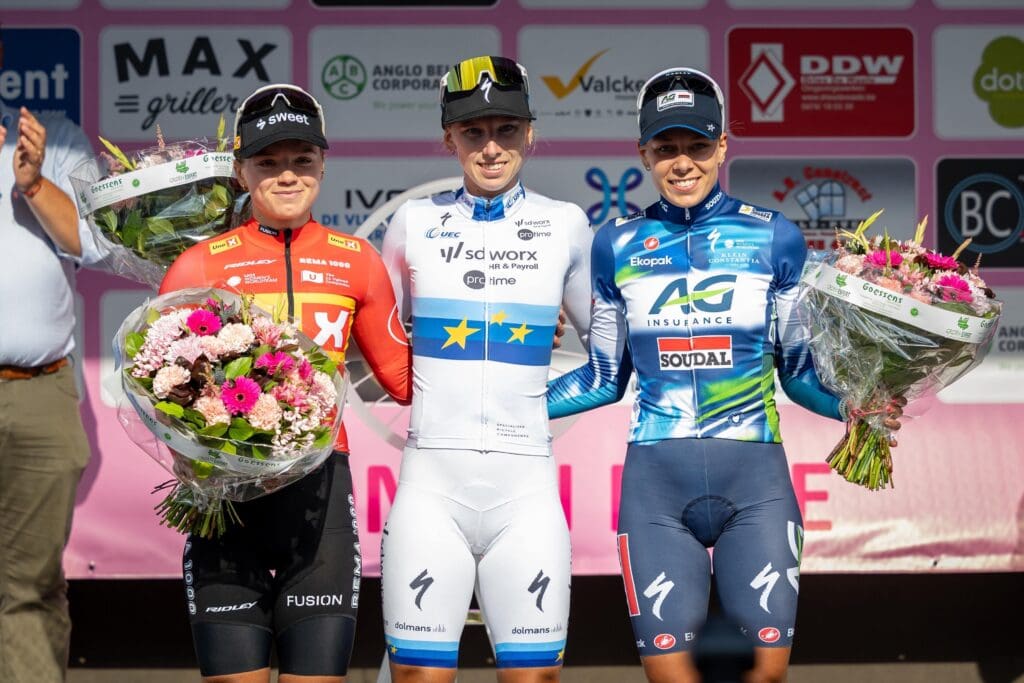
Wiebes is the obvious recent example. In 2025 she arrived at the finish with enough freshness to beat Susanne Andersen and Shari Bossuyt and claim what was already her 17th victory of the season.
The result confirmed that the route can be survived by an elite sprinter, but it did not prove that the race will always end the same way.
Evy Kuijpers showed the alternative in 2024
The first UCI edition produced a very different outcome.
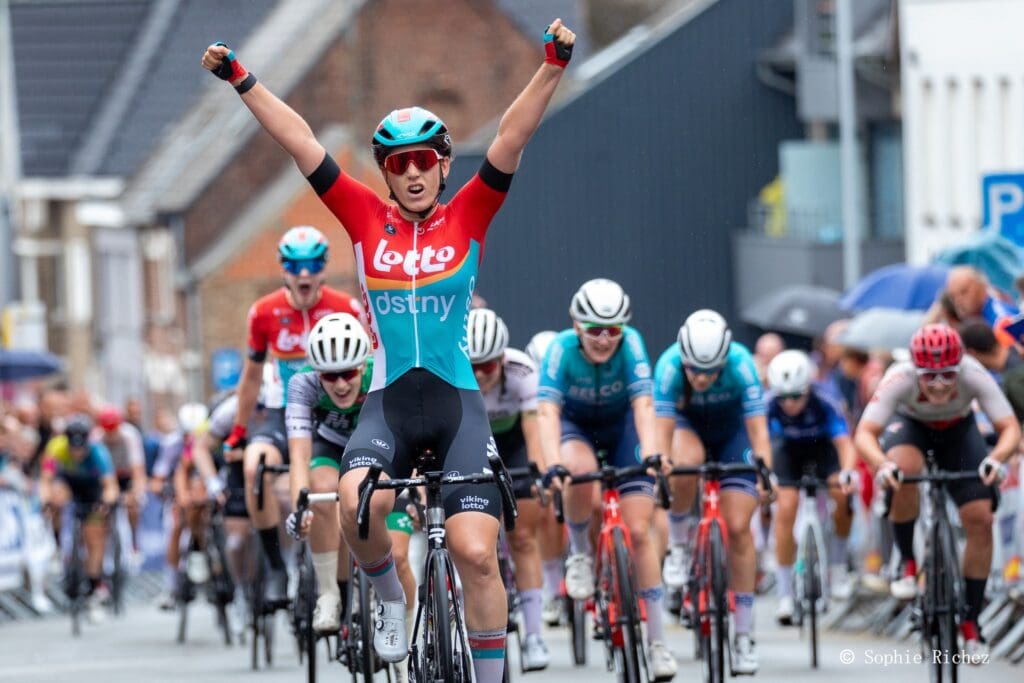
Evy Kuijpers escaped with Anastasiya Kolesava and beat her in a two-rider finish after 140.7km. It was Kuijpers’ first professional victory and immediately demonstrated that GP Lucien Van Impe does not need to wait for a bunch sprint.
Our 2024 GP Lucien Van Impe race report covers that breakthrough victory.
The contrast between Kuijpers in 2024 and Wiebes in 2025 gives the route its central tactical question.
Can the attacking riders create enough separation on the repeated rolling roads, or can the sprint teams keep everything close enough for their leader to decide the race in Erpe-Mere?
Where can GP Lucien Van Impe 2026 be won?
There are three realistic winning scenarios.
A controlled reduced sprint
This is the outcome the teams with the strongest fast finishers will want.
They allow an early breakaway to establish itself, keep the gap manageable and use the final circuits to gradually reduce the field without allowing a dangerous attack to gain enough time.
If 30 to 50 riders reach the closing kilometres together, the advantage swings heavily towards the fastest sprinters.
Wiebes’ 2025 victory is the obvious model.
A small group escapes late
This may be the biggest threat to the sprint teams.
Repeated short climbs provide puncheurs and Classics riders with several opportunities to attack, particularly once domestiques start disappearing from the front group.
A group of three to eight strong riders can quickly become difficult to chase because nobody behind wants to do all of the work only to deliver the strongest sprinter to the line.
Kuijpers showed in 2024 that this approach can succeed.
A late solo attack
This is less likely but remains possible.
The relatively short race distance means strong riders can still have enough energy for a decisive acceleration deep into the final circuit. If a favourite attacks immediately after one of the harder rises and the chase hesitates, even a ten-second advantage can become significant.
The false-flat finish also makes a late chase slightly harder than it would be on a completely flat road.
Positioning could matter more than climbing ability
The profile might suggest that the strongest riders simply need to survive the climbs.
In reality, positioning is likely to decide just as much.
Short Belgian rises often become difficult because of where a rider starts them. A rider entering a climb in tenth position can follow the acceleration near the front. Somebody beginning the same ascent in 50th may already be chasing before the road has properly started rising.
That effect compounds over repeated circuits.
Every corner, pinch point and short climb gives the strongest teams another opportunity to stretch the bunch. Riders continually forced to move back up spend energy even if they technically remain in contact.
The final 40km should therefore reward teams capable of keeping their leader consistently near the front rather than repeatedly rescuing them from poor position.
The step up to 1.Pro should change the racing
The move to 1.Pro status is more than an administrative upgrade.
A deeper field means more teams arrive with realistic ambitions of winning and more riders are capable of making a dangerous attack. That can make the race harder to control even though the roads themselves have not become substantially more difficult.
A dominant sprint team may still have the fastest rider, but there should be more moves worth chasing and more teams unwilling to cooperate with them.
That makes the 2026 edition tactically different from the race Kuijpers won as a 1.2 event only two years ago.
The stronger field should increase the value of good positioning, team depth and tactical flexibility.
How the route compares with recent editions
The broad character remains recognisable.
The 2025 race covered 139.3km, only slightly shorter than the 140.1km scheduled for 2026. The general structure again favours riders capable of coping with repeated short rises before either attacking or sprinting from a reduced group.
That continuity makes the previous two editions particularly useful when assessing the route.
Kuijpers proved a small move could survive.
Wiebes proved the sprinters could control it.
The course does not necessarily favour one solution over the other strongly enough to make the outcome predictable.
What type of rider does the route favour?
The ideal GP Lucien Van Impe rider is not a pure climber.
Instead, the course favours three overlapping profiles.
Powerful sprinters have the clearest route to victory if they can survive the repeated accelerations.
Puncheurs can use the short rises to attack without needing a sustained mountain.
Classics riders with a fast finish arguably have the most tactical flexibility because they can attack in the closing laps while still remaining dangerous if the race comes back together.
That mix helps explain why a race with less than 1,000 metres of climbing can remain difficult to classify cleanly as either a sprint race or a hilly Classic.
-
 Photo Credit: quentinphotographiebe
 -
 Photo Credit: Getty

GP Lucien Van Impe 2026 key route facts
Date: Thursday 20 August 2026
Distance: 140.1km
Elevation: Around 944 metres
Start: Erpe-Mere
Finish: Erpe-Mere
UCI classification: 1.Pro
Profile: Rolling/hilly
Finish: False flat
Defending champion: Lorena Wiebes
2024 winner: Evy Kuijpers
The women’s race has risen quickly from national level into the Women’s ProSeries. Our brief history of GP Lucien Van Impe follows that development and the race’s connection to Belgium’s 1976 Tour de France winner.
The route should again create a sprinters-versus-attackers contest
GP Lucien Van Impe does not need a major mountain or a famous cobbled climb to produce a selective race.
Its difficulty comes from repetition.
The sprinters know the course is manageable enough for them to win. The attackers know it is difficult enough to isolate those sprinters if they can keep making the race hard. The relatively short distance encourages aggressive riding, while the false-flat finish means a small late advantage cannot automatically be dismissed.
The first two UCI editions produced opposite solutions to the same tactical problem.
Kuijpers escaped the sprint.
Wiebes controlled it.
With the race now stepping up to 1.Pro level, the 2026 edition should pose the same question with a stronger and deeper field than ever before.

