
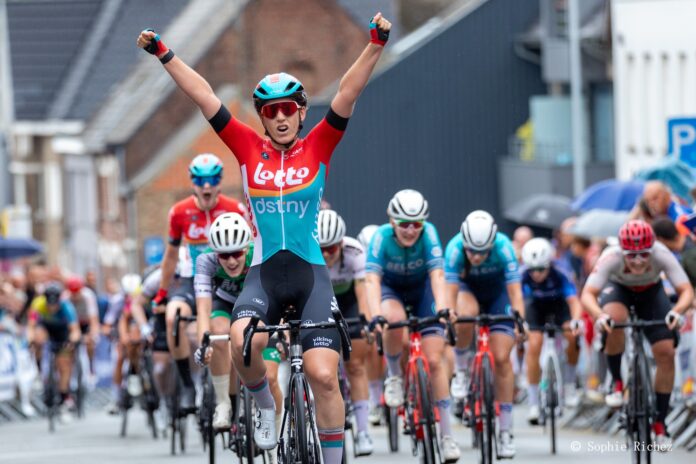
The GP Lucien Van Impe returns on Thursday 20 August 2026 with a new place in the UCI Women’s ProSeries and a growing reputation as one of Belgium’s most accessible late-summer one-day races.
Held around Erpe-Mere in East Flanders, the women’s event combines narrow Belgian roads, repeated short climbs and a finish that can still reward a fast rider. It is not a race for pure climbers despite carrying the name of one of Belgium’s greatest mountain specialists.
Recent editions have instead produced reduced sprints and tactical attacks. Lorena Wiebes won in 2025 after Evy Kuijpers took her first professional victory in the race a year earlier.
The promotion from 1.1 to 1.Pro should bring a stronger field, more leading teams and greater tactical depth. It also marks a rapid rise for an event that only joined the UCI calendar in 2024.
GP Lucien Van Impe 2026 race details
| Detail | Information |
|---|---|
| Date | Thursday 20 August 2026 |
| Country | Belgium |
| Start | Erpe-Mere |
| Finish | Erpe-Mere |
| UCI classification | 1.Pro |
| Race type | Women’s one-day road race |
| Expected distance | Approximately 140km |
| Likely terrain | Rolling circuit with short climbs |
| Defending champion | Lorena Wiebes |
| Previous winner | Evy Kuijpers |
Current race listings place the 2026 edition at approximately 140km. The final route, start time and finish schedule should still be treated as provisional until the organiser publishes the official roadbook.
What is the GP Lucien Van Impe?
The GP Lucien Van Impe is a women’s one-day race based in Erpe-Mere, a municipality between Ghent and Brussels.
The event began as a regional race before joining the UCI calendar as a 1.2 event in 2024. It moved to 1.1 status in 2025 and has now been promoted again for 2026.
That progression matters.
A 1.Pro race sits immediately below the Women’s WorldTour. It can attract WorldTour teams alongside leading ProTeams and Continental squads, while offering more UCI ranking points and greater international importance than a standard 1.1 race.
The promotion places GP Lucien Van Impe among Belgium’s more significant women’s one-day events rather than leaving it as a primarily domestic race.
Its calendar position is useful. The race comes after the Tour de France Femmes and alongside a busy period of Belgian and Dutch racing. Riders can arrive carrying strong condition from the Tour, while others use it to rebuild form for the final weeks of August and September.
The wider structure of the top level of women’s racing is covered in our guide to the 2026 Women’s WorldTour, teams and points system.
Who was Lucien Van Impe?
Lucien Van Impe is one of Belgium’s greatest Grand Tour riders and the most recent Belgian man to win the Tour de France.
He won the 1976 Tour after a mountain battle with Joop Zoetemelk and became particularly associated with aggressive climbing. Van Impe also won the Tour de France mountains classification six times and finished in the top five overall on eight occasions.
His career was defined by the high mountains, but he was more than a specialist collecting polka-dot points. Winning the Tour required him to defend his position against the clock and survive every type of stage.
Van Impe’s connection to the area is personal as well as symbolic. He comes from the local region and lives in Impe, one of the villages within Erpe-Mere.
The race therefore carries the name of a genuine local cycling figure rather than simply borrowing that of a famous Belgian champion.
Is GP Lucien Van Impe a climbing race?
Despite the name, this is not a mountain race.
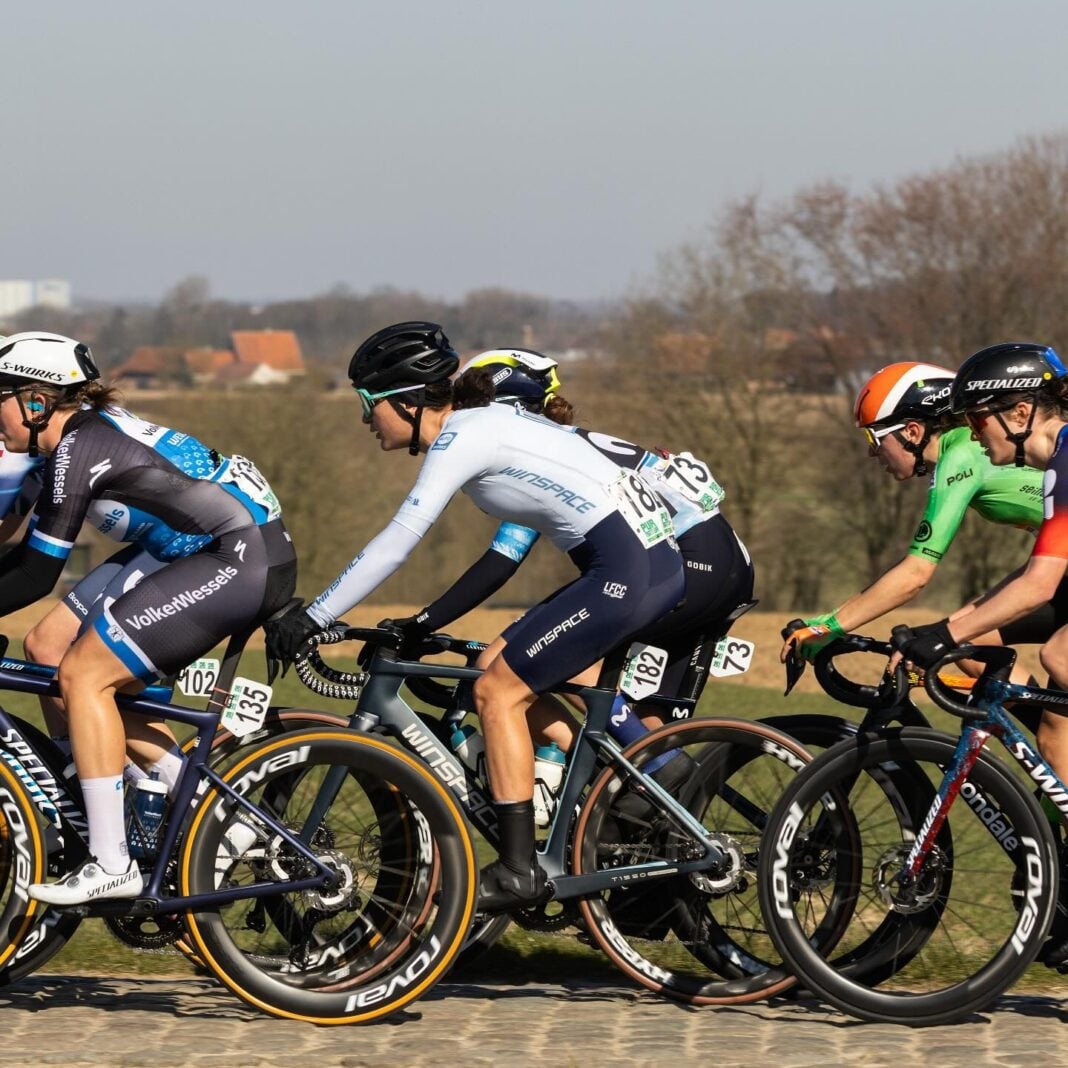
East Flanders has no Alpine climbs, and the course does not attempt to imitate the terrain on which Van Impe built his reputation. It instead uses the characteristics available locally: rolling roads, short rises, narrow lanes, repeated changes of direction and exposed sections where wind can influence the result.
The recent race pattern has favoured fast riders capable of surviving an attritional circuit.
The 2025 edition covered a little under 140km with around 1,000 metres of climbing. Wiebes still reached the finish in the leading group and won the sprint, demonstrating that the climbs are more likely to reduce the field than eliminate every sprinter.
Her victory is covered in our report on Lorena Wiebes winning the 2025 GP Lucien Van Impe.
That makes the race difficult to classify neatly.
It is harder than a flat Belgian sprinters’ race but less selective than an Ardennes Classic. Riders require speed, positioning and repeated short-climb strength rather than the ability to sustain one long mountain effort.

What will the 2026 route look like?
The complete official route has not yet been published.
Current listings indicate another race of around 140km beginning and ending in Erpe-Mere. That is consistent with the format used in 2024 and 2025, when the event was built around local circuits and finished on relatively fast roads.
The likely course should contain:
- Repeated short climbs rather than one decisive ascent
- Narrow rural roads around Erpe-Mere
- Several technical turns and changes of direction
- Open sections vulnerable to crosswinds
- A finish that remains suitable for a reduced sprint
The 2025 race covered 139.3km, while the 2024 edition measured 140.7km. The organisers have therefore established a compact event lasting around three and a half hours rather than extending it towards the distance of the longest Classics.
The ProSeries promotion could encourage minor route changes, particularly if the organiser wants to create a more selective finale. The essential character is still likely to remain unchanged.
This should be a Belgian circuit race in which accumulated fatigue matters more than any single climb.
Why the circuit format matters
Repeated circuits allow teams to learn the decisive sections as the race develops.
On the first passage, riders identify where the road narrows, where the wind is strongest and which rise creates the most damage. By the final lap, those same locations become obvious attacking points.
That familiarity does not necessarily make the race easier to control.
Every team knows where it needs to be near the front. The approach to a small hill or technical bend can therefore become more intense than the obstacle itself.
Positioning may decide which riders survive in the leading group. A contender entering a narrow section in 40th wheel can lose contact without lacking the physical strength to follow the leaders.
The circuit also allows strong teams to increase the pressure gradually. They can use different riders on successive laps before committing their protected leader near the finish.
 Photo Credit: Getty
What type of rider can win?
The ideal GP Lucien Van Impe winner is a fast finisher who can survive repeated rolling terrain.
A pure bunch sprinter can win, as Wiebes demonstrated in 2025, but only if her team keeps the race together and she handles the accumulated climbing.
A puncheur can win by attacking late, particularly if the strongest sprint teams have lost domestiques or become unwilling to chase one another.
A breakaway specialist also has a chance because the circuit offers repeated launching points. The difficulty is establishing enough separation before the faster approach to Erpe-Mere.
Durable sprinters
These riders want the race controlled but not necessarily easy.
A reduced peloton removes some fast rivals while leaving enough teammates to organise a lead-out. Wiebes is the clearest recent example, but riders such as Elisa Balsamo, Charlotte Kool, Chiara Consonni or Marta Lach would suit the broad profile if selected.
The actual start list will determine whether one team has enough sprinting strength to assume responsibility.
Classics riders with a fast finish
This may be the most versatile group.
Riders who can attack over a short climb and still sprint from a reduced group have several routes to victory. They can wait for the finish, follow a late move or use the final circuits to isolate the pure sprinters.
Shari Bossuyt’s third place in 2025 demonstrated the value of combining speed with the ability to survive a difficult Belgian race.
Late attackers
A rider without a top-level sprint must anticipate.
The best opportunity normally comes after the strongest sprint teams have spent riders controlling earlier moves. An attack during the final 10 to 20km can force those teams to decide who still has the resources to chase.
The move needs tactical cooperation. One isolated attacker is likely to be caught on the faster approach to Erpe-Mere, but a group containing riders from several major teams can become difficult to organise against.
Why Wiebes won in 2025
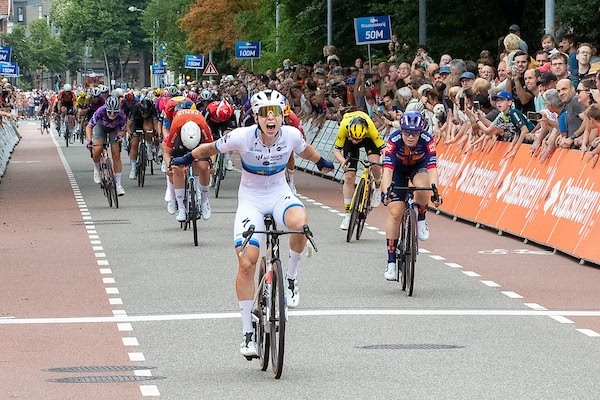
Wiebes entered the 2025 race as the obvious favourite and delivered through a controlled sprint.
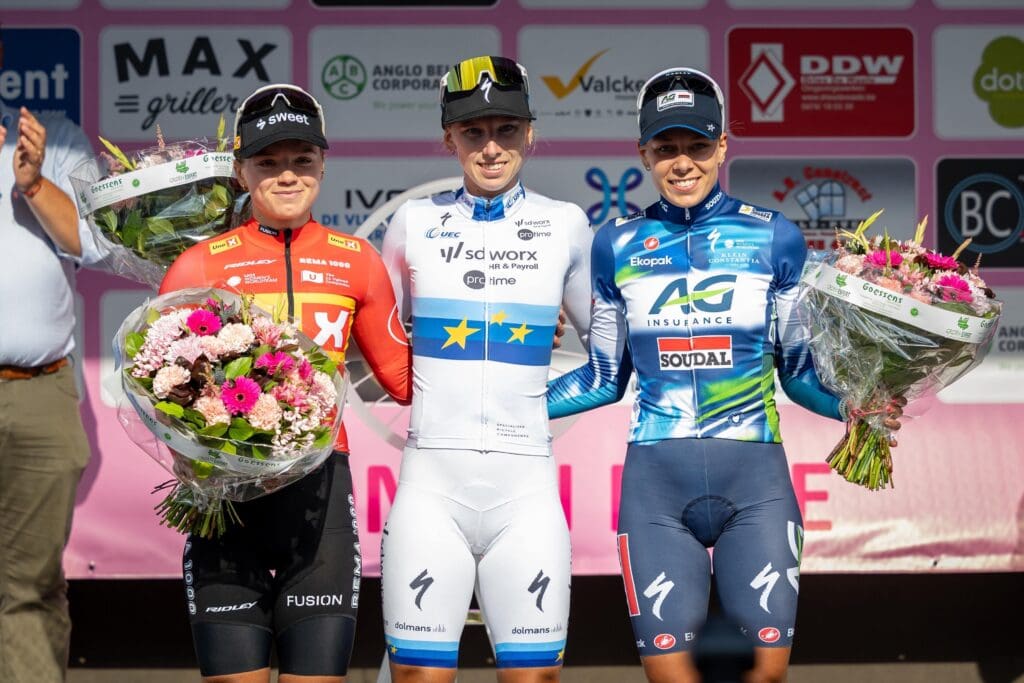
The European champion reached the finish in the leading group and beat Susanne Andersen and Shari Bossuyt. It was her 17th victory of an exceptionally successful season.
Her win illustrated both sides of the race.
The course was difficult enough to prevent a completely straightforward mass sprint, but not selective enough to remove the strongest durable sprinter in the field. Once Wiebes reached the finish near the front, the result became difficult for her rivals to overturn.
The 2026 ProSeries field may make that pattern harder to repeat.
More strong teams mean more attacks, more competing sprint plans and less willingness for one squad to perform all the chasing. A favourite can still win, but the race may become more tactical before the final kilometre.
The 2025 GP Lucien Van Impe preview provides a useful picture of how the race developed before its latest promotion.
Evy Kuijpers’ breakthrough in 2024
The 2024 edition produced a less predictable winner.
Evy Kuijpers beat Anastasiya Kolesava and Sofie van Rooijen after 140.7km, taking the first professional victory of her career.
That result showed why the race matters beyond its place on the calendar.
Smaller Belgian and Dutch one-day events give riders opportunities that can be difficult to find in the Women’s WorldTour. A rider normally working for a team leader can receive freedom, while a developing rider can test herself against an international field.
Kuijpers converted that opportunity into a career landmark.
The promotion to 1.Pro increases the level of the field, but the race should retain that pathway. Continental teams can still use aggressive tactics against more powerful squads, particularly if the favourites become too focused on one another.
The full story of her breakthrough is covered in Evy Kuijpers’ first professional victory at the GP Lucien Van Impe.
Previous GP Lucien Van Impe winners
| Year | Winner | Second | Third | UCI status |
|---|---|---|---|---|
| 2025 | Lorena Wiebes | Susanne Andersen | Shari Bossuyt | 1.1 |
| 2024 | Evy Kuijpers | Anastasiya Kolesava | Sofie van Rooijen | 1.2 |
| 2023 | Non-UCI edition | Regional race |
The short history means no rider has yet won more than once.
It also makes 2026 the beginning of a distinct new phase. The event has moved from a regional race to the Women’s ProSeries in only three years.
What does the 1.Pro classification mean?
The UCI classifies women’s one-day races through several levels.
At the top sits the Women’s WorldTour. Below that are ProSeries events, followed by 1.1 and 1.2 races.
GP Lucien Van Impe’s 1.Pro status means:
- More UCI points are available
- A stronger international field can be expected
- WorldTour and ProTeams are more likely to attend
- The race has greater calendar importance
- Continental teams gain a valuable chance to face leading opposition
It does not automatically guarantee live television coverage or the presence of every major team.
It does show that the event is considered capable of operating at a higher sporting and organisational level.
The promotion is particularly notable because the race was only classified as 1.2 in 2024. Few events rise through two categories so quickly.
How will teams approach the race?
Team strategy will depend heavily on the start list, but three broad approaches are likely.
Control for a sprint
A team with the strongest fast finisher will try to keep the breakaway manageable and preserve several riders for the final circuit.
The danger is doing too much work.
If one squad controls all afternoon, rival teams can repeatedly attack while protecting their own leaders. The favourite’s domestiques may then disappear before the final chase.
Make the circuit progressively harder
Teams without the fastest sprinter need attrition.
They can raise the pace on the short climbs, attack through technical sections and force the sprinters to close repeated gaps.
One attack may not work. A succession of moves across the final hour can gradually remove riders and reduce the strength of the chase.
Place several riders in moves
Continental teams should use numbers rather than wait for the leading favourites.
Sending one rider into the early break gives the team representation. A second can bridge during the later circuits, creating a more dangerous group without requiring the entire team to chase.
That approach also places responsibility on the strongest sprint squads.
When is the race likely to be decided?
The first half should establish the breakaway and reveal which teams are willing to control.
The decisive phase is likely to begin during the final two circuits.
That is when fatigue reduces the number of available domestiques, stronger riders begin attacking and teams must decide whether they are fully committed to a sprint.
Viewers should watch for three moments:
- A hard acceleration on the final meaningful climb
- Counter-attacks immediately after a move is caught
- Hesitation between rival sprint teams inside the final 15km
The winner may not be the rider who launches the strongest initial attack. Belgian one-day races are often decided by the counter-move after the obvious favourites have already responded.
Will GP Lucien Van Impe finish in a sprint?
A sprint is the most likely outcome, but it may involve a reduced group rather than the full peloton.
The 2025 result supports that expectation. The relatively fast final approach gives organised teams time to chase, while the overall amount of climbing is not severe enough to guarantee a decisive selection.
The ProSeries upgrade adds uncertainty.
A deeper field can produce stronger control, which helps the sprinters. It can also produce more credible attackers, making the race harder to manage.
The key question is whether the best sprint team still has enough riders after the final circuits.
A group of 30 to 50 riders reaching the finish together is plausible. A late breakaway containing five to 10 riders is the main alternative.
How to watch GP Lucien Van Impe 2026
UK broadcast details have not yet been confirmed.
Previous editions have received online coverage, and the race’s promotion may improve the chances of another live stream in 2026. The organiser is expected to publish viewing information closer to the event.
Possible options include:
- A free organiser stream
- Regional Belgian television
- Coverage through a cycling broadcaster or digital platform
- Live updates through the organiser’s website and social channels
Provisional timings suggest a start at approximately 12:30 BST, with the finish likely between 15:50 and 16:15 BST.
A dedicated viewing guide will be more reliable once the final broadcast schedule and technical guide have been published.
-
 Photo Credit: quentinphotographiebe
 -
 Photo Credit: Getty


Why the race is worth watching
GP Lucien Van Impe occupies an interesting place in the women’s calendar.
It is important enough to attract strong teams but still young enough to feel unpredictable. The field is likely to combine established riders, developing professionals and Belgian domestic squads treating it as one of their biggest races of the season.
The circuit format also makes the racing easy to understand.
The climbs gradually reduce the field, attackers try to escape before the sprint and the strongest teams must decide how much energy they are willing to spend controlling them.
It is a useful introduction to Belgian women’s racing because it contains many familiar elements without the extreme cobbles of Paris-Roubaix or the severe climbs of Liège-Bastogne-Liège.
It also takes place during the same week as the men’s Renewi Tour 2026, creating a concentrated period of racing across Belgium.
GP Lucien Van Impe 2026 prediction
The absence of a confirmed start list makes selecting one rider premature.
The profile still points towards a durable sprinter or Classics rider rather than a pure climber. A team with a leading fast finisher will probably accept responsibility, but the stronger ProSeries field should make control more difficult than it was in 2025.
The most likely result is a sprint from a reduced group of approximately 30 riders.
The rider to back will be someone capable of surviving repeated short climbs without losing position, then producing a high-speed effort on the flatter finish.
A late attack remains dangerous, particularly if several major teams reach the final circuit with competing sprint interests and refuse to organise a unified chase.
The race carries the name of a legendary climber, but its winner is more likely to be decided through speed, positioning and tactical patience on the roads of Erpe-Mere.

