

The Vuelta a España 2026 begins in Monaco on Saturday 22 August with Tadej Pogačar firmly established as the rider everyone else has to beat, but the fight further down the general classification is much less predictable.
Felix Gall, Oscar Onley, Richard Carapaz, Mattias Skjelmose, Enric Mas, Primož Roglič and João Almeida all begin the race with obvious GC credentials. Carlos Rodríguez and Matthew Riccitello also sit firmly inside the established classification conversation rather than qualifying as genuine outsiders.
The more interesting dark horses begin one level below that group.
Ben Tulett, Tobias Halland Johannessen, Jarno Widar, Harold Tejada, Jørgen Nordhagen, Léo Bisiaux and Luke Tuckwell all start with plausible routes towards an unexpectedly high finish without already carrying the expectation of a top-five result.
The Vuelta a España 2026 route guide explains why there is room for this kind of breakthrough. With repeated mountain stages, medium-mountain days and two individual time trials, the Vuelta gives riders plenty of opportunities to move gradually up the standings as others begin to crack.
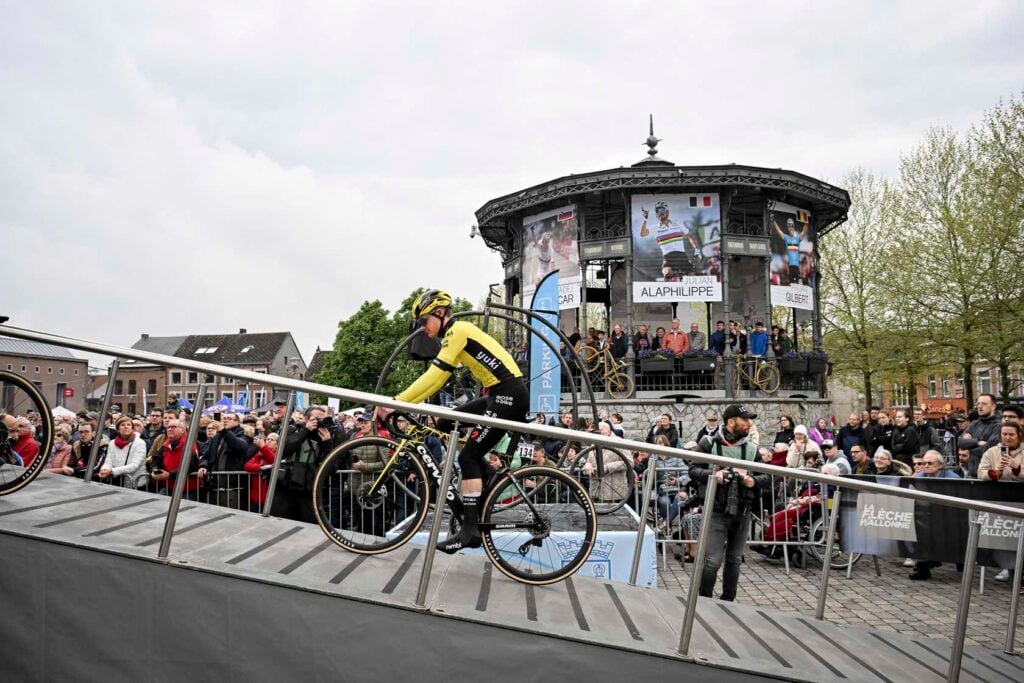 Photo Credit: A.S.O./Billy Ceusters
Ben Tulett
Ben Tulett is the strongest dark-horse pick for the 2026 Vuelta.
His recent form is good enough to make a top-10 challenge realistic, but he has not yet produced the Grand Tour result that would move him into the established contender category.
Tulett has looked increasingly comfortable against elite opposition during 2026. His third place at the Donostia San Sebastian Klasikoa showed how well he can handle a hard one-day climbing race, while a seventh place overall at the Vuelta a Burgos provided more relevant evidence immediately before the Vuelta.
That combination matters because this race is not simply about pure mountain ability. Riders need to position well, recover repeatedly and avoid losing large chunks of time on days that do not necessarily look decisive beforehand.
Team Visma | Lease a Bike’s structure also helps him. There is no Jonas Vingegaard-led GC project around which every mountain decision revolves. Sepp Kuss gives the team experience, while Wout van Aert and Matthew Brennan carry major stage-winning ambitions.
That should allow Tulett to discover his level naturally.
If he reaches the first rest day sitting around the lower end of the top 10, Visma can begin protecting the position. If he loses time, they can redirect him towards stage hunting without having compromised the race.
The longer individual time trial later in the Vuelta is another reason to like his chances. Tulett is more balanced than some of the pure climbers around him and should have fewer reasons to fear a substantial reshuffle against the clock.
Dark-horse verdict: The best combination of form, route suitability and tactical freedom. A top 10 is a realistic target if his level holds for three weeks.
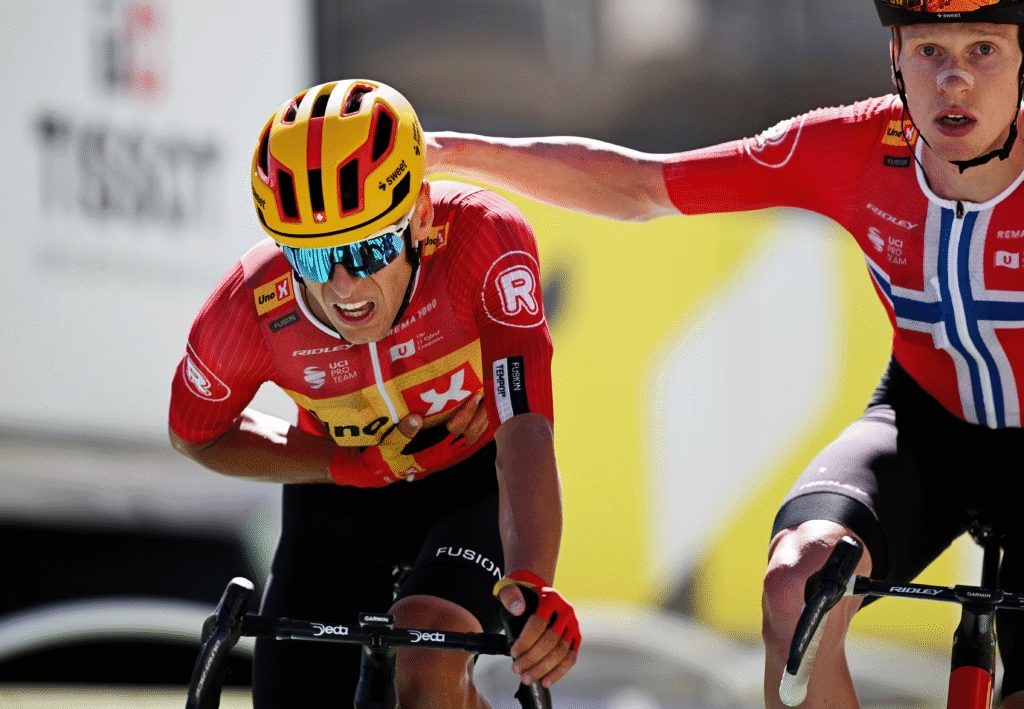 Photo Credit: Getty
Tobias Halland Johannessen
Tobias Halland Johannessen is one of the most consistently underrated Grand Tour riders in the peloton.
His results already demonstrate that he can survive three weeks at a high level, and that is important when assessing Vuelta outsiders. Plenty of riders can produce a strong climbing performance for a week. Far fewer can still do it deep into the third week of a Grand Tour.
Johannessen has shown precisely that ability.
The Vuelta should suit him. There are repeated steep climbs, fewer long periods of flat-road control than at the Tour de France and enough accumulated elevation to reward riders who simply continue producing a strong level day after day.
Uno-X Mobility also have no reason to overcomplicate his race. They do not need to defend a podium favourite or control mountain stages, meaning Johannessen can focus almost entirely on staying with the strongest possible group for as long as he can.
His main limitation is the time trial.
Against riders with stronger performances against the clock, Johannessen needs to create an advantage in the mountains rather than simply holding position.
Even so, another top-10 Grand Tour should be viewed as entirely realistic.
Dark-horse verdict: Probably the safest outsider on the list. His ceiling may be lower than some younger riders, but his three-week reliability is already proven.
 Photo Credit: Getty
Jarno Widar
Jarno Widar brings considerably more uncertainty and considerably more upside.
The Belgian is making his Grand Tour debut, meaning every projection comes with an obvious question: how does his climbing talent translate across 21 stages?
That is what makes him such an interesting dark horse.
Widar has already shown enough climbing ability to suggest he belongs at this level, but a Grand Tour introduces challenges that cannot be replicated in shorter stage races. Recovery, positioning, heat, nutrition and managing several consecutive mountain days all become part of the equation.
The Vuelta will reveal the answer quickly.
The first week includes enough significant climbing that Widar will not spend long wondering where he belongs. If he remains close to the main GC group, Lotto-Intermarché can begin thinking about the white jersey and potentially a top-10 finish.
If he loses several minutes, there is no reason to force the issue. Stage wins and development immediately become the more logical objectives.
That absence of pressure may actually help.
Young riders can sometimes build unexpectedly high classifications simply by staying close to the right group each day rather than being asked to defend a specific position.
Dark-horse verdict: The highest-upside young selection. A top 10 would represent a genuine breakthrough rather than an expected result.
 Photo Credit: Getty
Harold Tejada
Harold Tejada offers a completely different type of dark-horse case.
He is not a young rider waiting to announce himself. Instead, his 2026 season suggests he may simply be riding at the strongest sustained level of his career.
Tejada has already won at Paris-Nice this year and went close to another major result at the Tour de France, finishing second on a stage after making the decisive breakaway.
Those performances matter because they show more than basic climbing form. Tejada has been capable of repeatedly getting himself into the right races and then producing the level required when opportunities appear.
At the Vuelta, the question is whether he can translate that into GC consistency.
XDS Astana have several strong climbers but no rider arriving with an overwhelming podium expectation. That gives Tejada room to stay close to the classification without the team needing to organise everything around him.
He does not need to declare a top-10 ambition in Monaco. He can simply avoid unnecessary time losses and reassess after the first major mountain block.
The main obstacle is the time trial, where Tejada will probably concede ground to more complete stage racers.
That likely places a ceiling on his final result, but somewhere around eighth to twelfth is plausible if his climbing level remains strong.
Dark-horse verdict: A mature outsider whose 2026 form gives him a credible route towards a surprise top 10.
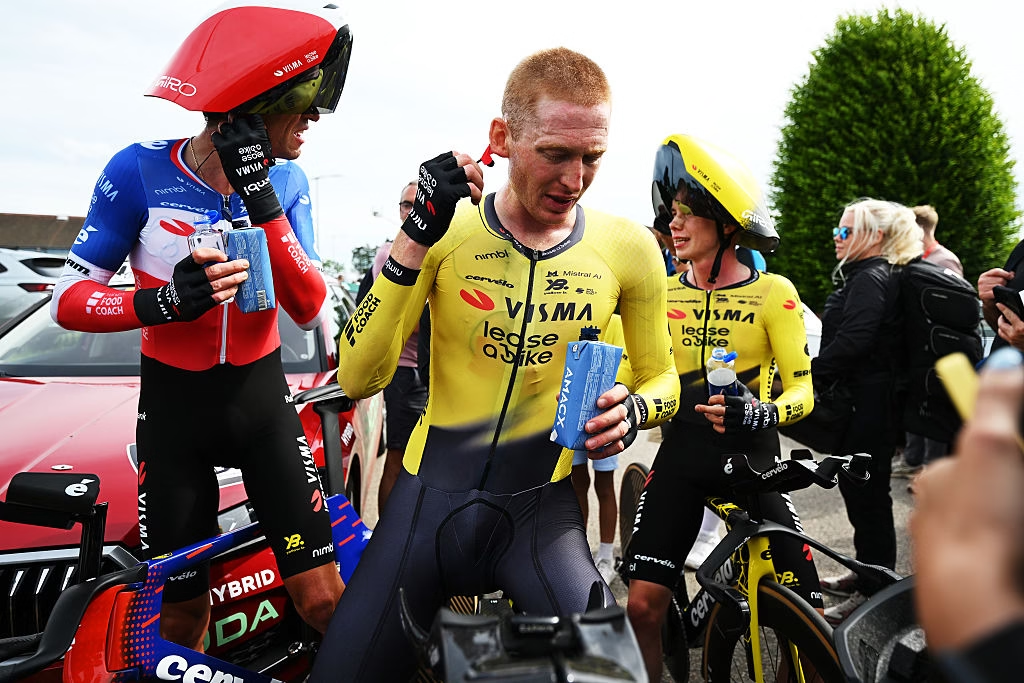 Photo Credit: Getty
Jørgen Nordhagen
Jørgen Nordhagen is another Visma rider with enough climbing potential to make the GC worth watching, even if his initial role is unlikely to revolve around protecting a classification.
That lack of responsibility may work in his favour.
Nordhagen can spend the opening mountains riding within the team’s wider tactical structure rather than worrying about defending 11th or 12th place. If he begins losing time, there is no problem. Visma can immediately use him for stages or support.
If he does not lose time, however, the situation becomes more interesting.
A young climber who repeatedly survives inside the second GC group can move surprisingly high by the third week simply because other riders begin having bad days.
The challenge is experience.
The Vuelta is not just a climbing test. Nordhagen also has to cope with three weeks of recovery, positioning and accumulated fatigue, while the longer time trial later in the race could expose the gaps in his all-round stage-racing profile.
Those uncertainties keep expectations sensible, but the upside remains significant.
Dark-horse verdict: A genuine top-10 wildcard if his climbing translates immediately to Grand Tour racing.
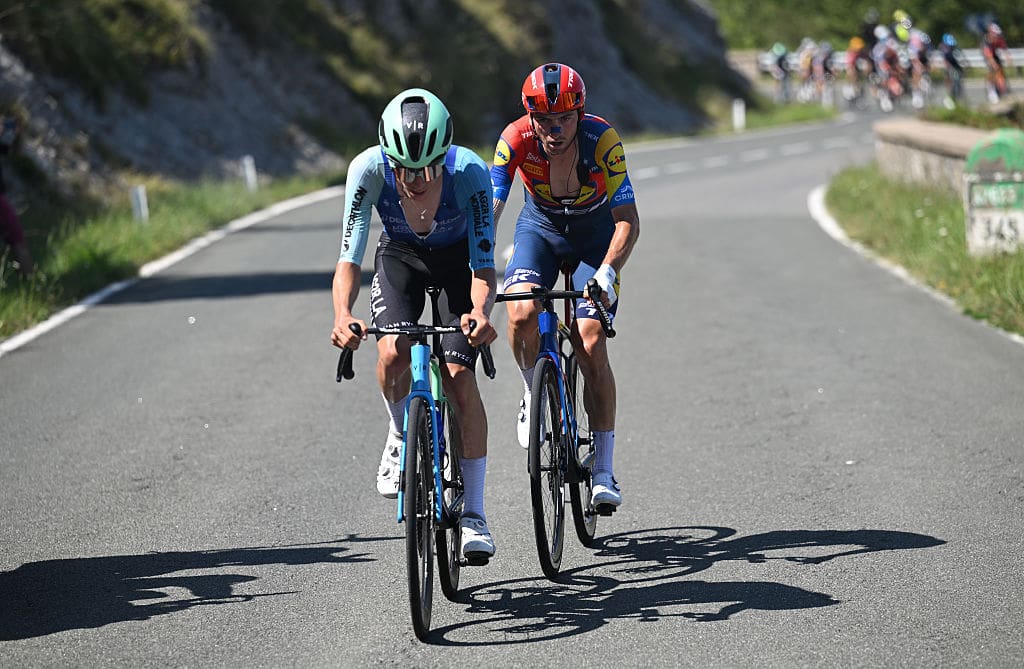 Photo Credit: Getty
Léo Bisiaux
Léo Bisiaux starts the Vuelta in one of the most interesting team environments for a young rider.
Decathlon CMA CGM already have Felix Gall targeting the podium and Matthew Riccitello carrying established GC credentials. That means Bisiaux does not need to begin the race with any pressure to defend his own position.
He can simply race.
For a developing climber, that can be an ideal situation. Bisiaux can spend the opening stages supporting the team’s leaders while quietly remaining close enough on time to see whether a classification develops naturally.
The route gives him plenty of opportunities to do so.
Repeated mountain stages reward riders who can climb consistently rather than relying on one explosive performance. If Bisiaux continues surviving deep into the second week, the lower end of the top 10 can come into view quickly.
The obvious complication is team responsibility.
If Gall is fighting for a podium place, Bisiaux will be expected to work for him. Decathlon are not going to sacrifice a major overall objective simply to preserve tenth place for a young teammate.
That makes his GC prospects highly dependent on how the race evolves.
Dark-horse verdict: A strong young climber with top-10 potential, but his own classification remains secondary to Decathlon’s larger objectives.
 Photo Credit: Getty
Luke Tuckwell
Luke Tuckwell is the longest shot among the leading outsiders.
That is not a criticism. It is what makes him a genuine dark horse.
The Australian has shown enough climbing potential to justify attention, but he enters his first Grand Tour with considerably less certainty than riders such as Tulett or Johannessen.
His position within Red Bull-BORA-hansgrohe is also complicated.
Primož Roglič remains the obvious team leader even after the disruption to his preparation. If Roglič is competitive, Tuckwell’s first responsibility will be supporting him rather than defending a personal GC result.
The opportunity appears if the race develops differently.
Should Roglič struggle or lose significant time, Red Bull suddenly have more freedom to allow their younger climbers to explore their own possibilities. Tuckwell could then become one of the riders given permission to stay high on GC or move into mountain breakaways.
The key is not to overstate what should be expected.
Simply completing the Vuelta strongly would represent useful progress. A top 10 would require a substantial leap, excellent recovery and a race in which his team role evolves favourably.
Dark-horse verdict: The true long shot. There is enough climbing ability to make him worth watching, but a high GC finish would be a genuine surprise.
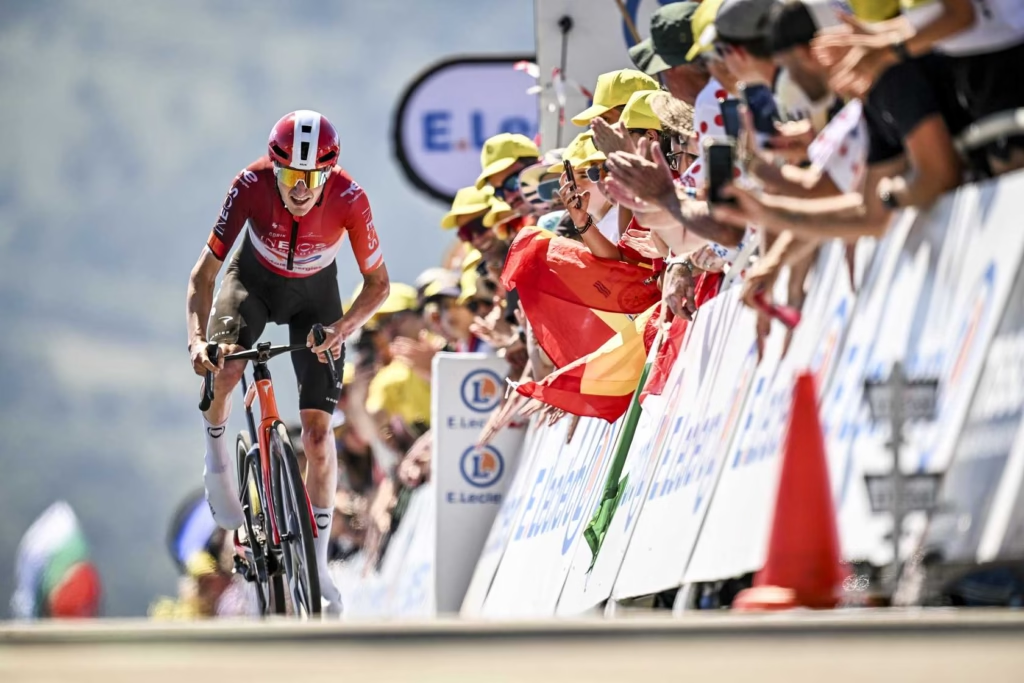 Photo Credit: A.S.O./Billy Ceusters
Why Carlos Rodríguez is already beyond dark-horse status
Carlos Rodríguez should be treated as an established GC contender rather than an outsider.
He has already finished inside the top five at the Tour de France and remains one of Netcompany INEOS’ recognised Grand Tour leaders alongside Oscar Onley.
A strong Vuelta would therefore be a return to a level Rodríguez has already demonstrated, not an unexpected breakthrough.
His experience and ability make him highly relevant to the overall race, but he belongs alongside the recognised contenders rather than riders attempting to establish a new GC ceiling.
ProCyclingUK’s Vuelta a España 2026 contenders preview covers that higher tier of riders.
 Photo Credit: Getty
Matthew Riccitello has already proved his Vuelta level
The same applies to Matthew Riccitello.
His fifth place overall and white jersey at the 2025 Vuelta changed the way he should be assessed.
Riccitello is no longer a rider whose ability to survive three weeks near the front is theoretical. He has already done it at this race.
Another top-five or top-10 finish would strengthen his position among the best young stage racers, but it would not qualify as a major upset.
His role alongside Gall is still tactically interesting, particularly if both Decathlon riders remain close on GC, but he begins the race too highly rated to fit comfortably into a dark-horse category.
 Photo Credit: Getty
Sepp Kuss is an outsider, but not an unknown
Sepp Kuss presents another unusual case.
His chances of winning the Vuelta may be much smaller than they were when he took the red jersey in 2023, particularly after the workload of racing both the Giro and Tour earlier this season.
But he is also a former Vuelta winner.
That makes him difficult to describe as a true dark horse.
Kuss may start outside the front line of favourites and his final result is unusually difficult to predict, but nobody would be shocked if one of the best Grand Tour climbing domestiques of his generation produced another strong race in Spain.
He remains an important Visma card, just not a breakthrough outsider.
 Photo Credit: Getty
Jay Vine has the legs, but not necessarily the freedom
Jay Vine is another rider whose ability alone makes a high GC finish plausible.
The problem is his job.
UAE Team Emirates-XRG have built the race around Tadej Pogačar, with João Almeida providing another elite climbing option. Vine’s primary responsibility is helping Pogačar win the Vuelta rather than protecting his own seventh or eighth place.
That distinction is crucial.
A rider can have top-10 legs and finish much lower because he empties himself working for a team leader.
Vine is therefore more interesting as a potential mountain stage winner or climbing domestique than as a genuine GC dark horse.
The Vuelta a España 2026 team-by-team guide looks at how those internal team roles shape the race.
The Vuelta route gives the outsiders nowhere to hide
The 2026 route should expose weak points quickly.
The short Monaco time trial opens the race before significant climbing arrives almost immediately, while the middle and final weeks repeatedly return to the mountains.
That creates a difficult balancing act for the outsiders.
Pure climbers such as Johannessen, Widar, Nordhagen and Bisiaux need to make enough difference uphill to protect themselves before the longer time trial. Tulett has a more balanced profile and should have fewer reasons to fear that stage.
Tejada’s best route is likely to involve consistency. He may not be the rider producing the most spectacular attacks, but avoiding a catastrophic mountain day is often more valuable for riders targeting seventh or eighth overall.
For Tuckwell, the first objective is simply surviving at a sufficiently high level for the GC question to remain relevant.
The full Vuelta route guide shows how frequently the classification can change. There are too many difficult stages for a rider to bluff his way through three weeks.
-
 Photo Credit: A.S.O./Billy Ceusters
The strongest Vuelta 2026 GC dark horses
1. Ben Tulett
The strongest overall dark-horse selection. Recent form, a balanced skill set and Visma’s flexible race structure give him a realistic route towards the top 10.
2. Tobias Halland Johannessen
The most proven three-week rider in this group. His consistency makes him one of the safest outsiders, although the time trial limits his upside.
3. Jarno Widar
The high-ceiling choice. His climbing talent is obvious, but his first Grand Tour means a top-10 challenge would still represent a genuine breakthrough.
4. Harold Tejada
Strong throughout 2026 and experienced enough to capitalise if more fancied GC riders begin to falter.
5. Jørgen Nordhagen
A talented young climber with little immediate pressure and the chance to let his classification develop naturally.
6. Léo Bisiaux
Another rider with the climbing ability to move surprisingly high, although his responsibilities to Gall and Riccitello complicate the picture.
7. Luke Tuckwell
The most speculative choice. A strong Vuelta would be a major step forward, but the potential is enough to make him worth following.
Who is the best Vuelta dark-horse pick?
Ben Tulett stands out as the strongest dark-horse choice.
He occupies the ideal space between proven ability and genuine uncertainty. His recent results suggest he can compete with riders who will start the Vuelta expecting top-10 finishes, but he has not yet produced the Grand Tour GC result that would make another one routine.
Tobias Halland Johannessen offers greater three-week certainty, while Jarno Widar has more unknown upside. Harold Tejada is the less fashionable option who could quietly keep moving upwards, and Nordhagen may be the rider whose status changes most dramatically during the opening week.
That is where the real interest lies.
Pogačar may make the identity of the favourite obvious, but Grand Tours are rarely predictable from fifth place downwards. One badly timed illness, one rider exceeding expectations or one unexpected collapse in the third week can completely reshape the top 10.
The full Vuelta a España 2026 start list contains enough young climbers and secondary leaders for that battle to remain wide open.
For Tulett, Johannessen, Widar, Tejada, Nordhagen, Bisiaux and Tuckwell, the opportunity is the same: stay close long enough, survive the days that break others, and turn an outsider’s Vuelta into the biggest general classification result of their careers.

