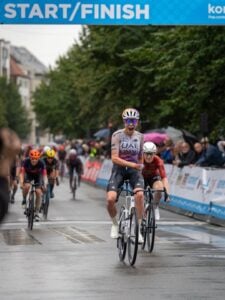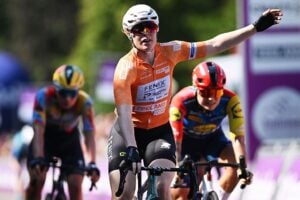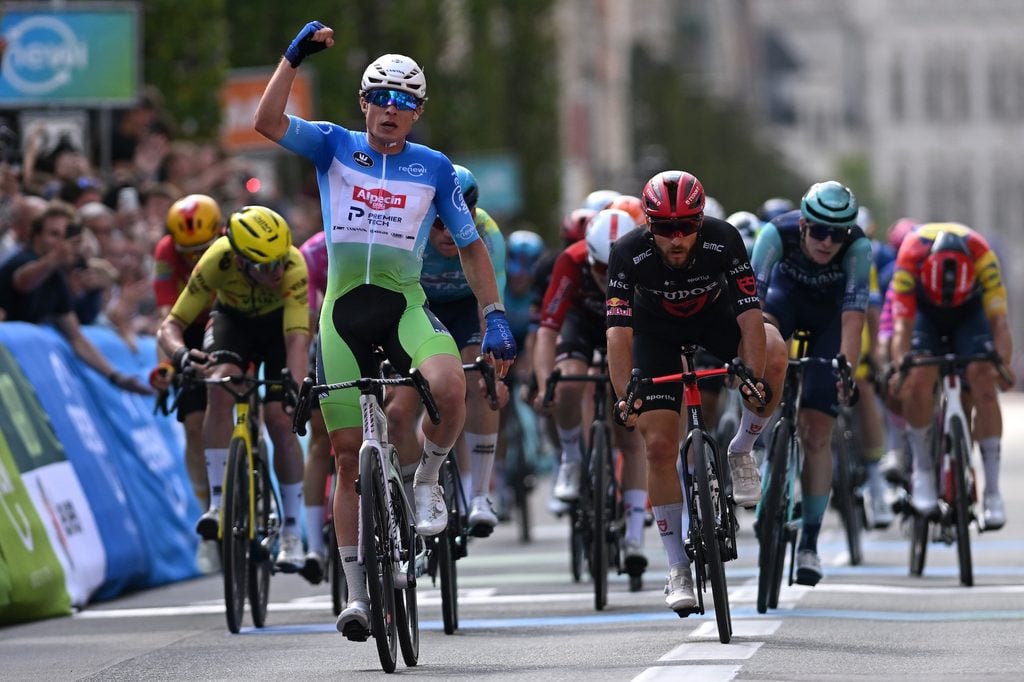
Jasper Philipsen won stage 5 of the 2026 Renewi Tour in Leuven, taking his third stage victory of the race and sealing the overall title after a chaotic final-day sprint.
The Alpecin-Premier Tech rider started the day in the leader’s jersey with only a narrow advantage over Jenno Berckmoes, but he controlled the decisive moments himself before finishing the job in the sprint on Bondgenotenlaan. Luca Mozzato finished second for Tudor Pro Cycling Team, with Mike Teunissen third for XDS Astana Team.
Philipsen’s final-stage victory completed a dominant end to the race. He had already won stage 2 in Ardooie and stage 4 in Bilzen-Hoeselt, then added the Leuven finale to secure the general classification by 14 seconds from Berckmoes. Olav Kooij completed the final podium at 20 seconds.
A final stage around Leuven with seconds still at stake
Stage 5 started and finished in Leuven, with 183.7 kilometres around one of Belgium’s major cycling cities.
The route was not a flat procession. Leuven has become a regular finale for the Renewi Tour, and the course again used roads associated with the 2021 World Championships, the Tour of Leuven and the Memorial Jef Scherens. That meant repeated accelerations, short climbs, technical roads and a finish that could still reward either a reduced sprint or a late attack.
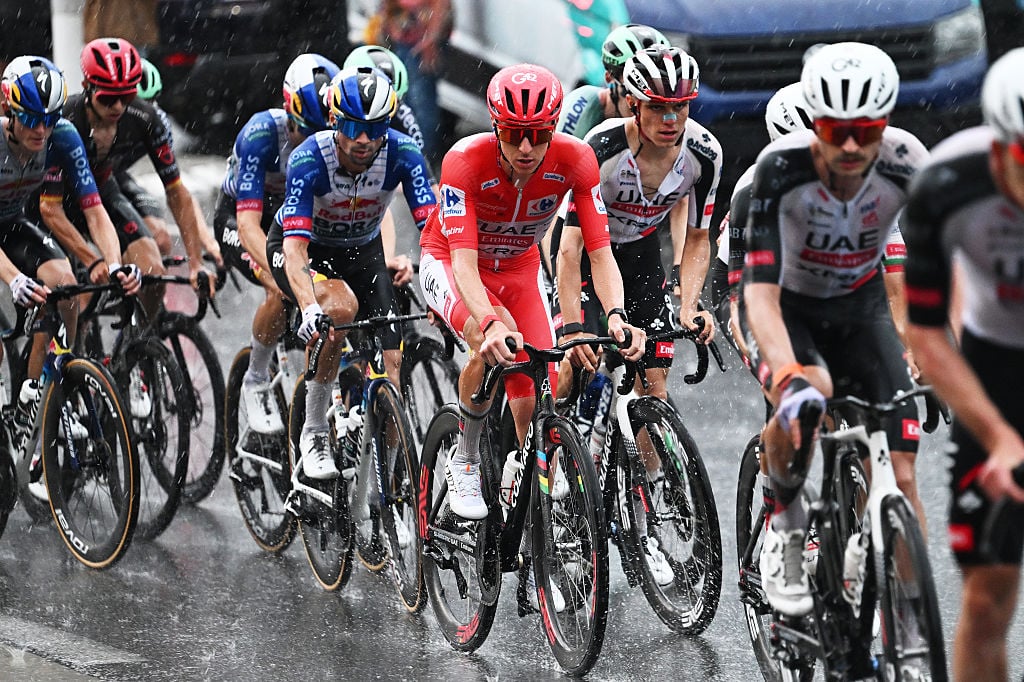
Philipsen began the day with a 4-second lead over Berckmoes. Kooij was third at 10 seconds, while Teunissen, Quinten Hermans, Alec Segaert, Søren Wærenskjold and Matteo Trentin were also close enough to keep the stage sharp.
The equation was clear. Philipsen had the fastest sprint, but not enough of a cushion to ride passively. Berckmoes only needed one moment, one Green Kilometre, one split or one late attack to put the blue-green jersey back under pressure.
That made the final day much more than a simple sprint stage.
De Lie out before the start
The stage began without Arnaud De Lie, who did not start because of illness.
That removed one of the most obvious disruptors from the finale. De Lie had won the Leuven stage and overall title in 2025, and his combination of climbing resistance, sprint power and aggression would have made him a major threat on the same roads a year later.
His absence changed the balance for Lotto-Intermarché. Berckmoes still had a realistic path to the overall, but the team no longer had De Lie as a second late-race card if the finish came back together.
There was another non-starter in Lukáš Kubiš, while Maikel Zijlaard abandoned early. It had already been a race marked by attrition, crashes and changing leaders, and the final day continued that pattern.
Six riders form the main breakaway
The stage began aggressively, with Frederik Frison of Pinarello-Q36.5 and Robert Stannard of Bahrain Victorious attacking from kilometre zero.
They were later joined by Edward Theuns of Lidl-Trek, Emil Herzog of Red Bull-Bora-Hansgrohe, Dries De Bondt of Team Jayco AlUla and Hartthijs de Vries of Unibet Rose Rockets, creating a six-rider breakaway.
The move built a lead of around 2:45 and gave the stage its main early structure. It was a strong enough group to make the peloton work, but not so dangerous that the race immediately tipped away from the GC contenders.
For Philipsen, the breakaway was useful in one sense. It kept bonus seconds away from riders behind him, provided the gap stayed manageable. But it also forced Alpecin-Premier Tech and the other interested teams to judge the chase carefully. Leave the leaders too long, and the stage win disappears. Bring them back too early, and the final circuits become a platform for attacks.
The peloton initially allowed the break to settle, but the race changed once the final 70 kilometres approached.
NSN and Decathlon CMA CGM lift the chase
When the six leaders came together properly with around 70 kilometres remaining, the urgency increased behind.
NSN Cycling Team and Decathlon CMA CGM were among the teams working to reduce the gap, with Kooij’s GC position and sprint chances giving Decathlon a clear reason to keep the race within reach. NSN had Biniam Girmay as a sprint option, and the Leuven finish still looked possible for the fast men if the break could be brought back.
With 50 kilometres remaining, the break still had more than 2 minutes. That was enough to keep the stage open. The leaders were not fading quickly, and the peloton still had to handle the technical Leuven circuits and late attacks from teams with GC ambitions.
By 25 kilometres to go, the gap had fallen to 46 seconds. UAE Team Emirates-XRG then added riders to the chase, showing that they had plans for the final rather than simply waiting for the sprint.
At that point, the stage was perfectly balanced. The break was close enough to be caught, but still far enough ahead to encourage more attacks from behind.
UAE Team Emirates-XRG light up the final 10km
The first major late move came from UAE Team Emirates-XRG with 10 kilometres remaining.
Mikkel Bjerg led Florian Vermeersch into a powerful attack, splitting the front of the peloton and briefly putting Philipsen under direct pressure. It was exactly the kind of move that could have complicated the overall battle. Vermeersch had the strength for the roads, and the acceleration came at a point where hesitation behind could have created a meaningful gap.
The problem was that too many riders followed. The group that formed was large, cooperation was poor, and the race soon came back together.
Still, it had an impact. It forced Philipsen and Alpecin-Premier Tech into a much more active defensive mode. The stage was no longer being controlled by a neat sprint train. It had become a series of attacks, counters and short regroupings, with the race leader needing to stay close to every serious move.
That suited the Classics-style riders and kept Berckmoes in the game.
Bittner and Kopecký bridge across
The attacks continued after Vermeersch’s move came back.
Pavel Bittner of Team Picnic PostNL and Matyáš Kopecký of Unibet Rose Rockets bridged across to the remnants of the breakaway, briefly refreshing the front of the race and forcing another response from behind.
It was a dangerous moment because the original break had been out front for much of the stage and was now close enough for late attackers to use as a springboard. A fresh rider joining a tired move can change the rhythm immediately, especially on a circuit where the bunch is already stretched and watching the GC battle.
But the renewed front group did not survive. Berckmoes then surged from behind, bringing Philipsen to the front of the race with him and effectively ending the breakaway’s long day out.
That was the clearest sign of Philipsen’s control. He was not relying only on teammates. When Berckmoes moved, Philipsen was there.
Berckmoes tests Philipsen
Berckmoes had no option but to attack.
The Lotto-Intermarché rider began the day only 4 seconds behind Philipsen, but he could not expect to beat him in a sprint. His best route to victory was to force the race into a split, take bonus seconds or make Philipsen chase too often before the finish.
His move inside the final 6 kilometres was the most important GC attack of the day. It brought Philipsen forward, disrupted the sprint structure and briefly created the possibility that the overall might still be pulled away from Alpecin-Premier Tech.
Philipsen responded calmly. He marked Berckmoes closely, refused to give him space and made sure that the Lotto-Intermarché rider could not use the final climbs and technical sections to create separation.
That was the decisive GC moment. Once Philipsen had survived Berckmoes’ attack, the race began to move back towards a sprint. Berckmoes would still finish sixth on the stage, but he had not managed to shift the leader.
Late attacks keep the sprint uncertain
Even after the GC attack was neutralised, the stage was not settled.
Tim van Dijke went on the attack with 3.9 kilometres remaining and was joined by Pepijn Reinderink. That move did not last, but it added to the disorder in the final phase. The sprint teams were no longer in a comfortable line, and Philipsen’s own lead-out was being steadily eroded by the constant accelerations.
Matej Mohorič also tried to influence the finale, attacking late as Bahrain Victorious looked for a way to avoid a straight sprint. The pattern was clear: nobody wanted to take Philipsen to the line, but nobody was able to get far enough clear to remove him from the equation.
Every attack had the same effect. It made the finale more chaotic, but it did not crack Philipsen. If anything, it forced him into the kind of alert, instinctive racing where he is at his best.
Then a crash inside the final 2 kilometres disrupted the run-in further.
Crash disrupts the final 2km
A crash with around 1.8 kilometres remaining brought down several riders, including Girmay and Michael Valgren.
The incident disrupted the sprint preparation and made the final even less organised. Philipsen was left without the kind of clean lead-out a sprinter would normally want, while other teams had to improvise quickly as the road rushed towards the finish.
For Girmay, it was a particularly frustrating end. He had been one of the riders who might have contested the sprint if the stage came back together, but the crash removed him from the fight at exactly the wrong moment.
The crash also opened the door for one last attack. With the bunch briefly disorganised and riders trying to reset after the fall, Carl-Frederik Bévort saw his chance.
Bévort almost steals it
Bévort attacked inside the final kilometre and briefly looked as though he might steal the stage.
The Uno-X Mobility rider went clear as the peloton hesitated, using the confusion from the crash and the fractured sprint trains to open a gap. It was a clever move. After such a hard, stop-start finale, the bunch was not moving with the same cohesion as a normal sprint chase.
XDS Astana Team helped keep the gap manageable, but Bévort still carried the move deep into the final few hundred metres. For a moment, the sprinters had left it too late.
Philipsen then came across.
The Belgian launched early, surged up to Bévort’s wheel and used the Dane’s effort as the final slingshot. Bévort’s move had been strong, but Philipsen’s speed was too much. He came past before the line and kept going clear.
It was a fitting finish to his race: alert enough to cover the GC attacks, strong enough to survive the chaos, and fast enough to finish the job without a full lead-out.
Philipsen wins by clear daylight
Philipsen crossed the line first in 4:06:49, taking his third stage win of the week and confirming the overall victory.
Mozzato finished second after another strong sprint for Tudor Pro Cycling Team, with Teunissen third for XDS Astana Team. Filippo Fiorelli was fourth for Team Visma | Lease a Bike, ahead of Alessandro Borgo of Bahrain Victorious and Berckmoes in sixth.
Marijn van den Berg took seventh, Bévort held on for eighth after his late attack, with Toms Skujiņš and Kim Heiduk completing the top 10.
The result sheet underlined the nature of the stage. It was won by a sprinter, but the top 10 was filled with riders who could handle a hard, technical and aggressive final circuit. This was not a simple bunch gallop. It was a sprint after the race had been repeatedly pulled apart.
Philipsen was simply the rider who had survived the disruption best and still had the fastest finish.
Overall victory for Philipsen
Philipsen finished the Renewi Tour 14 seconds ahead of Berckmoes, with Kooij third at 20 seconds.
That final margin was larger than the gap he started the day with, which shows how effectively he turned defence into attack. He did not just protect the jersey. He won the stage, took the final bonuses and removed any doubt about the overall classification.
Teunissen finished fourth overall at 32 seconds, with Hermans fifth at 33 seconds. Segaert and Wærenskjold were both 37 seconds down, ahead of Trentin, Robert Donaldson and Fiorelli in the final top 10.
It was Philipsen’s first overall victory in a WorldTour stage race, and it came in a race that was never designed for a pure GC rider. The Renewi Tour is about seconds, positioning, short climbs, sprint bonuses and survival. Philipsen managed all of those better than anyone else.
Berckmoes fights to second overall
Berckmoes could not repeat his Geraardsbergen raid, but his second place overall was still one of the strongest rides of the week.
He had taken the race lead on stage 3 with a brilliant attack alongside Segaert over the Muur van Geraardsbergen, then went solo on De Vesten to win the stage and take the jersey. Even after losing it to Philipsen in Bilzen-Hoeselt, he remained close enough to make the final day meaningful.
In Leuven, he did what he had to do. He attacked, forced Philipsen to respond and tried to drag the race away from a sprint. The problem was that Philipsen was too sharp. Every time Berckmoes moved, the race leader was there.
That does not diminish Berckmoes’ race. He won the hardest stage, finished second overall and helped make the Renewi Tour far more than a sprinters’ sequence.
Kooij finishes third after near misses
Kooij completed the final podium after another consistent week.
The Decathlon CMA CGM rider finished third overall at 20 seconds, but his race will also be remembered for near misses. He lost stage 1 to Jonathan Milan in a photo finish, then lost stage 4 to Philipsen by another tiny margin. Those seconds mattered in both the stage count and the general classification.
Leuven did not bring the stage win he had been chasing. He finished safely in the front group, but without the final kick needed to challenge Philipsen again.
Still, third overall in a race decided by sprint speed, bonuses and short climbs is a strong result. Kooij was present throughout. Philipsen simply converted his chances more ruthlessly.

A record-equalling Renewi Tour for Philipsen
Philipsen’s third stage win of the week also gave him six career stage victories at the race, drawing him level with André Greipel’s record.
That matters because this was not only a one-week burst of form. Philipsen has now built a real history in the race, and the 2026 edition added something new: not just stage wins, but the overall title.
His consistency made the difference. He was fourth on stage 1, won stage 2, finished second on the Muur stage in Geraardsbergen, won stage 4 in Bilzen-Hoeselt and then won again in Leuven. In a race where the classification was shaped by tiny gaps, those repeated high finishes were decisive.
The sprint wins were the headline. The overall came from never missing the front of the race.
A race decided by centimetres, bonuses and control
The 2026 Renewi Tour was one of fine margins from the start.
Milan beat Kooij in a photo finish on stage 1. Philipsen won stage 2 after chaos and crashes removed several rivals. Berckmoes took stage 3 through timing, bonus seconds and a late attack that survived by metres. Philipsen beat Kooij by a tyre-width on stage 4, then sealed the race in Leuven after marking Berckmoes and catching Bévort late.
That sequence explains the race. There were no high mountains and no time trial, but there was constant tension. Every sprint, split, crash and bonus second mattered.
Philipsen won because he had the fastest sprint, but also because he raced like a general classification contender when required. In Leuven, that meant following Berckmoes, staying calm after the crash, reacting to Bévort and still delivering a sprint strong enough to win clearly.
The final stage did not simply confirm the strongest sprinter. It confirmed the rider who had managed the whole week best.
Renewi Tour 2026 stage 5 result
Data powered by FirstCycling.com
Renewi Tour 2026 final general classification
Data powered by FirstCycling.com
Main photo credit: Getty