A rider can be strong enough to win a cyclocross race and still lose it on the wrong tyres. A rider who gets the pressure right can stay seated through a slippery corner, carry speed across rough grass and ride a bank that forces someone else to dismount. Get it wrong and the bike can feel nervous, slow or impossible to control, even when the rider has plenty of power.
There is no single correct cyclocross tyre pressure. Rider weight, tyre construction, rim width, ground conditions, riding style and the manufacturer’s permitted range all matter. Tread choice is just as important: a fast file tread can be excellent on firm ground but a liability in deep mud, while aggressive knobs may find grip in winter conditions at the cost of speed on hard surfaces. The answer is on the course, not on a pressure chart copied from somebody else’s bike.
How tyre pressure changes grip and speed
Lower pressure allows the tyre to deform around bumps and irregular ground. On rough grass and slippery cambers, that can increase the area of tread working against the surface and help the wheel stay in contact with the ground. The bike often feels calmer, particularly when the rider is leaning through a turn or trying to keep traction while climbing out of the saddle.
There is a point where the search for grip starts costing control and reliability. As pressure falls, the tyre can start to squirm under cornering load, the rim may strike the ground and a tubeless bead may lose its seal. With an inner tube, a sharp impact can trap the tube against the rim and cause a pinch puncture. The lowest pressure that feels fast on a smooth straight is not necessarily a safe or effective pressure for the whole lap.
More pressure can feel efficient on a smooth, dry surface, especially when there is little need for the tread to deform. On broken ground, however, an overinflated tyre bounces over the bumps rather than following them. The rider loses momentum and has to work harder to hold a line. Speed comes from a tyre that grips without squirming or smashing the rim, not from chasing the smallest number on a gauge.
Front and rear tyres do different jobs. The front wheel controls steering and is often the first to reveal a lack of grip on an off-camber turn. The rear carries much of the drive and may need more support against impacts or rim strikes. Many riders experiment with slightly different pressures front and rear, but the appropriate difference depends on weight distribution, tyre construction and how the bike behaves under load.
Why there is no universal pressure number
Two riders on nominally identical 33mm tyres can need very different pressures. A lighter rider may be able to run less pressure without the casing folding in a corner, while a heavier rider may need more support to avoid bottoming out. Rim internal width changes the inflated shape of a tyre, and a nominal 33mm casing can measure differently on different wheels. Tubular, tubeless and clincher systems also have different limits and failure modes.
Professional cyclocross riders sometimes use very low pressures with specialist tubular systems, but that is not a safe recommendation to copy blindly onto an ordinary tubeless wheel. Tyre manufacturers publish minimum and maximum pressures for particular models, and those figures may vary markedly between constructions. A shop’s advice for a tubular racing tyre should not be applied automatically to a tubeless-ready model with a different bead and rim interface.
Published pressure charts can provide a starting point, but they do not know whether your course has hidden roots, concrete steps, deep ruts or a dry, smooth finish straight. They also cannot account for a tyre that sits loosely on one rim and securely on another. Start within the limits specified for the exact tyre and rim, then adjust in small steps after riding a representative section of the course.
If the rear rim is striking the ground, the tyre folds when you turn sharply, or you hear air escaping from a tubeless bead, the setup needs attention. Increasing pressure may solve the problem, but so might choosing a stronger casing, checking rim compatibility or switching to a more appropriate tyre. Persistently running below the manufacturer’s stated minimum is not a sensible shortcut to extra grip.
File tread, intermediate and mud tyres
A file tread has a relatively low, closely packed centre pattern. It rolls quickly on firm grass, dry earth and hard-packed surfaces where tall knobs would flex without digging into anything useful. The side knobs still matter, because cornering grip comes from the outer part of the tread once the bike is leaned over. A file tread is less convincing when the surface becomes soft enough that the centre pattern cannot clear mud or bite into the ground.
Intermediate tyres sit between those extremes. Their knobs are more pronounced than a pure file tread but less aggressive than a dedicated mud pattern. They earn their place on mixed laps, where damp grass, muddy corners and firm tracks demand different things from the same tyre. For many amateur riders, an intermediate pattern is the most versatile single tyre to own.
Mud tyres use taller, more widely spaced knobs designed to penetrate soft ground and release accumulated dirt as the wheel turns. A pattern that clears itself is important because a tyre packed solid with clay can behave almost like a slick. Michelin’s Cyclocross Mud and Schwalbe’s X-One RX Pro illustrate the approach, with spaced or flexible lugs intended for soft, wet courses.
On a dry course, a mud tyre may be slower and less predictable than a lower-profile alternative. The tall knobs can flex on hard surfaces, and the extra tread is not automatically better on every corner. Choosing a tyre because the calendar says it is winter is less useful than inspecting the ground. A November race on frozen or baked-hard earth may suit a very different pattern from a wet October race on deep grass.
Choosing tyres for sand, grass, mud and hard ground
Sand asks different questions from clay. Deep sand can swallow a narrow wheel and punish abrupt steering inputs, while a fast, relatively open tread may allow the tyre to float and track more smoothly than a very aggressive mud pattern. Loose sand, compacted sand and sand interrupted by hard exits are three different problems. Technique is central: riders often benefit more from carrying momentum and avoiding sharp steering than from chasing a magic tread design.
On wet grass, grip can disappear without warning. The tyre needs enough edge to hold a line, but a pressure setting that allows controlled deformation may matter just as much as knob height. A fast file tread on slightly damp grass can work beautifully until one shaded camber becomes greasy. Riders should inspect the hardest corner rather than judging the whole course from the start straight.
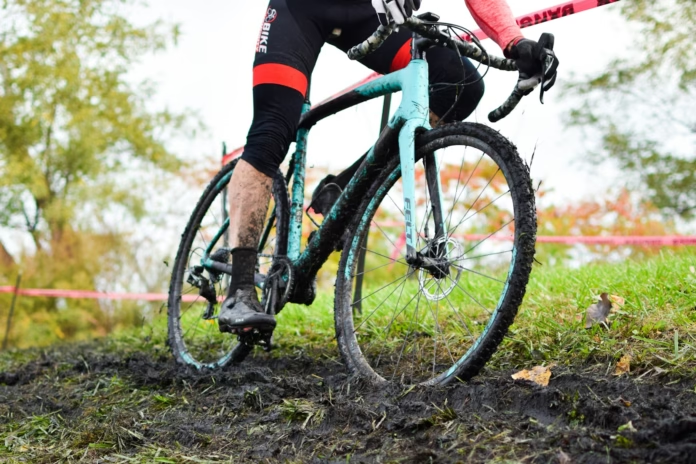
Heavy clay is where a genuine mud tyre earns its place. Wide gaps between knobs help the tread shed material instead of collecting it. A clogged tyre may be slow even if its rubber is soft and its pressure is low. Bike clearance also becomes a factor: mud can build around the fork, chainstays and brakes, making regular pit changes important. Our guide to riding sand, mud, banks and barriers explains the handling side of those choices.
Hard-packed dirt and short tarmac sections reward a faster-rolling tread, but they can hide sharp stones and ruts. The best compromise is often a tyre that feels secure on the most difficult part of the lap rather than the one that is quickest on the easiest part. Losing a second on each straight is frustrating; losing half a minute after sliding out on the same corner is worse.
Tubular, tubeless and inner tubes
Tubular tyres have long been associated with top-level cyclocross because the tyre is attached to a dedicated rim and can offer a supple ride at low pressure. They are expensive, require careful installation and are less convenient to repair. A rider using tubulars also needs to understand the particular tyre’s pressure limits and the consequences of a poor bond to the rim.
Tubeless setups are increasingly common because they avoid a conventional inner tube and allow many punctures to seal automatically. They can work extremely well, but the rim and tyre must be compatible and the bead must remain secure under lateral load. Burping, where air escapes briefly during a hard corner, is a real risk if pressure is too low or the fit is unsuitable. Sealant also needs maintenance, especially through a long winter.
A clincher with an inner tube remains a practical option for riders who want straightforward repairs and lower running costs. It may need more pressure to protect against pinch punctures, which can limit traction on very rough courses. Budget and the amount of maintenance you are willing to do matter as much as outright performance. A dependable setup that survives every lap is worth more than a theoretically faster one that fails on the first impact.
UCI-regulated cyclocross events also impose tyre-width restrictions, traditionally a maximum measured width of 33mm for the main categories. The important word is measured: tyre labels do not guarantee the mounted width, because rim dimensions and inflation affect the final result. Local amateur races may have different rules, so check the regulations for the event you are entering rather than assuming every race applies the same equipment standard.
A practical pre-race pressure test
Arrive early enough to ride the most awkward parts of the course before choosing a final setting. Check the manufacturer’s pressure range for your exact tyre and rim, inflate both wheels with a reliable gauge and note the readings. Use the same gauge each time; consistency makes the test useful. If you always use the same one, you can compare changes from one race to the next.
Ride a lap at a controlled pace, then test the most demanding camber, corner, climb and rough descent at something closer to race speed. Notice whether the front pushes wide, the rear spins on climbs, the casing squirms in corners or the rim hits the ground. Change one variable at a time, ideally in small pressure increments, and repeat the same section. If the problem persists, consider a different tread rather than continuing to lower the pressure.
Tyre choice and pressure should be treated as a pair. An intermediate tyre at a suitable pressure may be better on mixed ground than a mud tyre that feels vague on hard sections. Conversely, a file tread cannot be rescued by pressure adjustments if the ground is too soft for its knobs to find purchase. Riders with two wheelsets can make a late change if the weather shifts; those with one should favour the safest compromise for the hardest part of the lap.
Before the start, check for cuts, loose beads, sealant leaks and anything caught in the tread. Inspect the rim after a heavy impact, and do not assume a tyre that held air in the car park will behave identically after repeated cornering forces. Our cyclocross rules and pit guide covers why riders change bikes and how the service area works during a race.
What beginners should prioritise
A beginner does not need three expensive wheelsets to race cyclocross. One dependable intermediate tyre, a compatible wheel and a gauge you trust are enough to learn a great deal. Start with pressures that respect the manufacturer’s specifications and focus on riding clean lines. As experience grows, note which corners cause problems and whether the issue is lack of traction, poor technique or an unsuitable tread.
Do not copy a professional rider’s pressure without knowing their tyre construction, body weight and equipment. The number itself is not a badge of skill. The useful skill is recognising when the bike is bouncing, folding, slipping or striking the rim and making a measured change. Practise on familiar ground before experimenting at the start of an important race.
For riders new to the discipline, our beginner’s guide to cyclocross explains the race format, bikes and course features. The tyre decision becomes easier once you understand what the bike is being asked to do: accelerate repeatedly, hold a line on changing surfaces and stay predictable when fatigue makes every correction harder.