
No. The cancelled Stage 3 of the 2026 Vuelta a España will not be moved to another day or added back into the race later.
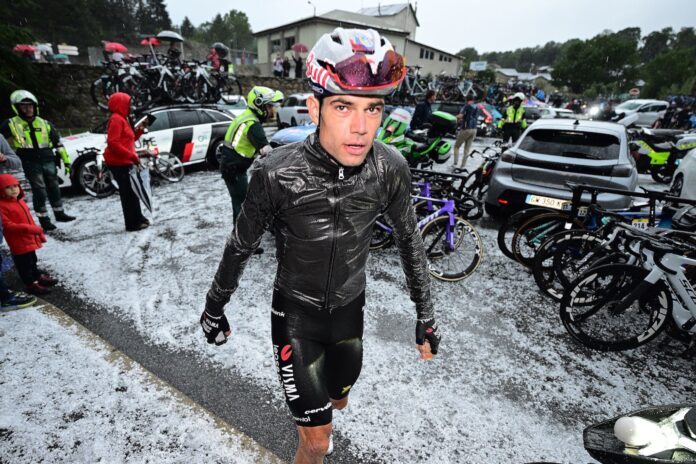
The stage from Gruissan-Aude to Font-Romeu was stopped on the Col de Mont-Louis after severe hail and extreme weather hit the Pyrenees. Racing was initially neutralised as riders sought shelter, but organisers subsequently went further and cancelled the stage completely.
That distinction matters. The Font-Romeu stage has not been postponed. There will be no attempt to race it again later in the Vuelta and no replacement date has been added to the schedule.
Instead, the race resumes on Tuesday 25 August with the 104.8km Stage 4 around Andorra la Vella exactly as originally planned.
What does a cancelled cycling stage actually mean?
A cancelled stage does not produce a stage winner or finishing times.
Stage 3 had already covered most of its scheduled 174 kilometres when the weather became too dangerous to continue, but that does not turn the day into an automatically shortened stage. Organisers did not establish an alternative finish line or take general classification times from the point where racing stopped.
There is therefore no official Stage 3 finishing result.
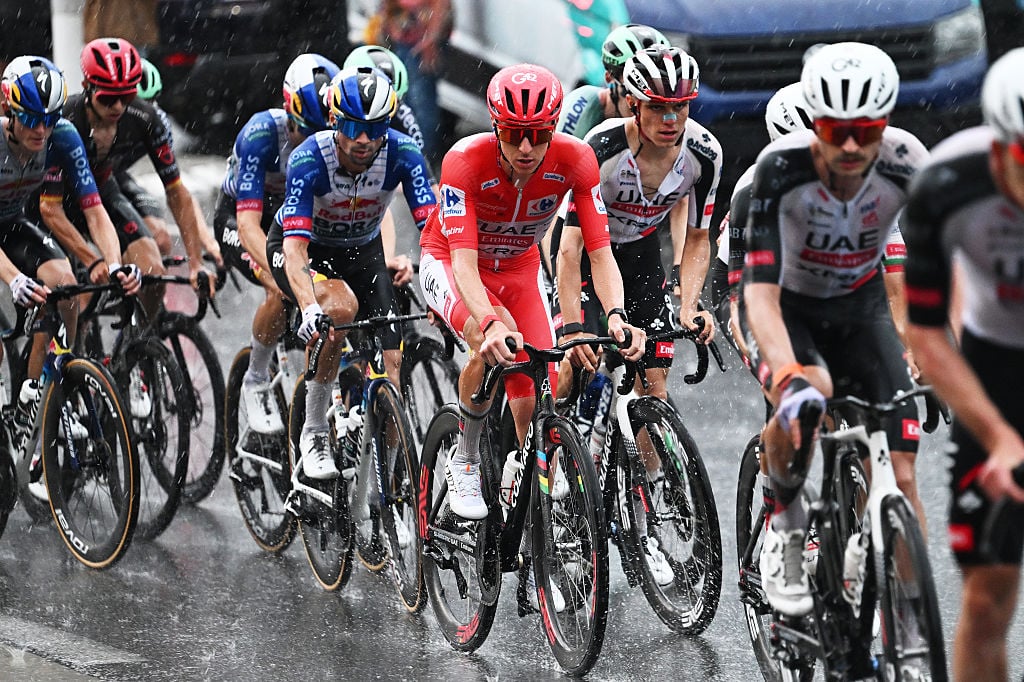
Tadej Pogačar remains in the red jersey going into Andorra, with the overall standings unchanged by the unfinished final part of the stage. He leads Wout van Aert by nine seconds, with Matthew Brennan third at 10 seconds.
For a fuller account of how the day unfolded, including the breakaway, the deteriorating weather and the eventual decision to stop, see our Vuelta a España Stage 3 report.
Importantly, cancellation does not necessarily erase everything that happened before the race was stopped. Ethan Hayter had already won the intermediate sprint at Villefranche-de-Conflent before the cancellation and those points counted towards the points classification. What disappeared was the stage finish itself and the classifications that would have depended on riders reaching Font-Romeu.
The distinction is therefore more precise than simply saying Stage 3 never happened. It was raced for much of the day, but it did not produce a completed stage result.
What is the difference between a neutralised and cancelled stage?
A neutralisation does not automatically mean a stage is finished.
Race organisers can temporarily suspend competitive racing because of dangerous weather, crashes, road conditions or another safety issue. Depending on the circumstances, the riders may slow down, stop completely or regroup before racing starts again.
That was initially the situation on the Col de Mont-Louis.
As the hail intensified, riders stopped and sought shelter while the race organisation assessed whether it would be possible to resume. At that point, Stage 3 had been neutralised rather than cancelled.
The problem was that conditions did not improve sufficiently to restart safely. Riders had become scattered while seeking shelter, the weather remained severe and recreating the race situation before the stoppage would have been extremely difficult.
The organisers therefore abandoned the possibility of restarting and declared the stage cancelled.
Once that happened, there could be no stage winner and no GC times from Font-Romeu.
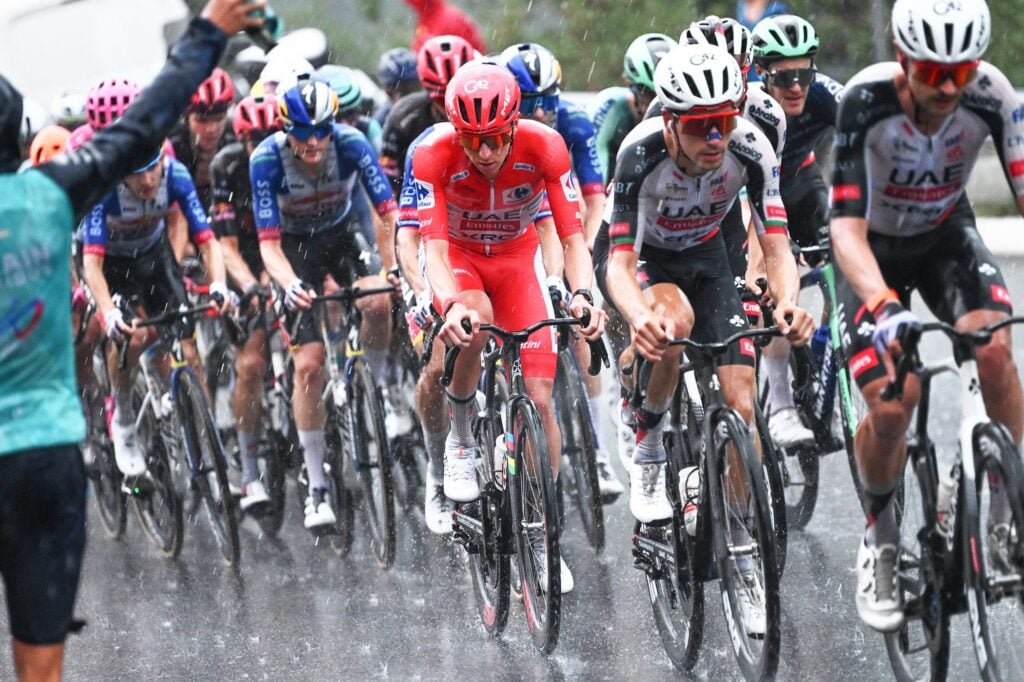 Photo Credit: Getty
Will the Font-Romeu stage be raced later in the Vuelta?
No.
This is the practical point likely to cause the most confusion.
A cancelled Grand Tour stage is not normally held in reserve for the next rest day or inserted elsewhere in the race. The Vuelta has a fixed schedule, with transfers, road closures, television production, police support, accommodation and thousands of staff all organised around each day’s route.
Font-Romeu therefore simply disappears from the competitive programme.
The original 2026 Vuelta route contained 21 stages. With Stage 3 cancelled, the race can now finish with only 20 completed stages unless another later stage is affected.
There is no extra Font-Romeu stage waiting to be fitted into the second or third week.
Why can’t the Vuelta just race Stage 3 tomorrow?
Because Tuesday already has its own stage.
The peloton is scheduled to race a short but extremely demanding loop around Andorra la Vella, packing three Category 1 climbs and almost 3,000 metres of ascent into just 104.8 kilometres.
Replacing that stage with Font-Romeu would require abandoning another part of the race, while adding Font-Romeu as an extra stage would completely change the Vuelta’s schedule and logistics.
Neither is happening.
Instead, the Andorra Stage 4 preview now becomes considerably more significant because the GC contenders lost the first planned mountain finish of the race.
-
 Photo Credit: Luc Claessen/ISPA



Does the cancellation change the Vuelta classifications?
The biggest effect is on the general classification because there were no finishing times at Font-Romeu.
Pogačar therefore carries the same overall advantage into Stage 4 that he held when Stage 3 began.
The cancellation also means there was no stage winner and no finishing-stage allocation of points, bonuses or mountain points at Font-Romeu. However, competitions already settled earlier on the road can still count, including Hayter’s intermediate sprint victory.
For readers following how each competition works, our Vuelta a España 2026 jerseys explained guide breaks down the red, green, polka dot and white jerseys and how points are normally awarded.
The same principle separates cancellation from issues such as riders finishing outside the permitted time. A rider cannot be recorded outside the time limit on a stage that never produced a finish, while our Vuelta a España 2026 time cuts explained guide covers how elimination normally works when a stage is completed.
What happens next at the Vuelta?
The race moves directly into Andorra.
Stage 4 takes place on Tuesday 25 August, starting and finishing in Andorra la Vella over 104.8 kilometres. Despite the short distance, three Category 1 climbs and almost 3,000 metres of ascent make it one of the most concentrated mountain stages of the entire 2026 Vuelta route.
It also becomes the first proper opportunity to establish a mountain hierarchy after Font-Romeu failed to provide one.
Pogačar and his main GC rivals effectively arrive in Andorra with the same overall positions they held before Monday’s stage began. The racing that took place on the Col de Mont-Louis may have offered clues about form, but it did not create GC time gaps.
For viewers in the UK, the wider Vuelta a España 2026 viewing guide covers the live options throughout the race.
The simplest way to understand what happened is therefore this:
Stage 3 was cancelled, not postponed. Font-Romeu will not be rescheduled, and the Vuelta resumes with Stage 4 in Andorra as planned.

