
The Vuelta a España 2026 reaches Spain for the first time on Wednesday 26 August, with Stage 5 taking the peloton 173.4km from Falset-Costa Daurada to Roquetes-Terres de l’Ebre.
After Tadej Pogačar’s devastating attack in Andorra, this is a very different kind of stage. There is only one significant late climb, the Alto de Paüls, and the profile gives Matthew Brennan, Mads Pedersen, Kaden Groves and the other stronger sprinters one of their best opportunities of the opening week.
It is not completely straightforward. The final climb comes close enough to Roquetes for teams to try to remove some of the pure sprinters, while the exposed roads around the Ebro valley could make positioning important long before the finale.
The stage therefore looks most likely to end in a reduced bunch sprint rather than a completely intact peloton.
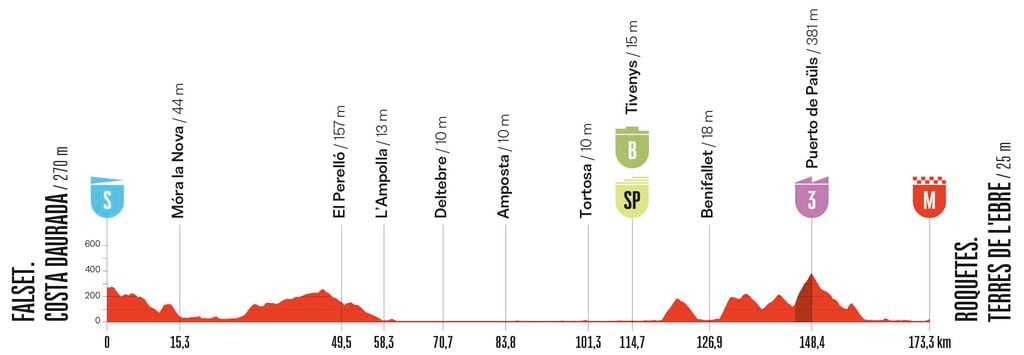
Vuelta a España Stage 5 route
Date: Wednesday 26 August 2026
Start: Falset-Costa Daurada
Finish: Roquetes-Terres de l’Ebre
Distance: 173.4km
Stage type: Hilly
Elevation gain: Around 1,660 metres
Intermediate sprint: Tivenys
Main climb: Alto de Paüls
Likely outcome: Reduced bunch sprint
Stage 5 begins among the rolling roads around Falset before gradually dropping towards flatter terrain around the Ebro.
The first half contains enough climbing and undulation to help establish the breakaway, but there is nothing severe enough to give the GC teams much reason to become involved.
The character changes late.
The Alto de Paüls is around 3.5km at 7.1%, with its summit coming less than 25km from the finish. It is short enough for most of the stronger sprinters to survive, but steep enough for Lidl-Trek, Visma | Lease a Bike and other teams to make the race uncomfortable.
From there the route descends towards Roquetes, where a reduced group should have enough road to reorganise before the sprint.
The full Vuelta a España 2026 route guide shows why Stage 5 matters so much to the sprinters. There are relatively few uncomplicated opportunities in a race dominated by climbing.
What time does Vuelta a España Stage 5 start?
Stage 5 is scheduled to begin during the early afternoon in Spain, with the finish expected during the early evening local time.
The precise timetable will depend on the speed of the stage, particularly across the flatter middle section and the Alto de Paüls.
For UK viewers, the decisive final hour should fall comfortably within the late afternoon.
A separate Stage 5 live viewing and start time update will cover the complete television schedule, UK broadcast information and expected timings for the Alto de Paüls and finish in Roquetes.
Why Stage 5 matters
This is the first stage of the 2026 Vuelta held entirely on Spanish roads.
The opening four days took the peloton from Monaco through southern France and into Andorra, producing an unusually demanding beginning to the race. Stage 3 towards Font-Romeu was then cancelled because of the severe hailstorm on the Col de Mont-Louis, before Stage 4 delivered the first decisive GC battle.
Stage 5 finally resembles a more conventional transition day.
For the overall contenders, the priority is simply to stay safe and avoid losing time through crashes, crosswinds or poor positioning.
For the sprinters, it is far more important.
Brennan has already won once, while Pedersen and Groves know opportunities are limited enough that they cannot afford to let a stage like this disappear up the road.
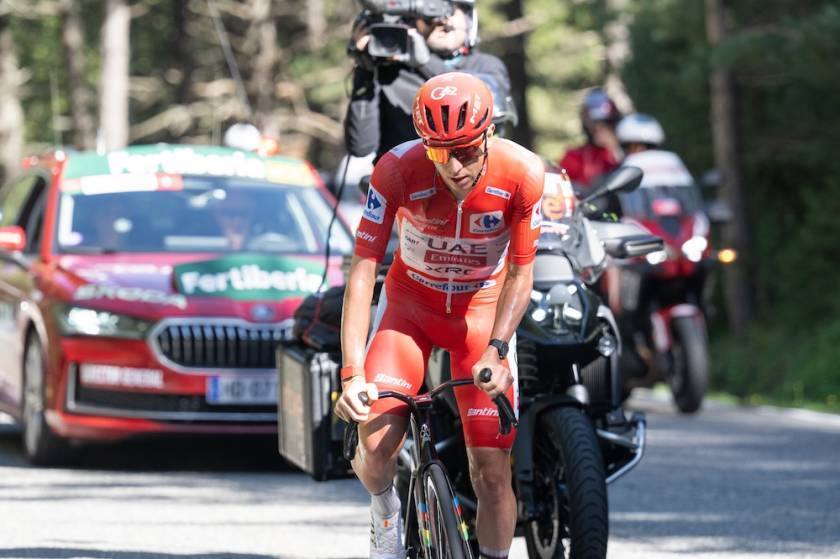 Photo Credit: ASO
How Stage 4 changed the race
Pogačar’s attack in Andorra transformed the general classification.
After the cancelled Font-Romeu stage denied the race its first planned mountain finish, Stage 4 finally gave the leading GC riders a chance to test one another.
Pogačar did considerably more than that.
His long-range attack opened major gaps and gave UAE Team Emirates-XRG considerably more control over the race than they had held after the opening stages.
That affects Stage 5 because UAE have very little reason to chase a harmless breakaway.
If the escape contains riders who pose no threat to Pogačar’s red jersey, responsibility should fall almost entirely on the sprint teams.
Visma, Lidl-Trek, Alpecin-Premier Tech and the other squads chasing the stage cannot expect UAE to do their work for them.
Why the Alto de Paüls matters
The Alto de Paüls is the tactical centre of the stage.
At roughly 3.5km at 7.1%, it is not difficult enough to produce meaningful GC gaps, but its placement gives the stronger sprinters a useful weapon.
Lidl-Trek should want the climb ridden hard for Pedersen.
Visma have similar reasons with Brennan and Wout van Aert.
If the pace rises sharply from the bottom, riders such as Jordi Meeus and Alberto Dainese may find themselves under pressure. Even if they are only dropped by 20 or 30 seconds, the effort required to chase back before Roquetes could significantly reduce their sprint.
That is why the most likely scenario is not an outright climbing selection but a gradual reduction in the number of genuine sprint contenders.
A group of perhaps 50 to 80 riders reaching Roquetes together would suit the profile.
 Photo Credit: Getty
Contenders to watch on Stage 5
Matthew Brennan
Brennan already has a stage victory after winning the uphill sprint in Manosque on Stage 2.
That result immediately makes him one of the leading favourites again.
The Alto de Paüls should be comfortably within his range, and Visma have enough tactical depth to make the climb harder without compromising their own chances.
Brennan is also quick enough to beat the specialists if a sizeable group reaches Roquetes.
Mads Pedersen
Pedersen may be the rider who benefits most from an aggressive final climb.
Lidl-Trek do not need Stage 5 to remain easy. The harder the Alto de Paüls becomes, the more likely it is that Pedersen loses some of the riders capable of beating him in a pure sprint.
His fourth place in Manosque showed that the speed is already there.
A reduced finish after a hard final 30km would be close to his ideal scenario.
Kaden Groves
Groves has repeatedly shown that he should not be treated like a conventional pure sprinter at the Vuelta.
He can survive climbing, deal with difficult finales and still produce a high-level sprint after a demanding day.
That makes the Alto de Paüls less threatening to him than it may initially appear.
If Groves remains in the first group over the summit, he could be the fastest rider left in the race.
Wout van Aert
Van Aert gives Visma another option if Stage 5 becomes harder than expected.
A conventional bunch sprint probably favours Brennan, but a heavily reduced group or late attacking race moves Van Aert higher up the list.
Visma do not need to decide which rider to support until the final climb has established the shape of the race.

Jordi Meeus
Meeus wants a quieter Alto de Paüls.
If Red Bull-Bora-Hansgrohe can keep him in the front group without forcing him into repeated accelerations, his outright speed makes him one of the strongest candidates in Roquetes.
His chances fall sharply if he has to chase back after the summit.
Marijn van den Berg
Van den Berg is well suited to precisely this sort of stage.
He climbs better than many of the pure sprinters but retains enough speed to win from a reduced group. The harder final 40km becomes, the more attractive his chances look.
Alberto Dainese
Dainese finally gets terrain closer to a conventional sprint opportunity.
His challenge is simply surviving Paüls.
If Soudal Quick-Step can keep him in contact, he has the speed to contest the stage. If he is dropped, Ethan Hayter gives the team an alternative from a smaller group.
Bryan Coquard and Orluis Aular
Both become more dangerous if the finale turns selective.
Neither needs a completely straightforward bunch sprint and both have enough climbing ability to survive a harder approach than some of the faster specialists.
A messy finish plays to their strengths.
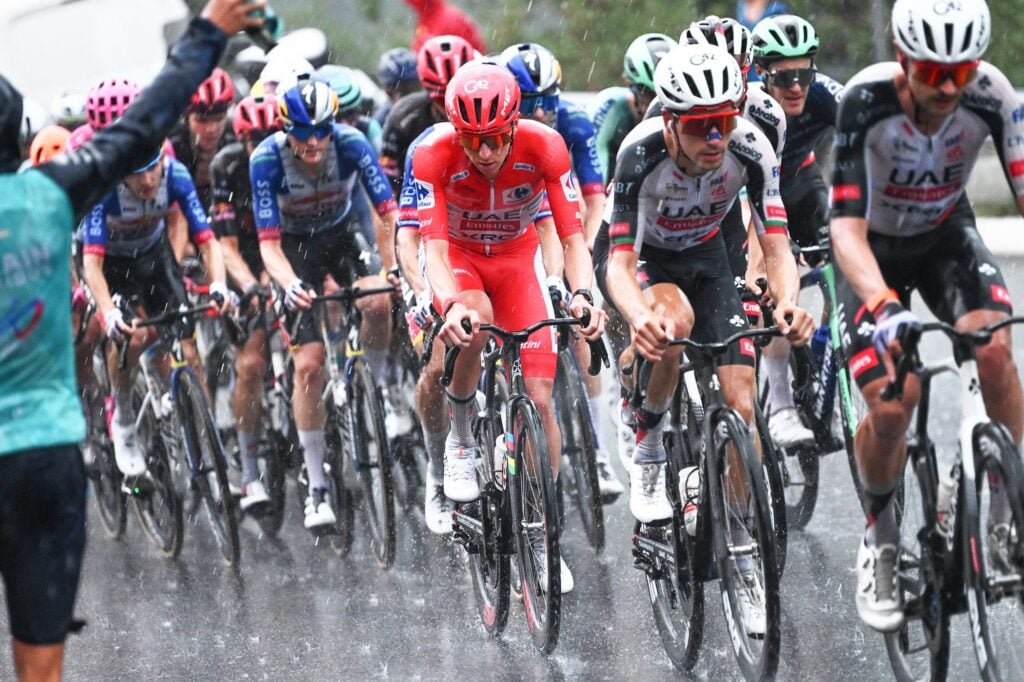 Photo Credit: Getty
Can the breakaway win Stage 5?
The breakaway should get some freedom because UAE have little incentive to control it.
That does not necessarily mean it will survive.
There are too many sprint teams with a realistic chance of victory.
Visma want another opportunity for Brennan. Lidl-Trek have Pedersen. Alpecin-Premier Tech have Groves. Red Bull-Bora-Hansgrohe have Meeus, while EF Education-EasyPost and Soudal Quick-Step also have realistic options.
That collective interest should eventually pull the breakaway back.
The more dangerous possibility is a late attack on the Alto de Paüls.
A strong rider going clear near the summit would have less than 25km to defend the gap and could force the sprint teams into a much more difficult chase.


Tactical outlook
The race should settle into a relatively familiar pattern early.
A small breakaway is likely to form, with UAE happy to let other teams take responsibility for the chase.
The tension should rise significantly as the peloton approaches the Alto de Paüls.
Lidl-Trek have the clearest incentive to push the pace. Pedersen can survive a harder climb than many of his rivals, so every sprinter dropped represents one fewer rider he needs to beat in Roquetes.
Visma can afford to contribute because both Brennan and Van Aert should survive.
Alpecin-Premier Tech may prefer a slightly more controlled ascent, trusting Groves’s ability to get over the climb without unnecessarily reducing his sprint.
The GC teams should simply concentrate on positioning.
Crosswinds, narrow roads and the approach to the climb are likely to be more dangerous for Pogačar, Roglič, Enric Mas, Sepp Kuss and Oscar Onley than the climb itself.
Vuelta a España Stage 5 prediction
Stage 5 looks most likely to end with a reduced bunch sprint.
The Alto de Paüls should remove some riders and weaken others, but there is enough road after the summit for a sizeable group to reform.
That leaves Brennan, Pedersen and Groves as the three clearest favourites.
Pedersen should benefit if Lidl-Trek make the final climb difficult, while Groves has repeatedly demonstrated that this type of selective Vuelta stage suits him.
Brennan has the strongest combination of climbing ability, sprint speed and team support.
Prediction: Matthew Brennan to win Stage 5 ahead of Mads Pedersen and Kaden Groves.