The Vuelta a España returns immediately to difficult terrain on Thursday 27 August, with Stage 6 covering 177.5km from Alcossebre to Castelló and placing a steep gravel sector on the Puerto El Bartolo at the centre of a fascinating finale.
After Matthew Brennan took his second victory of the race in the Stage 5 sprint into Roquetes, the GC riders have little opportunity to relax. Stage 6 contains close to 3,000 metres of climbing, an early second-category ascent, two passages through the hills above Benicàssim and a final first-category climb where the hardest section is partly unpaved.
The Puerto El Bartolo tops out with only 20.7km remaining. Its 1.9km gravel section arrives near the top of a climb already capable of producing GC gaps, with double-digit gradients and ramps approaching 20%. A fast descent into Castelló follows, making this less a conventional mountain stage than a difficult hybrid between a breakaway day, a gravel test and a late GC ambush.
Tadej Pogačar does not need to attack after the enormous advantage he created in Andorra, particularly with the summit finish at Valdelinares coming on Stage 7. The problem for everybody else is that El Bartolo is precisely the sort of climb where Pogačar can become involved even without UAE Team Emirates-XRG setting out to control the stage.
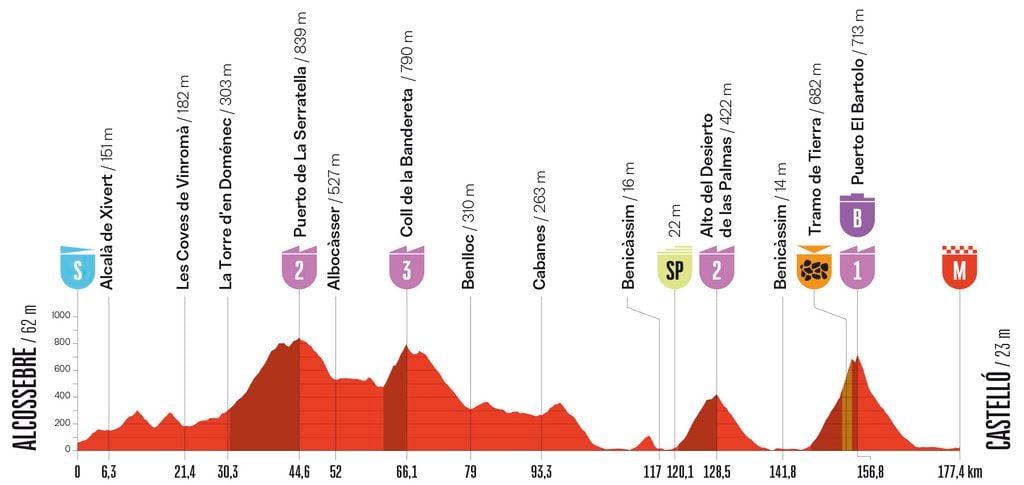
Vuelta a España Stage 6 route
Date: Thursday 27 August 2026
Start: Alcossebre
Finish: Castelló
Distance: 177.5km
Stage type: Medium mountains
Neutralised start: 13:11 CEST / 12:11 BST
Expected finish: Around 17:18 CEST / 16:18 BST
Key climb: Puerto El Bartolo
El Bartolo summit: 20.7km from the finish
Stage 6 begins close to the Mediterranean at Alcossebre before quickly turning inland through the province of Castellón. The first significant climb arrives early enough to shape the entire race, with the road rising towards the Puerto de la Serratella during the opening third of the stage.
It is not severe enough to decide the GC, but its position makes it ideal terrain for a substantial breakaway to form. Riders looking for a stage victory will know that waiting until the final 60km is unlikely to work because by then the overall contenders and their teams will be positioning for the much harder closing sequence.
The profile becomes more complicated after the race returns towards the coast. The riders first climb the Alto del Desierto de las Palmas, a second-category ascent whose summit comes 49km from Castelló. They then descend towards Benicàssim before turning back into the same hills for the far harder Puerto El Bartolo.
That final section is where Stage 6 changes completely.
The gravel on Puerto El Bartolo is the decisive feature
The Puerto El Bartolo begins with 30.1km remaining, and the official race itinerary places the start of the 1.9km unpaved sector at 23.7km to go.
The gravel alone would make positioning important, but it comes on a climb where the gradient is already capable of splitting the group. The road becomes increasingly severe as the riders approach El Bartolo, with sections well into double figures and the steepest ramps close to 20%.
The first-category summit arrives at 20.7km from the finish, meaning any gaps created on the gravel can survive beyond the top.
There is also relatively little time to reorganise. The initial kilometres after the summit descend rapidly towards Castelló, so a rider who reaches the top alone with 15 or 20 seconds has an obvious reason to commit. Equally, a GC contender caught behind a split, puncture or mechanical problem could find the gap expanding before team-mates are able to organise a chase.
It makes the gravel about much more than spectacle. Even if nobody launches a deliberate long-range GC attack, El Bartolo is capable of creating time differences through positioning alone.
Stage 6 comes at an awkward moment for the GC contenders
The timing of the stage may discourage the most ambitious attacks.
Stage 7 finishes at Aramón Valdelinares, giving the race its next genuine summit finish only 24 hours later. UAE Team Emirates-XRG therefore have little reason to expend large amounts of energy controlling a breakaway on Thursday when Pogačar already holds a commanding advantage.
That should make Stage 6 an excellent breakaway opportunity.
It does not necessarily make the GC battle quiet.
Once the race reaches the final climb, teams protecting podium ambitions cannot simply allow Pogačar to ride away if he accelerates. Primož Roglič, Enric Mas, Sepp Kuss, Oscar Onley, Richard Carapaz and Felix Gall are separated by relatively small margins compared with the enormous gap between all of them and the red jersey.
A few seconds lost on the gravel might therefore mean very little to Pogačar but considerably more in the fight for second and third.
The Stage 4 race through Andorra changed the nature of the Vuelta. Pogačar is now racing from a position of strength while almost everybody behind him is still separated by gaps small enough to encourage attacks.
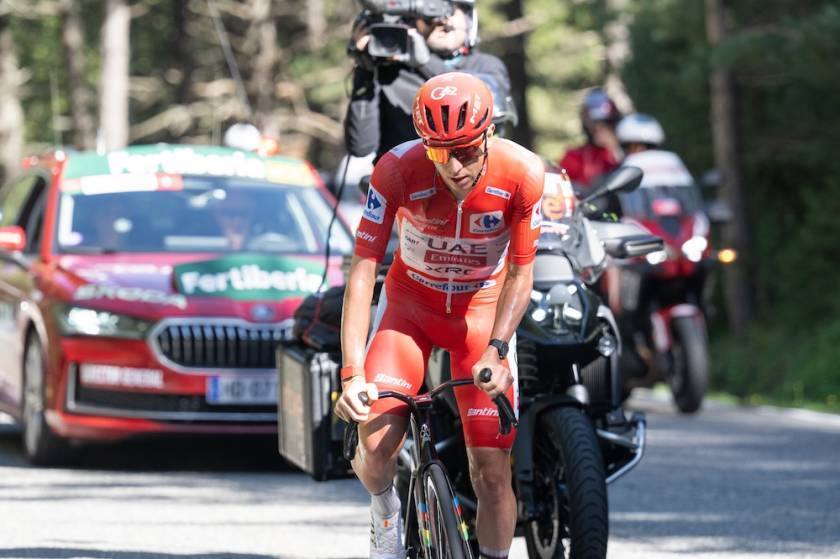 Photo Credit: ASO
Pogačar does not need another attack
Pogačar’s biggest advantage on Stage 6 may be that he has no tactical reason to force anything.
His 50km solo ride in Andorra gave him more than three minutes over every established GC rival. UAE can therefore allow a safe breakaway to build a substantial advantage and concentrate almost entirely on positioning Pogačar for the final climb.
If that happens, the stage victory could disappear up the road long before El Bartolo.
The problem is what happens when the red jersey reaches the gravel.
Pogačar is exceptionally strong on steep, irregular climbs and confident on loose surfaces. If another team increases the pace and reduces the GC group to a handful of riders, he does not need a carefully constructed UAE plan to attack. A gap can emerge simply from following the strongest wheel.
That makes him more difficult to race against than a conventional leader defending a three-minute advantage. His team can approach the stage conservatively without guaranteeing that Pogačar himself will do the same.
The wider significance of his Andorra performance is explored in From breakthrough to domination: Tadej Pogačar comes full circle in Andorra, with his return to the roads where he took his first Grand Tour stage victory in 2019 producing one of the defining performances of the opening week.
Roglič needs to stop the gap getting any larger
Primož Roglič enters Stage 6 as Pogačar’s closest major rival on general classification, but the immediate goal is probably consolidation rather than trying to recover three minutes in one move.
El Bartolo should suit him reasonably well. The steepest sections reward acceleration, and the descent to Castelló means nobody has to sustain an attack all the way to a summit finish.
The concern is another Pogačar acceleration near the top.
Losing another 20 or 30 seconds would not decide the Vuelta by itself, but the cumulative effect matters. Roglič already needs something significant to happen later in the race if he is going to challenge Pogačar for red. Allowing that deficit to grow before the Vuelta has completed its first week would make an already difficult task substantially harder.
He also has to think about the riders immediately around him. Mas, Kuss, Onley, Carapaz and Gall remain close enough that Roglič cannot race only against Pogačar.
Enric Mas can reinforce his excellent Andorra start
Enric Mas was one of the riders who came out of Andorra with his Vuelta prospects strengthened despite losing heavily to Pogačar.
Mas sits third overall and showed that, behind the red jersey, he is currently climbing at a level comparable with Roglič, Kuss, Onley and Gall.
Stage 6 offers a different test.
El Bartolo is shorter and more explosive than the major Andorran climbs, while the gravel adds a technical element that makes positioning critical. Mas generally prefers a sustained climbing rhythm, so the succession of accelerations near the summit may be less naturally suited to him than a long mountain finish.
Movistar also have less tactical depth after Cian Uijtdebroeks was withdrawn before Stage 5 because of the ankle fracture suffered in his Stage 2 crash. The team’s GC ambitions are now concentrated much more heavily around Mas.
That makes avoiding trouble on El Bartolo at least as important as attacking.

Onley, Kuss, Carapaz and Gall have reasons to be aggressive
The battle behind Pogačar remains one of the most interesting parts of the Vuelta.
Oscar Onley and Sepp Kuss both survived the decisive Andorra selection and remain within touching distance of the podium. Felix Gall was one of the riders who helped provoke the action there, while Richard Carapaz is rarely at his most dangerous when a race remains predictable.
Stage 6 gives all four an opportunity.
Onley has the punch required for the steep final kilometres. Kuss should be comfortable with the climbing but will want to avoid being caught behind a split as the peloton reaches the gravel. Gall has already shown a willingness to attack, while the chaotic shape of the finale should appeal to Carapaz.
The key issue is whether any of them are prepared to risk losing time before Valdelinares.
Attacking Pogačar directly may be unrealistic. Attacking one another is not.
Jarno Widar gets another interesting test
Jarno Widar produced one of the performances of Stage 4 when he finished second behind Pogačar in Andorra.
Stage 6 provides another useful measure of how sustainable that level is.
The Puerto El Bartolo is much shorter than the Andorran climbing and probably suits Widar’s explosive qualities even better. If he remains with the main GC group into the steepest kilometres, he has the acceleration to become involved around the summit.
His presence also complicates the tactical decisions of the more established GC riders. Widar is young enough that teams may still hesitate over how seriously to treat every attack, but his Andorra ride has made allowing him freedom considerably harder.
Another strong result would shift the conversation from an exceptional day in Andorra towards something more significant.
Stage 6 should be a serious breakaway opportunity
The strongest argument against a Pogačar stage victory is not the final climb. It is what happens during the first 120km.
UAE have no obvious reason to control riders who are already well outside the GC battle, and Stage 7 provides a much clearer opportunity for Pogačar to win another mountain stage if he wants one.
That should encourage a large breakaway containing genuine climbing quality.
The ideal stage hunter needs enough strength to survive the opening battle for the move, climb well enough to handle El Bartolo and preferably possess either a strong descent or enough finishing speed to win from a reduced group in Castelló.
Pello Bilbao immediately fits that description. His climbing is strong enough for the final ascent, while a downhill finish greatly increases his chances compared with a summit arrival.
Milan Vader is another interesting option because his off-road background and technical ability should make the gravel less intimidating than it is for some pure road climbers.
Clément Berthet, Andreas Leknessund, Gianmarco Garofoli, Finn Fisher-Black and Santiago Buitrago are among the other riders who could profit if the right breakaway receives enough freedom.
Valentin Paret-Peintre has the climbing ability required for El Bartolo but would ideally need to arrive at the summit alone or with a very small group because a flat finish in Castelló works against him.
The biggest question is how much time UAE are willing to concede. A break reaching the foot of El Bartolo with four or five minutes should be in an excellent position. If the advantage has already fallen towards two minutes, the GC race could swallow it rapidly.
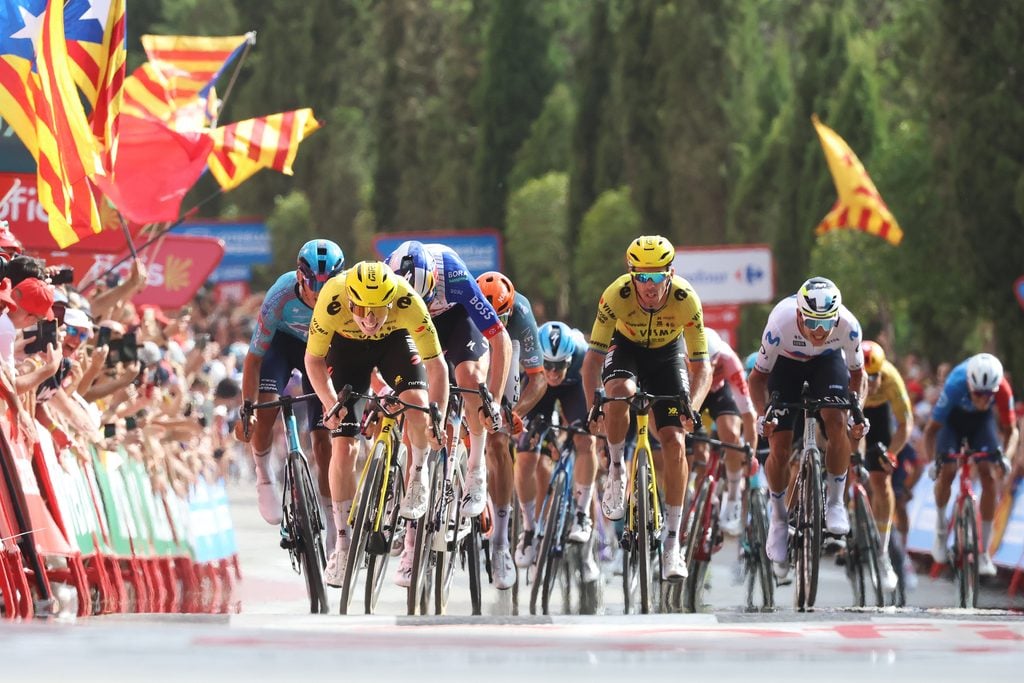 Photo Credit: Getty
Matthew Brennan can forget about a third straight opportunity
Brennan’s Stage 5 victory confirmed just how quickly he has adapted to Grand Tour racing.
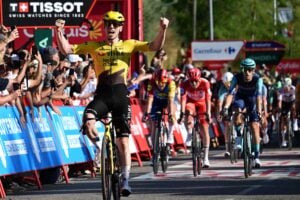
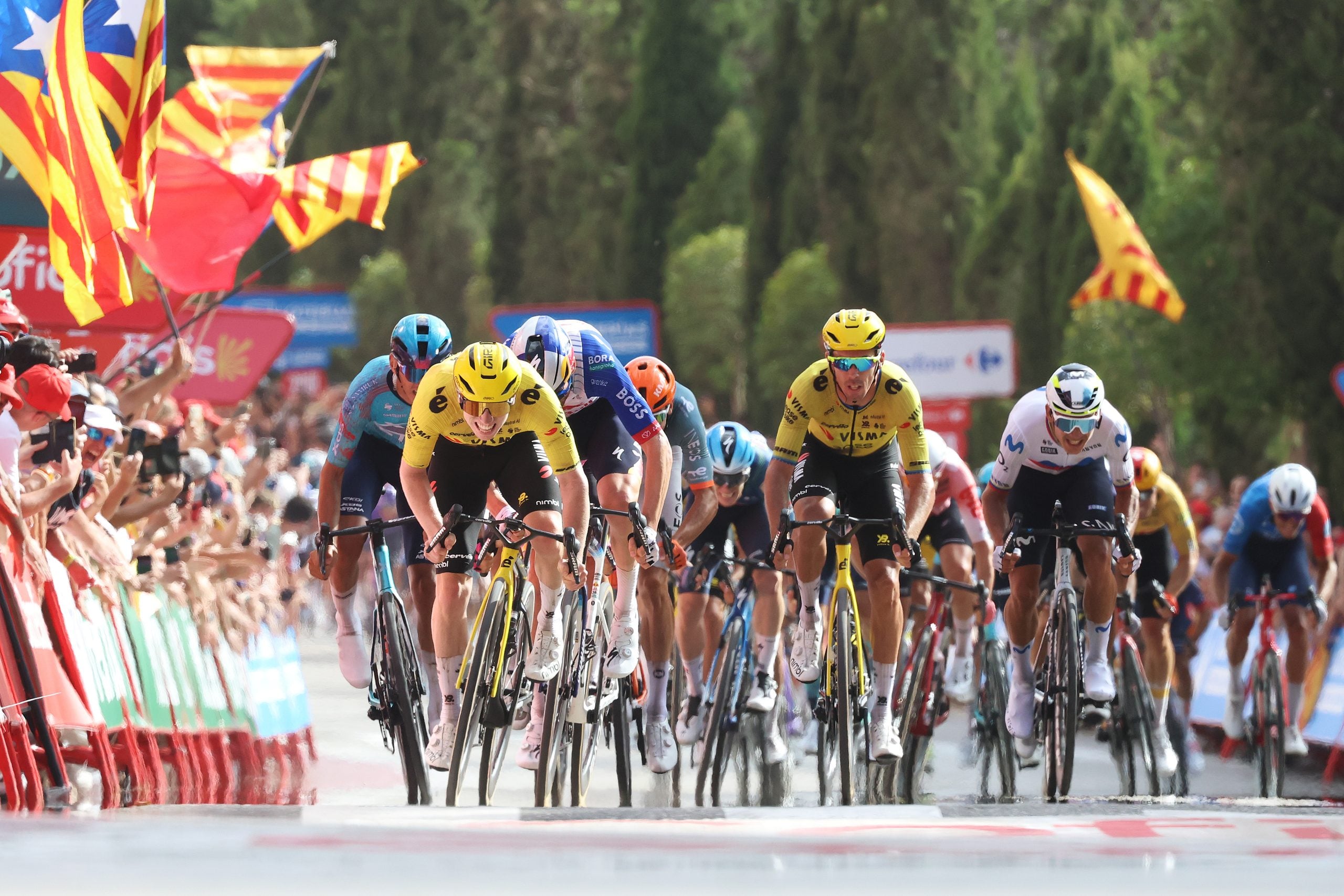
After already winning the uphill sprint in Manosque on Stage 2, the 21-year-old converted another superb Visma | Lease a Bike lead-out in Roquetes, beating Jordi Meeus after Wout van Aert and Christophe Laporte controlled the final kilometres.
For a debut Grand Tour, two victories inside the opening five stages is an exceptional return.
Stage 6 is a very different proposition.
Even Brennan’s impressive ability to survive hilly terrain is unlikely to make the Puerto El Bartolo manageable once the GC teams accelerate. Mads Pedersen, Kaden Groves and the other sprinters face the same problem.
Their task is survival rather than victory, particularly with another mountain stage coming immediately afterwards.
The Stage 5 live viewing guide showed why Roquetes was one of the relatively scarce opportunities for the faster riders in this year’s route. Stage 6 brings the Vuelta firmly back towards the climbers and breakaway specialists.
What time does Vuelta a España Stage 6 start?
The neutralised start in Alcossebre is scheduled for 13:11 local time, or 12:11 BST.
The first passage over the Alto del Desierto de las Palmas is expected between approximately 16:11 and 16:30 CEST, which means 15:11 to 15:30 BST for UK viewers.
The final Puerto El Bartolo should begin between approximately 16:33 and 16:53 CEST, or 15:33 to 15:53 BST. The gravel sector follows shortly afterwards, with the summit expected between roughly 15:56 and 16:19 BST.
The finish in Castelló is scheduled for approximately 16:18 BST on the fastest projection, although a slower stage could push the arrival beyond 16:40.
Anyone primarily interested in the GC battle should therefore aim to be watching by around 15:30 BST. That should capture the complete approach to El Bartolo, the gravel section, any GC attacks and the descent towards Castelló.
UK viewers can follow the race through TNT Sports and HBO Max, with the wider broadcast arrangements covered in ProCyclingUK’s Stage 5 live viewing guide. A dedicated Stage 6 viewing update will provide the final channel and coverage timings on Thursday.
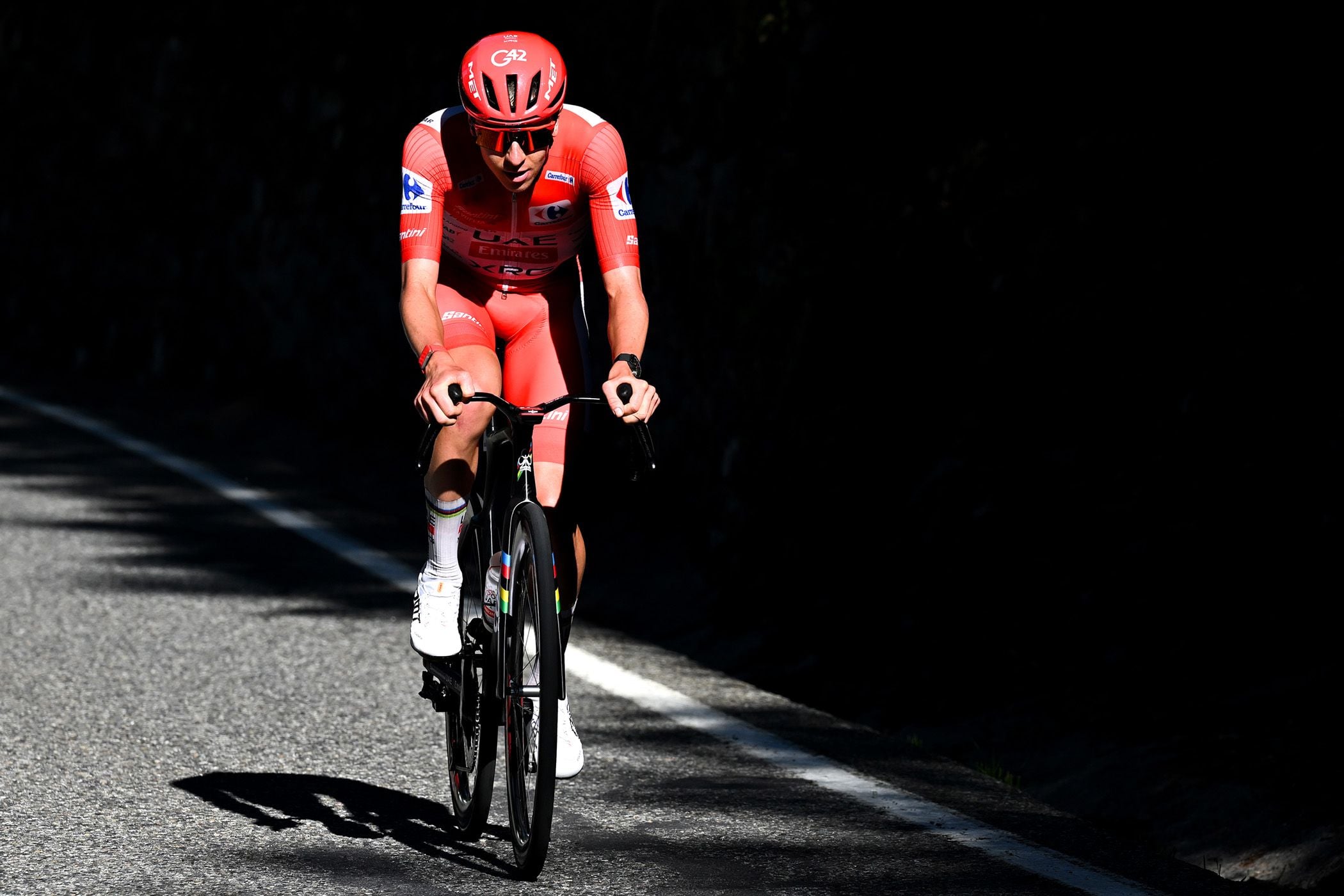
Stage 6 tactical outlook
The most logical version of Stage 6 has two races developing at the same time.
A strong break should form during the difficult opening terrain, with UAE Team Emirates-XRG allowing riders without dangerous GC positions to build a substantial advantage. Teams without an overall contender have every reason to put numbers into that move because El Bartolo provides a genuine stage-winning opportunity without requiring anyone to outclimb Pogačar directly.
Behind, UAE should concentrate on protecting the red jersey rather than reducing the gap.
Everything changes during the final 50km.
The first passage through the Desierto de las Palmas should begin reducing both the break and peloton before positioning becomes frantic ahead of El Bartolo. Once the road turns steep and then unpaved, the GC contenders will have little choice but to race hard enough to protect themselves.
That could produce the strange situation where nobody deliberately chases the breakaway but the gap nevertheless collapses because the favourites are riding so quickly behind.
The summit position will then determine the final 20km. A lone stage hunter may have enough road to stay away. A small breakaway group containing Bilbao should be reluctant to take him to the finish. Any GC rider who gains a gap has every reason to continue down the descent.
It is a stage where the race can remain controlled for four hours and then become extremely difficult to organise within five minutes.
Vuelta a España Stage 6 prediction
The breakaway has the advantage.
UAE Team Emirates-XRG have little reason to spend Stage 6 chasing a stage victory when Pogačar already holds such a large GC lead and Valdelinares follows on Friday. The terrain is also difficult enough early in the day for a genuinely strong group to establish itself.
The best stage-winning profile is therefore a climber who can descend well and still finish quickly if several riders reach Castelló together.
Pello Bilbao stands out on that basis. The Puerto El Bartolo is within his climbing range, the technical finale should not trouble him and the downhill run towards Castelló gives him a major advantage over riders who require a summit finish to win.
Milan Vader is particularly interesting because of the gravel, while Santiago Buitrago has enough climbing strength to create separation if the race becomes especially hard.
Behind them, expect another GC selection on El Bartolo without necessarily seeing a full-scale battle for red.
Pogačar does not need to attack.
The question with this version of Pogačar is whether that has ever been enough to stop him.