
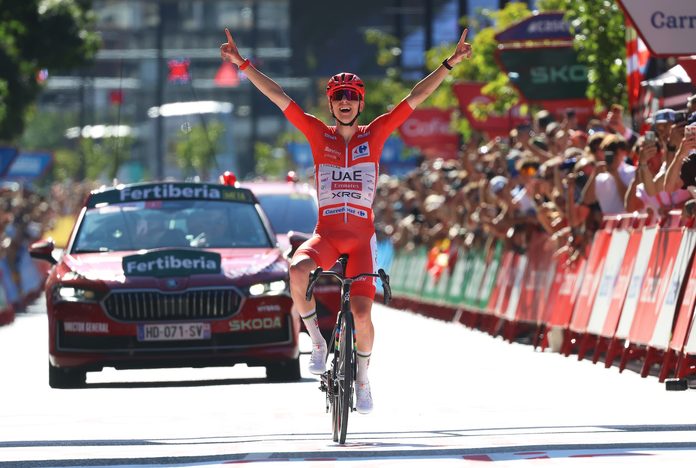
Seven years ago, Tadej Pogačar arrived in Andorra as a 20-year-old neo-pro riding his first Grand Tour.
He left with his first Grand Tour stage victory.
On Tuesday, Pogačar returned to the same mountain country wearing the red jersey of Vuelta a España leader, attacked with exactly 50 kilometres remaining and completed the longest solo victory of his Grand Tour career.
The difference between those two days says almost everything about what has happened in between.
In 2019, Andorra was where cycling first saw just how good Pogačar might become. In 2026, it became the place where a rider with five Tour de France victories and a Giro d’Italia title showed the scale of what he has become.
Few locations could have provided a neater full-circle moment.
Andorra gave Pogačar his first Grand Tour stage win
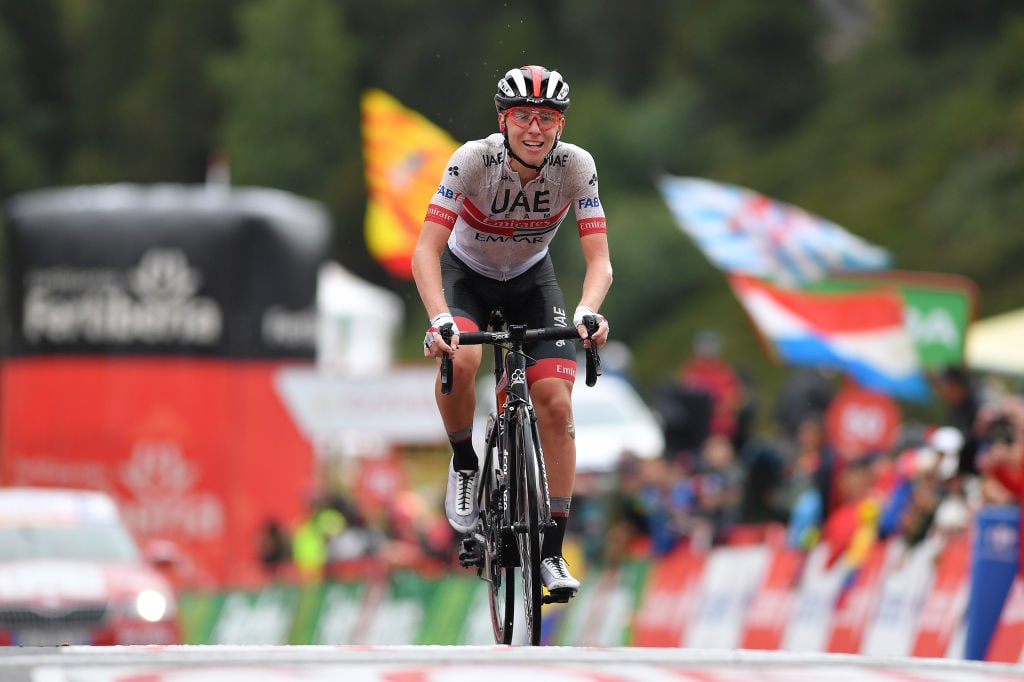
Pogačar’s first breakthrough on these roads came on Stage 9 of the 2019 Vuelta.
The race stayed entirely within Andorra, covering just 94.4km from Andorra la Vella to Cortals d’Encamp. It was short, mountainous and chaotic, with the Coll d’Ordino, Coll de la Gallina, Alto de La Comella and Engolasters packed into the route before the final climb to the finish.
Pogačar was still an unknown quantity at Grand Tour level.
He had joined UAE Team Emirates at the beginning of the season after winning the 2018 Tour de l’Avenir, but the Vuelta was his first three-week race. He was only 20 and still discovering how far his ability could take him against established Grand Tour leaders.
Miguel Ángel López attacked from distance, while Nairo Quintana and Primož Roglič were fighting for the overall race.
Pogačar waited until the final climb.
He attacked from the leading GC group in the final kilometres and nobody could follow. Pogačar reached Cortals d’Encamp alone, 23 seconds ahead of Quintana and 48 seconds ahead of Roglič.
It was his first Grand Tour stage victory.
At the time it looked like a breakthrough. Seven years later, it looks more like the opening chapter of everything that followed.
The wider significance of that first Vuelta appearance is central to our look at whether Pogačar can win all three Grand Tours. He eventually finished third overall in 2019 and won three stages, turning his Grand Tour debut into one of the defining young-rider performances of the modern era.
Seven years later, the same landscape produced something much bigger
The circumstances could scarcely have been more different when Pogačar returned to Andorra in 2026.
He no longer needed to demonstrate that he belonged among the world’s best stage racers.
He arrived wearing red after winning the opening Monaco time trial, already a five-time Tour de France winner and a Giro champion. Victory at this Vuelta would complete his career set of all three men’s Grand Tours.
Yet the Stage 4 route through Andorra contained some very familiar roads.
The 104.8km stage started and finished in Andorra la Vella and included the Port d’Envalira, Collada de Beixalis, Coll d’Ordino and Alto de La Comella.
Both the Coll d’Ordino and La Comella had featured on the day of Pogačar’s first Grand Tour victory in 2019.
Seven years later, he crossed them again in completely different circumstances.
In 2019, Pogačar waited for the final climb
That contrast is what makes the two victories so striking.
The 2019 version of Pogačar waited until the final ascent.
The 2026 version attacked with exactly 50 kilometres remaining.
Pogačar launched on the Collada de Beixalis after Decathlon CMA CGM had driven a hard pace into the climb. Felix Gall was briefly able to respond, but Pogačar quickly dropped him and began building an advantage over almost every major GC contender in the race.
The gap expanded rapidly.
By the time he crossed the later climbs, the stage had stopped looking like a contest for victory and started looking like a battle to limit the damage.
Pogačar eventually reached Andorra la Vella alone in 2:40:35.
Jarno Widar won the sprint for second 2:39 behind, with Gall, Oscar Onley, Sepp Kuss, Enric Mas and Primož Roglič arriving on the same time.
The full Stage 4 race report shows just how quickly the GC race disintegrated once Pogačar attacked.
The difference from 2019 could hardly have been clearer.
One attack came from a young rider trying to prove himself in the final kilometres of a mountain stage.
The other came from the dominant Grand Tour rider of his generation deciding that 50 kilometres was an acceptable distance from which to try to finish the race alone.
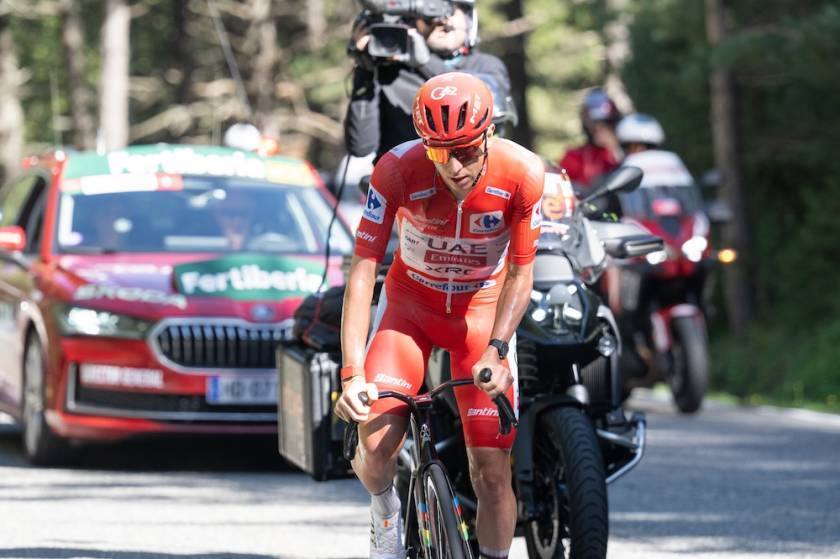 Photo Credit: ASO
It was Pogačar’s longest Grand Tour solo victory
Long-range attacks are now such a familiar part of Pogačar’s racing that even a 50km move can risk feeling almost normal.
It was not.
The Andorra raid was the longest solo victory of his Grand Tour career.
That distinction matters because many of Pogačar’s greatest Grand Tour performances have still come through attacks much closer to the finish. He has repeatedly demolished rivals on final climbs, used accelerations inside the last 10 kilometres and converted smaller gaps into decisive time gains.
Stage 4 was different.
He attacked on the second major climb of the day, then had to cross Beixalis, Ordino and La Comella while also managing the descents and flat sections between them.
There was no protection from a team-mate and no final summit waiting a few kilometres up the road.
Once Pogačar went, he had to make the entire remaining stage work.
That is why the 50km figure matters more than simply as a statistic. It describes the confidence behind the move.
The Coll d’Ordino links the two performances
The Coll d’Ordino provides one of the strongest geographical links between 2019 and 2026.
In 2019 it appeared after only 17km.
Pogačar crossed it as one rider among a field of established Grand Tour contenders, still hours away from the performance that would change how the peloton viewed him.
In 2026, he reached Ordino alone with the Vuelta already stretched across the mountains behind him.
The climb had not changed fundamentally.
Pogačar’s relationship with it had.
The same is true of Alto de La Comella, another climb shared by the two stages. In 2019 it formed part of the difficult approach to Cortals d’Encamp. In 2026 it was the final categorised obstacle between Pogačar and one of his most dominant Grand Tour stage wins.
Cycling regularly revisits the same mountains, but rarely do those roads provide such a clean comparison between two stages of the same rider’s career.
The 2019 Vuelta created the first Pogačar question
Before the 2019 Vuelta, Pogačar was an exceptional prospect.
After Andorra, the question became much bigger.
Could he actually win Grand Tours?
By the end of the race, there was little doubt.
Pogačar won again at Los Machucos before producing another spectacular attack on Stage 20 towards Plataforma de Gredos. He finished the Vuelta third overall behind Roglič and Alejandro Valverde.
Less than a year later, he won his first Tour de France.
The progression now looks almost impossibly quick, but Andorra was the moment when the trajectory became visible.
Our history of the men’s Vuelta a España is full of riders whose relationship with the race changed their careers. Pogačar’s 2019 debut has become one of the clearest modern examples.
The Vuelta did not simply give him three stage wins and a podium.
It introduced the Grand Tour version of Tadej Pogačar.
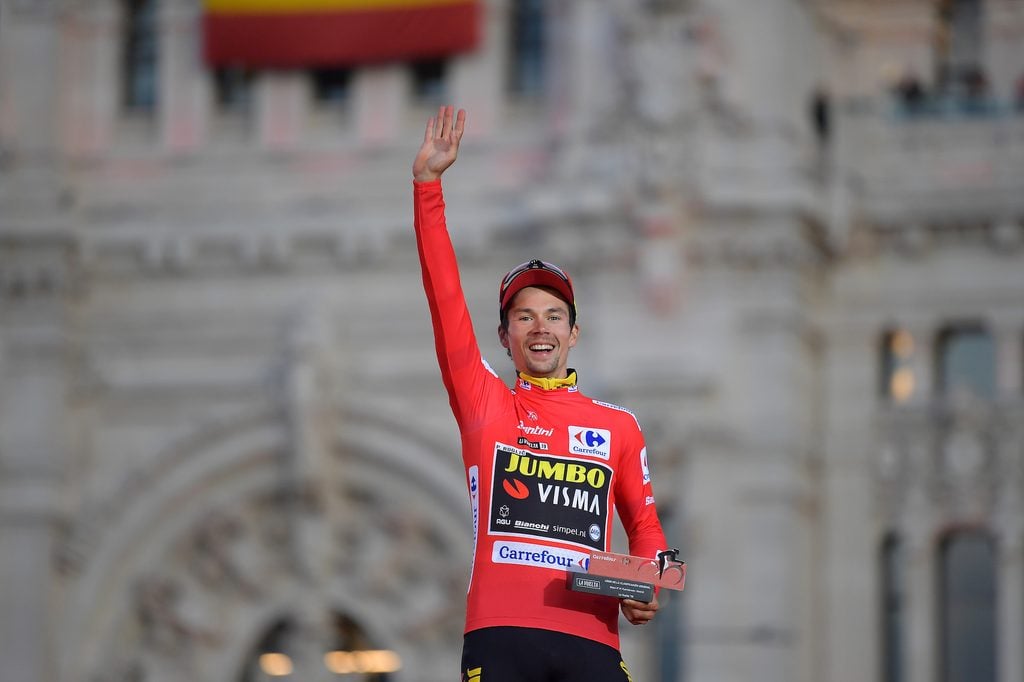 Photo Credit: Getty
Primož Roglič was there at the beginning as well
There is another full-circle element running through the two Andorran stages.
Roglič finished third behind Pogačar in 2019.
He went on to win that Vuelta, his first Grand Tour overall victory.
Seven years later, he was once again chasing Pogačar through Andorra.
This time the hierarchy was very different.
Roglič began Stage 4 as one of Pogačar’s principal challengers. He ended it 3:21 behind the red jersey on general classification.
In 2019, Roglič was the established Slovenian GC leader and Pogačar the extraordinary young outsider.
In 2026, Roglič is one of many elite stage racers trying to find a way to contain the rider Pogačar became.
That reversal makes the comparison even sharper.
Pogačar no longer needs to wait for the obvious moment
The tactical difference between 2019 and 2026 may be more revealing than the results themselves.
Young Pogačar chose the logical moment.
He stayed with the favourites and attacked late on the final climb.
Modern Pogačar increasingly rejects that sort of restraint when he believes he is strong enough to do something more ambitious.
There was no sporting requirement for him to attack from 50km in Andorra.
He already led the Vuelta. UAE Team Emirates-XRG could have controlled the stage, waited for Ordino or La Comella and allowed Pogačar to attack much closer to the finish.
That would have been safer.
Instead, he went on Beixalis.
It reflects something that has increasingly defined his racing across Grand Tours and one-day races alike. Pogačar does not simply look for the most efficient way to win. When the opportunity exists, he tries to make races decisive much earlier than convention suggests.
That characteristic is one reason his wider place in cycling history has become such a substantial discussion. Our analysis of whether Pogačar will become the greatest Tour de France rider of all time looks at the results behind that argument, but performances such as Andorra explain why the conversation cannot be reduced to numbers alone.
The 2019 victory announced possibility, the 2026 victory demonstrated authority
It would be easy to make this story entirely sentimental.
Pogačar returned to the place where his Grand Tour winning career began and won again.
The more interesting point is what the comparison reveals.
The 2019 victory announced possibility.
The 2026 victory demonstrated authority.
Seven years ago, beating Quintana and Roglič on a Vuelta mountain stage was evidence that Pogačar might eventually become one of the best Grand Tour riders in the world.
Now that status is already established.
He has won the Tour de France five times, joining Jacques Anquetil, Eddy Merckx, Bernard Hinault and Miguel Indurain at the top of the official winners list. He won the Giro at his first attempt in 2024. The Vuelta is now the only Grand Tour missing.
The question surrounding him is no longer whether he is capable of winning these races.
It is how much of cycling history he can eventually collect.
-
 Photo Credit: Cs-wolves / Wikimedia Commons, CC BY-SA 4.0

Andorra changed the shape of the 2026 Vuelta
The sporting consequence is also far greater than it was in 2019.
Pogačar left Andorra with a 3:21 advantage over Roglič.
Mas is third at 3:32.
Kuss sits at 3:44, while Onley is at 3:45.
There is still the overwhelming majority of the Vuelta left to race. The 2026 route contains enough mountains, altitude and time trialling for the general classification to change dramatically.
But the tactical problem confronting Pogačar’s rivals has already changed.
Following him and waiting for a weakness is unlikely to be enough.
They now have to take more than three minutes back.
That makes the race for the one Grand Tour Pogačar has never won substantially different after only four stages.
Seven years between two very different Pogačars
There are seven years between the two Andorran victories.
They contain five Tour de France titles, a Giro d’Italia, a World Championship, Monument victories and a transformation from prodigious young stage racer into the defining rider of his generation.
That is what makes Stage 4 such a strong full-circle moment.
In September 2019, Pogačar rode away on the roads above Andorra la Vella and won his first Grand Tour stage.
Nobody watching could know exactly where it would lead.
In August 2026, he returned in red and rode away again.
The Coll d’Ordino was still there. La Comella was still there. Andorra still provided the same compact, unforgiving mountain roads.
Almost everything about the rider crossing them had changed.

