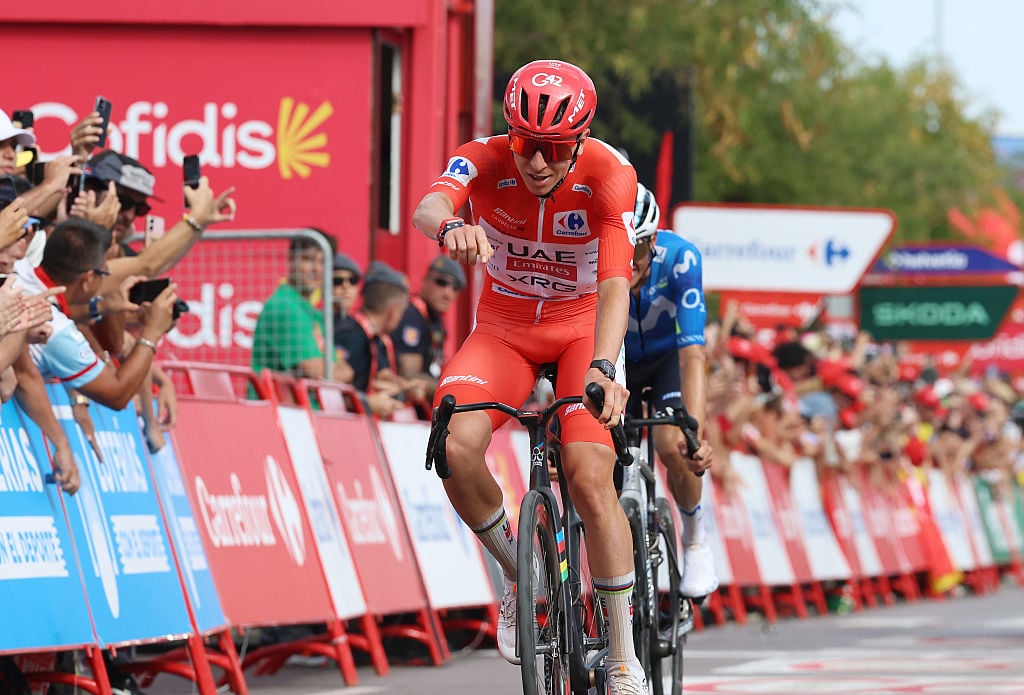
Tadej Pogačar won stage 6 of the 2026 Vuelta a España in Castelló, beating Enric Mas after a dramatic finale on the gravel slopes of Puerto El Bartolo and a brief scare on the descent.
The UAE Team Emirates-XRG rider attacked on the steep unpaved section of the final climb, dropped his main rivals, caught Ramses Debruyne from the breakaway and briefly looked set for another solo victory. Mas, though, produced one of the strongest rides of his race so far, chasing back to Pogačar before the summit and taking maximum mountain points and bonus seconds over the top.
Pogačar then ran wide on a corner during the descent, came to a full stop without crashing, and quickly got back onto Mas’ wheel. The pair worked together on the flat run-in before Pogačar won the two-up sprint, taking another stage win and extending his overall lead.
Mas finished second in the same time and moved up to second overall. Debruyne took third at 46 seconds, ahead of Richard Carapaz, Harold Tejada, Felix Gall and Primož Roglič. Cristian Rodríguez, Clément Berthet, Mattias Skjelmose, Sepp Kuss and Oscar Onley all finished 1:38 down after the final climb split the GC group apart.
A gravel stage designed for ambush
Stage 6 took the Vuelta from Alcossebre to Castelló over 177.4 kilometres, with four categorised climbs and a final ascent designed to create chaos.
The stage began with the Puerto de la Serratella, then continued with the Coll de la Bandereta before the race reached the Alto del Desierto de las Palmas and Puerto El Bartolo in the final third. The final climb was the obvious focal point. The ascent totalled 9.4 kilometres at 7.1 per cent, but the most important detail was the final section: 1.9 kilometres of gravel and gradients reaching 20 per cent.
That made the day very different from the controlled punchy sprint into Roquetes and even from Pogačar’s long solo raid in Andorra. This was not only about climbing strength. It was about positioning before the gravel, traction on steep loose surfaces, descending under pressure and avoiding disaster when the road turned technical.
Pogačar began the stage with a large overall lead after his 50-kilometre solo win on stage 4 and a calm stage 5 defence. He did not need to attack. But the route looked too tempting for a rider who had already shown that he wanted to control the race through domination rather than caution.
A long fight for the breakaway
The opening phase was one of the hardest breakaway battles of the race so far.
Attacks came immediately, but nothing settled for a long time. Léo Bisiaux and Alexey Lutsenko were among the first riders to open a gap, with Walter Calzoni trying to bridge, but the peloton refused to let the early moves go. The first hour was fast and aggressive, with the bunch repeatedly closing down groups as they approached the Puerto de la Serratella.
Buitrago took the first mountain points over the Serratella, ahead of Lorenzo Fortunato and Stefan Küng, but the race still had no settled break. More moves came on the Coll de la Bandereta, where Buitrago again showed his climbing strength, taking points ahead of Gijs Leemreize and George Bennett.
Eventually, after more than 80 kilometres of racing, a 16-rider group finally became the move of the day. It was strong, varied and dangerous enough to shape the stage, but never given the kind of margin that would make the peloton relax.
Van Aert and Debruyne join the move
The 16-rider breakaway contained serious quality.
Wout van Aert was there for Team Visma | Lease a Bike, with Pello Bilbao and Buitrago for Bahrain Victorious, Patrick Konrad for Lidl-Trek, Debruyne for Alpecin-Premier Tech, Bennett for NSN Cycling Team, Andrea Garofoli for Soudal Quick-Step, Andreas Kron for Uno-X Mobility and Vincenzo Albanese for EF Education-EasyPost.
The group also included Carlos Canal, Tom Gloag, Nils Berrade, Leemreize, José Manuel Díaz, Lars Craps and Hannes Wilksch.
Debruyne was the main GC threat in the move, starting the day 12th overall at 4:44. That meant UAE Team Emirates-XRG could not completely switch off. A big advantage would have put him back into the top 10 and created a potential complication, even if Pogačar’s overall lead was already substantial.
The break still had enough rope to race. Van Aert won the intermediate sprint at Benicàssim, while Díaz and Buitrago battled for mountain points on the Alto del Desierto de las Palmas. But the gap never looked fully safe.
UAE decide to chase
For a while, it looked as though the breakaway might be allowed to contest the stage.
The gap moved above 2 minutes, and the strongest climbers in the move began dropping the weaker riders on the Alto del Desierto de las Palmas. Van Aert was among those distanced when the climbers pressed on, leaving the break more suited to the final climb.
But UAE Team Emirates-XRG never gave up control. João Almeida did a long, valuable turn on the front, bringing the gap down and softening the peloton before the final climb. Jay Vine then took over, followed by Pablo Torres, with Pogačar placed directly behind.
That sequence made UAE’s intention clear. They were not only keeping Pogačar safe. They were setting up another attack.
By the time the race reached Puerto El Bartolo, the breakaway’s lead had fallen below 2 minutes. On a climb with gravel, 20 per cent gradients and a GC group being pulled by UAE, that was not enough.
The breakaway explodes on Puerto El Bartolo
The final climb began with the breakaway still ahead, but already under pressure.
Bilbao had done work for Buitrago before being distanced, and the front group began to split as the gradients steepened. Craps and Kron tried to lift the pace, Buitrago responded, and the breakaway fractured.
With 5 kilometres to the summit, only a handful of riders remained in front: Buitrago, Debruyne, Garofoli, Kron, Díaz, Craps and Berrade. Behind, Vine was finished after his UAE work and Torres took over for Pogačar.
The gap was down to under a minute, and the GC group had been reduced to around 30 riders. Jarno Widar, second on stage 4 and still high overall, was one of the first notable riders to struggle.
The gravel was approaching, and the race was ready to detonate.
Pogačar attacks on the gravel
Pogačar accelerated as the race hit the steep, unpaved section of Puerto El Bartolo.
Onley briefly managed to follow, with Roglič and Carapaz also close for a moment, but the move soon became too much. Pogačar pushed clear, caught and dropped riders from the break, and then reached Debruyne, who had gone solo at the head of the race.
The Slovenian’s attack looked familiar in its violence, but not quite in its outcome. He dropped everyone, yet he did not immediately build the kind of unstoppable gap he had created in Andorra. Debruyne was passed, the GC group splintered, but Mas was riding his own pace behind and beginning to close.
Roglič and Gall formed part of the next chase, with Carapaz and Onley behind. The steep gradients and gravel surface made the climb less about smooth pacing and more about survival. Riders were scattered across the slope, fighting traction as much as one another.
For a few minutes, it looked as though Pogačar had done enough. Then Mas began to change the stage.
Mas rides back to Pogačar
Mas produced the most impressive response of the day.
The Movistar rider first distanced the Roglič and Gall group, then caught Debruyne, and continued closing on Pogačar near the top of the climb. The gap that had looked decisive was suddenly shrinking. By the final kilometre of the ascent, Mas was only around 15 seconds behind.
Then he made contact.
Mas caught Pogačar at the summit and went over the top first, taking 10 mountain points and 6 bonus seconds. Pogačar followed, taking 6 points and 4 seconds. Behind them, Gall took third over the summit, with Roglič fourth and Debruyne fifth.
It was a significant moment. Pogačar had attacked, but he had not ridden away completely. Mas had not only limited the damage, he had bridged back and then beaten him to the summit.
That gave the stage a very different edge. Instead of another Pogačar solo, the race had become a two-rider fight.
Pogačar runs wide on the descent
The drama did not end at the summit.
On the descent, Pogačar misjudged a corner and ran off the road. He did not crash, but he came to a full stop before quickly getting back moving. Mas was ahead at that moment, but Pogačar reacted immediately and returned to the Spaniard’s wheel.
It was a rare moment of visible vulnerability from the red jersey. After the dominance of Andorra, the sight of Pogačar overcooking a descent and having to restart under pressure gave the chasers a glimpse of an opportunity.
They did not get close enough to exploit it. Roglič, Gall and Debruyne were still around half a minute behind, and Carapaz and Tejada were not far behind them. Onley, Kuss and others were further back, already paying for the gravel section.
Once Pogačar was back with Mas, the leading pair began working together. Mas had a stage win to chase and second place overall to gain. Pogačar had the chance to add another victory and extend his red jersey advantage.
Mas and Pogačar hold off the chasers
The lead pair worked well on the flat run-in to Castelló.
With 10 kilometres remaining, the Roglič group briefly closed to within 15 seconds, raising the possibility that the race might come back together. It would have been unusual to see a Pogačar attack neutralised after the climb, and the gap gave his rivals a small burst of hope.
It did not last. Pogačar and Mas steadied their effort and pushed the margin back out above 30 seconds. The chasers behind began to lose cohesion, and the race for the stage became a two-up sprint.
That suited both leaders in different ways. Pogačar had the faster finish, but Mas had already done more than enough to transform his overall position. By staying clear, he was moving ahead of Roglič and strengthening Movistar’s GC challenge.
Behind them, the chase group became more about limiting losses than fighting for the stage.
Pogačar wins the two-up sprint
Pogačar led under the flamme rouge with Mas still on his wheel.
The two had taken turns into the final kilometre, but once the sprint opened, Pogačar had the speed to finish the job. Mas had ridden superbly to return on the climb and force the final into a duel, but he could not match the Slovenian in the final metres.
Pogačar crossed the line in 4:12:40, taking another stage win in red and continuing his dominant opening week. Mas finished on the same time after one of his strongest performances of the race.
Debruyne took third at 46 seconds, a reward for his aggressive breakaway ride and his persistence after being caught on the final climb. Carapaz finished fourth, also at 46 seconds, ahead of Tejada, Gall and Roglič.
Rodríguez, Berthet, Skjelmose, Kuss and Onley finished at 1:38, a costly result for several riders who had started the day inside the upper GC fight.

Mas moves up to second overall
The biggest GC winner behind Pogačar was Mas.
His ride over Puerto El Bartolo and into Castelló moved him to second overall, 3:34 behind Pogačar. That is still a large gap, but it is a major shift in the podium race. He began the day behind Roglič, but finished it ahead of him after attacking on the final climb, catching Pogačar and staying clear to the finish.
Roglič slipped to third overall at 4:21. He limited the damage reasonably well, finishing in the same group as Gall, Debruyne, Carapaz and Tejada, but he lost time to Mas and more time to Pogačar.
Carapaz remains fourth overall at 4:50, with Gall fifth at 4:55. Kuss is now sixth at 5:36, just ahead of Onley at 5:37. Debruyne moved into eighth overall at 5:40 after his breakaway podium, with Skjelmose ninth at 5:58.
The red jersey looks increasingly secure, but the fight behind Pogačar has become more volatile.
Onley and Kuss lose time
Onley and Kuss were the clearest losers among the top GC names.
Onley had started stage 6 fifth overall, only 1 second behind Kuss and still very much in the podium conversation. He was briefly able to respond when Pogačar accelerated on the gravel, but the effort did not last. Once the climb steepened and the race split, he lost contact and eventually finished 1:38 down.
Kuss suffered a similar fate. His mountain-bike background and comfort on gravel had made him an interesting contender for this kind of stage, but he could not stay with the front of the race once Pogačar, Mas, Roglič, Gall and Carapaz separated themselves.
Both remain in the top seven overall, but the gap to the podium has grown. More importantly, they lost time to riders they were directly fighting: Mas, Roglič, Carapaz and Gall.
The gravel sector did not decide the Vuelta, but it did reorder the second tier of the GC battle.
Debruyne turns the break into a GC gain
Debruyne’s ride was one of the best from the breakaway.
The Alpecin-Premier Tech rider had started the day 12th overall and was the main GC threat in the move. He survived the long fight for the break, lasted through the climbs and then went solo on the gravel before Pogačar and Mas came through.
He could have collapsed completely after being caught. Instead, he kept enough strength to finish third on the stage at 46 seconds and move into eighth overall.
That was a valuable result in two ways. It gave him a podium on one of the hardest and most technical stages of the opening week, and it moved him back into the top 10 overall.
For Alpecin-Premier Tech, it was a strong reward from a day where the breakaway always looked difficult to convert into victory once UAE Team Emirates-XRG decided to chase.
Carapaz and Gall stay close
Carapaz and Gall both avoided the larger losses suffered by Onley and Kuss.
Carapaz did not look entirely comfortable on the gravel at first, but he limited the damage and finished fourth on the stage. That kept him fourth overall, still within 29 seconds of Roglič and 1:16 of Mas.
Gall was slightly stronger on the final climb, taking third at the Puerto El Bartolo summit before finishing sixth on the stage. He now sits fifth overall at 4:55, only 5 seconds behind Carapaz.
Neither rider looked capable of following Pogačar or matching Mas’ surge, but both stayed in the podium race. On a day designed to create gaps, that mattered.
The podium battle now has a clearer shape: Mas, Roglič, Carapaz and Gall are the main group behind Pogačar, with Kuss, Onley, Debruyne and Skjelmose chasing from further back.
Pogačar strengthens red, but not without questions
Pogačar won again, but this was not the same kind of domination as Andorra.
He attacked, dropped the main group and won the stage. In that sense, the result looks brutally familiar. But the details were different. Mas caught him at the summit. Roglič, Gall and Debruyne briefly came close on the descent. Pogačar made a mistake on a corner and had to stop before chasing back to Mas.
For his rivals, those details matter. Pogačar is still clearly the strongest rider in the race, but stage 6 showed he is not completely unreachable in every scenario. A steep gravel climb, a technical descent and a committed Mas response briefly turned the race into something less predictable.
The problem for everyone else is that Pogačar still won. Even on a day with a wobble, he took the stage, extended his advantage and kept the race firmly under control.
The Vuelta is increasingly his race to lose.
Gravel gives the Vuelta its first real uncertainty
Stage 6 gave the Vuelta something it needed after Pogačar’s 50-kilometre destruction in Andorra: uncertainty.
The gravel sector did not produce a puncture lottery or an unfair disaster. Instead, it created a selective climb where bike handling, traction and pacing mattered as much as raw climbing power. It let Pogačar attack, but it also gave Mas the chance to ride back. It split Onley and Kuss from the podium group, lifted Debruyne into the top 10, and forced Roglič, Carapaz and Gall into a difficult chase.
The result was still another Pogačar win, but the race itself was far messier than stage 4. That matters for the story of the Vuelta. Pogačar remains dominant, yet the fight behind him is still alive, and Mas has now shown that he can at least make the red jersey work for it.
Castelló delivered a stage with gravel, a descent scare, a two-up sprint and a reshaped podium battle. Even in a Vuelta controlled by Pogačar, that was enough to make the race feel alive.
Vuelta a España 2026 stage 6 result
Data powered by FirstCycling.com
Main photo credit: Getty