Stage 9 of the 2026 Vuelta a España was already supposed to be one of the decisive days of the opening week. After Tadej Pogačar’s dramatic abandonment on Stage 8, it has become something much bigger.
The race heads from La Vila Joiosa/Villajoyosa to Alto de Aitana on Sunday 30 August for 187.4km with more than 5,000 metres of climbing, six categorised ascents and a summit finish after a final climb of 22km.
Pogačar’s crash on the road to Xeraco has completely changed the general classification. Enric Mas now leads the Vuelta, with Felix Gall at 1:11, Primož Roglič at 1:33, Sepp Kuss at 2:15, Oscar Onley at 2:16 and Richard Carapaz at 2:22.
The full race has effectively been reset overnight. ProCyclingUK’s report on Tadej Pogačar abandoning the 2026 Vuelta covers the incident that abruptly ended his race, while the Vuelta withdrawal tracker is being updated as riders leave the race.
Aitana is no longer about limiting losses to an overwhelming favourite. It is the first real chance for the remaining contenders to establish a new hierarchy.
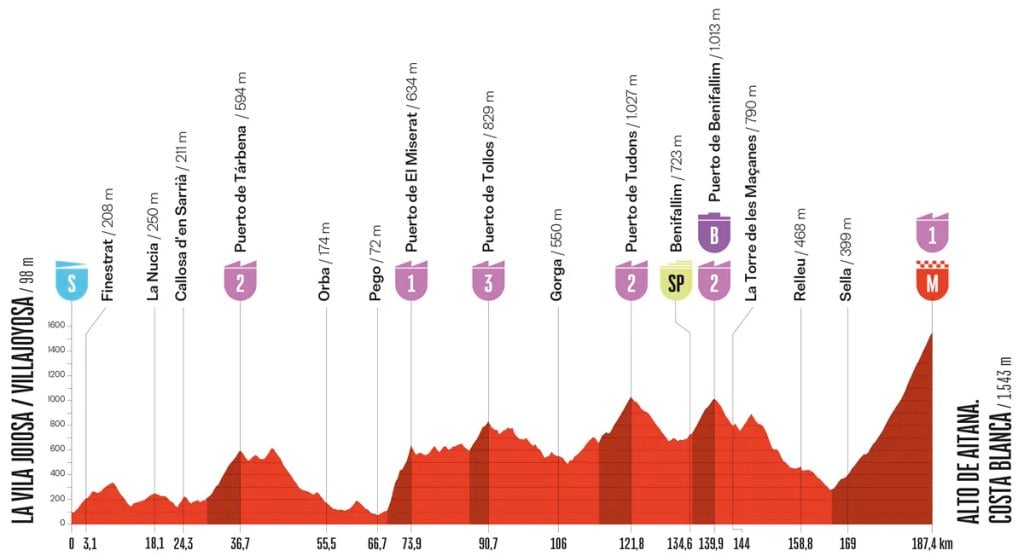
Vuelta Stage 9 route
Stage 9 starts in Villajoyosa on the Mediterranean coast before heading almost immediately into the mountains of Alicante.
There is very little easy terrain.
The race contains six categorised climbs, beginning with the Puerto de Tárbena, 7.2km at 5.4%.
The Puerto de Miserat is much steeper at 5.2km and 10%, making it the most severe climb before the finale.
That is followed by the Puerto de Tollos, Puerto de Tudons and Puerto de Benifallim before the long final ascent to Alto de Aitana.
The complete three-week context is in ProCyclingUK’s Vuelta a España 2026 route guide, but Stage 9 stands out even within a route already packed with climbing.
The opening terrain should also make forming the breakaway difficult.
There are enough climbing specialists interested in the stage win and mountains points that the first hour could become extremely aggressive.
Alto de Aitana is the first true marathon climb of the Vuelta
The decisive ascent is Alto de Aitana, returning as a Vuelta summit finish for the first time since 2016.
The climb measures 22km at 5.8%, gaining 1,264 metres before finishing at 1,543 metres.
Those numbers do not tell the whole story.
Aitana is not a short, explosive finish where riders can wait comfortably until the final two kilometres.
After more than 5,000 metres of accumulated climbing, a final ascent lasting well over 40 minutes places far greater emphasis on pacing, recovery and sustained climbing strength.
It is exactly the sort of ascent where a rider can lose contact early and continue leaking time for kilometre after kilometre.
The climb has already played an important part in Vuelta history, including the 2016 battle between Nairo Quintana and Chris Froome.
Ten years later, it returns at the perfect moment to reshape another general classification.
Pogačar’s absence has transformed the race
Before Stage 8, the main question surrounding Aitana was how much more time Pogačar might take.
That question disappeared when the race leader crashed with around 32km remaining on the road to Xeraco and was unable to continue.
Pogačar had led the race throughout the opening week and had already won three stages, including his extraordinary 50km solo victory in Andorra on Stage 4.
His advantage had reached 3:50 over Mas before the crash.
That dominance had led to the obvious question of whether the 2026 Vuelta was already effectively decided.
Stage 8 changed the answer completely.
Pogačar suffered significant injuries in the crash and his race ended on the road to Xeraco, meaning the rest of the contenders suddenly moved several minutes closer to the red jersey without turning a pedal.
For Mas, Gall, Roglič, Kuss, Onley and Carapaz, the race they wake up to on Sunday is almost unrecognisable from the one they were riding 24 hours earlier.
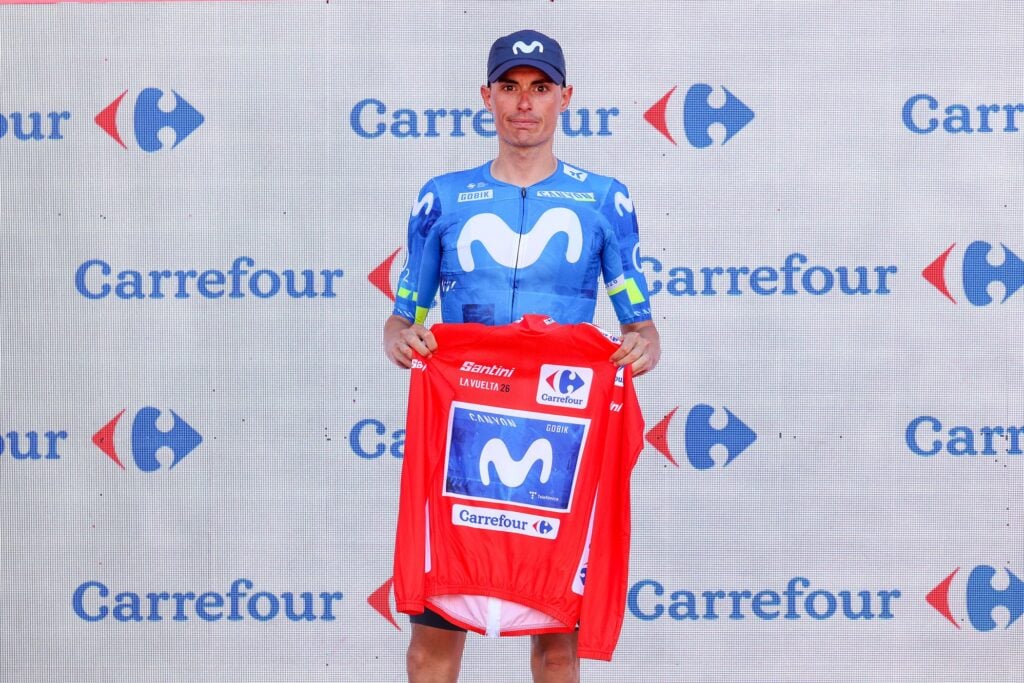 Photo Credit: Getty
Enric Mas starts his first day in red under immediate pressure
Mas inherits the race lead at almost the worst possible moment if his objective is simply to settle into the jersey.
There is no transitional day.
His first stage in red is one of the hardest of the entire Vuelta.
Mas has nevertheless been one of the strongest riders of the opening week.
His best performance came on Stage 6, when he matched Pogačar over Puerto El Bartolo and even came past him near the summit before the pair worked together on the descent into Castelló.
Pogačar ultimately won the sprint, but Mas had demonstrated that he could compete directly with the rider who had dominated the race until then.
That result suddenly matters much more.
Mas no longer needs to measure himself against Pogačar.
He needs to defend 1:11 over Gall and 1:33 over Roglič.
Movistar therefore face a completely different tactical responsibility.
They can ride conservatively and force rivals to attack, or use Mas’s form to make Aitana an opportunity rather than a defensive exercise.
The second approach may be the safer long-term strategy.
There is far too much climbing left in this Vuelta to assume a lead of just over a minute can simply be protected all the way to Granada.
Felix Gall is suddenly second overall
Gall may be the rider whose position has changed most dramatically.
He starts Stage 9 second overall at 1:11, with Roglič another 22 seconds behind him.
That makes Aitana one of the biggest opportunities of his career.
Gall’s strength lies in sustained mountain efforts rather than short explosive finishes, making this final climb an exceptionally natural fit.
He does not need a tactical sprint for bonus seconds.
He needs a hard race.
If Decathlon CMA CGM can make Aitana a long threshold battle, Gall has a realistic chance of taking substantial time from riders who are less comfortable with prolonged climbing.
The larger tactical question is whether he waits for the final ascent or asks his team to increase the attrition earlier.
With Miserat reaching double-digit gradients and more than 5,000 metres of climbing across the day, there is enough terrain to make the final climb hurt before it even begins.
Primož Roglič suddenly has another chance to win the Vuelta
Roglič starts Stage 9 third overall at 1:33.
For a rider who has already won the Vuelta four times, that still transforms the race completely.
His opening week had been overshadowed by Pogačar’s dominance, but those time losses to the former leader are now irrelevant.
Roglič does not need to recover nearly five minutes.
He needs just over a minute and a half.
The question is whether he is climbing well enough to take it.
He has not consistently looked as strong as Mas or Gall during the opening week, and Valdelinares again suggested that several riders around him could match or better his level when the road turned uphill.
Aitana offers a much clearer test.
If Roglič is back near his best, this is exactly the sort of summit finish where he can transform his race.
If he loses more ground, his position as the obvious favourite after Pogačar’s exit will become much harder to justify.
 Photo Credit: Getty
Sepp Kuss is back in a familiar Vuelta position
Kuss starts fourth at 2:15.
That gap is large enough that he needs to gain time but small enough that one exceptional mountain stage could change the shape of his race.
His victory in the 2023 Vuelta remains the obvious reference point.
Kuss is at his best when the race becomes a genuine climbing contest rather than a sequence of short accelerations.
Aitana provides exactly that environment.
Team Visma | Lease a Bike also have enough strength to make the race difficult if they decide Kuss is capable of moving towards the podium.
The challenge is that they cannot race only against Mas.
Gall and Roglič are both ahead, while Onley and Carapaz sit almost alongside Kuss in the standings.
Every move now has consequences for several riders at once.
Oscar Onley has another major GC opportunity
Onley begins Stage 9 fifth overall at 2:16, only one second behind Kuss.
His opening week has already confirmed that he belongs in this group.
The question now is whether he can maintain that level on the longest and hardest climb of the race so far.
Aitana is a different challenge from shorter summit finishes.
There is nowhere to hide if the pace is too high.
That makes Stage 9 particularly important for Onley’s three-week prospects.
If he reaches the final kilometres alongside Mas, Gall, Roglič and Kuss, his podium challenge becomes considerably more serious.
If he loses several minutes, the hierarchy begins to look much more conventional again.
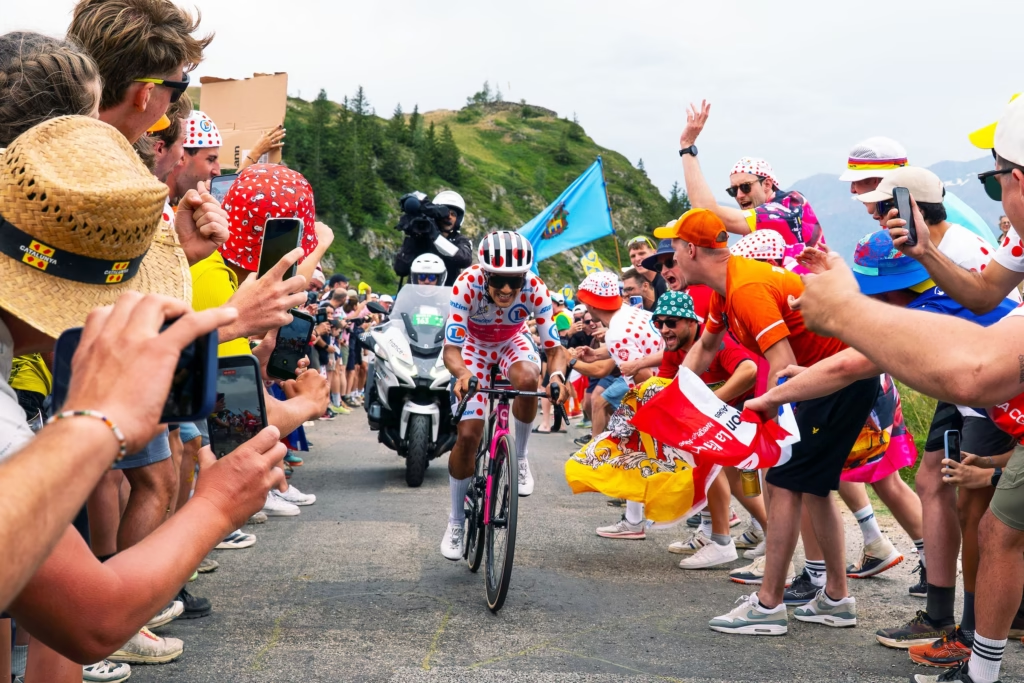
Richard Carapaz cannot afford another difficult day
Carapaz sits sixth at 2:22.
That still leaves him completely involved, but he has less margin for error than the riders immediately ahead.
His racing style should suit what the new GC situation demands.
Carapaz rarely benefits from sitting behind stronger finishers and waiting for the final few hundred metres.
He is at his best when the race becomes unpredictable.
Stage 9 offers several places to attack before Aitana, and EF Education-EasyPost have very little reason to help Movistar control everything.
A long-range move would be risky.
But with Pogačar gone and the race suddenly compressed, aggressive racing carries a much larger potential reward than it did before Stage 8.
Stage 8 completely reset the GC
The previous stage was supposed to be a relatively straightforward sprint day.
Instead, it became the most consequential stage of the race so far.
Bryan Coquard won in Xeraco ahead of Mads Pedersen and Jordi Meeus, but the stage result became secondary once Pogačar crashed and abandoned.
Mas moved into red, Gall jumped into second, Roglič sits third and the top six are now covered by 2:22.
Anyone who had been following ProCyclingUK’s Stage 8 live viewing guide had expected Puerto de Barx to provide the main late complication for the sprinters.
Instead, the crash before the climb changed the entire Vuelta.
The breakaway has a real chance
Despite the importance of the GC battle, the stage winner does not necessarily have to come from the favourites.
The opening terrain is extremely favourable for a strong mountain breakaway.
Climbers already several minutes down on GC can attack early without automatically becoming a threat to Mas.
That may leave Movistar willing to allow a sizeable advantage.
The difficulty is that the final climb is so long that the break needs substantial time before Aitana.
Three or four minutes may not be enough if the GC group begins racing hard from the foot.
A gap closer to six or seven minutes would give the strongest escapees a much better chance.
Riders such as Andreas Leknessund, Tobias Halland Johannessen, Lorenzo Fortunato, Santiago Buitrago, Jarno Widar and Léo Bisiaux could all be suited to an aggressive mountain stage if their teams give them freedom.
Andreas Leknessund could target another mountain day
Leknessund arrives only two days after winning Stage 7 at Valdelinares.
His victory came from the breakaway and was made even more remarkable by team-mate Tobias Halland Johannessen taking second for an Uno-X Mobility one-two.
It showed excellent form and a willingness to commit early.
Stage 9 offers another opportunity, although repeating the trick across a much harder day would require an exceptional ride.
Uno-X do at least have multiple options.
Johannessen proved at Valdelinares that he is also climbing well enough to be relevant from the break.
That means the team can put pressure on the race without becoming involved in the fight for red.
The mountains classification could change dramatically
The sheer amount of climbing on Stage 9 also makes the polka dot competition important.
There are five categorised climbs before Aitana, followed by the first-category summit finish itself.
A rider entering the early break can accumulate a large number of points before the GC battle even begins.
That creates an additional reason for strong climbers outside the top overall positions to attack from the start.
For newer viewers, ProCyclingUK’s Vuelta a España 2026 jerseys guide explains how the mountains classification works alongside red, green and white.
Heat could become another factor
Late August in Alicante means heat should add another layer to what is already a brutal stage.
The riders face 187.4km and more than 5,000 metres of climbing before reaching Aitana.
Cooling, hydration and fuelling will therefore be crucial.
Long mountain stages amplify small mistakes.
Missing a bottle or under-fuelling early can become decisive an hour later when the final climb begins.
That may be particularly important after an opening week already containing Andorra, gravel, Valdelinares and the chaos of Stage 8.
The first rest day follows on Monday.
Several riders may therefore be willing to empty the tank knowing they have a full recovery day immediately afterwards.
Stage 9 could produce the first true GC alliances
Pogačar’s presence had simplified the race tactically.
Everyone else was trying to limit losses to the same rider.
Now the incentives are completely different.
Gall may want Roglič to help attack Mas.
Roglič may prefer Gall to expose himself first.
Kuss and Onley can allow the first three to watch one another before counter-attacking.
Carapaz may decide none of that matters and simply go early.
Mas cannot personally chase every move.
That creates the possibility of temporary alliances.
If one contender attacks with 8km remaining, another may help because the move also threatens someone else.
That is exactly the sort of tactical complexity that had largely disappeared while Pogačar held a commanding lead.
Where Stage 9 could be won
The first important point is the battle for the breakaway.
With climbing beginning early, there could be an extended fight to establish the move.
The second is Puerto de Miserat.
At 5.2km and 10%, it is hard enough to inflict genuine damage even though there is still a long way to the finish.
The third is the sequence through Tudons and Benifallim.
If Movistar decide to control aggressively, the peloton could already be heavily reduced before Aitana.
If they ride conservatively, the breakaway may establish a stage-winning advantage.
Then comes Aitana.
Waiting until the final kilometre makes very little sense for riders who need minutes rather than seconds.
A sustained attack with 8-10km remaining could be much more damaging than one explosive move near the summit.
That is especially true for Gall, Kuss and Carapaz.
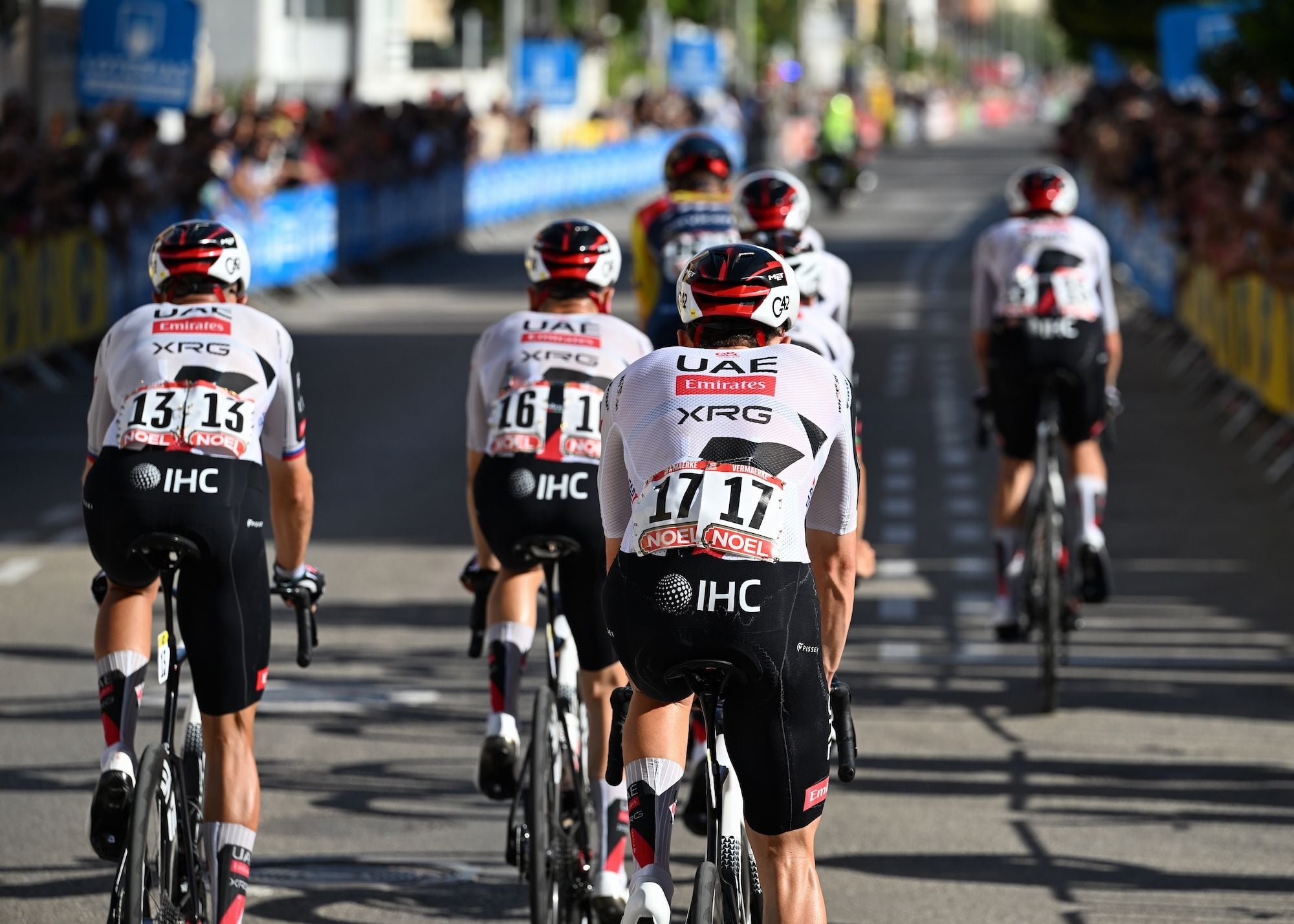
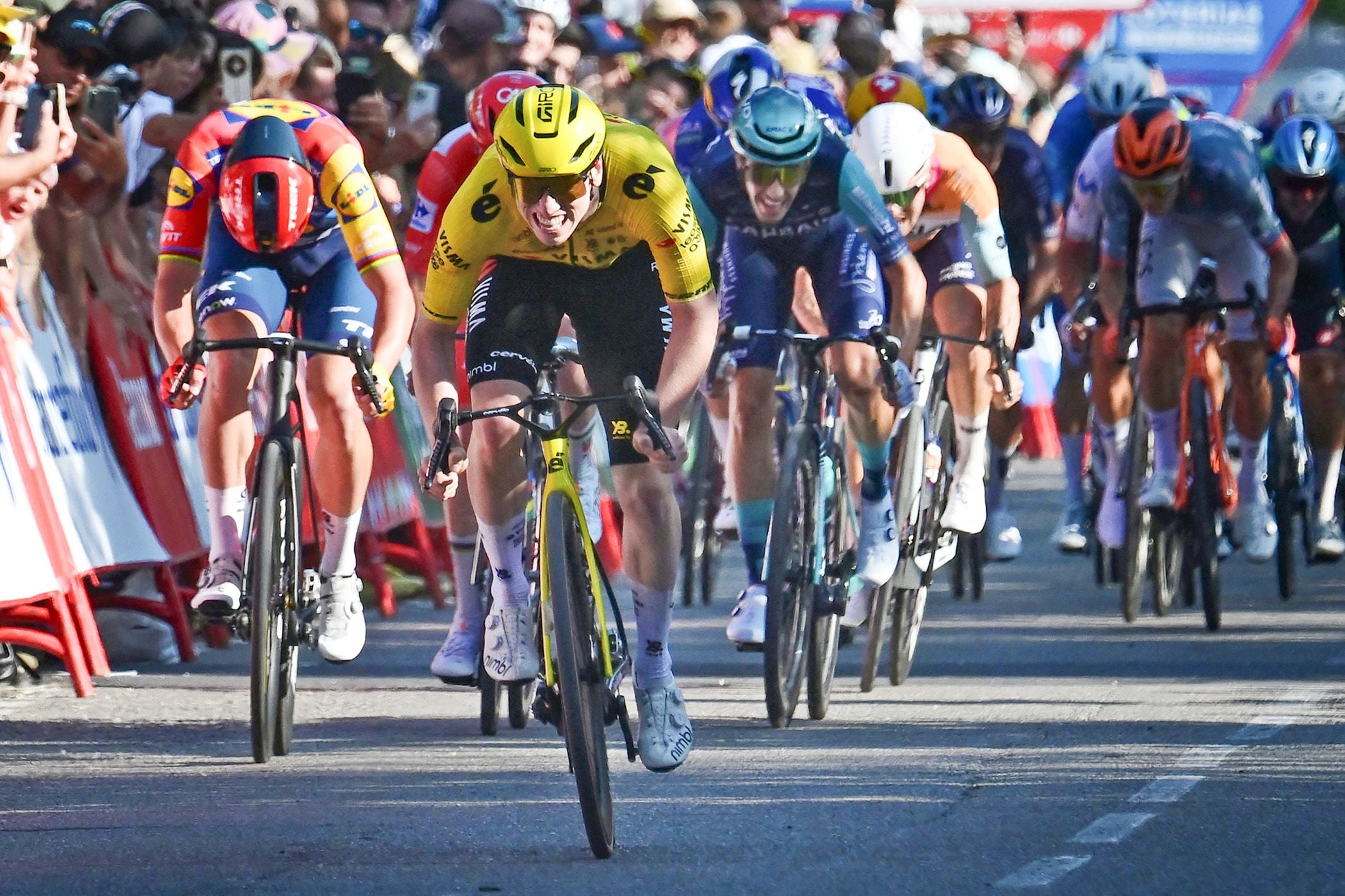
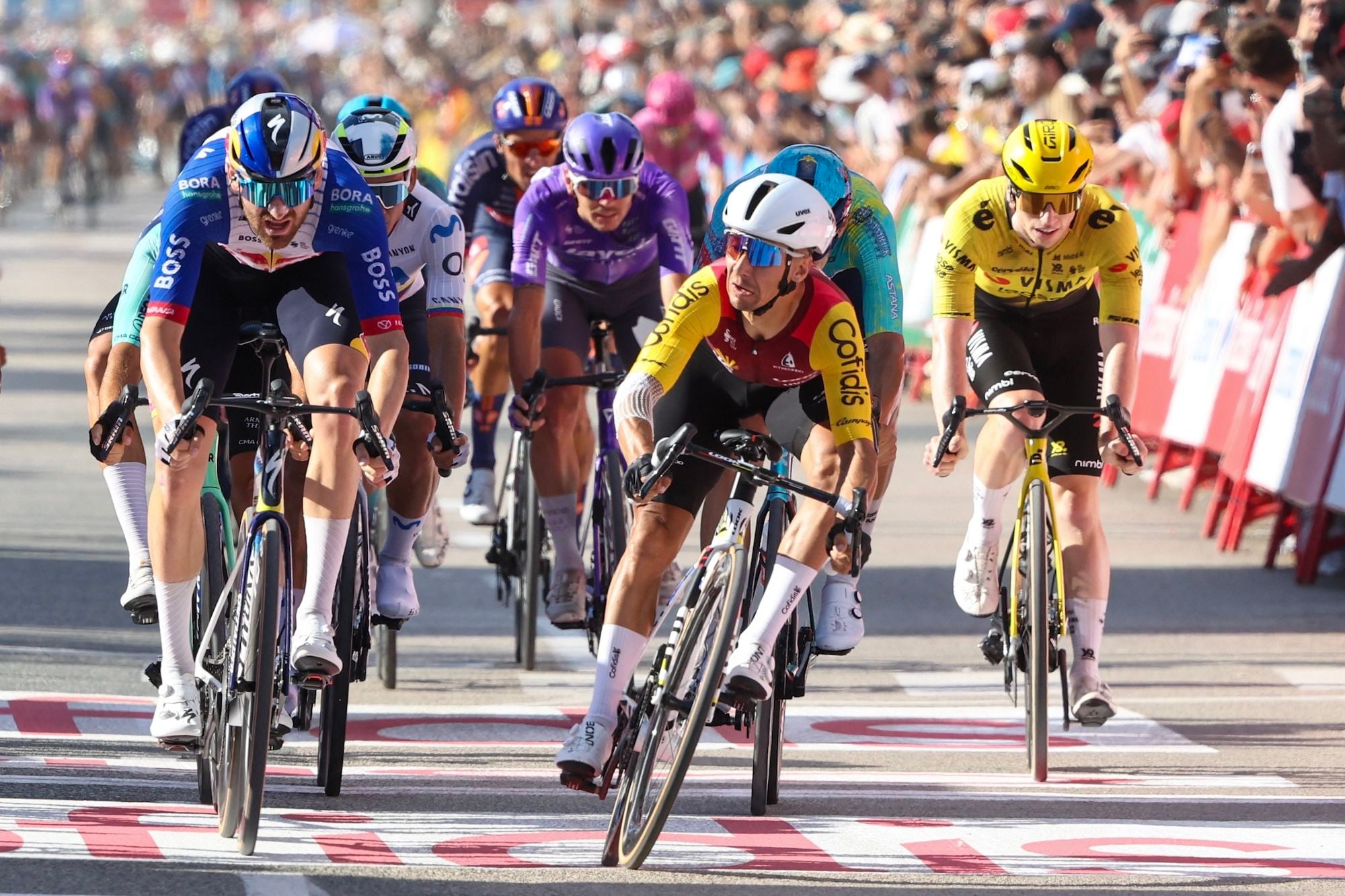
Vuelta a España Stage 9 favourites
The unusual race situation makes this one of the hardest stages to predict so far.
Enric Mas has looked extremely strong and now has the additional motivation of defending red.
Felix Gall may be the pure climber most naturally suited to a long ascent like Aitana.
Primož Roglič has the experience and still sits close enough to turn the race around with one strong mountain stage.
Sepp Kuss should become increasingly dangerous if the race turns into a sustained climbing test.
Richard Carapaz has the aggression to attack before the obvious moments.
Oscar Onley continues to deserve inclusion among the main GC contenders after an excellent opening week.
The breakaway remains a serious alternative, particularly if Movistar decide that defending the jersey matters more than chasing the stage.
Stage 9 prediction
Before Stage 8, Stage 9 looked like another opportunity for Pogačar to extend an already dominant lead.
Now it looks like the stage that could restart the entire Vuelta.
Mas begins in red, but 1:11 over Gall and 1:33 over Roglič offers very little security on a climb as long as Aitana.
Kuss, Onley and Carapaz remain close enough that none can be treated as a secondary contender.
The strongest rider on Sunday may therefore leave Aitana not simply with a stage win but as the new favourite for the entire Vuelta.
Mas has shown enough climbing form to defend the jersey, but Gall looks particularly dangerous if the stage becomes a pure endurance test.
Roglič remains impossible to ignore because of his history in this race and the relatively small gap he now needs to close.
The most likely scenario is a heavily reduced GC group reaching Aitana before attacks begin well before the summit.
Unlike almost every mountain stage of the opening week, there is no longer one rider everyone expects to control the result.
That makes Stage 9 considerably more important, and considerably more unpredictable, than it looked 24 hours ago.