
Clémence Latimier will join Cofidis from the start of the 2027 season after signing a two-year contract through to the end of 2028.
The 23-year-old French rider moves across from Ma Petite Entreprise after a breakthrough 2026 campaign in which she has produced her best results on climbing-heavy courses, including second at the Alpes Grésivaudan Classic, sixth at the French road championships and fifth at Kreiz Breizh Elites Féminin.
Cofidis see Latimier as a rider with considerable room for development despite already proving competitive against WorldTour opposition. She only entered the professional peloton in 2025 and came to cycling relatively late after initially focusing on running.
“This year, I’ve overcome physical and mental hurdles that have enabled me to achieve good results. I believe this is the right time to join Cofidis so that I can benefit from the team’s professionalism and continue to improve.”
Latimier’s rise has accelerated in 2026
Latimier’s development has been unusually quick.
A runner before turning to cycling following an injury, she initially tried mountain biking before joining a club and moving onto the road. She developed with Team Féminin Chambéry and first entered a professional environment as an Arkéa-B&B Hotels stagiaire in 2024.
ProCyclingUK covered that first Arkéa opportunity when Latimier was still making the transition from the amateur ranks.
She stepped up to the professional team during 2025 and rode her first Tour de France Femmes, before joining the newly created Ma Petite Entreprise programme for this season. Her move to Ma Petite Entreprise for 2026 gave her a larger role and the freedom to chase results of her own.
That opportunity has paid off.
Latimier finished ninth at the Grand Prix Féminin de Chambéry in April before taking second at the Alpes Grésivaudan Classic in June. She then finished sixth in the French road championships and fourth overall at the Tour Féminin International des Pyrénées.
That Pyrénées result was particularly revealing. Latimier was part of the main chasing group behind Paula Blasi on the Tourmalet stage and eventually finished only 2:10 behind the overall winner.
The final Tour Féminin International des Pyrénées classification placed Latimier ahead of Cofidis rider Ema Comte and confirmed that her progress was beginning to translate into stage-race results as well as one-day performances.
Cofidis noticed Latimier during the Tour de France Femmes
Her second Tour de France Femmes gave Cofidis further evidence.
Latimier completed the race 37th overall and eighth in the young rider classification, but her value was not limited to the final standings. She repeatedly tried to get ahead of the race and was visible in breakaways when the terrain became harder.
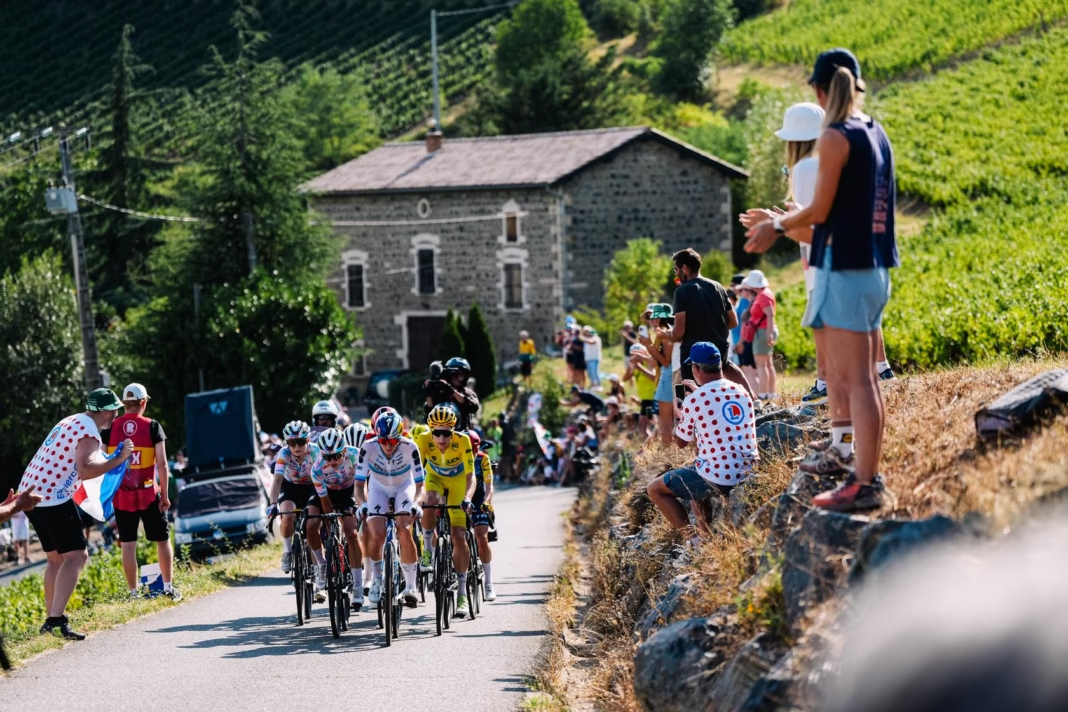
That included Stage 7 to Mont Ventoux, where Latimier was part of the 11-rider breakaway that formed before the decisive GC battle on the Giant of Provence.
The Tour de France Femmes Stage 7 race report showed Latimier again trying to influence the race rather than waiting for the favourites to dictate it.
That approach is exactly what she identifies as one of her main characteristics.
Latimier describes herself as attack-minded and says she likes taking the initiative rather than simply following.
Cofidis manager Raphaël Jeune said her Tour performances reinforced the team’s interest.
“We’ve seen recently, particularly during the Tour de France Femmes with Zwift, that she was very often right at the front when the battle kicked off.”
He added:
“We’re committed to helping her raise her game even further so she can continue to progress. I’m convinced she can deliver outstanding performances and bring prestigious victories to the Cofidis team in the future.”
-
 Photo Credit: A.S.O./Billy Ceusters
Climbing is already a strength but Latimier wants a broader role
Latimier’s best results point clearly towards climbing and hilly racing.
Second at Alpes Grésivaudan, fourth at the Tour Féminin International des Pyrénées and her performances during the Tour de France Femmes all suggest that longer climbs are becoming an increasingly important part of her profile.
She does not want to define herself too narrowly yet.
“I still have a lot of work to do to improve and reach the level of the world’s best female riders. But I don’t want to set any limits for myself. I want to work on my weaknesses, improve my strengths and become a well-rounded rider.”
That makes the length of the Cofidis contract useful.
Two seasons gives Latimier time to improve inside a more established structure without needing to arrive as a finished WorldTour-level leader. She can continue developing as a climber while also learning how to convert her aggressive racing into results across hilly Classics and shorter stage races.
Her fifth place at Kreiz Breizh Elites Féminin in August offered another example of that broader potential, coming on a course that rewarded repeated efforts and positioning rather than one long mountain.
Cofidis continue investing in French talent
Latimier will join a Cofidis women’s squad that already contains several talented French riders, including Julie Bego and Ema Comte.
There is an interesting link between the three.
At this year’s Alpes Grésivaudan Classic, Latimier finished second, Comte was third and Bego fourth. From next season, all three will be wearing the same jersey.
For Cofidis, Latimier provides another rider who can grow with that group rather than simply being added as immediate support for an established leader.
Her arrival also continues an increasingly active 2027 transfer market across the women’s peloton, with confirmed moves and contract extensions being tracked in ProCyclingUK’s women’s cycling transfers hub.
Latimier’s trajectory makes her one of the more interesting French moves within it.
She was still racing primarily at amateur level little more than two years ago. Since then she has joined the professional peloton, ridden two Tours de France Femmes, finished second in a demanding climbing Classic and established herself inside the top group of emerging French stage-race riders.
The Cofidis move gives her the next step she was looking for, but not a reason to become more conservative.
“I don’t want to set any limits for myself.”
For a rider whose progress has largely come from attacking rather than waiting, Cofidis will hope that remains the case.

