Canyon SRAM Generation was launched in 2022 with a broader purpose than simply giving Canyon SRAM a reserve squad. The new Continental team was intended to address one of the persistent weaknesses in women’s cycling: talented riders could emerge almost anywhere, but the routes into the European professional peloton were concentrated in relatively few countries.
A rider developing in Germany, the Netherlands, France, Italy or Britain could usually access established clubs, regular racing and people who understood how to navigate the sport. The same ability in Rwanda, Namibia, Malaysia, Jamaica or Paraguay did not automatically come with the same opportunities. Travel costs, visas, equipment, coaching and the basic problem of being seen by professional teams could all become significant barriers.
Canyon SRAM’s answer was a formal development programme attached to its Women’s WorldTour structure. The team offered supervised training, coaching, equipment, racing and practical support, while specifically looking beyond the countries that already supplied much of the professional peloton.
The aim was not to guarantee WorldTour contracts. It was to give riders a serious opportunity to find out whether they could reach that level.
Why Canyon SRAM created a development team
The idea was announced in July 2021 as part of Canyon SRAM’s longer-term diversity and inclusion programme. At the time, a formal development team attached to a European-based Women’s WorldTour squad was new territory.
The original Canyon SRAM Generation announcement set out a two-tier structure in which eight riders would receive scholarships covering the main requirements of training and racing, alongside mentorship and opportunities to spend time with the WorldTour team.
Recruitment was focused particularly, although not exclusively, on Africa, Asia and South America.
That distinction was important. The team was not intended simply to identify the best under-23 riders already racing successfully in Belgium, France or the Netherlands and put them into different colours. Its starting point was that the normal scouting system was more likely to miss riders whose geography had limited their racing opportunities.
The scale of the response suggested the problem was real. Canyon SRAM received 239 applications from riders representing 62 nationalities when places for the first roster were opened. The application process for Canyon SRAM Generation gave the team a far wider pool than conventional European scouting alone would have produced.
Selecting eight riders from that group was only the beginning. The more difficult part was turning very different sporting backgrounds into a functioning Continental racing team.
The 2022 roster made the idea immediately visible
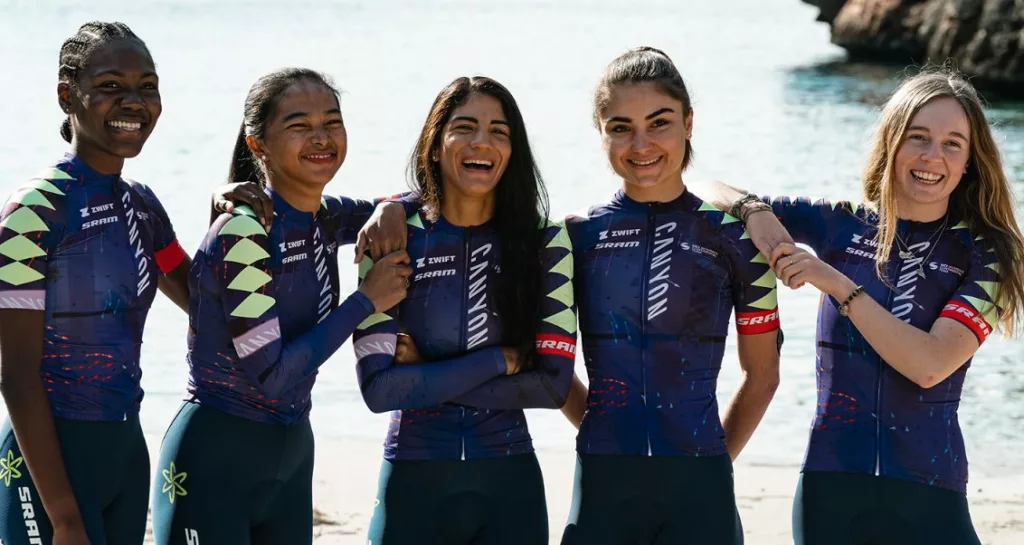
The inaugural squad contained eight riders from seven countries across four continents.
Agua Marina Espínola represented Paraguay, Fatima Deborah Conteh came from Sierra Leone, Valentine Nzayisenga from Rwanda, Siti Nur Alia Mansor from Malaysia, Llori Sharpe from Jamaica and Olivia Shililifa from Namibia. Germans Ricarda Bauernfeind and Antonia Niedermaier completed the roster.
The first Canyon SRAM Generation line-up was unusual not because every rider was an unknown quantity, but because their routes into the team were so different.
Espínola was already an Olympian and an established international rider. Bauernfeind had a strong German racing background. Niedermaier had come to cycling after competing at a high level in ski mountaineering. Other riders had far less experience of the European road calendar.
Putting them into one programme created an immediate challenge for the staff. Development could not mean the same thing for everyone.
For one rider it might involve learning how to position for a European bunch sprint. Another needed stronger tactical understanding. Someone else might already have the physical level required but need experience of stage racing, nutrition or recovery.
That became one of the defining characteristics of Generation. It was less a conventional age-group squad than a collection of riders whose careers had reached different points by different routes.
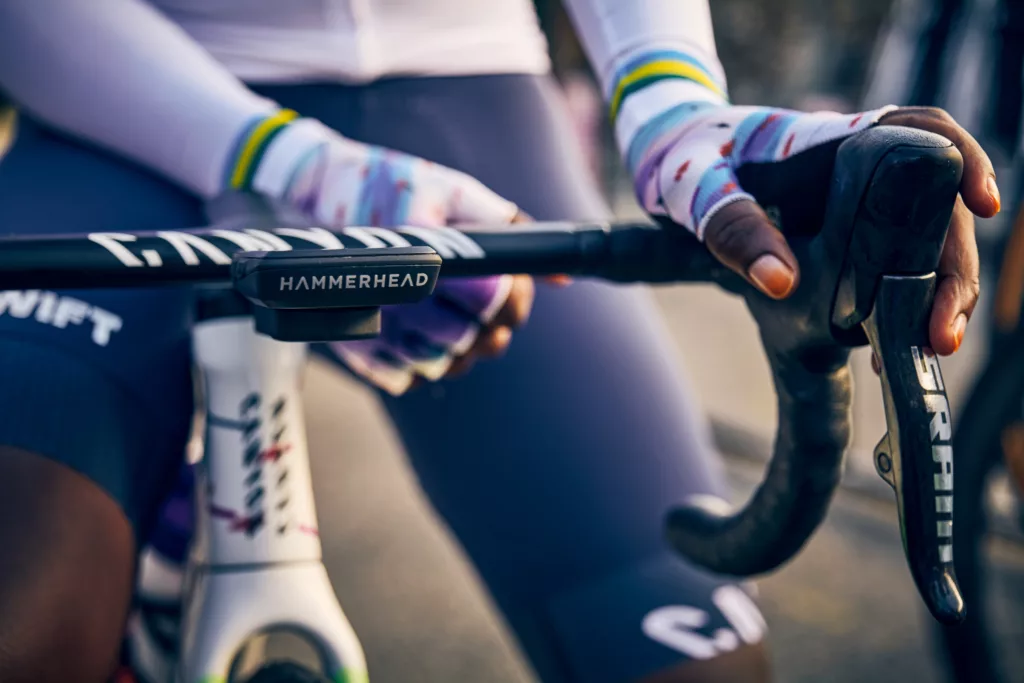 Photo Credit: Tino Pohlmann
Bauernfeind and Niedermaier provided an immediate proof of concept
The programme could hardly have asked for a clearer first-season outcome than the development of Bauernfeind and Niedermaier.
Bauernfeind quickly began producing results in 2022, including victory at GP Cidade de Pontevedra and strong performances at the Vuelta a Andalucía, Thüringen Ladies Tour and CIC-Tour Féminin International des Pyrénées. Niedermaier went even further as the season developed, winning the Tour Cycliste Féminin International de l’Ardèche overall.
By October, Canyon SRAM had decided both were ready to move up. The team promoted Bauernfeind and Niedermaier to its WorldTour roster for 2023.
What followed gave the development project credibility far beyond the initial announcement.
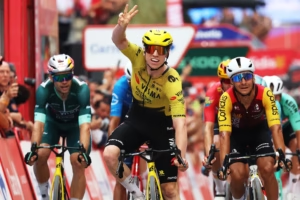
Niedermaier won a stage of the 2023 Giro d’Italia Donne after attacking more than 20km from the finish, a breakthrough covered in our report from the Giro queen stage. She also became the under-23 world time trial champion and continued developing into a major stage-race rider.
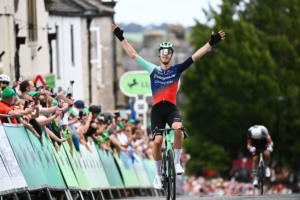
Bauernfeind produced an even more visible result at the Tour de France Femmes. She attacked with 36km remaining on Stage 5 and held off the chase to take a solo victory in Albi, her first Women’s WorldTour win. The full race story is covered in Ricarda Bauernfeind’s Tour de France Femmes stage victory.
Neither result proved that every Generation rider would eventually become a WorldTour winner. They did prove that the route from the development squad to the highest level was real.
The second intake showed that Generation was not a one-year experiment
With Bauernfeind and Niedermaier promoted, the 2023 roster became the first test of whether Canyon SRAM could repeat the process rather than simply celebrate two successful recruits.
Four riders remained from the inaugural squad: Espínola, Nzayisenga, Sharpe and Shililifa. They were joined by Nesrine Houili of Algeria, Rwandan champion Diane Ingabire, Austrian Daniela Schmidsberger and German teenager Justyna Czapla.
The 2023 Canyon SRAM Generation roster again covered seven countries and four continents.
Czapla represented another version of the development model. Unlike some of the programme’s recruits, she already possessed an outstanding junior record, including European and German junior time trial titles and silver at the junior World Championships.
Her challenge was not gaining access to cycling for the first time. It was making the notoriously difficult transition from junior racing into the senior peloton.
Canyon SRAM judged one season in Generation sufficient. Czapla was promoted into the WorldTour team for 2024, giving the project a third direct progression within its first two years.
That also demonstrated that Generation did not have to recruit from one particular type of background. Its diversity objective could exist alongside the more familiar work of developing a highly rated European junior.
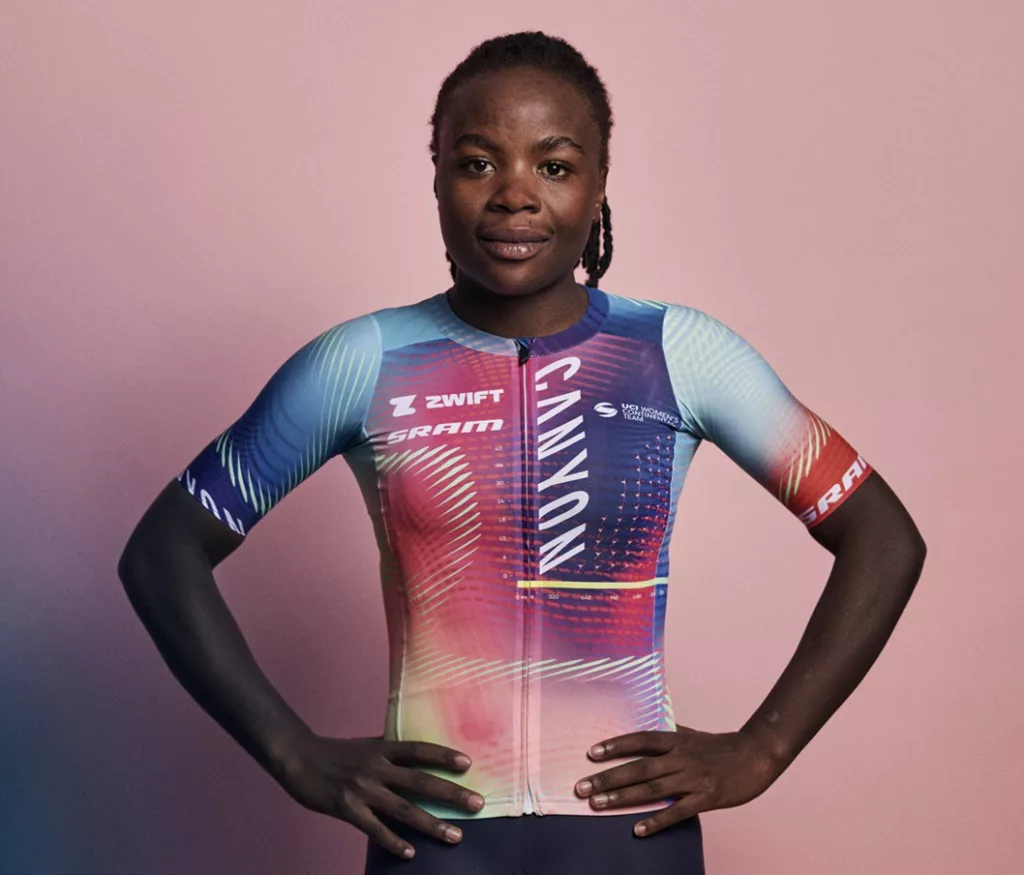
Racing progression mattered more than throwing riders into the deepest field
A development team only works if its calendar reflects what the riders need.
Canyon SRAM Generation generally began seasons with smaller races before moving towards stronger UCI events, allowing riders to build their tactical and physical understanding rather than immediately spending every weekend trying to survive against Women’s WorldTour squads.
That did not mean avoiding difficult opposition.
Generation regularly raced events containing WorldTour teams, where positioning and decision-making could be exposed as quickly as physical weakness. The purpose was to reach those races with enough experience for them to be useful rather than simply overwhelming.
That difference can be easy to miss when development is judged through results databases.
A rider finishing 60th in a difficult UCI race might have made a significant improvement if she had spent the previous season struggling simply to remain comfortable in a European peloton. Learning when to eat, how to move through the bunch, where crosswinds are likely to split a race and how to communicate with a sports director are not immediately visible in a result.
Generation gave riders somewhere to learn those skills without every difficult afternoon becoming a referendum on whether they deserved to remain professional.
The 2024 roster pushed the international model further
By 2024, Canyon SRAM Generation had expanded to nine riders, its largest squad to that point.
Ingabire and Schmidsberger remained, while the incoming group included Ethiopia’s Selam Amha Gerefiel, Uganda’s Florence Nakagwa, Nigeria’s Ese Lovina Ukpeseraye, Welsh rider Awen Roberts, Germany’s Jule Märkl and Anastasiya Kolesava. South African Maddie Le Roux completed the roster after winning the 2023 Zwift Academy.
Our guide to the 2024 Canyon SRAM Generation riders showed how difficult it had become to describe a typical route into the programme.
Amha had developed through Ethiopian cycling and the World Cycling Centre. Nakagwa’s competitive career had started relatively late. Ukpeseraye arrived as an African champion from a country with little representation in the European women’s peloton. Roberts had followed a more recognisable British development route, while Kolesava already had several years of Continental-level racing behind her.
That last example is particularly useful when understanding what Generation had become.
Kolesava was not an inexperienced rider being introduced to professional cycling. She had already raced for the World Cycling Centre, Stade Rochelais and Arkéa and had finished third overall at the 2023 Tour de l’Ardèche.
Generation instead gave her a route back towards the highest level.
After one season she was promoted to Canyon SRAM’s Women’s WorldTour squad for 2025.
By that point, the feeder pathway had worked for riders at very different stages of their careers.
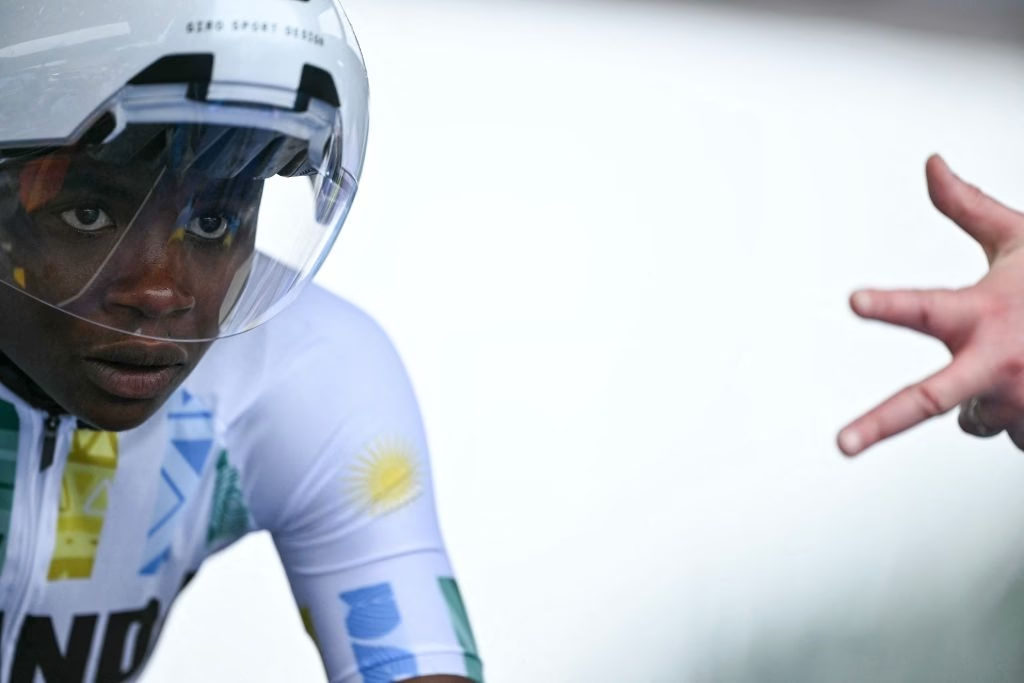
Zwift Academy added another way of finding riders
Maddie Le Roux’s arrival illustrated how Generation could sit alongside another of Canyon SRAM’s development projects.
Le Roux earned her contract through Zwift Academy after a selection process that looked beyond simple indoor power numbers. Finalists were assessed in a team environment, including how they responded to racing situations and worked with other riders.
Her background was unconventional. The South African had come through triathlon, worked as a teacher and only later committed fully to cycling.
The story of Le Roux winning the 2023 Zwift Academy therefore fitted Generation particularly well. Her opportunity did not depend on having spent her teenage years building a results sheet in the traditional European junior system.
Zwift Academy and Generation were not identical projects, but together they reflected the same willingness to search for riders through routes outside conventional professional recruitment.
That matters most when evaluating athletes who have not had comparable opportunities. A rider with 50 European race days carries a much richer body of evidence than someone with five. Judging the second rider solely against the first risks confusing lack of access with lack of ability.
The project also exposed the barriers a contract could not remove
Generation could reduce structural disadvantages, but it could not eliminate them.
Florence Nakagwa’s experience provided a particularly clear example. After joining the programme for 2024, visa problems prevented the Ugandan champion from joining the team’s European racing programme as intended. She remained under contract and was retained for 2025, but an entire season of planned development had effectively been interrupted by an issue unrelated to her ability to race a bike.
The 2025 Canyon SRAM Generation roster announcement discussed Nakagwa’s situation alongside the continuation of Ingabire and Roberts and the arrival of German track prospect Joëlle Messemer.
It demonstrated both what Generation could offer and where its influence ended.
A European development team can provide equipment, coaching, accommodation and races. It cannot make immigration systems disappear. Riders from countries with established access to the Schengen area simply do not face the same administrative obstacles.
That is why measuring an international development programme solely through promotions would be too narrow. The starting conditions are not equal.
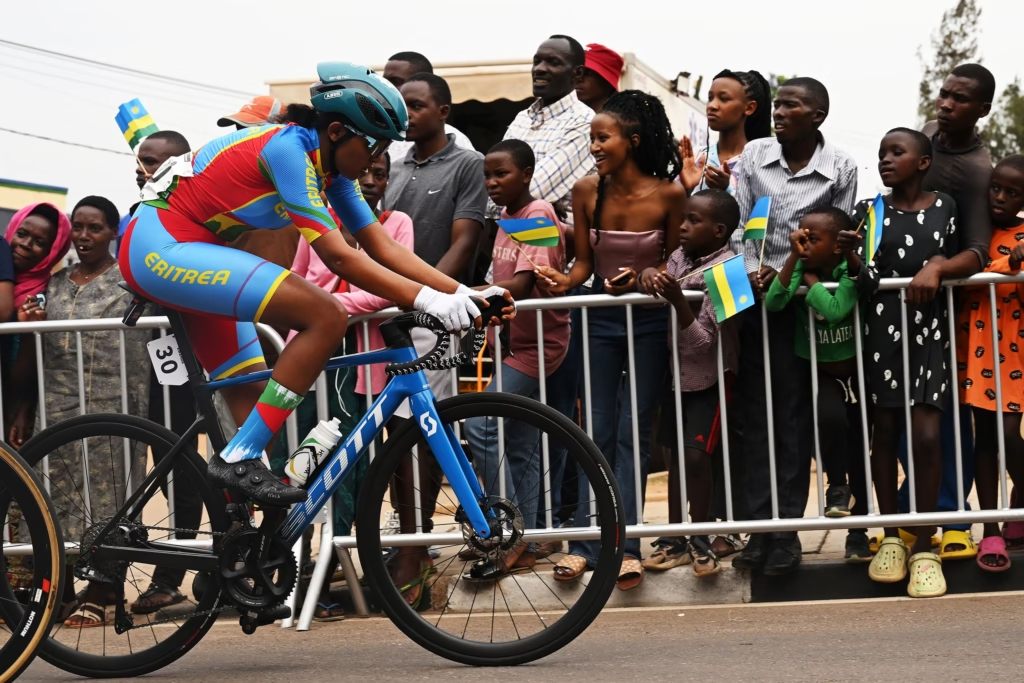
WorldTour promotion was never the only acceptable outcome
Development squads are often reduced to a simple statistic: how many riders reached the parent team?
Generation produced enough examples for that metric to matter. Bauernfeind, Niedermaier, Czapla and Kolesava all moved directly from the development structure into Canyon SRAM’s WorldTour squad.
Their subsequent careers also make those promotions meaningful rather than cosmetic. Niedermaier developed into a leading GC rider and remains with Canyon SRAM on a long-term contract, while Czapla and Kolesava have continued racing at WorldTour level. Bauernfeind’s path eventually took her onwards to Lidl-Trek after her formative years within Canyon SRAM.
But expecting every rider to follow the same path would misunderstand development.
Some riders spend a season or two in a programme and find contracts elsewhere. Some discover that their level sits below the WorldTour. Others may become significantly better cyclists without producing the results needed for another professional contract.
A development structure has to allow for all of those outcomes.
If promotion is treated as the only evidence of success, teams are encouraged to recruit riders who are already almost certain to reach the top. That produces excellent conversion statistics but does very little to widen access.
Generation was interesting because it accepted more uncertainty than that.
The roster continued evolving in 2025 and 2026
The team did not retreat towards a purely conventional European feeder model after its first few seasons.
The 2025 roster retained riders including Ingabire, Nakagwa, Roberts, Le Roux, Märkl and Ukpeseraye while bringing Messemer into the programme. By then the balance between international recruitment and more traditional European prospects had become one of the squad’s established characteristics.
The fifth season in 2026 continued that pattern with a ten-rider roster. Returning riders included Roberts, Märkl and Messemer, while the new intake brought another mixture of experience and geography.
One of the most significant additions was Eritrean champion Monaliza Araya Chneslasie. Her move to Canyon SRAM Generation for 2026 added another country with a strong cycling culture but very limited representation in the European women’s professional peloton.
Ethiopia’s Tsige Kahsay Kiros provided another direct connection with East African cycling, while Sophie Alisch arrived through a completely different route after previously competing as a professional boxer. Italian Valentina Corvi and Australian Emily Dixon added more conventional high-level cycling backgrounds.
The result was not diversity for the sake of producing a long list of nationalities. The useful question remained whether those riders could receive enough appropriate racing and support to establish what their ceiling actually was.
The senior team’s identity increasingly included the development structure
Generation also became harder to separate from the wider identity Canyon SRAM wanted to build.
The WorldTour team had long presented itself as more than a results operation, whether through distinctive kit, the Zwift Academy or its public emphasis on creating opportunities within women’s cycling. Generation gave that identity a practical structure.
It was still a racing team. Riders had contracts to earn, roles to fulfil and selection decisions to justify. Results remained important because professional development without competitive standards would eventually become meaningless.
The distinction was in where the team was prepared to look before making those judgements.
When Canyon SRAM ended its zondacrypto title partnership during the 2026 season, the organisation specifically included Generation among the programmes it viewed as part of its long-term foundations. The sponsor split and return to the Canyon SRAM name changed the branding of both squads but not the existence of the development structure.
Five seasons after its launch, Generation was no longer an experimental addition. It had become an established part of how Canyon SRAM operated.
Why Canyon SRAM Generation matters beyond Canyon SRAM
The wider significance of Generation is easier to see when compared with how women’s cycling development traditionally worked.
For years, the sport relied heavily on clubs, national federations and smaller independent teams to prepare riders for the professional peloton. Those organisations remain essential, but access varies enormously between countries.
Men’s WorldTour organisations have long been able to use under-23 and Continental development teams to control more of the pathway themselves. Women’s teams historically had far fewer equivalent structures.
Canyon SRAM Generation helped demonstrate that a Women’s WorldTour organisation could operate its own dedicated pathway and use it for more than recruiting the most obvious European teenagers.
That model has become increasingly relevant as the top level of women’s cycling grows stronger.
Professionalisation has raised salaries, improved support and made Women’s WorldTour racing faster and more specialised. Those changes are positive, but they also increase the difficulty of stepping directly from a limited domestic calendar into the best races in the world.
A rider who arrives underprepared is competing against athletes supported by full-time coaches, nutritionists, aerodynamic testing and increasingly sophisticated performance departments. Raw talent alone is less likely to bridge that gap than it was a decade ago.
A genuine development level between domestic racing and the WorldTour therefore becomes more valuable as the sport improves.
Generation’s strongest legacy is the range of pathways it created
Bauernfeind and Niedermaier remain the clearest early success stories because of what they achieved after leaving the development squad. A Tour de France Femmes stage victory and a Giro stage win are difficult evidence to argue against.
Czapla showed how Generation could handle the junior-to-elite transition. Kolesava showed that it could also provide an experienced Continental rider with a route into the WorldTour. Le Roux demonstrated the connection with Zwift Academy, while riders from Rwanda, Nigeria, Uganda, Ethiopia, Namibia, Malaysia, Jamaica, Paraguay and Eritrea showed how far beyond the usual European recruitment map the project was willing to look.
Not all of those careers produced the same outcome, and that is an important part of the history rather than something to hide.
A development team taking genuine risks should have riders who do not reach the WorldTour. If everyone succeeds, the recruitment process probably was not taking many risks in the first place.
Canyon SRAM Generation’s contribution has been to make that uncertainty part of the model. It created a professional environment in which riders with very different levels of previous access could race, learn and be judged on what they became once those opportunities were available.
That is what separated Generation from simply being Canyon SRAM’s reserve team. The pathway was designed to produce stronger riders, but it also widened the group given a realistic chance to enter it.