
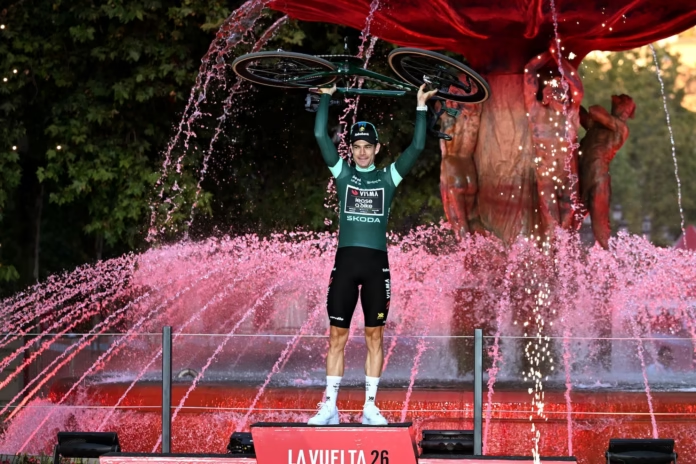
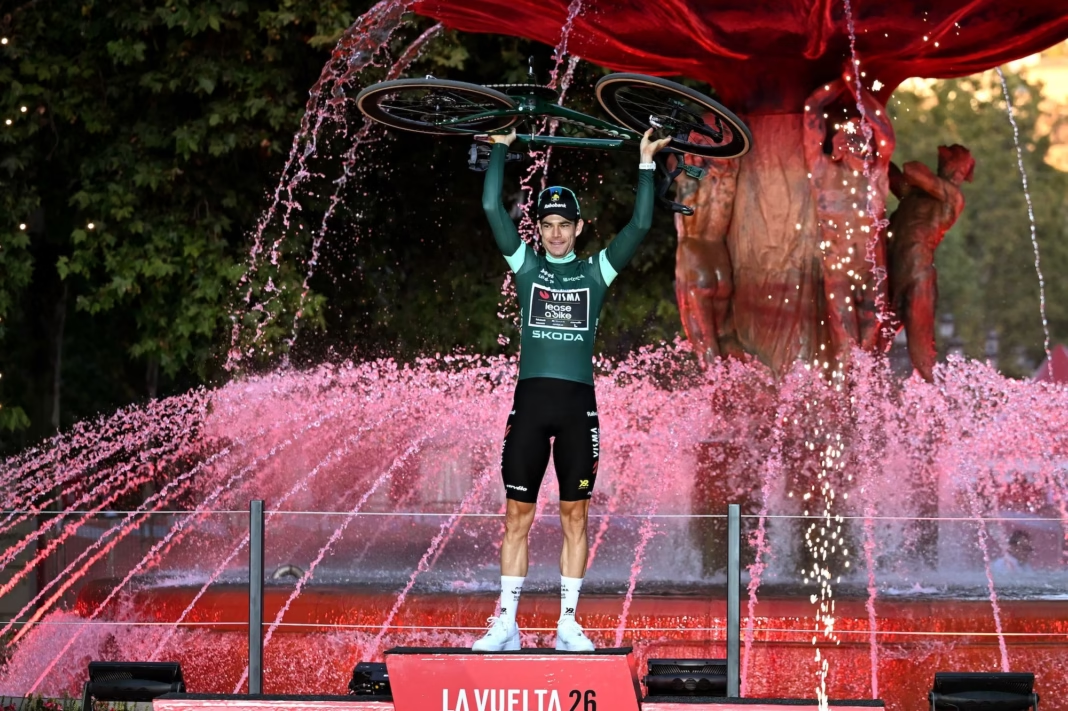
Wout van Aert leaves the Vuelta a España with two stage victories, the green jersey and the overall combativity award. Less than two weeks later, he will line up in Montréal still chasing the biggest road title missing from his career.
The result sheet alone makes his Vuelta look good. The manner in which he accumulated those results makes it considerably more interesting ahead of the World Championships.
Van Aert won from difficult breakaways, survived days containing more than 3,000 metres of climbing, collected points across almost every type of terrain and repeatedly sacrificed his own sprint to lead out Matthew Brennan. He also remained strong enough late in the race to test himself in the Jerez time trial.
He finished with 326 points, 53 more than Brennan, despite his Visma | Lease a Bike teammate winning five stages.
As the Vuelta’s final classification confirmed, Van Aert did not merely survive three weeks in Spain. He remained one of its most influential riders from the opening stages through to Granada.
The obvious question now is whether the Vuelta has built him towards Montréal or taken too much out of him.
 Photo Credit: Getty
Van Aert’s Vuelta became much more than a green jersey campaign
Van Aert had unfinished business with the Vuelta.
His first appearance in 2024 ended abruptly after a Stage 16 crash while he was leading the points classification and had already won three stages. The injuries brought his season to an end and left green as one of the objectives he had been unable to complete.
Two years later, he finally did.
The points classification began to move firmly in his direction during the opening week, when Van Aert used breakaways and intermediate sprints rather than waiting exclusively for conventional finishes. He continued scoring almost everywhere afterwards, eventually taking green despite Brennan’s extraordinary five-win Grand Tour debut.
There was also considerable work that produced no points for Van Aert at all.
He repeatedly acted as Brennan’s lead-out, including on Stage 11 into Lorca, where Visma controlled the finale before Brennan took his third victory.
The pattern continued deeper into the race. On Stage 16 at La Rábida, Van Aert again delivered Brennan through the final corner and kept accelerating until little more than 100 metres remained.
Brennan did not simply have one of the world’s best Classics riders on his team. He effectively had him as his final lead-out man.
That makes Van Aert’s own two victories more significant. He was not spending three weeks conserving himself for selected personal targets.
Loja was the strongest indication of Montréal potential
Of Van Aert’s two victories, Stage 13 into Loja probably tells us most about his World Championships condition.
The stage covered 192.8km and almost 3,300 metres of climbing. A huge breakaway dominated the day, with both Van Aert and Brennan present for Visma.
That gave the team a tactical advantage that became increasingly difficult for everyone else to solve.
If the race came down to a reduced sprint, Brennan was waiting. If attacks began, Van Aert could follow them without worrying about preserving himself for the finish.
Eventually, Van Aert stopped following and made the decisive move himself.
With around four kilometres remaining he attacked from the reduced breakaway, with Valentin Paret-Peintre the only rider able to go with him. Van Aert then comfortably won their two-man sprint, while Brennan took third from the group behind.
The Stage 13 race report showed a version of Van Aert that looks highly relevant to Montréal.
He had survived several hours of hard climbing, remained tactically alert after a chaotic race and still possessed enough acceleration to create separation before winning the sprint.
The World Championships course asks similar questions, only over a considerably longer distance.
There is no single mountain large enough to make Van Aert’s weight an obvious disadvantage. Instead, the men’s race repeatedly returns to the Mount Royal climbs, forcing riders to reproduce hard efforts after several hours of racing.
Loja showed he can still do exactly that.
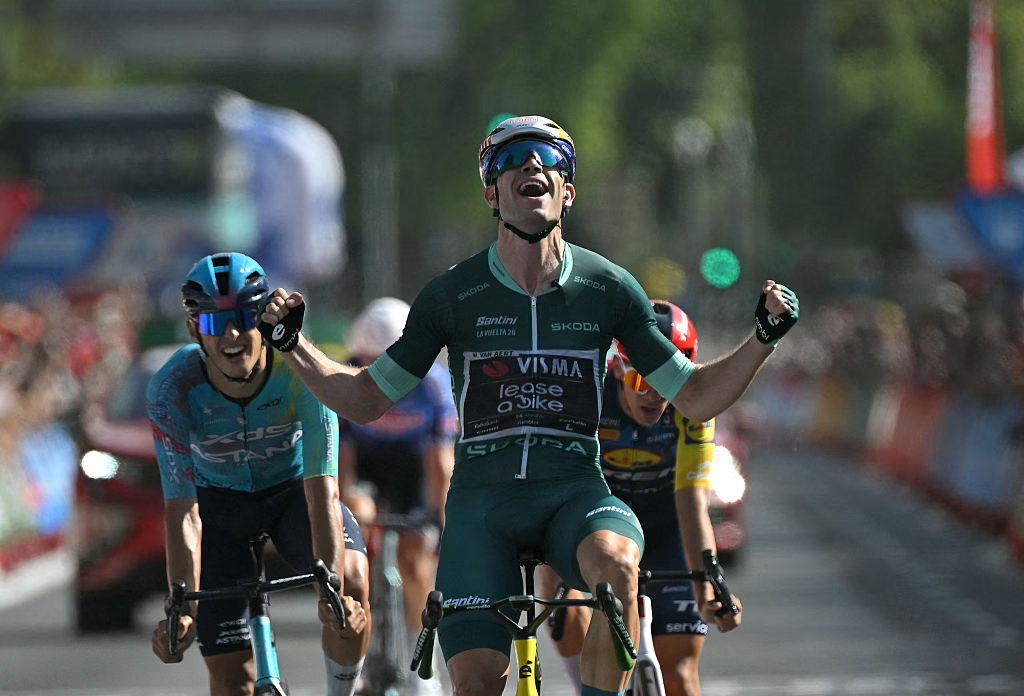 Photo Credit: Getty
Córdoba showed the other side of Van Aert’s threat
Two days later, Van Aert won again in Córdoba.
The stage had been shortened because of extreme heat, but what followed was still far removed from a routine sprint.
Van Aert attacked through the intermediate sprint with around 30km remaining and bridged to the front of the race. Alessandro Romele and Thibau Nys were among those who eventually joined a five-rider selection, but Van Aert remained in control and won the sprint comfortably.
The full sequence is covered in the Stage 15 race report.
The important detail was that Van Aert had no reason to make the race simple.
Brennan remained behind as Visma’s option if everything came back together. Van Aert therefore had the freedom to turn the stage into something much less predictable.
“Nobody expected that we would attack,” he said afterwards.
That principle could become central to Belgium’s World Championships tactics.
Van Aert and Evenepoel give Belgium opposite routes to the rainbow jersey
Belgium do not have to decide between protecting one obvious leader and sacrificing everybody else.
Remco Evenepoel and Van Aert can win Montréal in completely different ways.
Evenepoel has already shown his form in Canada. His GP Québec victory came after an attack from 28km out, exactly the sort of move opponents know they cannot allow much freedom.
Van Aert creates almost the opposite problem.
If a reduced group survives into the final kilometres, very few likely contenders will want him there. He does not need to attack from 30km out if Evenepoel is already forcing everyone else to chase.
That creates a familiar championship dilemma.
If Evenepoel attacks, does the Netherlands chase for Mathieu van der Poel? Does France commit riders for Paul Seixas? Does Britain work for Tom Pidcock? Does Mexico protect Isaac del Toro?
Van Aert can sit behind those efforts.
If Evenepoel is caught, Belgium still have one of the fastest riders capable of surviving a race this difficult.
The same structure can work in reverse. Van Aert can enter a dangerous move knowing Belgium still have Evenepoel behind, making it much harder for rivals to judge whether chasing is actually in their interests.
Van Aert spent much of the Vuelta benefiting from that sort of two-card racing alongside Brennan.
In Montréal, the second card is considerably more dangerous.
GP Montréal showed what Belgium will have to survive
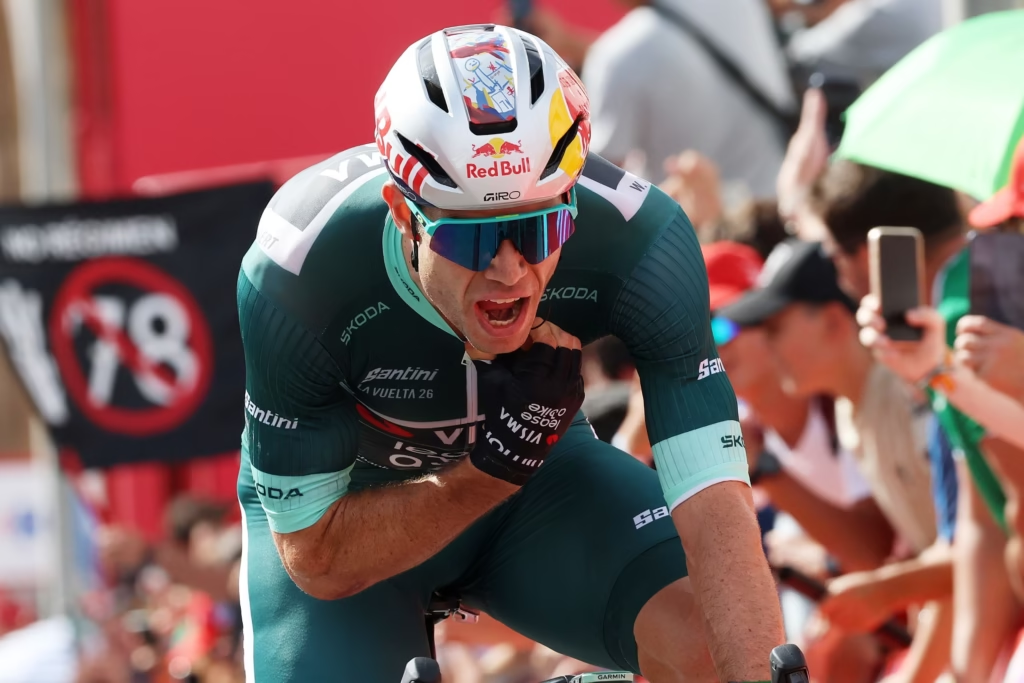
The final kilometres of Sunday’s GP Montréal offered a warning.
Seixas made the decisive acceleration on the final Mount Royal lap. Del Toro was able to respond, and the pair quickly built enough of a gap to decide the victory between themselves.
Evenepoel made the chasing group but could not bring them back. Pidcock, Giulio Ciccone and Ben Healy were also beaten by the final selection.
Van Aert did not need that reconnaissance. He was still racing the Vuelta in Spain.
What he does have is three weeks of evidence that repeated climbing has not removed his ability to sprint or attack late.
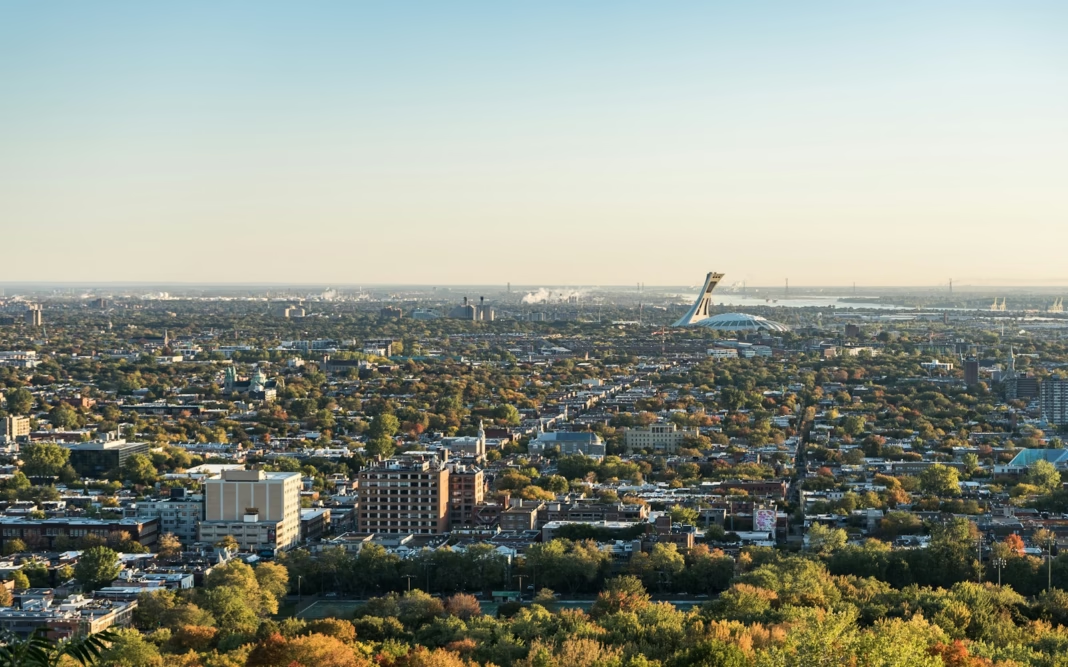
The numbers from Montréal matter. The men’s World Championships covers 273.7km and 3,803 metres of climbing, with 12 laps of the Mount Royal finishing circuit.
Van Aert will have to survive Camillien-Houde and the Côte de la Polytechnique repeatedly.
That is harder than anything he faced on one individual Vuelta stage, but the type of effort is favourable compared with a championship built around a long mountain pass.
The climbs are short enough for power to matter. Recovery between them is limited. The decisive question is likely to be who can continue producing near-maximal efforts after five or six hours.
That has always been one of Van Aert’s strengths.
His work for Brennan matters when judging the form
It is easy to look at the Vuelta and count two stage wins.
That undersells the workload.
Van Aert spent significant periods riding for Brennan rather than himself. Visma frequently used him to position the 21-year-old through technical finales and deliver him towards the sprint.
The clearest example came on Stage 16.
Van Aert took control after the final left-hand bend and accelerated hard enough to force the other sprinters to react. Brennan stayed directly on his wheel before being released around 125 metres from the finish.
He won comfortably.
Van Aert had already done something similar in Lorca, where Brennan took his third victory.
Those efforts matter because Van Aert was not treating Spain simply as a three-week training camp for Montréal. He was racing almost every day.
He contested intermediate sprints, went into breaks, chased points and worked for teammates.
His best personal results still came in the second half of the Vuelta.
That is encouraging.
 Photo Credit: Getty
Van Aert appeared to get stronger through the middle of the race
The sequence of results is probably more useful than any single victory.
Van Aert had been prominent from the opening week without winning. By Stage 13 he converted that form in Loja. Two days later he won again in Córdoba.
The wider Vuelta week-two analysis reflected just how abruptly his race changed.
For much of the first half, Van Aert had been collecting points and making himself useful.
Then he started winning.
That suggests his condition was responding well to the workload rather than deteriorating immediately under it.
For a rider targeting a 274km World Championships, that is a useful trend.
Montréal will not be won by the rider with the best five-minute power when fresh. It will be decided by whoever can reproduce that power after several thousand metres of climbing and well over six hours of racing.
Van Aert’s Vuelta suggests he has built exactly that sort of endurance.
The final stage provided the necessary warning
There is, however, a reason not to treat the Vuelta as an uncomplicated positive.
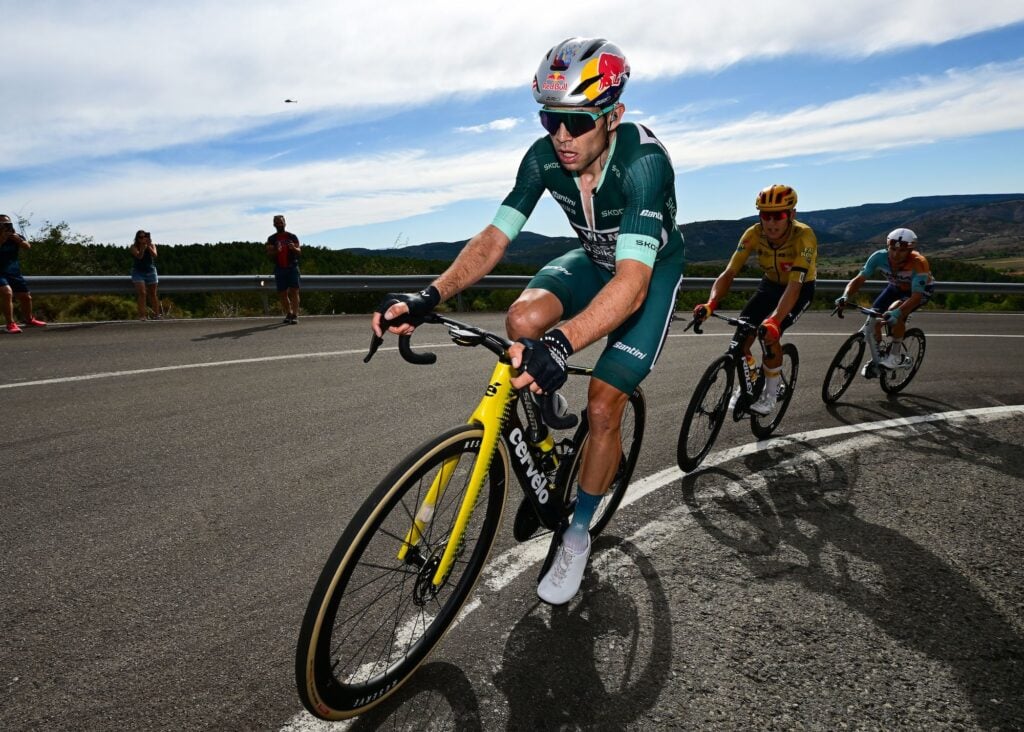
Van Aert looked tired in Granada.
The final circuit appeared suitable for him on paper, but he knew almost immediately that another stage victory was unlikely.
“Already on the first climb I could feel that it hurt a bit too much,” he admitted afterwards. “The fatigue is definitely there after three weeks.”
That is not alarming in isolation.
A rider reaching Stage 21 of a Grand Tour without accumulated fatigue would be considerably more surprising.
It does make the next fortnight important.
Van Aert does not need more racing. His work is largely recovery, allowing the fatigue accumulated across 21 stages to disappear while retaining the aerobic base and race sharpness the Vuelta has produced.
There is always a balance when using a Grand Tour as preparation for a one-day championship.
Arrive too tired and the race has taken more than it gave.
Recover correctly and three weeks of competition can produce a level that is almost impossible to replicate through training.
Van Aert has 14 days between Granada and the men’s road race.
That should be enough. Whether it actually is will be one of the main Belgian storylines of Worlds week.
Jerez showed the engine was still there
The Stage 18 time trial provided another useful marker.
Van Aert had already spent almost three weeks working across multiple roles, yet still chose to test himself over the 32.1km course into Jerez.
He finished among the strongest riders on the day.
That does not directly predict success in Montréal, where he will not ride the elite time trial, but it shows that his sustained power had survived the accumulated workload of the Vuelta.
It is also another reason the final Granada stage should not be overinterpreted.
Van Aert was producing high-level efforts very late in the race. One flat day after three weeks does not undo that.
The rainbow jersey remains one of the major omissions
Van Aert has built a career in which very few races feel beyond him.
He has won Milan-San Remo and Paris-Roubaix, collected Tour de France stages on terrain ranging from bunch sprints to mountain stages and time trials, won green at the Tour and now done the same at the Vuelta.
The elite road world title remains missing.
He has come close enough to understand exactly what that means.
Van Aert finished second behind Julian Alaphilippe at Imola in 2020 and was runner-up again behind Mathieu van der Poel in Glasgow three years later.
At 32, the opportunities are no longer unlimited.
That does not mean Montréal is a final chance. It does mean there are unlikely to be many future World Championships where Van Aert arrives with such an attractive combination of course, form and national-team strength.
Belgium have Evenepoel for the attacks Van Aert would prefer not to chase.
Van Aert gives Evenepoel exactly the same luxury.
The Vuelta has put Van Aert among the serious Montréal contenders
The strongest argument for Van Aert is not the green jersey itself.
It is everything required to win it.
He raced aggressively in the mountains, collected intermediate points, worked as Brennan’s lead-out, won on a day containing almost 3,300 metres of climbing, attacked his way into another winning break and still produced a strong time trial late in the third week.
The overall combativity award was an appropriate summary of the race.
There are riders arriving in Montréal fresher.
Del Toro and Seixas have already demonstrated that they can make the decisive selection on Mount Royal. Evenepoel has won in Québec. Pidcock has produced top-six finishes in both Canadian WorldTour races.
Van Aert’s preparation has followed a completely different route.
He has just spent three weeks racing.
If the fatigue visible in Granada disappears and the underlying form remains, that may prove to have been exactly what he needed.

