
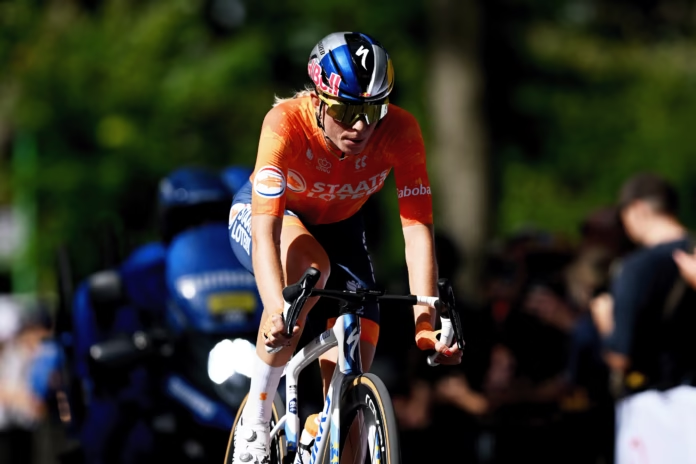
Demi Vollering did not win the 2026 World Championships because her first plan worked. She won because, when that plan was dragged back with 15 kilometres remaining, she was still strong enough and calm enough to build another one.
For much of the final hour in Montréal, the race looked as though it might become a story about Vollering attacking too early. The Netherlands had spent the day controlling the peloton, Puck Pieterse delivered a brutal acceleration on Camillien-Houde and Vollering launched with 38.5km remaining. Yet her advantage never became comfortable. Katarzyna Niewiadoma-Phinney and Elisa Longo Borghini kept the chase alive, Marlen Reusser helped on the flatter roads, and eventually the world championship favourite was caught.
That would have broken a simpler race plan. Instead, it became the point where Vollering’s victory really took shape. She absorbed the return of her rivals, closed Longo Borghini’s final-lap attack, survived Niewiadoma-Phinney’s last acceleration and then won the sprint herself. The race report tells the full sequence of attacks; the more interesting question afterwards is why Vollering was still able to finish it off after spending so much of the finale exposed at the front.
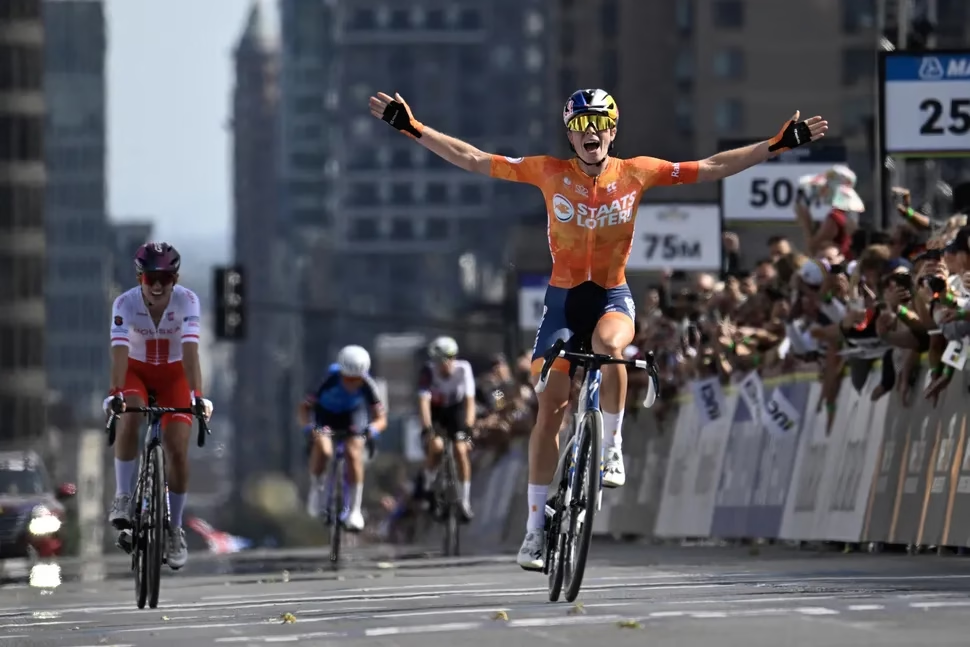 Photo Credit: Getty
The Netherlands finally committed completely to one rider
The first reason sits with the Dutch team rather than Vollering alone. From the opening kilometres out of Brossard, the Netherlands made their intentions obvious. A harmless early break was allowed to go, but behind it the orange jerseys repeatedly occupied the front and controlled the gap.
That mattered because the Netherlands did not arrive in Montréal trying to preserve three or four possible winning scenarios. Vollering was the clear leader and the team raced accordingly. Femke de Vries, Lieke Nooijen, Riejanne Markus, Karlijn Swinkels and Amber Kraak were all used before the decisive phase, allowing the race to become progressively harder without forcing Vollering to spend energy solving every problem herself.
It was a notably uncomplicated approach for a nation whose World Championships teams have often contained several riders capable of winning in their own right. The trade-off was obvious. If Vollering failed, there was no protected second plan waiting behind her. In return, she reached the decisive laps with the whole team having shaped the race around the way she wanted to win it.
Vollering later described the result as the product of asking her teammates to sacrifice their own opportunities for one plan. That pressure is easy to overlook. A national team is not a trade team, and several Dutch riders could reasonably have chased their own result on a course like Montréal. Instead, they spent their strength narrowing the race for one leader.
Puck Pieterse made the winning attack possible
The most important piece of work came from Pieterse. By the time the race reached the final 50km, the main group had already been reduced heavily, but there were still enough contenders present for Vollering to become trapped if she simply waited for the final lap.
Pieterse changed that on Camillien-Houde. Her acceleration was hard enough to put Lotte Kopecky, Niewiadoma-Phinney and several other major names under immediate pressure. Vollering then went over the top of that effort rather than starting her own attack from a settled group.
That distinction was crucial. Vollering did not have to create the initial selection and then attack it. Pieterse had already forced everybody towards their limit, so when Vollering accelerated with 38.5km remaining, Longo Borghini was briefly the closest rider but could not hold the wheel.
On paper, the move looked very similar to the scenario outlined in our women’s World Championships preview: repeated Mount Royal efforts allowing Vollering’s climbing strength to become more important than pure sprint speed. The difference was that she went earlier than many expected.
 Photo Credit: Getty
The 38km solo attack failed, but it was not wasted
Vollering quickly caught and dropped Maëva Squiban, who had attacked earlier for France, and went into the final 38km alone. The gap then hovered around 20 to 30 seconds rather than expanding towards a race-winning minute.
That made the move expensive. Vollering was riding continuously at the front while a group containing Niewiadoma-Phinney, Longo Borghini, Reusser, Juliette Berthet, Célia Gery, Dominika Włodarczyk, Squiban and Pieterse tried to organise behind. With 15.3km to go, the chase finally made contact.
It is tempting to treat that as a mistake which Vollering simply overcame through superior strength. The effect of the attack was more complicated. Bringing her back required serious work from the riders who eventually became her main rivals. Niewiadoma-Phinney and Longo Borghini had to commit to the chase, while Reusser contributed where the terrain suited her. Pieterse, as Vollering’s teammate, had no reason to help them.
So although Vollering spent energy alone, the riders trying to beat her were not sitting comfortably in a large group. They were spending their own reserves to prevent the rainbow jersey disappearing up the road. The Dutch attack had changed the race from one in which every favourite could wait into one where Vollering dictated what everyone else had to do.
That became important once the catch happened. There was no large, fresh group ready to reset. The race had already been reduced to a handful of tired riders who had spent the previous lap chasing Vollering.
Plan B started the moment Vollering was caught
The most impressive part of Vollering’s race came after contact was made.
A rider who has spent more than 20km alone at the World Championships can easily become passive once the chase returns. The physical effort is one problem, but the psychological shift can be just as difficult. A move which felt like the winning attack has failed, rivals are suddenly back on the wheel and the race has to be recalculated immediately.
Vollering did not wait for that recalculation to happen around her. When Longo Borghini attacked over the line at the start of the final lap with about 13km remaining, Niewiadoma-Phinney looked towards Vollering rather than taking responsibility herself. The Italian quickly gained around ten seconds.
That was probably the most dangerous tactical moment of the race. Longo Borghini is far too strong to be given freedom that late, and Vollering had already done more work than anybody else in the leading group. Yet allowing the attack to go because somebody else ought to chase would have thrown away everything the Dutch team had built.
Vollering took responsibility again. She rode Camillien-Houde hard enough to bring Longo Borghini back just before the summit, dropping Berthet in the process. Longo Borghini then paid for her attack and slipped away, leaving Vollering and Niewiadoma-Phinney together at the front.
Niewiadoma-Phinney forced Vollering to win in a different way
The final pairing carried obvious recent history. Niewiadoma-Phinney had already been the rider most capable of turning Vollering’s 2026 Tour de France Femmes into a tactical problem. On Mont Ventoux she exploited the hesitation between Vollering and Reusser to take yellow, only for Vollering to respond over the final weekend.
That Tour became a lesson in adaptation, as explored in our analysis of how Vollering won the 2026 Tour de France Femmes. Montréal ended up requiring something similar in miniature.
Niewiadoma-Phinney had little reason to help once the pair were clear. Vollering had shown the stronger sprint in several selective finishes this season and had also spent more time attacking. The Polish rider’s best chance was to make Vollering continue working and then attack before Avenue du Parc.
She did exactly that with around four kilometres remaining, accelerating on one of the late rises and briefly putting Vollering under pressure. It was the right move. Waiting for a conventional sprint against Vollering would have reduced her options to one of the Dutch rider’s strengths.
Vollering held the wheel. From there, the race tilted back towards her. She led through the final corner with roughly 750 metres remaining and did not panic when Niewiadoma-Phinney launched first at around 200 metres. Vollering kept accelerating and came past before the line to take her first elite road world title.
 Photo Credit: Getty
Why the early attack did not cost Vollering the sprint
The obvious question is how a rider who had spent so long alone still had enough left to sprint after 180km.
Part of the answer is simply physical. Vollering has spent 2026 showing an unusually broad range, from winning the Tour of Flanders and Ardennes Classics to taking the Giro d’Italia Women and Tour de France Femmes. Montréal sat almost exactly between those demands. It required repeated short climbs, sustained power, the ability to recover between efforts and enough speed to finish from a very small group.
But the tactical explanation matters too. Her solo attack was not 38km of riding at an uncontested maximum while everyone behind sat in the wheels. The gap was small, which forced her to work, but it also forced the chase to work almost continuously. By the time the race reached its final kilometre, Niewiadoma-Phinney had chased Vollering, helped eliminate the rest of the field and then attacked her again.
Vollering’s advantage was therefore not that she had preserved more energy. It was that after an extremely expensive race, she still possessed the best finishing power of the two riders left.
The biggest change was how Vollering handled the race going wrong
That may be the clearest thread connecting Montréal with the rest of her season.
The strongest version of Vollering in previous years could look almost unbeatable when the race developed cleanly around her. The more revealing performances have been the ones where it did not. The 2026 Tour was won after losing yellow on Ventoux. The Giro was won through a final-stage reversal. At the World Championships, the attack designed to win the race outright was caught with more than a lap still to go.
Each time, the response was immediate rather than emotional. In Montréal she did not spend the final lap racing as though the earlier attack ought to have worked. She accepted that it had not, switched to a different problem and solved that instead.
That is why the win is more interesting than a 38km solo victory would have been. A long-range ride would have demonstrated the strength everybody already knew she possessed. Being caught and still winning showed how much harder she has become to beat when the expected scenario disappears.
The rainbow jersey completes an extraordinary 2026 season
Vollering called the world title the biggest victory of her career, and the timing makes that understandable. The rainbow jersey was one of the obvious omissions from a palmarès already containing the biggest stage races and one-day events in women’s cycling.
Her 2026 season now includes Omloop Het Nieuwsblad, the Tour of Flanders, La Flèche Wallonne, Liège-Bastogne-Liège, the Giro d’Italia Women, the Tour de France Femmes and the elite road World Championships. Earlier in Montréal she had finished only eighth in the World Championships time trial won by Marlen Reusser, a reminder that even this season has contained races she could not control.
The road race was different because it rewarded almost everything Vollering has become good at. She needed a team willing to commit completely, an explosive attack, sustained power while isolated, enough composure to reset after being caught and then a sprint after nearly five hours of racing.

Before Montréal, the argument around Vollering’s 2026 season was already about where it sat among the best individual seasons of the modern era. The rainbow jersey does not settle every historical comparison, but it removes one of the few missing achievements that could still be pointed to in her career.
More importantly, the way she won it explained why this season has been so difficult for everyone else. Vollering’s first plan can fail now and the race still does not become safe.

