
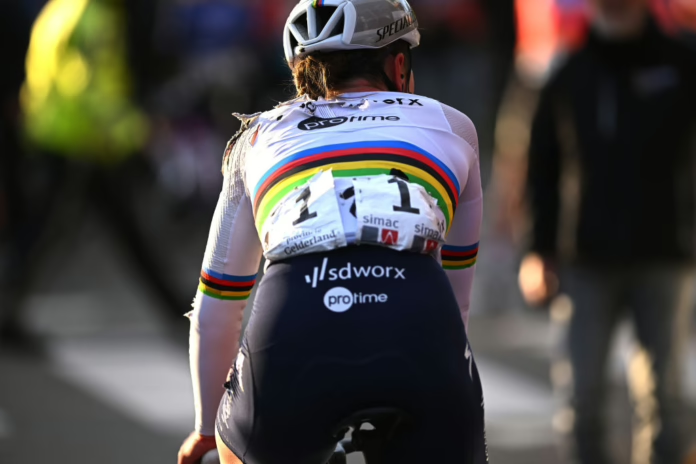
The elite women’s road race at the 2026 UCI Road World Championships takes place in Montréal on Saturday 26 September, with 180.4km and eight laps of Mount Royal standing between a deep field of contenders and the rainbow jersey.
Demi Vollering arrives with the strongest season of anyone on the start list. She has won the Giro d’Italia Women and Tour de France Femmes alongside Omloop Het Nieuwsblad, the Tour of Flanders, La Flèche Wallonne and Liège-Bastogne-Liège. A first elite road world title would complete a season already well beyond anything she has previously achieved.
There is no shortage of opposition. Katarzyna Niewiadoma-Phinney pushed Vollering deep into the final weekend of the Tour. Elisa Longo Borghini finished third there and remains one of the best championship racers of her generation. Paula Blasi has won La Vuelta Femenina and Amstel Gold Race, while Kim Le Court-Pienaar reaches Montréal having added greater climbing range to the sprint that has always made her dangerous.
Lotte Kopecky is attempting to win a third world title in four years, Marlen Reusser gives Switzerland a powerful long-range option and Magdeleine Vallières Mill returns as defending champion at a home World Championships.
The course is difficult enough to reward the climbers without completely ruling out the stronger Classics riders. That balance is what should make the final two laps so difficult to control.
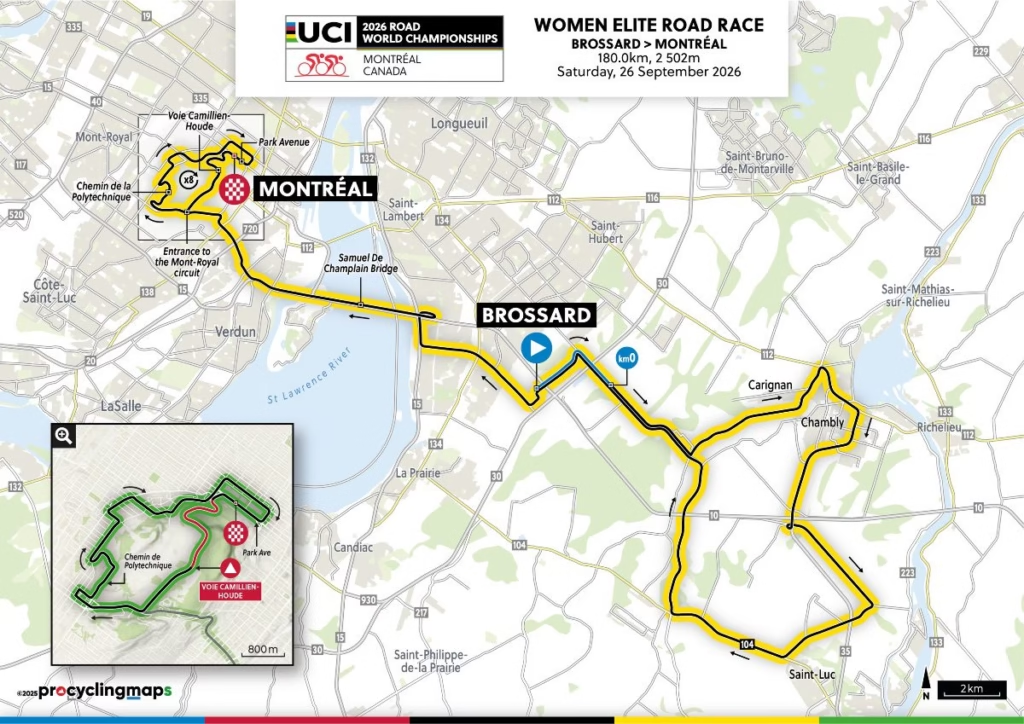
UCI Road World Championships 2026 women’s road race details
| Detail | 2026 elite women’s road race |
|---|---|
| Date | Saturday 26 September 2026 |
| Start | Quartier DIX30, Brossard |
| Finish | Avenue du Parc, Montréal |
| Distance | 180.4km |
| Climbing | 2,570 metres |
| Start time | 09:00 EDT / 14:00 BST |
| Expected finish | Around 19:10 BST |
| Finishing circuit | 13.4km |
| Mount Royal laps | 8 |
| Defending champion | Magdeleine Vallières Mill |
The opening 72.7km takes the race through Montérégie before the riders reach Montréal. More than 2,150 metres of the total climbing then comes during the eight Mount Royal circuits.
Our Women’s World Championships 2026 road race route guide goes into the climbs and the tactical effect of concentrating almost all of the difficult terrain into the final 107km.
For broadcast details, the World Championships TV and streaming guide has the full schedule and international viewing options.
Previous winners
| Year | Winner |
|---|---|
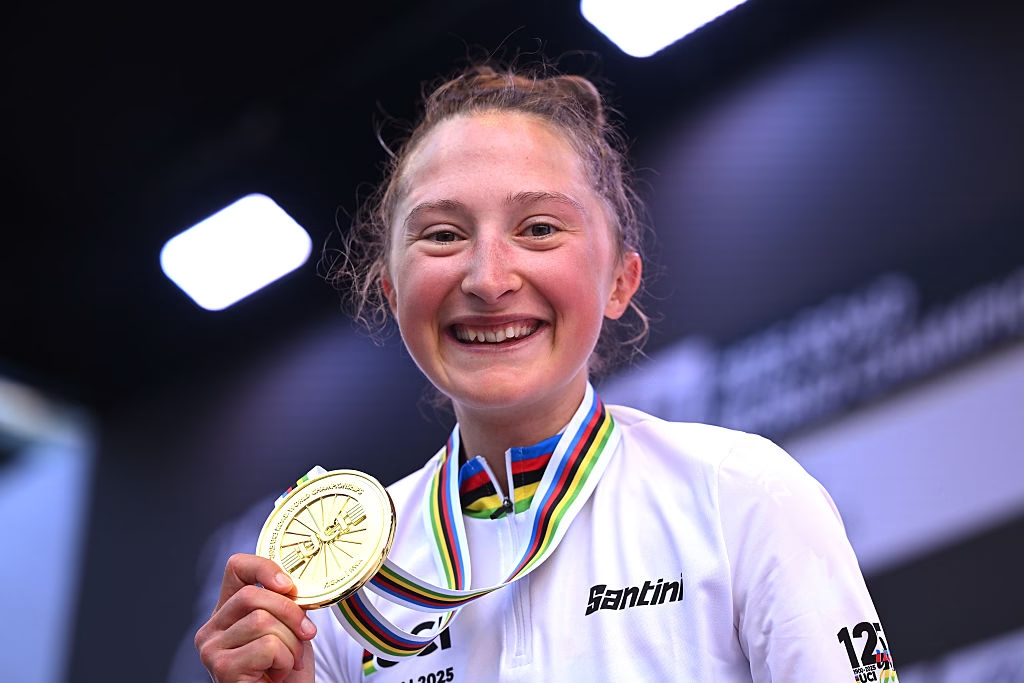
| 2025 | Magdeleine Vallières Mill |
| 2024 | Lotte Kopecky |
| 2023 | Lotte Kopecky |
| 2022 | Annemiek van Vleuten |
| 2021 | Elisa Balsamo |
Kopecky is the only rider on this year’s start list to have won the elite road title more than once. Vallières Mill has the opportunity to defend the rainbow jersey on home roads.
Eight Mount Royal laps should steadily break the race apart
There is no single enormous climb around which every tactic has to revolve.
Instead, Montréal keeps repeating the same difficulties until the riders start reaching them with very different legs.
Camillien-Houde provides the main sustained effort. The hardest section is around 1.8km at 8%, enough for the best climbers to create separation once fatigue begins accumulating.
Côte de la Polytechnique comes later and is much shorter, but the ramps above 11% offer a sharper attacking point. Pagnuelo adds another rise before the riders return towards Avenue du Parc.
One lap is manageable for almost everybody likely to play a meaningful role.
Eight are different.
The first few circuits should gradually reduce the support available to the leaders. By the final two laps, positioning before Camillien-Houde becomes increasingly important because every gap requires more energy to close than it did an hour earlier.
That accumulation is why this race should suit riders who combine climbing with one-day endurance rather than pure mountain specialists.
Avenue du Parc means the climbers cannot afford to wait too long
The final road rises towards the finish.
It is not a brutal climb, but the gradient of around 4% gives riders such as Kopecky, Le Court-Pienaar and Noemi Rüegg a much stronger finish than most of the obvious climbers.
That matters long before the sprint itself.
Niewiadoma-Phinney does not want to reach Avenue du Parc with Kopecky.
Longo Borghini would prefer not to take Le Court-Pienaar there.
Vollering has a powerful uphill acceleration, but even she has little reason to leave Kopecky in contention if the opportunity appears to remove her earlier.
The faster finishers therefore influence the final lap simply by surviving.
Their presence gives the climbers a reason to keep attacking.

Demi Vollering arrives after an extraordinary 2026 season
Vollering has spent much of the year winning almost every type of race required to become world champion in Montréal.
She took Omloop Het Nieuwsblad and the Tour of Flanders before dominating the Ardennes, winning both La Flèche Wallonne and Liège-Bastogne-Liège.
She then turned towards the stage races and won the Giro d’Italia Women before completing the Giro-Tour double at the Tour de France Femmes.
Her Tour victory was particularly relevant.
Vollering did not simply dominate one mountain stage and protect a large advantage. She repeatedly had to repair difficult tactical situations before finally taking control during the last weekend.
Our analysis of how Vollering won the 2026 Tour de France Femmes showed how differently she had to race from one stage to another.
Niewiadoma-Phinney took yellow from her on Mont Ventoux. Vollering responded by attacking into Nice the following day and began the final stage with only an eight-second advantage. Her attack on the Col d’Èze then turned the closest final-day GC battle in the modern Tour into a victory by 1:18.
That ability to produce another major effort after days of pressure is exactly what makes her difficult to beat in Montréal.
The Netherlands have Vollering but cannot simply control everything
The Dutch team was originally built around Vollering with Mischa Bredewold as one of its most important support riders.
Bredewold’s pelvic fracture at the Faun Tour Femmes has changed that plan, with Amber Kraak replacing her.
The Netherlands still have Riejanne Markus, Lieke Nooijen, Puck Pieterse, Karlijn Swinkels, Femke de Vries and Kraak around Vollering.
It is a strong team, but there are reasons to avoid simply riding on the front for 100km.
Pieterse gives them another rider capable of being influential very late. She won the mountains classification at the Tour de France Femmes and has the punch required for the shorter Mount Royal climbs.
Swinkels and de Vries have both shown strong late-season form.
If the Netherlands simply ask those riders to close every attack, Vollering may reach the final circuits surrounded by rivals whose teammates have spent far less energy.
The better option is allowing their secondary riders to follow dangerous moves rather than treating every break as something that must immediately be eliminated.
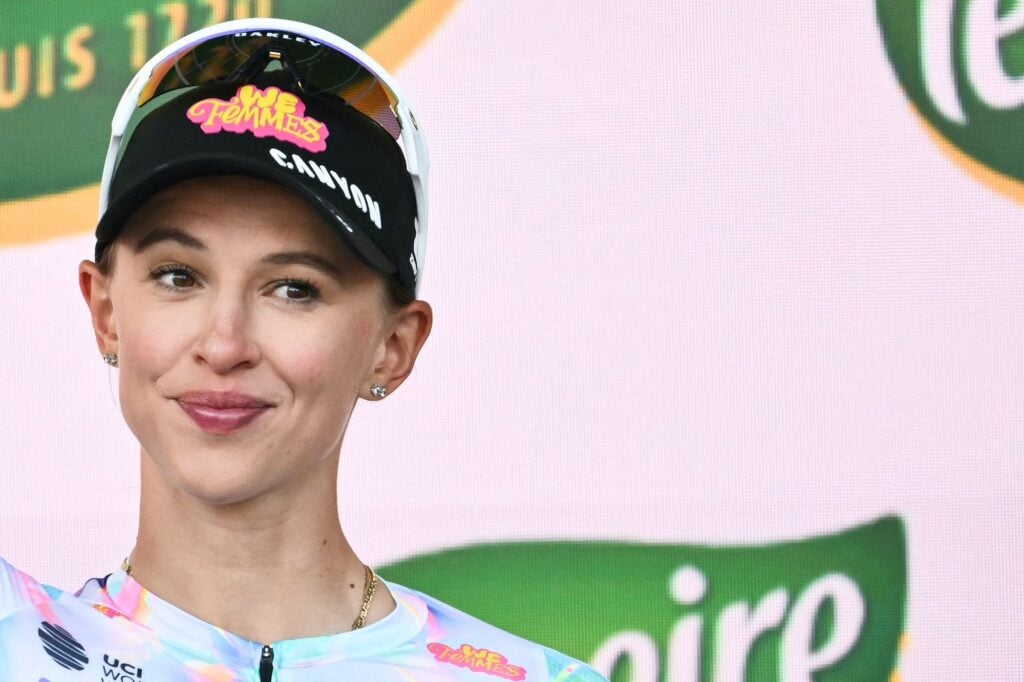 Photo Credit: Getty
Katarzyna Niewiadoma-Phinney has already shown she can hurt Vollering
Niewiadoma-Phinney produced one of the rides of the season on Mont Ventoux.
She attacked while Vollering and Marlen Reusser hesitated behind, won the stage and moved into the yellow jersey. It was only Vollering’s response over the final two days that denied her a second Tour victory.
Montréal should suit Niewiadoma-Phinney particularly well.
There are repeated climbs rather than one long mountain, plenty of points where an attack can force hesitation and a final hour where tactical judgement matters almost as much as raw climbing strength.
Her problem is the finish.
Niewiadoma-Phinney is unlikely to want Kopecky, Le Court-Pienaar or Rüegg alongside her on Avenue du Parc.
Poland therefore need to attack.
Fortunately, they have Dominika Włodarczyk.
Włodarczyk finished seventh overall at the Tour de France Femmes and has continued carrying strong form through the late season. She gives Poland a rider strong enough to attack before Niewiadoma-Phinney needs to commit.
That division of labour could be one of the most useful tactical combinations in the race.
Elisa Longo Borghini knows how to survive a World Championship
Longo Borghini has been collecting major World Championship results for more than a decade.
Her first elite road race bronze medal came in 2012. She added another in 2020 and a third in 2024.
What remains missing is the rainbow jersey.
Montréal provides another course which fits the way she races. Long distance helps rather than hurts her, repeated climbing gives her opportunities to attack and she has never needed a conventional finishing scenario to produce a result.
She also reaches Worlds after another strong Tour de France Femmes.
Longo Borghini finished third overall behind Vollering and Niewiadoma-Phinney, moving onto the podium during the final weekend after consistently staying around the front of the GC group.
The final Tour de France Femmes classification also showed the strength Italy will have to account for when judging several of their biggest rivals. Paula Blasi finished fifth, Dominika Włodarczyk seventh and Kim Le Court-Pienaar ninth.
Longo Borghini’s route to victory probably involves attacking rather than waiting.
If she reaches the final kilometre with several quicker riders, her opportunities narrow considerably.
 Photo Credit: Getty
Paula Blasi has become one of the defining riders of 2026
Blasi no longer belongs in the outsider category.
Her season has removed any doubt about that.
She won Amstel Gold Race and then La Vuelta Femenina, where she overturned Anna van der Breggen’s advantage on the Angliru to take the biggest stage-race victory of her career.
She followed that with further wins before finishing fifth at the Tour de France Femmes.
Her September form has remained strong too.
At the Pointe du Raz Ladies Classic, Blasi joined Célia Gery in the decisive late move and came within metres of holding off the chase before Nina Berton bridged across in the closing moments.
That performance matters for Montréal.
Blasi does not need to wait for the final climb and hope she can simply outclimb Vollering. She has already shown repeatedly this year that she can race aggressively from further out.
Spain also have Mavi García, who took bronze in Kigali last year and has now extended her career into 2027.
García gives them somebody capable of making the race harder before Blasi has to move.
Kim Le Court-Pienaar has become far more than a fast finisher
Le Court-Pienaar’s progression during 2026 is one of the reasons the women’s race is so difficult to reduce to the usual climbing hierarchy.
She remains fast.
The difference is how much climbing she can now survive before using that speed.
She won Stage 6 of the Tour de France Femmes and finished ninth overall, then produced an even more significant performance at the Tour of Britain Women.
The Great Orme gave the race its main climbing test. Le Court-Pienaar attacked near the finish, opened a decisive gap and eventually won the general classification.
Our analysis of what the Tour of Britain Women means for the rest of the season identified Montréal as one of the most obvious races affected by that improvement.
Her challenge is the lack of national-team depth.
Mauritius cannot surround her with riders capable of controlling the final circuits.
Le Court-Pienaar therefore has to let the major nations solve as many tactical problems as possible.
If she spends the last 50km chasing every dangerous attack herself, her sprint becomes irrelevant.
If she reaches the final lap close to the favourites without having wasted energy, everyone else has a problem.
 Photo Credit: Getty
Lotte Kopecky is still the rider nobody wants to carry to the finish
Kopecky has won two of the last three World Championships.
That alone keeps her central to the race.
Glasgow in 2023 and Zürich in 2024 required different performances, but both demonstrated how difficult Kopecky is to race against once she survives the hardest part of the course.
Her 2026 season has included victory at Milano-Sanremo Women, showing that the fundamental combination of endurance, climbing strength and finishing speed remains intact.
The uncertainty is her recent condition.
Kopecky went to the Tour of Britain Women looking for a late-season racing block but withdrew through illness before the stages most relevant to Montréal.
Our updated form guide after the Tour of Britain Women therefore left her as the biggest unanswered question rather than downgrading her condition.
There has been enough time to recover.
If Kopecky reaches the final Camillien-Houde in the front group, the climbers cannot afford to wait.
Nobody wants to discover how fast a two-time world champion still is after 180km.
Marlen Reusser gives Switzerland a completely different weapon
Reusser has the first major title of Worlds week to think about before the road race.
She defends the elite individual time trial rainbow jersey on Sunday 20 September.
Six days later, Switzerland can use the same power in a very different way.
Reusser is unlikely to want repeated late accelerations on Camillien-Houde against Vollering, Niewiadoma-Phinney and Blasi.
She does not need to wait for them.
Her value is the ability to attack on the roads between the climbs and make rival nations decide who is going to chase.
A committed Reusser move cannot simply be given a minute.
That allows Noemi Rüegg to wait behind.
It is a very useful combination.
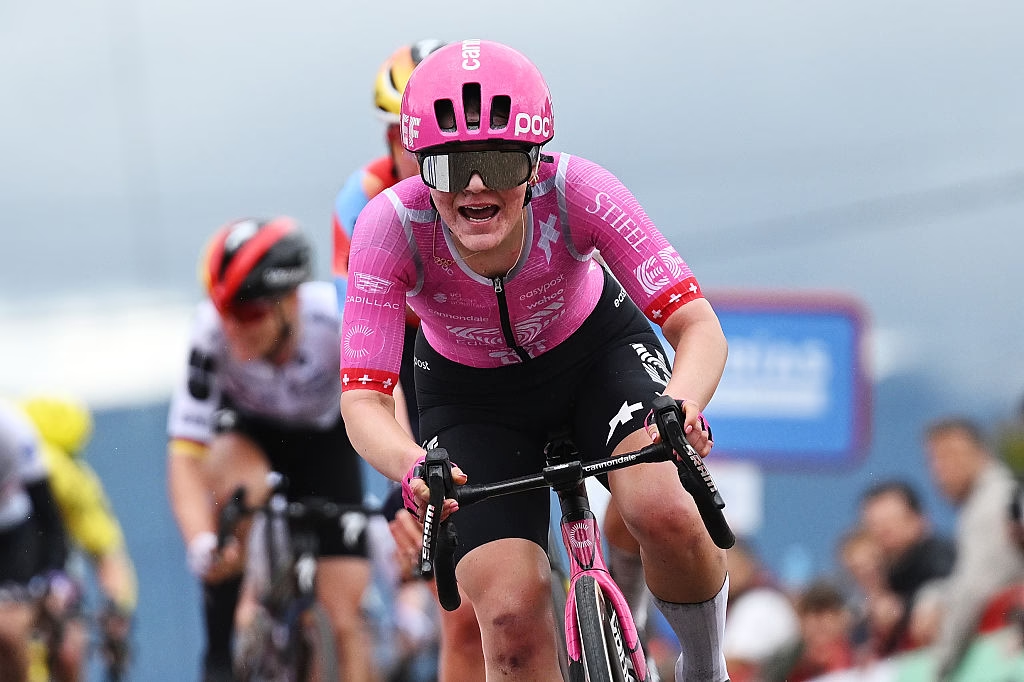 Photo Credit: Getty
Noemi Rüegg could benefit if Switzerland force others to chase
Rüegg has produced another season full of strong one-day and stage-race performances.
Her finishing speed separates her from most of the climbing contenders.
She was second at Milano-Sanremo Women and has repeatedly shown that she can survive difficult terrain before sprinting from a reduced group.
That makes the Swiss strategy straightforward.
Reusser can make the race uncomfortable from distance.
Rüegg does not need to help bring her back.
If another country closes the move, Switzerland still have their quicker finisher sitting in the favourites’ group.
If nobody does, Reusser is more than strong enough to make a long-range attack stick.
Magdeleine Vallières Mill defends the rainbow jersey on home roads
Vallières Mill arrives in Montréal in a completely different position from the one she occupied before Kigali.
Last year she was a dangerous rider capable of exploiting the right situation.
Now everybody knows exactly what happens if she is allowed to exploit it.
Her victory in Rwanda made her Canada’s first elite road world champion, and she now gets to defend the jersey in front of a home crowd.
Her 2026 results have shown that the title was not an isolated performance. She has remained competitive across the hardest Classics and finished 18th at the Tour de France Femmes.
Canada also have enough depth that Vallières Mill does not need to personally respond to everything.
Sarah Van Dam gives them recent form and a strong engine for an aggressive race. Alison Jackson provides experience and is capable of entering earlier moves. Nadia Gontova offers climbing strength after winning the Canadian time trial title.
The rainbow jersey will inevitably attract attention, but Canada should be able to share some of that workload.

Niamh Fisher-Black is arriving in strong climbing form
Fisher-Black finished second at the 2025 World Championships and is again building towards Montréal with useful form.
She came within two seconds of winning the recent Faun Tour Femmes, eventually finishing second overall behind Juliette Berthet.
The final stage was particularly encouraging.
Fisher-Black repeatedly attacked on the major climbs and looked capable of putting Berthet under serious pressure, but the Frenchwoman had enough team strength around her to manage the situation.
The same issue exists at Worlds.
New Zealand have fewer riders than the major European nations.
Fisher-Black therefore cannot spend three laps reacting to every move made by the Netherlands, Italy, Spain and France.
Her best chance is making one of her own efforts count.
She already showed in Kigali that she can race a World Championship without the support numbers enjoyed by the largest countries.
France can attack without committing to one leader
The absence of Pauline Ferrand-Prévot removes the most obvious French headline name.
It does not leave France short of options.
Juliette Berthet comes into Worlds immediately after winning the Faun Tour Femmes, taking two stages before surviving Fisher-Black’s attacks on the final day.
Célia Gery has continued her rapid progression and was third behind Nina Berton and Blasi at Pointe du Raz.
Cédrine Kerbaol, Évita Muzic and Maëva Squiban add further climbing strength.
France therefore have little reason to wait.
They can place riders into moves without worrying that doing so compromises one clear protected leader.
That can be particularly awkward for the Netherlands.
Every French attack forces somebody else to decide whether the rider ahead is dangerous enough to chase.
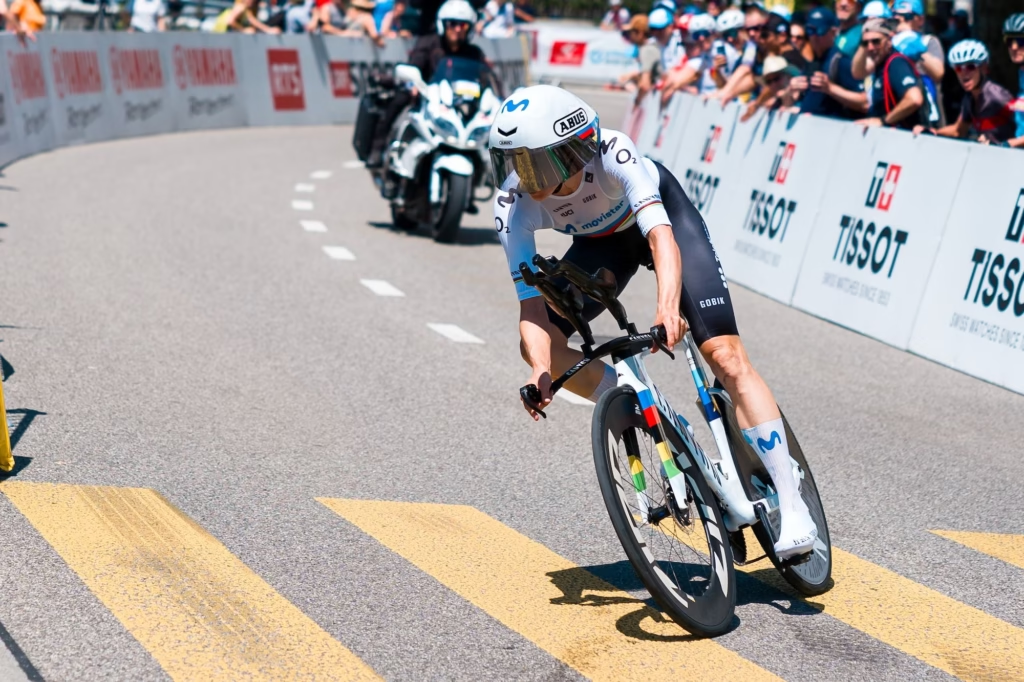
Great Britain need to keep the race tactical for Zoe Bäckstedt
Zoe Bäckstedt leads a British group containing several riders capable of being useful on the Mount Royal circuit.
The key question is how hard the Netherlands and the pure climbers make the final hour.
Bäckstedt has developed into a far more complete road rider, winning both British national titles this year and adding selective road performances to the time trial ability that has always been obvious.
The Great Britain World Championships preview looks at how Montréal fits her development.
Eight relentlessly hard climbing laps would not be ideal.
A race which breaks, reforms and allows powerful riders back into contention is much more interesting.
Anna Henderson and Pfeiffer Georgi can help create that type of race, while Lauren Dickson arrives with good climbing form after winning the final stage of the Faun Tour Femmes.
Britain should use those riders rather than simply trying to protect Bäckstedt until the final circuit.
Dominika Włodarczyk gives Poland more than a support rider
Reducing Włodarczyk to Niewiadoma-Phinney’s domestique would waste one of Poland’s strongest weapons.
She finished seventh at the Tour de France Femmes and has continued racing aggressively through September.
That makes her exactly the sort of rider who can attack one or two laps before the obvious favourites want to commit.
The tactical benefit is substantial.
The Netherlands cannot ignore her.
Italy cannot automatically wait for Longo Borghini.
Spain have to decide how much responsibility they want to take.
Niewiadoma-Phinney can stay behind while everybody else makes those calculations.
World Championships are often won because one nation has a second rider too strong to be treated as harmless.
Poland have that rider.
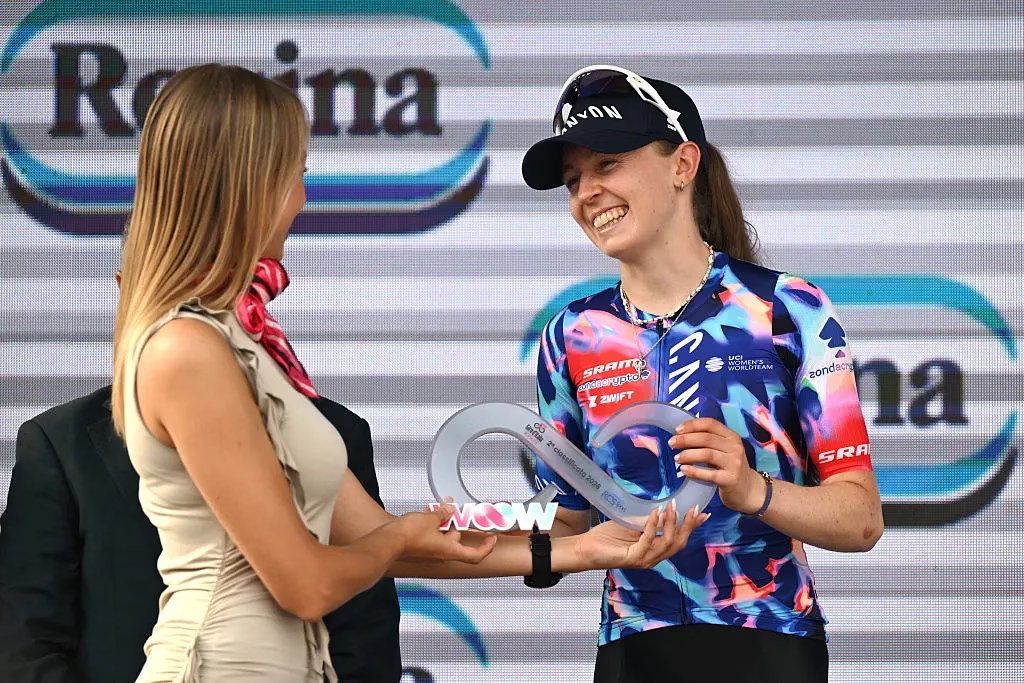
Antonia Niedermaier can benefit from a very hard race
Niedermaier has spent 2026 establishing herself among the best stage-race climbers in the world.
She finished second overall at the Giro d’Italia Women and fourth at the Tour de France Femmes, where she also won the white jersey.
The Tour de France Femmes final results underline how consistently she stayed close to the very best GC riders through the decisive mountain stages.
A World Championship is tactically very different.
Niedermaier does not have the same finish as Kopecky, Le Court-Pienaar or Rüegg, so Germany need the race to become extremely selective.
That gives her a clear objective.
The harder the final three laps become, the more interesting Niedermaier gets.
Other riders to watch
Puck Pieterse is far too strong to think of solely as a Dutch helper. Her Tour de France Femmes mountains jersey and podiums at both La Flèche Wallonne and Liège-Bastogne-Liège make her a genuine option if the race develops away from Vollering.
Mavi García can attack before Blasi has to show herself, while Silvia Persico gives Italy another rider capable of surviving a difficult race and finishing quickly enough to exploit a small group.
Kristen Faulkner remains one of the most dangerous long-range riders available to the United States. Montréal offers enough road between climbs for a committed solo move to become difficult to organise against.
Liane Lippert showed excellent climbing form at the Tour of Britain Women and remains particularly well suited to races built around repeated short climbs rather than long mountain passes.
Cédrine Kerbaol has the same opportunity within a French team that should be looking to attack rather than chase.
Nina Berton arrives after winning Pointe du Raz by bridging across to Blasi and Gery in the closing kilometres, another indication that her late-season form is moving in the right direction.
 Photo Credit: Getty
The Netherlands have the strongest leader and the biggest burden
Vollering being the strongest rider in the race does not automatically make the Netherlands the easiest team to race for.
Everyone knows who carries the greatest responsibility.
If an Italian attacks, the Netherlands are expected to respond.
If France place somebody ahead, the Netherlands are watched.
If Włodarczyk moves, Poland sit back and wait for orange jerseys to appear at the front.
That is how a strong team can gradually spend itself.
The Dutch need to avoid that trap.
Pieterse, Swinkels and de Vries are strong enough to be used as tactical riders rather than simply workers. Kraak knows Vollering well from their trade-team environment and can be particularly valuable in keeping the race organised around her without asking Vollering herself to solve every problem.
The Netherlands do not need a controlled peloton.
They need the race to reach its final phase with Vollering having spent less energy than her rivals.
There is an important difference.
The final lap could be shaped by who is still capable of sprinting
By the last Camillien-Houde ascent, everyone left at the front will be tired.
Their tactical needs will still be different.
Kopecky wants to remain attached.
Le Court-Pienaar wants to remain attached.
Rüegg may be perfectly happy to remain attached.
Niewiadoma-Phinney wants them gone.
Longo Borghini probably wants them gone.
Fisher-Black needs separation.
Niedermaier certainly does.
Vollering can play either way, but she would still rather arrive at Avenue du Parc without the strongest finishers.
That should prevent the final climb from becoming a waiting game.
If nobody attacks, the race moves towards riders who are dangerous in the sprint.
That forces somebody to make the first move.
Who can win the 2026 women’s World Championships?
Vollering has the strongest body of evidence.
She has won the biggest stage races, the Ardennes Classics and Flanders during the same season. The Montréal course falls almost directly between those specialities.
Niewiadoma-Phinney has already shown that she can exploit a tactical hesitation from Vollering and has Włodarczyk available to make Poland difficult to control.
Longo Borghini has the endurance and World Championships record to survive whatever the race becomes.
Blasi has spent 2026 winning races through both climbing and aggression.
Le Court-Pienaar brings a finish that none of the pure climbers want to face.
Kopecky has already solved this championship twice.
Reusser can attack from areas where the climbers would prefer not to work. Rüegg can wait behind her. Fisher-Black arrives with excellent climbing form and Vallières Mill will have the rainbow jersey and a home crowd behind her.
It is a deep race.
Vollering is still the rider everyone has to find a way to beat.
Top 3 prediction
1. Demi Vollering
2. Katarzyna Niewiadoma-Phinney
3. Kim Le Court-Pienaar
Vollering’s season has shown that she no longer needs one particular type of race to win. She can attack from distance, finish from small groups and sustain the repeated climbing that Mount Royal will demand.
Niewiadoma-Phinney has perhaps the best combination of form, course suitability and tactical freedom among the riders trying to stop her.
Le Court-Pienaar is the rider who could benefit most if the strongest climbers fail to make the final lap selective enough. If she survives Polytechnique for the last time, nobody will be keen to take her to Avenue du Parc.

