
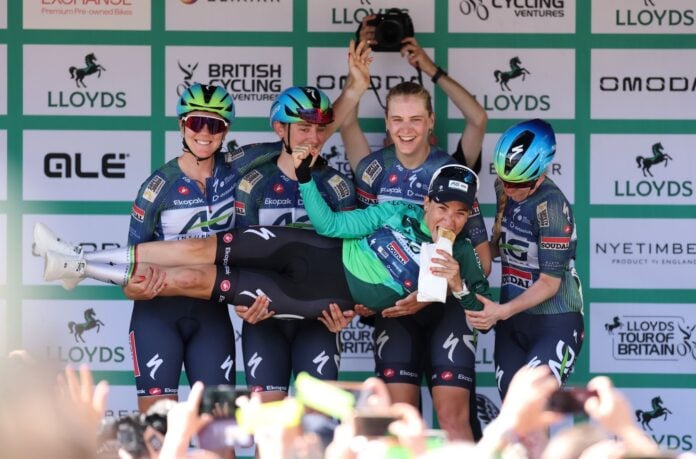
The Tour of Britain Women has provided one of the last substantial form checks before the 2026 season moves towards its biggest remaining target: the UCI Road World Championships in Montréal.
That changes how the results from Britain should be read. There is no longer half a season available for riders to transform their year. Classic Lorient Agglomération comes almost immediately, the Tour de Romandie Féminin follows in early September and there are further late-season opportunities after the Worlds, but for many of the biggest names who raced in Britain, Montréal is now the target around which everything else is being organised.
The five days in Britain therefore offered something particularly useful. Lorena Wiebes showed that her climbing range has moved forward again. Kim Le Court-Pienaar produced the first stage-race overall victory of her career. Liane Lippert looked increasingly close to the level required to win a major selective one-day race. Caroline Andersson and Femke de Vries emerged from The Great Orme with stronger credentials than they arrived with, while Fleur Moors added another significant result to a season that has increasingly looked like a breakthrough.
Lotte Kopecky, meanwhile, remains the great unresolved question. She came to Britain needing racing before Montréal, helped Wiebes dominate the opening stages and then withdrew through illness before the stages that would have told us most about her own condition.
This updated form guide is therefore deliberately restricted to riders who actually raced the 2026 Tour of Britain Women. It is not a general ranking of the best riders in women’s cycling. It is a snapshot of what Britain told us about the riders who were there and what that might mean as the season enters its final important block.
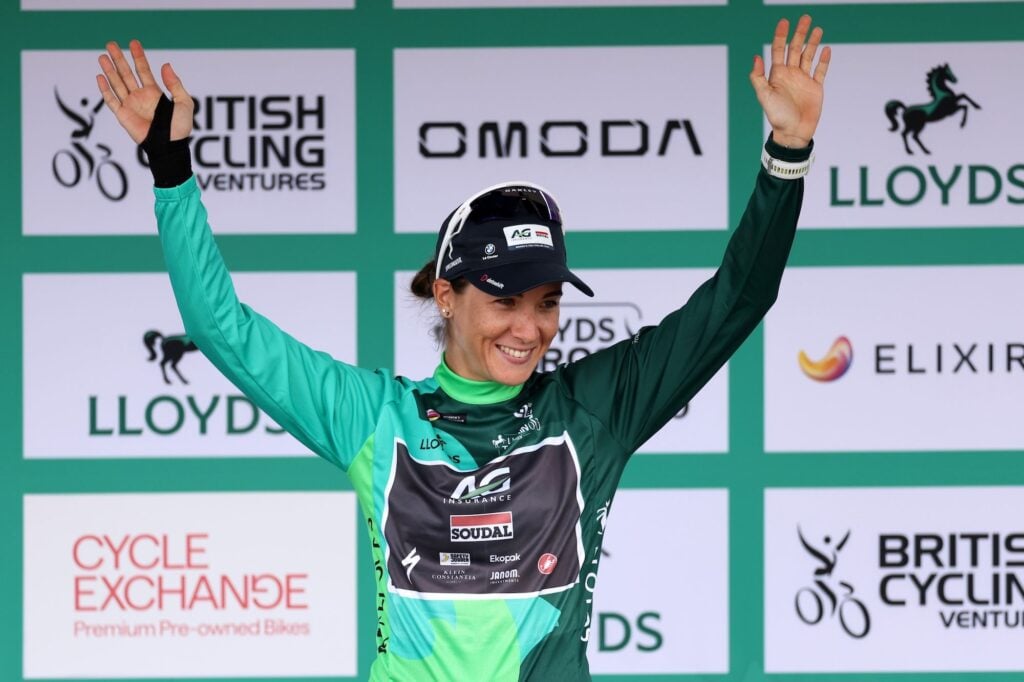
Kim Le Court-Pienaar: Britain confirmed that her summer form is real
Kim Le Court-Pienaar leaves Britain with the strongest single result of anyone in the race because she did something she had never previously achieved: she won a stage race overall.
The decisive moment came on Stage 3 at The Great Orme, where she attacked with around two kilometres remaining and immediately opened a gap that nobody could close. Liane Lippert finished 13 seconds behind, Caroline Andersson at 20 seconds and Femke de Vries at 21, while Wiebes finally encountered terrain hard enough to remove her from the front.
It was significant because Le Court-Pienaar did not win the Tour of Britain through accumulated bonuses or by taking advantage of one tactical mistake. She was clearly the strongest rider on the race’s decisive uphill finish and then successfully managed the lead through two stages where her opponents repeatedly had opportunities to challenge her.
That adds another dimension to what had already been an excellent summer. Le Court-Pienaar won a stage of the Tour de France Femmes and showed there that she could perform deep into difficult WorldTour racing. Britain demonstrated that she can also carry the responsibility of being a race leader, absorb repeated attacks and protect an overall advantage.
The relevance to Montréal is obvious. The World Championship road race is unlikely to behave like a stage-race GC contest, but the qualities Le Court-Pienaar displayed in Britain transfer very well: repeated climbing, the ability to attack hard after a difficult race and enough speed that rivals cannot simply allow her to reach the final kilometres in a small group.
Her broader progression is why our post-Tour of Britain analysis already identified her as one of the riders whose World Championship prospects improved during the week.
She leaves Britain not merely in good form, but with greater tactical credibility than she had before it.
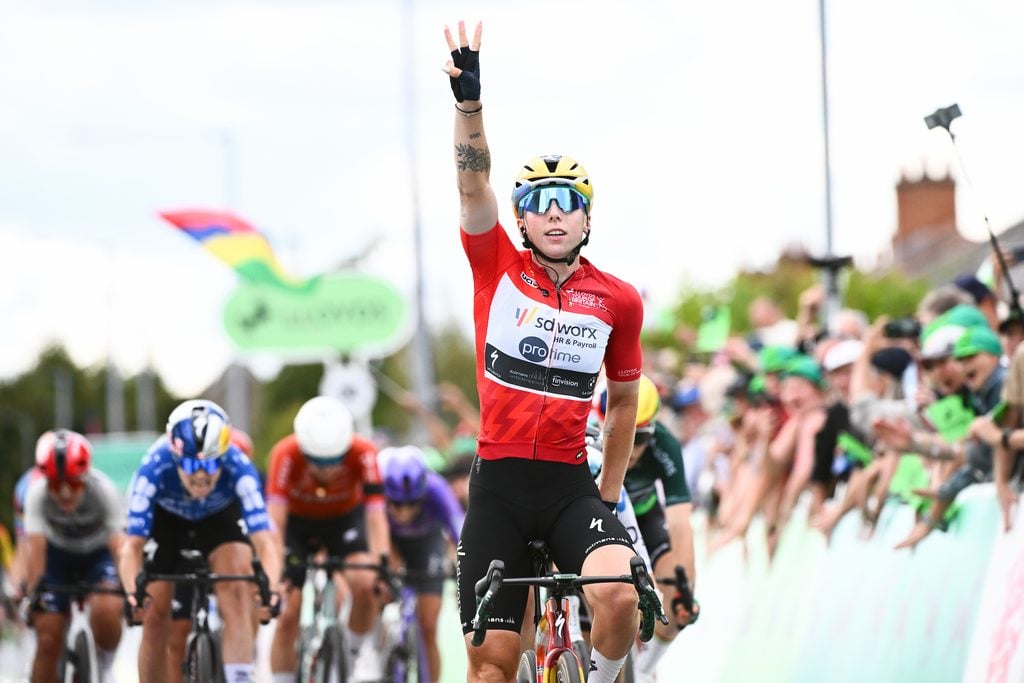 Photo Credit: Simon Wilkinson/SWpix.com
Lorena Wiebes: four wins tell only part of the story
Four stage victories from five days makes Wiebes the most obviously successful rider of the Tour of Britain, but the most important performance may not have been one of the straightforward sprints.
Winning Cockermouth and Blackpool confirmed something everybody already knew: in a conventional fast finish, Wiebes remains extremely difficult to beat. Winning again in Royal Leamington Spa reinforced that dominance and moved her to second overall through bonus seconds.
Stage 4 into Hay-on-Wye told us something more useful.
The route contained repeated climbing through Mid Wales and provided Lippert and Le Court-Pienaar with several opportunities to attack. On the final climbs, the race repeatedly looked capable of becoming too hard for Wiebes. Instead, she survived long enough for the groups to reform and then won the reduced sprint.
That is the development that matters as the season narrows towards Montréal. For years, the obvious tactical solution against Wiebes has been simple in principle: make the race hard enough that she is not there for the sprint. Increasingly, that requires a much harder race than before.
The Great Orme still demonstrated that there is a limit. Le Court-Pienaar could attack away from her on a sustained steep finish and Wiebes eventually lost 37 seconds. Nobody should therefore mistake her for a specialist climber.
But that is not the threshold required at the World Championships. Wiebes does not have to climb with the strongest riders indefinitely. She only needs to keep returning, survive enough of the selections and reach the decisive final kilometres with a manageable group.
Britain showed that this scenario is becoming increasingly plausible.
She leaves the Tour of Britain with four wins, second overall and perhaps the most important message of all for her potential World Championship rivals: simply making the race hilly may no longer be enough to get rid of Lorena Wiebes.
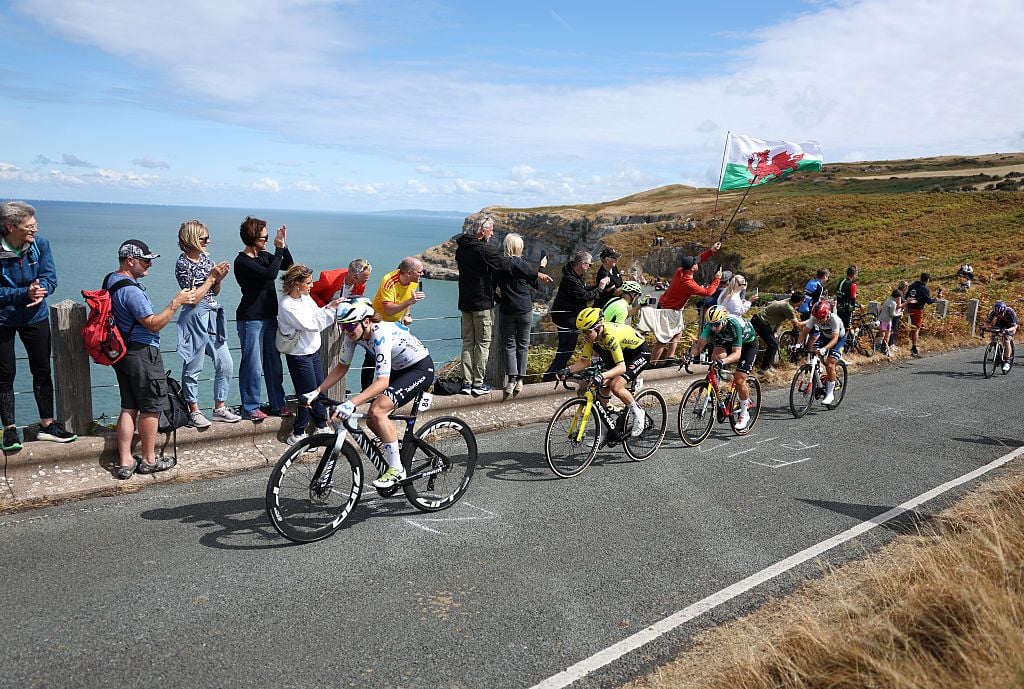 Photo Credit: Getty
Liane Lippert: no victory, but some of the strongest form in the race
Liane Lippert’s final result slightly disguises how well she rode.
She finished third overall at 24 seconds, having spent the decisive stages trying to turn the race against Le Court-Pienaar rather than simply protecting a podium place. On The Great Orme, Lippert was the closest rider to the winning attack, finishing 13 seconds behind after Movistar had helped make the entire approach difficult.
The following day reinforced the point. Lippert attacked again on the late climbs towards Hay-on-Wye and briefly separated with Le Court-Pienaar, attempting to create exactly the sort of difficult race required to overturn the GC. Wiebes eventually returned and won the stage, but Lippert finished second and had again been one of the riders responsible for shaping the race.
She eventually lost second overall to Wiebes through bonus seconds on the final day, rather than because another GC rider was stronger on the climbing terrain.
That distinction matters. Lippert did not win in Britain, but she repeatedly looked like one of the three strongest riders whenever the route became selective.
With the season now so close to the World Championships, that is arguably more relevant than accumulating another minor result. Lippert’s ideal races involve repeated short climbs, tactical selections and enough difficulty to reduce the number of faster finishers. Her Tour of Britain performances suggest her climbing condition is exactly where it needs to be heading into the final major target of the year.
The missing element remains the decisive attack. Le Court-Pienaar could create separation on The Great Orme that Lippert could not close, while Wiebes remained too fast whenever the race returned to a group.
Lippert is therefore carrying excellent form into the final weeks, but still needs to convert being consistently close into a major victory.
Caroline Andersson: one of the biggest upward revisions
Caroline Andersson was one of the most impressive riders outside the headline battle between Le Court-Pienaar, Wiebes and Lippert.
Her third place on The Great Orme was particularly significant. Andersson finished only 20 seconds behind Le Court-Pienaar and seven seconds behind Lippert on a climb that cleanly exposed the strongest riders in the field.
That was not the sort of result created by hiding in a large bunch or winning a tactical sprint. The Great Orme forced everyone to ride close to their limit, and Andersson emerged as the third-best rider on the day.
She remained fourth overall after Stage 4, only 39 seconds behind Le Court-Pienaar, showing that the Great Orme performance was not simply one isolated uphill effort followed by a collapse the next day.
The Tour of Britain therefore strengthens Andersson’s position considerably heading towards the end of the year. She may not carry the same World Championship expectations as Wiebes, Lippert or Kopecky, but Sweden now have another rider arriving at the most important one-day race remaining with clear evidence of high-level climbing form.
For Andersson personally, Britain may matter just as much for 2027. Performances such as The Great Orme provide teams with evidence that she can be trusted in more significant roles rather than simply being used around established leaders.
Femke de Vries: another GC performance that deserves attention
Femke de Vries followed a very similar trajectory.
She finished fourth on The Great Orme, 21 seconds behind Le Court-Pienaar, and moved to fifth overall after the first meaningful GC separation of the race. She then remained fifth after the much longer climbing stage into Hay-on-Wye.
That combination is important. The Great Orme rewarded punch, while Stage 4 required considerably greater endurance. De Vries handled both.
For Team Visma | Lease a Bike, her performance became particularly valuable after Lieke Nooijen crashed out on Stage 1. De Vries gave the team a consistent GC presence and demonstrated that she can remain competitive when a Women’s WorldTour stage race becomes genuinely selective.
The immediate World Championship implications depend on national selection and role, but the broader form message is straightforward. De Vries leaves Britain looking stronger than she entered it, particularly across the sort of rolling and repeatedly climbing terrain that becomes valuable in difficult one-day racing.
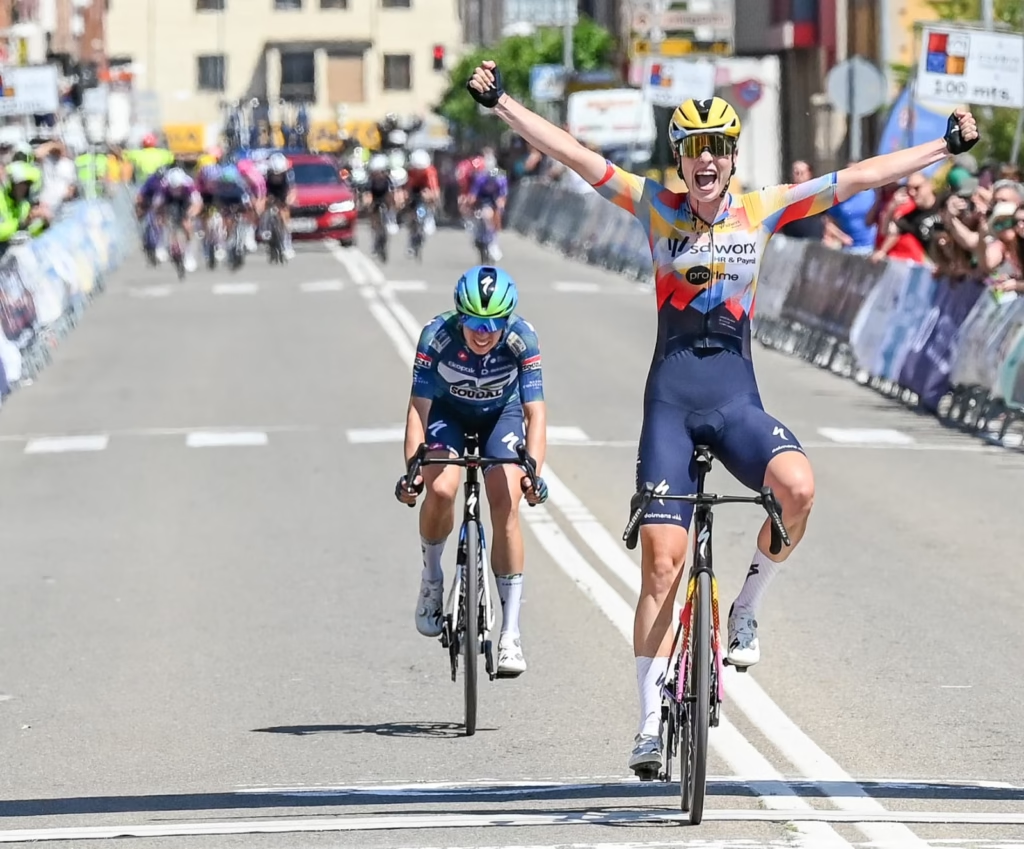
Mischa Bredewold: strong enough to stay close without becoming the main story
Mischa Bredewold produced a quieter but still valuable Tour of Britain.
She played an important role for Wiebes during the opening stages and then remained close enough on the harder terrain to sit sixth overall after Stage 4, only 46 seconds behind Le Court-Pienaar.
That is a useful form marker because Bredewold’s best races require a blend of endurance, positioning and late speed rather than pure climbing. Britain showed she can still survive a difficult multi-day block while contributing significantly to a team built around somebody else’s victories.
The question ahead of Montréal is how much freedom she receives within an extremely deep Dutch team. Wiebes’ form makes her impossible to ignore, while the Netherlands have several riders capable of influencing a selective race.
Bredewold’s Tour of Britain did not force her ahead of those names, but it did nothing to weaken her case either.
Karlijn Swinkels: consistency remains the defining quality
Karlijn Swinkels again demonstrated why she has become so valuable across stage races and Classics.
She did not produce the single explosive performance of Le Court-Pienaar or Lippert, but she remained close on The Great Orme and entered the final weekend firmly inside the top 10 overall.
That reflects the type of rider Swinkels has become. She is difficult to remove, tactically reliable and capable of finishing well enough that repeated small performances accumulate into significant results.
For UAE Team L’IMAD, that consistency is particularly useful because it allows Swinkels to contribute across a wide variety of race scenarios without requiring the entire team to be built around her.
The same applies when looking towards the final part of the season. She is unlikely to enter Montréal as the obvious favourite, but difficult Championship races often create opportunities for riders who survive while more fancied names eliminate one another.
Britain suggests Swinkels is still capable of doing exactly that.
 Photo Credit: RCS
Cecilie Uttrup Ludwig: signs of useful climbing form
Cecilie Uttrup Ludwig also produced a quietly encouraging week.
She finished fifth on The Great Orme, only 23 seconds behind Le Court-Pienaar, and remained inside the top 10 overall after the long Welsh Stage 4.
For a rider whose best performances historically come when races become difficult through repeated climbing rather than outright sprint speed, those results are more important than the absence of a stage victory.
The World Championships offer a very different challenge from the Tour of Britain, but the ability to repeatedly handle short climbs and recover between them should still be useful. Britain provided evidence that Uttrup Ludwig is carrying worthwhile condition into the final weeks of the European season.
Fleur Moors: Britain strengthens the breakthrough story
Fleur Moors may not have featured prominently in the battle for the overall victory, but her Tour of Britain deserves attention because of where it sits within her wider development.
The 20-year-old finished 12th overall, won the youth classification and took the race’s combativity award. Those results came after a season in which she has increasingly moved beyond simply gaining WorldTour experience and started becoming genuinely competitive within it.
That distinction matters enormously at her age. A young rider can produce one spectacular day because a particular route suits them or a tactical situation opens unexpectedly. Finishing strongly across five days while also racing aggressively enough to take combativity points towards something more sustainable.
Moors has openly identified the Montréal World Championships as an important target, which makes Britain especially relevant as a late-season form check. The Canadian route is substantially longer and harder than anything she faced in Britain, so expectations should remain realistic, but her current trajectory suggests she is arriving at the Championships as more than simply a development selection.
The bigger story may still be 2027 and beyond. Britain added another race to the growing body of evidence that Moors is progressing rapidly towards a much larger role.
 Photo Credit: Getty
Lara Gillespie: one of the fastest riders behind Wiebes
Lara Gillespie saved her strongest result of the race for the final day.
The UAE Team L’IMAD rider finished second behind Wiebes in Royal Leamington Spa, beating Chiara Consonni as the final breakaway was caught inside the last two kilometres.
There is no shame in being beaten by Wiebes in the form she showed during this Tour. The more relevant comparison is with the rest of the sprint field, and Gillespie’s second place put her firmly among the quickest riders once the race reached a conventional finish.
Her development on the road continues to move quickly. The challenge is now repeating those results often enough that she moves from being an emerging sprint option into a rider teams actively organise around.
Britain was another step in that direction.
Chiara Consonni: consistent without finding a way past Wiebes
Consonni’s week illustrates the problem facing almost every sprinter currently racing against Wiebes.
She finished second on Stage 1 and third on Stage 5, repeatedly placing herself around the front of high-quality sprint fields without ever finding a route past the dominant Dutch rider.
Those results still represent strong form.
Consonni remains one of the most reliable fast finishers in the peloton and has enough endurance to survive races that remove some of the more specialised sprinters. The issue is that Wiebes is increasingly developing exactly the same resilience while retaining superior outright speed.
That makes races such as Montréal tactically interesting for riders like Consonni. Waiting for a straightforward sprint against Wiebes is unlikely to be sufficient. The race needs to become selective enough to change the composition of the final group.
Britain demonstrated again why.
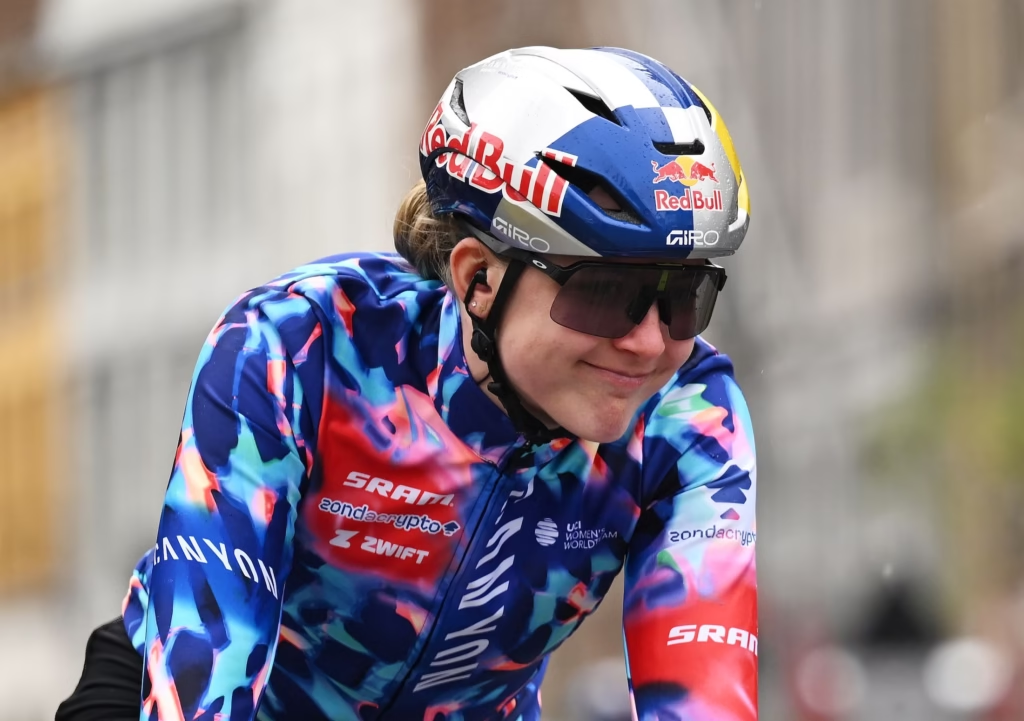
Zoe Bäckstedt: Britain did not change the broader direction
Zoe Bäckstedt did not leave the Tour of Britain with one of her defining results of 2026, but there was little need for the race to establish her current trajectory.
She had already produced a strong summer before lining up in Britain, including success against the clock and overall in shorter stage races. The Tour of Britain became another opportunity to race a varied Women’s WorldTour programme rather than a week that fundamentally changed how she should be viewed.
Her fourth place on the final stage in Royal Leamington Spa was a useful reminder of the finishing speed that sits alongside her time-trial strength.
That versatility remains the key theme. Bäckstedt can already win against the clock, contribute in Classics-style races and contest fast finishes. The longer-term question is how those abilities eventually combine into a more defined elite profile.
With Montréal approaching, her time-trial ability may be as significant as anything Britain told us.
Lotte Kopecky: the major unanswered form question
Kopecky is the rider Britain left us knowing least about.
She completed the first two stages and played an important role in SD Worx-Protime’s control for Wiebes, but illness forced her to withdraw before Stage 3.
That timing was particularly frustrating because The Great Orme was exactly the stage that should have told us where Kopecky’s own condition stood.
Instead, the race ended before she could test herself against Le Court-Pienaar and Lippert on the selective terrain most relevant to her late-season ambitions.
The withdrawal before Stage 3 therefore matters more now than it might have earlier in the season.
There is not an enormous amount of racing left before the World Championships. Kopecky does not have two months to gradually rebuild through multiple WorldTour blocks. Any interruption at this stage compresses the route towards Montréal and makes her next appearance more informative.
That does not mean her form has disappeared. Illness prevented Britain from providing an answer rather than providing evidence that she is weak.
But with the World Championship road race now one of the biggest remaining targets of her season, Kopecky’s condition becomes one of the main questions to monitor over the next few weeks.
Who leaves Britain with the strongest form?
The Tour of Britain produced three particularly clear answers.
Kim Le Court-Pienaar leaves with the strongest GC statement. Winning The Great Orme and then defending the overall lead demonstrated both physical condition and the ability to manage a race once everybody was targeting her.
Lorena Wiebes leaves with the strongest winning form. Four stages from five would be extraordinary on its own, but surviving the Welsh climbing before winning Stage 4 made the week significantly more important than another collection of sprint victories.
Liane Lippert leaves without a win but with some of the clearest evidence of Championship-level condition. She repeatedly attacked on the hardest terrain and was the rider who came closest to matching Le Court-Pienaar uphill.
Behind those three, Andersson and De Vries made the biggest positive revisions to their status. Moors strengthened an already impressive development season, while Gillespie and Consonni showed that the sprint level immediately behind Wiebes remains strong even if the results column makes the hierarchy look brutally one-sided.
Kopecky is the exception. Britain cannot reasonably be used to rank her current strength because illness removed her before the relevant stages.
-
 Photo Credit: Getty
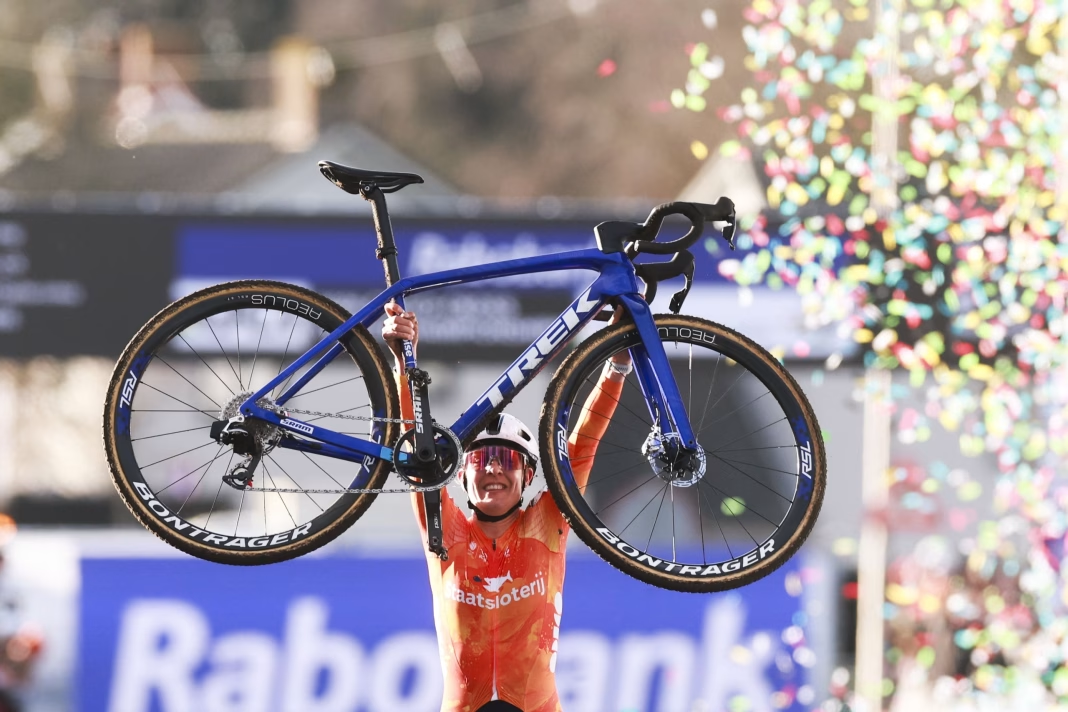
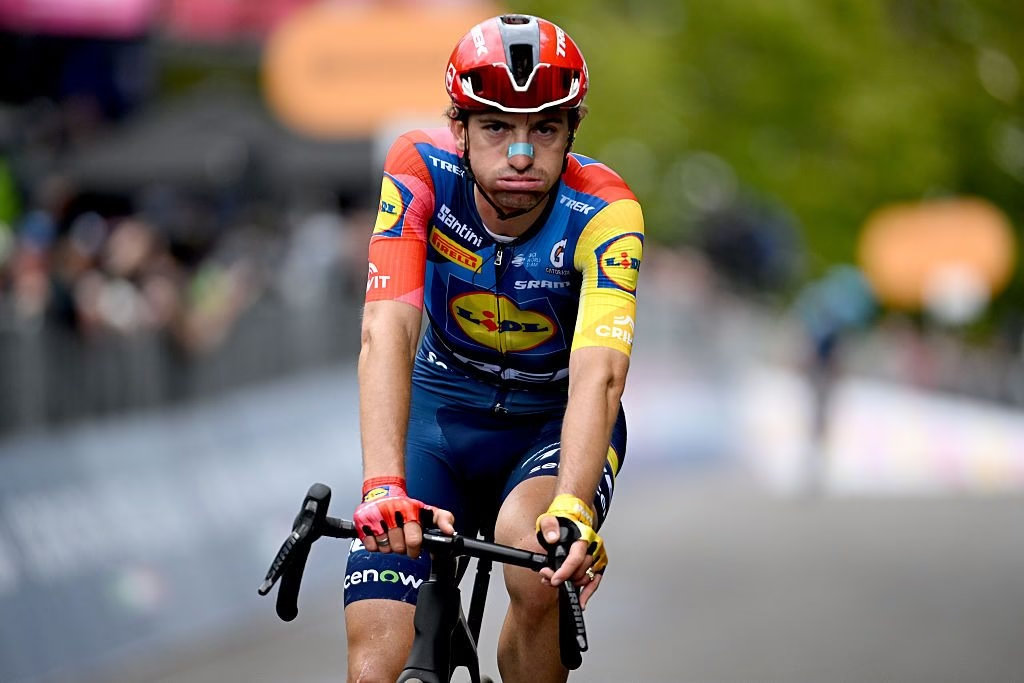

The season is now about Montréal rather than long-term momentum
This is the most important difference from an equivalent form guide written in May or June.
There is not much of the 2026 season left.
Classic Lorient Agglomération arrives immediately and provides another useful one-day test. The Tour de Romandie Féminin offers three days of stage racing in early September. Other races continue after that, including the final Asian WorldTour events in October, but for many of the riders who raced the Tour of Britain, those are now secondary to what happens in Canada.
The World Championships in Montréal are the major remaining reference point.
That makes Britain’s timing particularly valuable. The riders are no longer building towards a Tour de France several months away. The condition shown here needs to carry through only a few more weeks.
For Le Court-Pienaar, that is encouraging because she appears to be reaching a peak at almost exactly the right moment. For Lippert, Britain suggests the climbing and repeated acceleration required for Montréal are already present. For Wiebes, the crucial question is whether the Canadian circuit is hard enough to finally push her beyond the limit she resisted so impressively in Wales.
For Kopecky, the calculation is different. She needs to recover from illness quickly enough to regain the racing rhythm Britain was supposed to provide.
Britain may have been more relevant to the Worlds than the final GC suggests
The overall classification ultimately reads Le Court-Pienaar, Wiebes and Lippert.
The World Championships will not be raced like a five-day stage race, so those positions should not simply be converted into a favourites ranking.
The useful information lies underneath them.
Le Court-Pienaar showed she can make a decisive uphill attack after a difficult race. Lippert repeatedly proved willing and able to force selections. Wiebes demonstrated that repeated climbing is becoming less reliable as a method of removing her. Andersson and De Vries showed they can remain close to elite riders on selective terrain, while Moors continued demonstrating how quickly her WorldTour level is rising.
Those are the details national teams will care about far more than whether somebody finished sixth or ninth overall.
The Tour of Britain Women 2026 in historical context explains why this year’s expanded race mattered for the event itself. From a rider perspective, its timing may prove just as important.
There is now only a short bridge between Britain and the biggest remaining one-day race of the year.
That makes the updated form picture relatively simple. Le Court-Pienaar and Wiebes leave Britain with the greatest momentum, Lippert looks extremely close to a major result, several riders behind them improved their standing, and Kopecky leaves as the biggest uncertainty.
The next question is no longer what they can do with that form over the remainder of a long season.
It is whether they can carry it to Montréal.

