
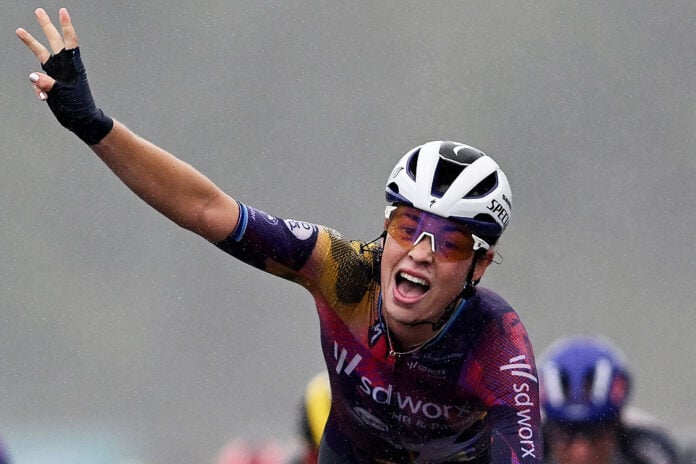
The Classic Lorient Agglomération has become one of the most durable one-day races in women’s professional cycling, even if its changing name means it is not always immediately recognised as one of the calendar’s long-established events.
For most of its history it was known as the GP de Plouay, taking its identity from the small Breton town where the race finishes. The name has evolved through different sponsors and partnerships, but the fundamental challenge has remained remarkably consistent: rolling roads, repeated short climbs, attritional racing and a finale that rewards riders who can still produce explosive power after several hours of constant effort.
The Beginner’s guide to Classic Lorient Agglomération 2026 covers how the modern race works in more detail. Its history explains why riders such as Nicole Cooke, Emma Pooley, Marianne Vos, Lizzie Deignan, Anna van der Breggen, Elisa Longo Borghini and Mischa Bredewold have all been able to win on the same Breton roads.
The modern women’s race begins in 2002
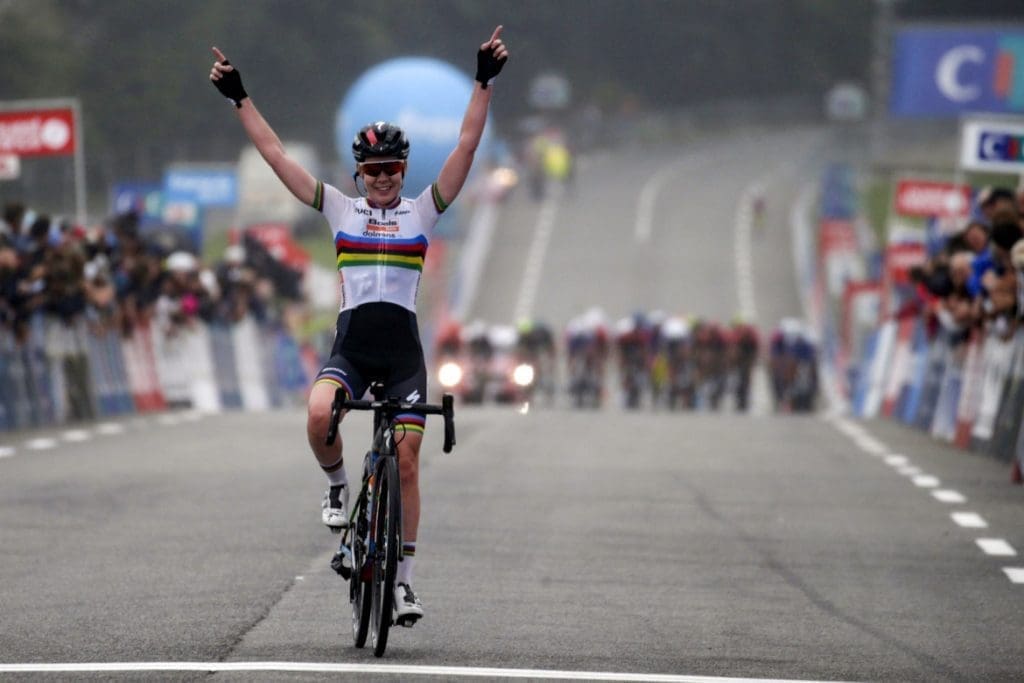
The modern Classic Lorient Agglomération traces its history to 2002, when the women’s GP de Plouay became part of the UCI Women’s Road World Cup.
German sprinter Regina Schleicher won that first edition, ahead of Petra Rossner and Susanne Ljungskog.
Plouay was already one of France’s most deeply established cycling venues by then. The men’s race dated back many decades, while the town had hosted the 2000 UCI Road World Championships, bringing the world’s best riders to a circuit that helped cement Plouay’s international reputation.
There is a small historical complication around the starting date. UCI historical coverage has also referred to women’s Plouay victories for Anna Millward in 1999 and 2001. However, the current race’s modern edition numbering begins with the World Cup event in 2002, making the 2026 Classic Lorient Agglomération its 25th edition.
That 2002 entry into the World Cup is therefore the most useful starting point when tracing the race in its present form.
Nicole Cooke helps establish Plouay’s reputation
The quality of the early winners quickly gave the race credibility.
Nicole Cooke won in 2003, years before adding Olympic and world road race titles on the same day in 2008. Cooke was particularly well suited to Plouay because she could climb strongly enough to survive a selective race while retaining the speed necessary to win from a reduced group.
That combination would become a recurring theme.
Plouay has rarely been a race for pure sprinters, but neither is it normally difficult enough for the best climbers simply to ride everyone else off their wheels. The ideal winner sits somewhere between the two.
Italian Noemi Cantele became the first multiple winner of the modern era when she took victories in 2005 and 2007.
The race was beginning to establish its own type of specialist.
Emma Pooley shows that attackers can win too
If some winners relied on their finishing speed, Emma Pooley demonstrated another way to solve Plouay.
The British rider won consecutive editions in 2009 and 2010.
Pooley was one of the outstanding climbers and time triallists of her generation, but she was never going to want a sizeable group arriving together for a sprint. Her route to victory depended on using the accumulation of climbs to break the race apart.
Those victories illustrated one of Plouay’s defining tactical characteristics.
There is rarely one climb so difficult that everybody knows the winning move must happen there. Instead, the race gradually removes riders through repeated efforts. Someone prepared to attack before the obvious moment can turn that attrition into a decisive advantage.
Marianne Vos brings a different solution
Two years after Pooley’s second victory, Marianne Vos won in 2012 and 2013.
Vos could approach the race almost completely differently.
Rather than needing to escape before the finish, she could survive the same difficult terrain and still trust one of the strongest sprints in women’s cycling.
Her consecutive victories reinforced the central tactical problem of Plouay. Teams have to decide whether enough damage has been done to eliminate the fastest riders.
Attack too early and the bunch may reorganise.
Wait too long and someone such as Vos can still be there at the finish.
That tension between attackers and fast finishers has remained part of the race’s identity ever since.
Lizzie Deignan becomes Plouay’s defining modern winner
The next major chapter belonged to Lizzie Deignan.
Then racing under her maiden name Lizzie Armitstead, she won for the first time in 2015, during the final season of the old UCI Women’s Road World Cup.
That victory came in a year when Deignan was operating at the very highest level. She would later win the world road race title in Richmond and finish the season as the overall winner of the final Women’s Road World Cup.
When the World Cup was replaced by the UCI Women’s WorldTour in 2016, Plouay moved directly into the new top-tier series.
Eugenia Bujak won that first WorldTour edition before Deignan returned in 2017.
Her second victory came after she escaped late with Pauline Ferrand-Prévot and then distanced the French rider towards the finish.
Amy Pieters won in 2018 before Anna van der Breggen added Plouay to her enormous collection of major victories in 2019.
By this point the race had proved it could survive the transition between two distinct eras of women’s professional cycling.

Deignan makes it three in the rain
The disrupted 2020 season produced one of the most memorable editions.
Bad weather added another layer of difficulty to the Breton course, and Deignan eventually found herself at the front alongside fellow British rider Lizzy Banks.
The pair worked together to keep the chasing group behind before settling victory between themselves.
Deignan won the sprint to take her third Plouay victory, adding 2020 to her successes in 2015 and 2017.
That made her the most successful rider of the modern race.
It was also part of an exceptional period of form. Only four days later, Deignan beat Marianne Vos to win La Course by Le Tour de France in Nice.
Her Plouay victories were spread across six seasons and came under different tactical circumstances. That versatility is precisely what the race tends to reward.
The route begins to move beyond the traditional Plouay circuit
For much of its history, the women’s race was closely associated with repeated laps of the circuit around Plouay.
The structure gradually became more ambitious.
Rather than spending virtually the entire race circulating around the same roads, organisers began incorporating longer loops through the surrounding Lorient Agglomération before returning to Plouay for the decisive finishing circuits.
That expanded the tactical possibilities.
Instead of riders simply learning the rhythm of one repeated circuit, teams had more opportunities to send riders up the road before the race reached its traditional final climbs.
Elisa Longo Borghini won in 2021 with a late solo move, producing exactly the sort of aggressive victory that suits the race.
A year later, the course was altered again for a 159.5km edition that eventually became a battle between Mavi García and Amber Kraak.
García attacked late from the decisive group, with only Kraak able to follow. The Spaniard then won their two-rider sprint to take the 2022 title. The full report from Mavi García’s 2022 victory showed how the revised parcours encouraged attacks before the traditional final sprint.
Why did the GP de Plouay become Classic Lorient Agglomération?
The race’s name has changed repeatedly, largely because of sponsorship and the growing involvement of Lorient Agglomération.
Older results can appear under variations including:
- GP de Plouay
- GP de Plouay-Bretagne
- GP de Plouay – Lorient Agglomération
- GP de Plouay – Lorient Agglomération – Trophée WNT
- GP de Plouay – Lorient Agglomération – Trophée Ceratizit
- Classic Lorient Agglomération – Trophée Ceratizit
- Classic Lorient Agglomération
The Classic Lorient Agglomération identity became established from 2022.
The change did not create a new race. It was another name for the same WorldTour event centred on Plouay.
That is important when comparing generations. Nicole Cooke winning the GP de Plouay and Mischa Bredewold winning the Classic Lorient Agglomération represent victories in the same historical event.
Mischa Bredewold begins a remarkable winning run
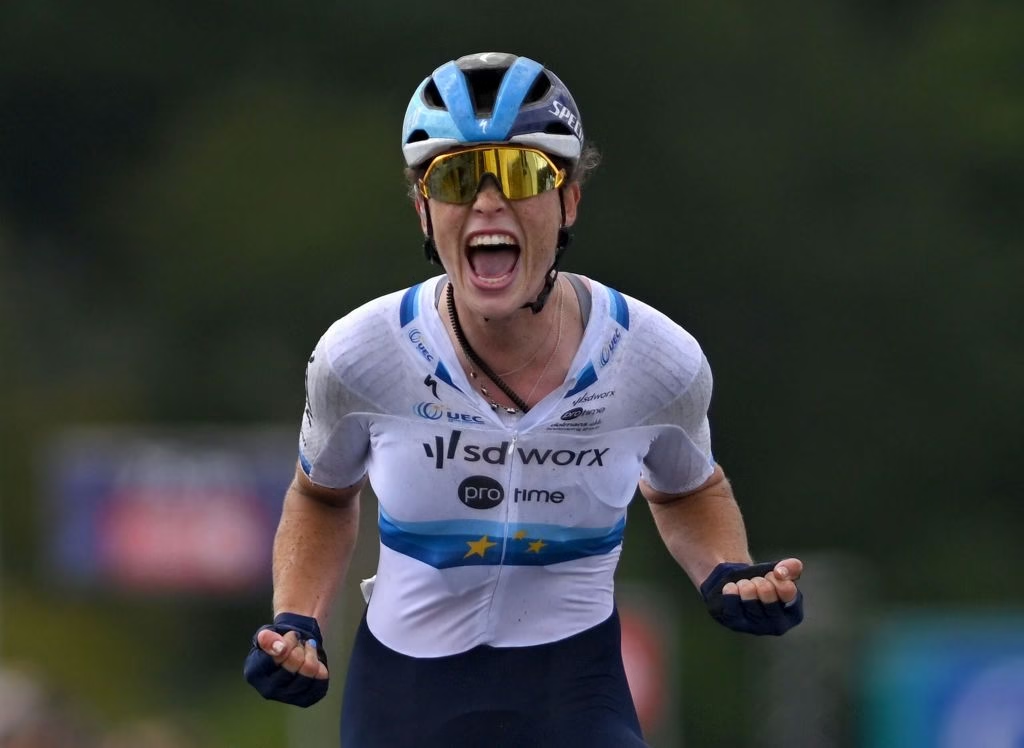
The modern era has increasingly belonged to Mischa Bredewold.
The Dutch rider won for the first time in 2023, establishing a relationship with the race that would quickly become comparable with Deignan’s.
She returned in 2024 wearing the European champion’s jersey.
That edition showed just how finely balanced Plouay can be. Amber Kraak spent much of the finale trying to hold off the peloton before Liane Lippert attacked on the final climb.
Bredewold and Chloé Dygert bridged across, creating a leading trio.
Dygert then tried to surprise her rivals inside the final kilometre, but Bredewold remained patient and came past in the final metres.
The 2024 Classic Lorient Agglomération race report captured a victory built as much around tactical judgement as outright strength.
Bredewold had now won twice in succession.
Three in a row for Bredewold in 2025
Her 2025 victory was arguably even more impressive.
The race covered 165.3km and became another attritional contest across the rolling Breton roads. A large breakaway formed before repeated attacks on the finishing circuit gradually reduced the field.
Bredewold’s chances appeared to suffer when she was caught behind a crash, forcing her to chase back before the decisive phase.
She recovered.
Liane Lippert and Pauline Ferrand-Prévot were among the riders who tried to force the final selection, but a group of around 21 eventually came into the closing kilometres together.
Marianne Vos seemed perfectly placed.
Bredewold launched first, Vos came past, and for a moment the two-time Plouay winner appeared to have taken control of the sprint.
Bredewold responded again.
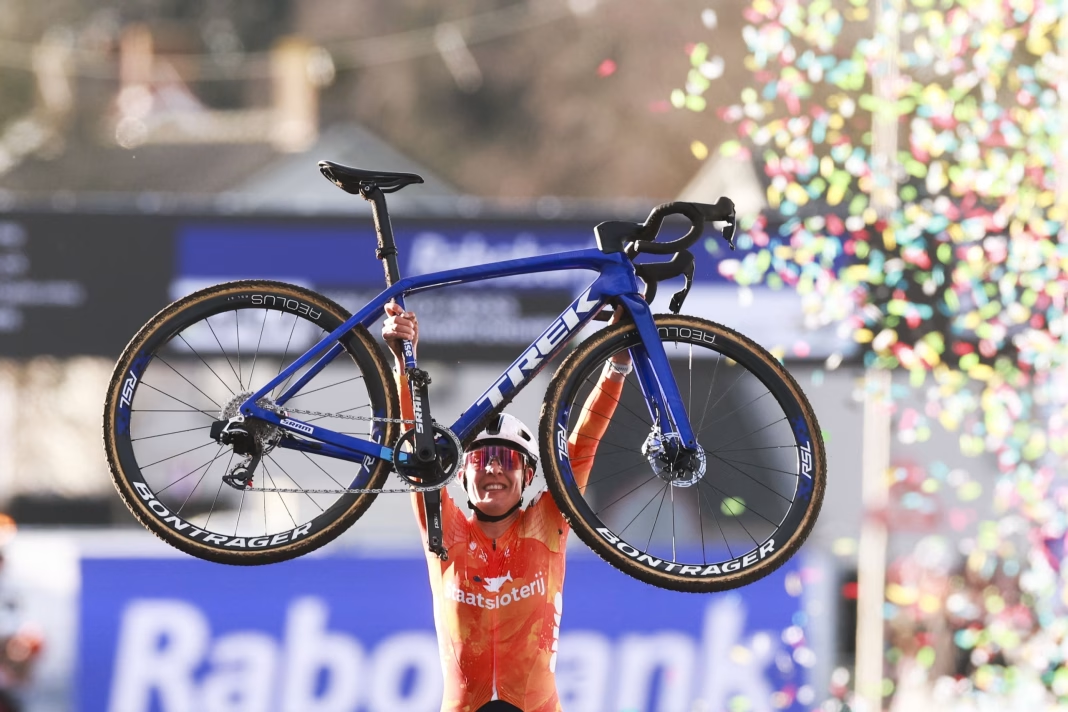
She found another acceleration in the final metres and edged back ahead, with Vos second and Eline Jansen completing an all-Dutch podium.
The 2025 Classic Lorient Agglomération report tells the full story of a victory that made Bredewold the first rider to win three consecutive modern editions.
It also moved her level with Deignan on three victories.
Classic Lorient Agglomération’s most successful riders
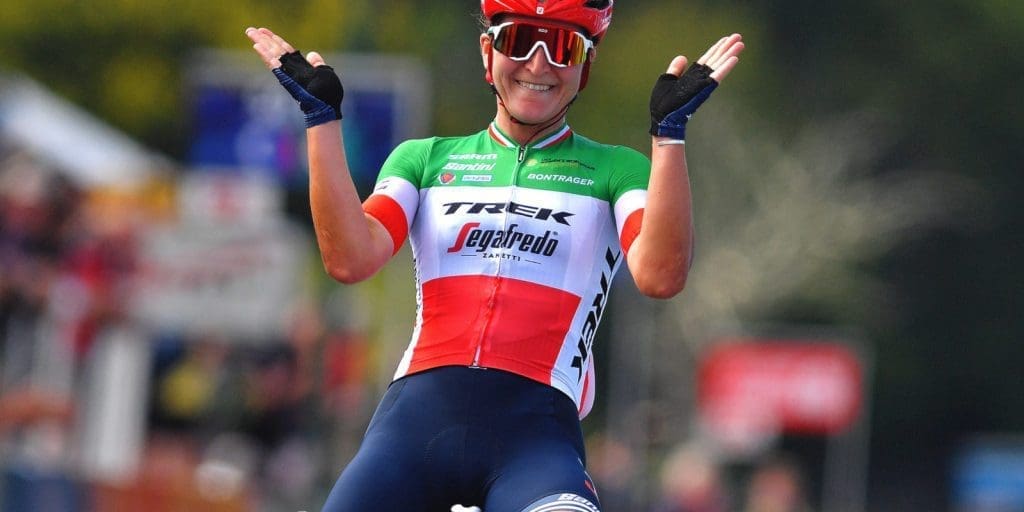
The modern race has produced remarkably few repeat winners given the variety of riders capable of succeeding in Plouay.
| Rider | Wins | Winning years |
|---|---|---|
| Lizzie Deignan | 3 | 2015, 2017, 2020 |
| Mischa Bredewold | 3 | 2023, 2024, 2025 |
| Noemi Cantele | 2 | 2005, 2007 |
| Emma Pooley | 2 | 2009, 2010 |
| Marianne Vos | 2 | 2012, 2013 |
Bredewold therefore enters the 2026 edition with an opportunity to do something nobody has achieved in the modern history of the race: win four times.
The 2025 Classic Lorient Agglomération preview provides another illustration of the breadth of riders who can contend here. Climbers, puncheurs, Classics specialists and resilient sprinters can all arrive with legitimate ambitions.
Why the Plouay circuit became so important
The race’s history cannot really be separated from its location.
Plouay is a small town in Morbihan, Brittany, but in cycling terms its importance is far greater than its size would suggest.
The surrounding roads are almost ideally designed for selective one-day racing.
There is rarely much genuinely flat terrain. Instead, the road continually rises, falls and changes direction.
Climbs such as the Côte du Lézot have repeatedly featured in the finale, while different versions of the circuit have incorporated other short ascents capable of creating separation.
None needs to be exceptionally long.
Their effect comes through repetition.
A rider may comfortably survive the first climb, react to an attack on the second and still be present after the third. By the final ascent, however, those repeated accelerations begin to expose the difference between simply surviving and still having enough power to attack.
That is why the race can produce such different winners without losing its identity.
-
 Photo Credit: Getty

From the Women’s World Cup to the Women’s WorldTour
Plouay’s longevity also gives it an important place in the wider development of women’s cycling.
The race spent more than a decade in the UCI Women’s Road World Cup, the leading season-long one-day competition before the creation of the Women’s WorldTour.
When the Women’s WorldTour began in 2016, Plouay was one of the established races that carried directly into the new series.
It has remained there ever since.
That continuity means its roll of honour connects very different periods of the sport.
Cooke and Pooley raced when women’s professional cycling operated on a much smaller commercial scale.
Vos helped define the generation that followed.
Deignan and Van der Breggen won as the Women’s WorldTour began expanding.
Bredewold’s victories have come in an era with significantly stronger team structures, larger calendars and increasingly specialised preparation.
Yet all of them had to solve essentially the same tactical problem around Plouay.
The race enters its 25th modern edition in 2026
The 2026 Classic Lorient Agglomération takes place on Saturday 29 August, with the race again forming part of the Women’s WorldTour.
It is the 25th edition in the modern chronology that begins with Regina Schleicher’s victory in 2002.
Bredewold arrives as the obvious historical focus after three consecutive wins, but Plouay’s past suggests defending a title is never straightforward.
Some editions have rewarded long-range solo attacks. Others have finished with two or three riders fighting for victory. Occasionally, a larger reduced group survives long enough for a sprint.
That uncertainty is what has kept the race relevant through more than two decades of change.
The sponsors have changed, the title has changed and the route has expanded well beyond the original repeated circuit. What has survived is the character of racing around Plouay: relentless rather than mountainous, tactical rather than predictable and difficult enough that only a genuinely versatile rider tends to reach the final kilometre with both the legs and the options required to win.

