
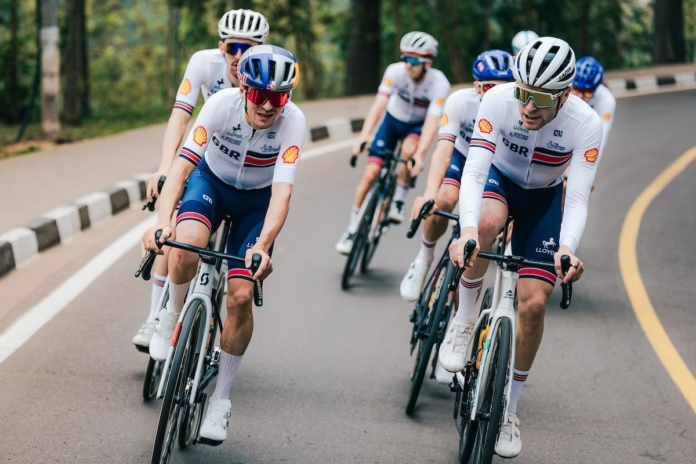
Eleven years have passed since a British rider last pulled on the elite road race rainbow jersey.
Lizzie Deignan was 25 when she won in Richmond in 2015, delivering under the pressure of entering the World Championships as one of the favourites. Mark Cavendish’s men’s title in Copenhagen had come four years earlier. Since then, Great Britain have continued winning Olympic medals, Grand Tours, Classics and world titles across other disciplines, but the elite road race has remained out of reach.
The timing makes Montréal particularly interesting. Deignan is now back inside British Cycling as a directeur sportif and spoke openly when she returned to the Great Britain set-up earlier this year about the need to turn Britain’s depth into more rainbow jerseys.
Montréal gives the current generation a genuine opportunity.
Tom Pidcock has just finished fourth at GP Québec and sixth at GP Montréal. Oscar Onley arrives as the Vuelta a España white jersey winner after finishing sixth overall. Adam Yates gives Britain another rider who can survive a brutally selective race, while Zoe Bäckstedt has developed from an exceptional time triallist into a rider capable of winning hard road races as well.
None starts as the overwhelming favourite. That may suit Britain better.
Montréal is difficult without being a pure climbers’ World Championships
Both elite road races finish on repeated laps around Mount Royal, where Camillien-Houde, Côte de la Polytechnique and the rising Avenue du Parc finish provide three different opportunities to force selections.
The elite women race 180.4km with 2,570 metres of climbing, including eight laps of the 13.4km Montréal circuit. The men cover 273.7km and face 12 circuits after the longer approach into the city.
The women’s World Championships route guide shows why the headline climbing figure only tells part of the story. More than 2,150 metres of the women’s elevation comes during the eight finishing laps. The difficulty is concentrated late, when the race has already been going for several hours.
There is no one huge climb.
Camillien-Houde is long enough to reward sustained power, Polytechnique is steep enough for explosive attacks and the roads between them offer little chance for a depleted group to reorganise. Repeat the sequence often enough and the circuit becomes far harder than any individual ascent suggests.
The men’s peloton received an unusually useful preview at GP Montréal on Sunday. The 2026 race used the same redesigned 13.4km circuit 16 times, accumulating more than 4,300 metres of climbing.
For Britain, what happened there was encouraging.
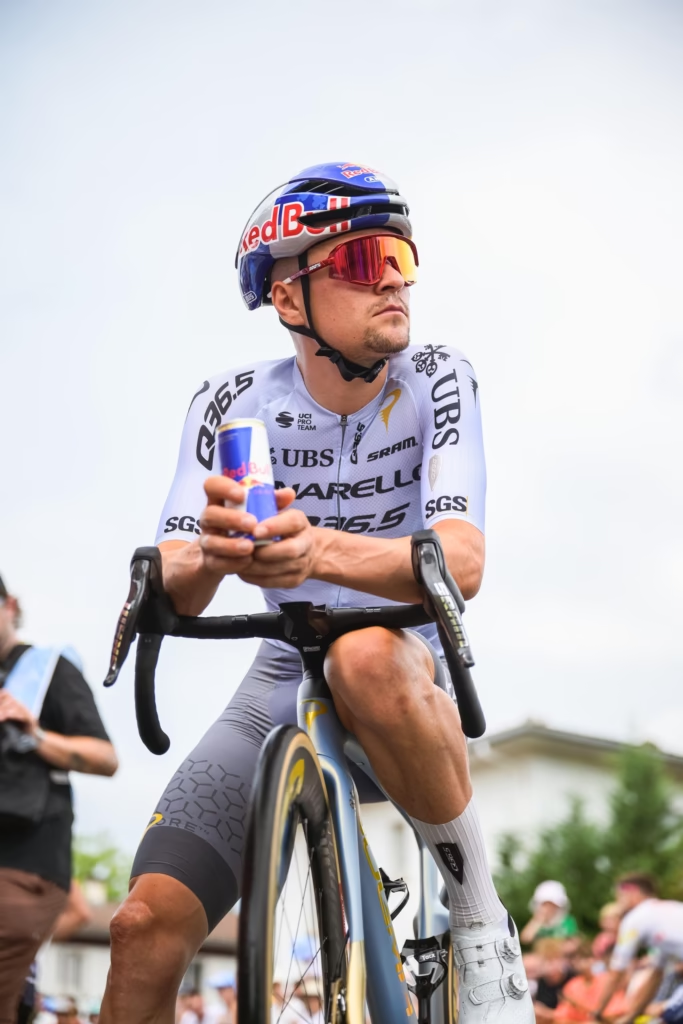
Pidcock’s Canadian form makes him Britain’s clearest men’s contender
Pidcock went to Canada specifically to rebuild his road rhythm after winning another mountain bike world title.
The results have removed most doubts about his condition.
He finished fourth at GP Québec after Remco Evenepoel and Giulio Ciccone escaped the decisive group, then followed with sixth in Montréal two days later. The finishing position at Montréal was respectable rather than spectacular, but the way he reached it was more relevant for the World Championships.
Pidcock survived deep into a race containing repeated attacks, more than four hours of circuit racing and over 4,300 metres of climbing. He was still among the contenders when Paul Seixas launched the acceleration that finally split the front group on the last Camillien-Houde ascent.
Isaac del Toro bridged to Seixas and the pair disappeared.
As covered in the GP Montréal race report, Pidcock remained in the group behind alongside Evenepoel, Giulio Ciccone and Ben Healy.
That is a useful benchmark.
He was not quite strong enough to follow the winning move, but he was still racing for the victory on the final lap against several of the riders expected to shape the World Championships.
His fourth place in Québec provided another positive sign. Our post-race analysis from GP Québec highlighted how comfortably Pidcock transferred his late-summer form back onto the road.
Two weeks before the World Championships, Britain know their likely leader is already competitive.
Pidcock cannot simply wait for a sprint
The Montréal result also showed why Britain’s tactics need to be more imaginative than protecting Pidcock until the final kilometre.
His sprint is dangerous after a difficult race, but there are several riders he would rather not take to Avenue du Parc.
Mathieu van der Poel and Wout van Aert bring obvious finishing speed. Evenepoel may prefer to avoid a sprint altogether, but his Québec victory showed that he is already capable of attacking from distance. Del Toro beat Seixas comfortably in their two-man Montréal finish.
Britain therefore need to make other nations race before Pidcock has to.
A passive race in which Belgium, France, Mexico and the Netherlands arrive at the last lap with their leaders and support riders intact would leave Pidcock with fewer options.
The British men’s squad is well designed to avoid that.
Oscar Onley and Adam Yates are not riders other nations can casually allow to disappear up the road. Both are strong enough climbers to turn 20 or 30 seconds into a serious problem.
Sending one of them forward on the penultimate or antepenultimate lap forces somebody else to make a decision.
Britain should make those decisions as expensive as possible.
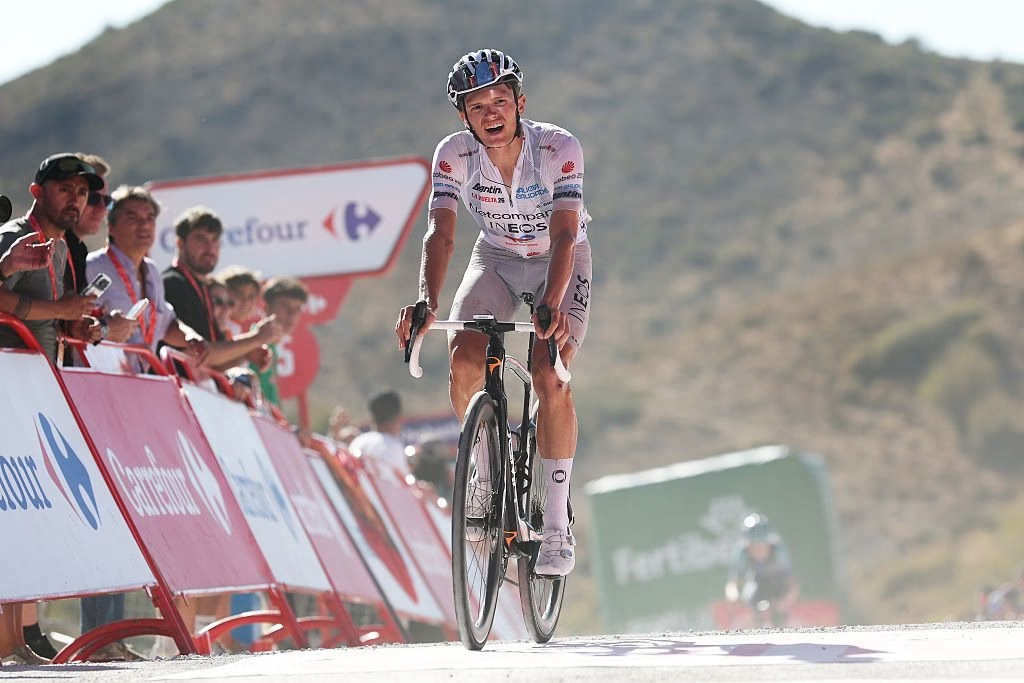 Photo Credit: Getty
Oscar Onley arrives from his best Vuelta yet
Onley’s place in the team looks particularly valuable after what he achieved in Spain.
He finished sixth overall at the Vuelta and won the young rider classification, becoming the first British winner of the white jersey at the race. His final placing is documented in the 2026 Vuelta classification recap, but the more relevant performance for Montréal came much earlier.
On Alto de Aitana, Onley was the only rider capable of following eventual Vuelta winner Enric Mas when the Spaniard made the decisive attack.
He finished with Mas while Primož Roglič, Felix Gall and Richard Carapaz all lost time.
That ride turned what had begun as a white jersey campaign into a genuine Vuelta podium challenge.
The question is recovery.
Onley finished three weeks of Grand Tour racing in Granada only a fortnight before the men’s road race in Montréal. He does not need to find fitness. The risk is whether the accumulated load of the Vuelta leaves him sharp enough when the championship reaches its final hour.
If the recovery works, his tactical value is enormous.
Onley does not need to wait for the final Camillien-Houde climb. He can attack earlier, force stronger nations to chase and potentially create a race in which Britain’s nominal second option suddenly becomes the rider everyone has to catch.
Adam Yates gives Britain another rider who cannot be ignored
Adam Yates adds experience to what could otherwise become a team overly dependent on Pidcock and Onley.
He knows how to race difficult one-day events, has the climbing strength to survive the Mount Royal circuits and is dangerous enough that a late attack demands a response.
That should be his value in Montréal.
Britain have little reason to ask Yates simply to ride tempo until he is dropped. A reduced group containing Pidcock, Onley and Yates with three laps remaining gives them a numerical advantage worth using.
One attacks.
Someone else follows.
Another British rider remains behind.
It is basic championship racing, but it becomes particularly effective when none of the three riders can safely be given much freedom.
Fred Wright adds another layer. He has repeatedly shown in Classics and championship races that he can remain useful deep into attritional events, while Mark Donovan, Finlay Pickering, James Shaw and Callum Thornley complete an eight-rider men’s squad with enough climbing strength to avoid burning the leaders simply keeping the race under control.
The confirmed British men’s road race team is Pidcock, Onley, Yates, Wright, Donovan, Pickering, Shaw and Thornley.
It is not built around one leader and seven conventional domestiques.
That should be treated as a strength.
Pogačar’s absence completely changes the men’s race
Tadej Pogačar would have changed almost every tactical calculation.
The defending world champion had been expected to arrive in Montréal as the benchmark after another dominant season, but the serious injuries he suffered when he crashed out of the Vuelta a España removed him from the remainder of the season.
Without Pogačar, there is no rider every major nation automatically expects to be strongest.
Evenepoel’s Québec victory makes him the obvious reference point. Del Toro’s Montréal win puts him alongside the Belgian. Seixas looked exceptional on the final circuit and Van der Poel remains one of the most dangerous championship racers of his generation.
Britain sit just behind that first line of favourites.
That is probably the right place for them.
Pidcock does not need to carry the responsibility of controlling the race. Onley and Yates can attack without immediately compromising the favourite. Britain can afford to let Belgium, France or the Netherlands decide whether an early dangerous move needs chasing.
On a circuit where every chase costs energy that cannot be recovered later, avoiding unnecessary work matters.
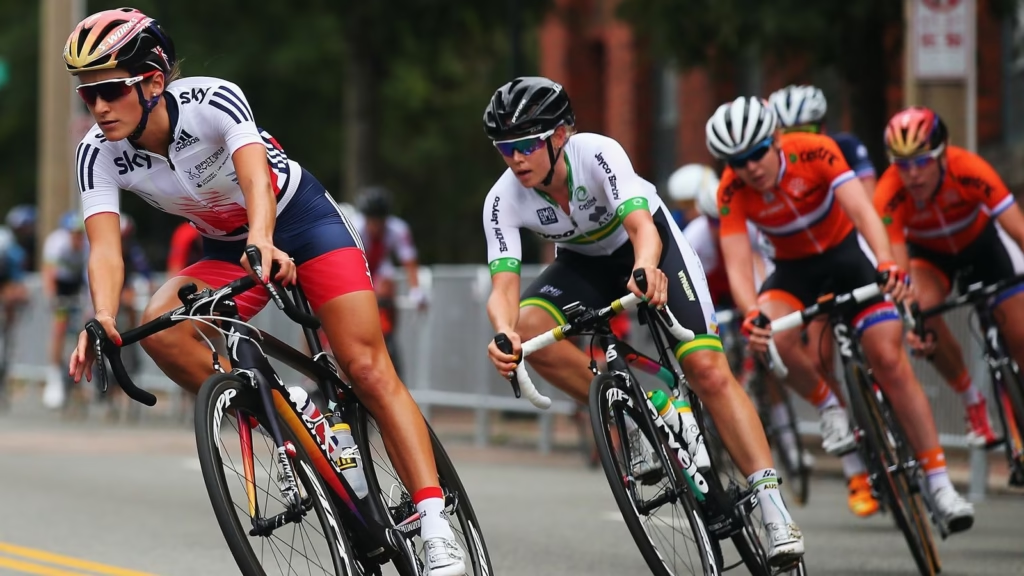
Eleven years since Deignan’s Richmond title
The women’s road race carries the stronger historical thread.
Deignan’s 2015 victory remains Britain’s most recent elite road race world title in either category.
She entered Richmond as one of the favourites and handled the pressure perfectly, following the decisive moves before winning the sprint from a small group.
Her career subsequently added the Tour of Flanders, Liège-Bastogne-Liège and the inaugural Paris-Roubaix Femmes, but the rainbow jersey remained one of the defining results. ProCyclingUK’s look back at Deignan’s career covers how central that 2015 victory was to her place in British cycling.
There is an obvious generational link this year.
Deignan is no longer racing, but she is back inside the national set-up. The riders attempting to end the drought include a generation who grew up watching the period when British riders regularly expected to contest the biggest championships.
Zoe Bäckstedt is the most intriguing of them.
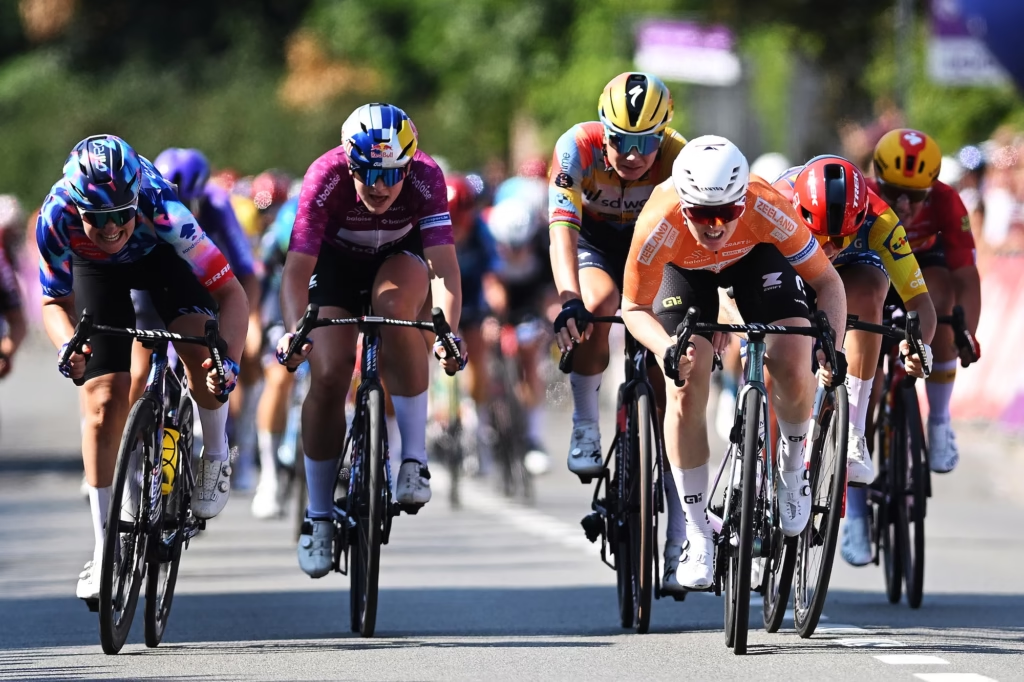
Bäckstedt has become a much more complete road rider
Bäckstedt has always looked like an obvious future World Championships contender against the clock.
The road race question has been more complicated.
Her size, power and track-cycling background initially pointed towards flatter racing. The last two seasons have gradually broken down that assumption.
The 2026 British Championships provided the clearest example. Bäckstedt won both the time trial and the road race, taking the road title with a long individual chase and attack rather than simply relying on her sprint.
She then carried that form into the summer. A Tour de Suisse stage victory showed she could finish after a more selective race, before she opened the Baloise Ladies Tour by winning the prologue in IJzendijke.
Montréal is harder.
Eight Mount Royal laps place a significant demand on a rider who will not be among the best pure climbers in the field. Demi Vollering has an obvious incentive to make the race as difficult as possible. Elisa Longo Borghini, Kasia Niewiadoma-Phinney and other climbers will have the same idea.
Bäckstedt’s task is to prevent the climbing from becoming purely a watts-per-kilogram contest.
If the race repeatedly breaks and reforms, she becomes increasingly dangerous.
No leading nation wants Bäckstedt reaching Avenue du Parc in a group of eight or ten riders.
That alone gives Britain tactical leverage.
Anna Henderson brings a different route to the medals
Anna Henderson offers experience and another powerful engine for a race that may be decided through repeated moves rather than one final climb.
Her Olympic silver medal in the Paris time trial established her against the clock, but her road development has continued since then. She is capable of contributing in selective races, working from distance and attacking on terrain where hesitation behind can rapidly create a meaningful gap.
The difficulty is similar to Bäckstedt’s.
Neither wants the Netherlands driving Camillien-Houde as hard as possible for eight laps.
Britain’s women’s tactics should therefore be aggressive before Vollering and the strongest climbers reach the point where they can simply dictate terms.
Henderson can help create that race.
Pfeiffer Georgi, Cat Ferguson and Imogen Wolff are among Britain’s other high-level road options, giving the selectors far greater depth than they had available for the unusually difficult Kigali course in 2025.
Montréal is a better fit for the British pool.
It rewards power as well as climbing and gives riders several different ways to remain involved.
Britain’s strongest tactic is numbers in the final
Neither British elite team should try to imitate the strongest nation in its race.
The men do not need to race like Belgium have only Evenepoel. The women gain little from helping the Netherlands create a pure climbing contest for Vollering.
Britain’s advantage lies in alternatives.
For the men, Pidcock is the rider most likely to finish the job if a small group reaches the final kilometre. Onley and Yates provide credible attacks before then. Wright can cover moves deep into the race and the remaining riders give Britain enough depth to preserve those options.
For the women, Bäckstedt becomes increasingly dangerous if the selection remains broader than expected, while Henderson gives Britain another rider capable of using strength rather than pure climbing to influence the final circuits.
There is no British rider who begins Montréal as the single rider everyone else has to beat.
Eleven years after Deignan’s victory, that does not make the wait for another rainbow jersey any less realistic.
It simply means Britain will probably have to win it differently.

