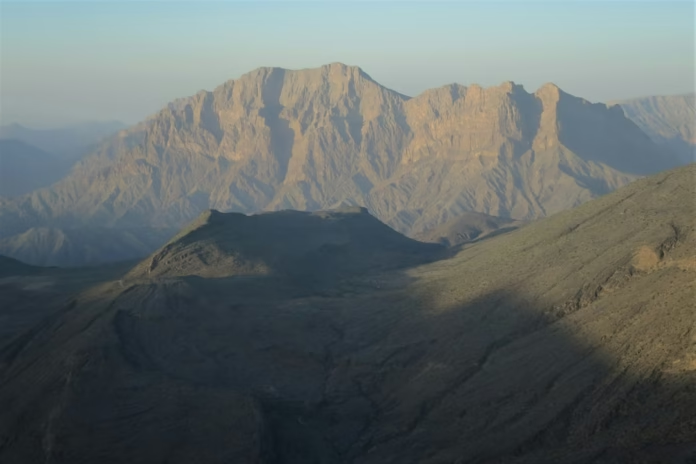
The Hajar Mountains offer some of the hardest and most unusual climbing in the Middle East. Jebel Akhdar rises sharply above Birkat Al Mouz, Jebel Shams sits beyond the old villages west of Nizwa, and the roads between them move quickly from broad valley tarmac to steep mountain ramps, gravel and isolated tracks.
That variety is the appeal, but it is also what makes a cycling trip here different from a week in the Alps or Pyrenees. You cannot assume every road on the map is suitable for a road bike, water stops are not guaranteed and the famous Jebel Akhdar road has a police checkpoint at its base. The best trips are built around a few properly researched rides rather than trying to link every mountain together in one ambitious loop.
Nizwa is the most practical base for a first visit. It gives easy access to Birkat Al Mouz, Al Hamra and the roads towards Jebel Shams, while still offering the accommodation, food and transport options that become much scarcer once you move into the mountains.
Nizwa and Birkat Al Mouz make the best base
Nizwa works well because it lets you separate the hard mountain days from the logistics around them. You can start a ride from town, but a short vehicle transfer is often the better option if it keeps you off the busiest approach roads and closer to the foothills.
Birkat Al Mouz sits at the foot of Jebel Akhdar and makes a useful first-day destination. The lower roads around the village are much easier than the mountain itself, with palm groves, irrigation channels and quiet sections once you move away from the main road. It is a good place to check the bike, get used to the heat and see how the traffic feels before committing to a serious climb.
 Photo Credit: Unsplash / Andy Arbeit
A support vehicle is not essential for every ride, but it is unusually useful in Oman. It means extra water can be left at the foot of a climb, tired riders can skip a long transfer back along a fast road and the day can be adjusted if access or weather does not match the plan.
Jebel Akhdar is the headline climb, but access needs checking
The road from Birkat Al Mouz towards the Saiq Plateau is the climb most closely associated with cycling in Oman. The main surveyed ascent is roughly 13.9km long, gains about 1,430 metres and averages close to 10 per cent. There is very little easy riding once it properly begins.
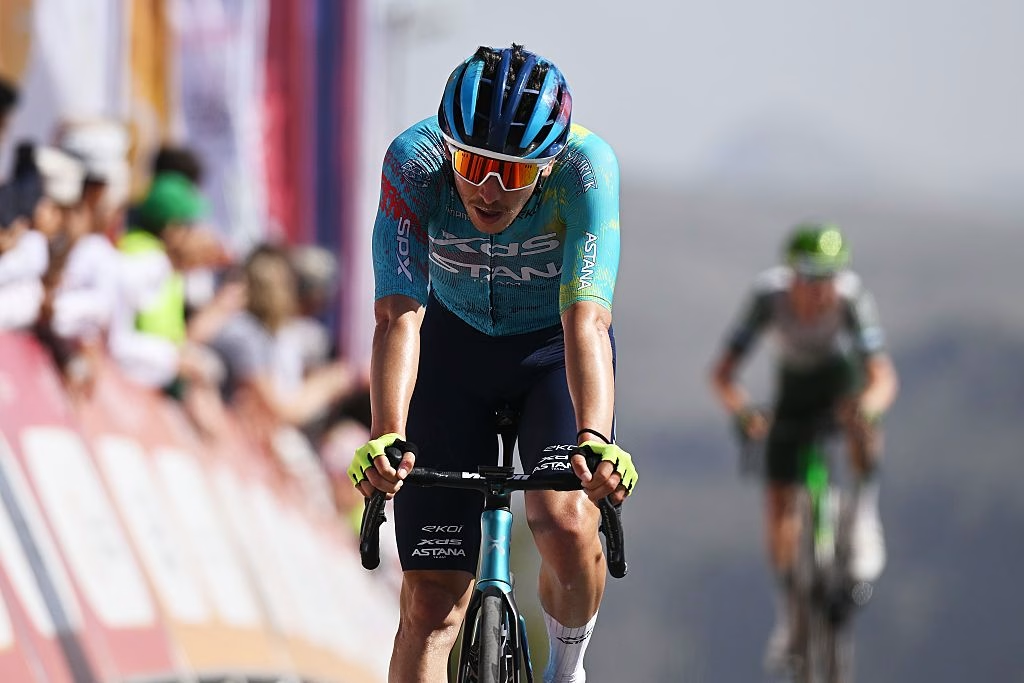
That is far harder than the shorter section normally used by the Tour of Oman. The professional race gives a good sense of the gradient, but riding from the lower road to the plateau is a much bigger effort. The climb reaches around 2,000 metres, so pacing and temperature management matter as much as gearing.
The road itself is smooth and engineered for tourist traffic, but there is a police checkpoint at the foot of the ascent. The four-wheel-drive rule for motor vehicles is well established. Bicycle access is less straightforward in practice, so do not build the entire trip around simply turning up and riding through. Confirm current access locally before the day, ideally through the Royal Oman Police or an established cycling operator.
If you do ride it, start conservatively. A compact or sub-compact chainset and a cassette giving roughly a 1:1 bottom gear, such as 34×34, is sensible for most recreational riders. Strong climbers may want something bigger, but there is little advantage in over-gearing a climb where double-digit gradients continue for kilometre after kilometre.
The descent deserves equal respect. Long, steep ramps put sustained heat into the brakes, while tourist vehicles may be travelling slowly around hairpins. Carry a windproof layer even on a warm day because the temperature on the plateau can be very different from the valley below.
Al Hamra and Misfat offer a more flexible day
West of Nizwa, Al Hamra gives a different kind of riding. The roads around the town and towards Misfat Al Abriyeen are still steep in places, but they are easier to turn into a two or three-hour ride rather than an all-day mountain effort.
Misfat is particularly useful as a turnaround point. The approach climbs towards old stone houses and cultivated terraces, then drops back towards Al Hamra. It is still worth checking the exact route beforehand because local roads can narrow quickly near the village, but the day is much easier to shorten if the heat or tired legs become a problem.
This part of the Hajar also works well after Jebel Akhdar. Rather than following one huge climbing day with another, ride the lower roads around Al Hamra and keep some energy for Jebel Shams the following morning.
Jebel Shams suits a gravel-capable bike better
Jebel Shams is a bigger and rougher undertaking. The approaches climb towards the high plateau and the viewpoints above Wadi Nakhr, but the upper roads are not consistently smooth tarmac. Paved sections can give way to gravel and hard-packed surfaces, so a lightweight gravel bike or endurance road bike with wider tyres is far more versatile than a pure race bike.
The important point is not to chase the highest summit shown on the map. The true summit area includes restricted sections and is not a normal cycling destination. Build the ride around accessible roads and viewpoints instead.
 Photo Credit: Unsplash / Rafael Peier
For a mixed-surface Jebel Shams day, 32mm tyres are a reasonable minimum and 35mm or wider gives more margin on rougher sections. Tubeless tyres are useful if your setup supports them, but carry plugs, a tube and a proper pump rather than relying on a tiny emergency inflator in a remote mountain area.
Wadi Bani Awf is an adventure ride, not a road-bike shortcut
Wadi Bani Awf and the crossing towards Bilad Sayt look tempting when planning a route across the Hajar. On the ground, they are a completely different proposition from the sealed mountain roads. Expect steep gravel, loose surfaces and sections intended for four-wheel-drive vehicles.
A capable gravel bike or mountain bike can open up parts of the route, but this is where local knowledge becomes valuable. Phone coverage can be limited, water is not guaranteed and a mechanical problem can leave you a long way from an easy pickup point.
Wadis also need respect after rain. Water can arrive from storms elsewhere in the catchment, so a dry valley where you are standing does not automatically mean the route is safe. If unsettled weather is forecast, keep the day on higher, sealed roads instead.
October to April is the easiest window
For northern Oman, October through April is the most useful period for a cycling trip. The lowlands are more manageable than in summer and early starts can give several comfortable hours before the temperature rises.
The mountains have their own climate. Jebel Akhdar and Jebel Shams can be much cooler than Nizwa, especially early in the morning and after sunset. A light windproof layer, arm warmers and thin gloves are easy to carry and can make a long descent far more pleasant.
March and April add another attraction on Jebel Akhdar because the high villages are known for rose cultivation. That also means more visitors, so an early start matters for traffic as well as temperature.
Summer is a poor default for a cycling holiday based in Nizwa. Even if the highest roads are cooler, the approaches and return journeys can expose you to severe heat. ProCyclingUK’s guide to cycling in extreme heat explains why pacing, cooling and hydration all become harder once temperatures climb.
What bike should you take?
A normal road bike works well if the trip is centred on Jebel Akhdar and sealed foothill roads. Use low gearing, dependable brakes and tyres in the 28mm to 32mm range rather than an aggressive race setup built around speed on perfect tarmac.
If Jebel Shams, gravel connectors or wadi tracks are part of the plan, an endurance or gravel bike becomes the better choice. The small speed penalty on smooth roads is outweighed by the freedom to keep riding when the surface changes.
Carry more water than you would on a similar ride in Britain. Two large bottles should be the starting point rather than the maximum, and longer mountain days may justify extra capacity or support. Mark confirmed shops and cafés on the route before leaving because a village on the map does not guarantee an open resupply stop.
The same applies to food and repairs. Take enough to finish the ride if the planned stop is shut, plus a tube, plugs if using tubeless, tyre levers, pump, chain link and a small multitool. In the Hajar, a simple mechanical problem becomes much more serious if the nearest useful shop is back in Nizwa.
A realistic four-day Hajar cycling itinerary
Day one: keep it easy around Nizwa and Birkat Al Mouz. Use the ride to check the bike, traffic and heat, then finish early enough to organise the following day’s mountain ride.
Day two: ride Jebel Akhdar only if bicycle access has been confirmed. Start early, take enough water and treat the climb as the main effort of the trip rather than adding unnecessary distance before or afterwards. If access is refused, switch to a lower foothill loop rather than improvising.
Day three: move towards Al Hamra and ride to Misfat Al Abriyeen. Keep the distance flexible and use the afternoon for the village and surrounding terraces instead of turning every day into an endurance test.
Day four: make Jebel Shams the final big ride, using a route that matches the bike and current road surface. A gravel-capable setup gives the most options. If the mountain is unsuitable, the lower roads around Al Hamra still make a good final morning.
If several climbing days in a row are new territory, ProCyclingUK’s multi-day cycling holiday training guide is a useful starting point for pacing and recovery. For a more straightforward European mountain comparison, the Serra da Estrela cycling guide covers the same questions around climbing, weather and choosing a base.
The Hajar are at their best when the trip is built around the roads as they actually are rather than the neatest line on a route-planning app. Nizwa and Al Hamra give you practical bases, Jebel Akhdar supplies the marquee climb and Jebel Shams adds a rougher mountain day. Get the access, surfaces and water plan right first, and the riding takes care of the rest.