Ceylin del Carmen Alvarado, Inge van der Heijden and Manon Bakker are among the first women named for HG Cross Heerde on Saturday 24 October 2026, where the soft sand beside the Heerderstrand lake has regularly decided the race. The elite women start at 13:45 CEST, which is 12:45 BST in the UK. Alvarado and Bakker have both won at this venue, while Van der Heijden arrives with a European title and the experience needed to turn an awkward circuit into a controlled effort.
The 2025 champion Fem van Empel returned to racing at Meulebeke last weekend, having been absent from competition for almost a year. That makes her recent progress a major cyclocross story, but it does not establish her as a confirmed Heerde entrant. The organisers’ early announcement on 13 October named Alvarado, Van der Heijden and Bakker. Further participation should be checked against the final start list before Saturday.
Heerderstrand is a standalone UCI C2 event and the third fixture in the seven-race HG Cross programme, the new umbrella for several races previously associated with Exact Cross. It follows Dendermonde and Meulebeke, where the early-season races have already shown that the form guide can change rapidly from one surface to the next. Heerde’s particular challenge is the way its sand sections interrupt a rider’s rhythm, making the ability to dismount and remount a measurable advantage rather than a secondary skill.
The course beside Heerderstrand: how the sand changes the race
The venue sits in woodland beside a recreational lake in Gelderland. Grass, short hard-surfaced sections and soft, coarse sand are combined into a circuit that is more awkward than a casual look across the lake suggests. The sand is not uniformly rideable. Riders often have to decide whether to keep pedalling, risking a near-stop, or dismount early and run through the softest part at a steadier speed.
That choice creates a difference between raw speed and effective lap time. Alvarado is an accomplished rider of technical courses and can gain ground by maintaining speed through corners before the sand. Bakker has repeatedly described Heerde as a course closely associated with her coach and organiser Bert Jan Hamer, giving her local knowledge of where a run may be quicker than forcing the bike forward. Van der Heijden’s consistent handling is valuable when the surface changes every few seconds.
The exit from a sandpit matters as much as the entrance. A rider who runs efficiently can lose the benefit if she cannot clip into a pedal immediately or is forced to brake behind someone else. The fastest competitors carry momentum over the firm ground, select a clear line for the next corner and accelerate before the rival behind has fully recovered. The cumulative effect over six or seven laps can create a sizeable separation without any one dramatic attack.
Race conditions may alter the balance. Dry, loose sand tends to reward technical efficiency and good line choice, whereas wet grass can make tyre pressure and grip unusually important. Heerde has wooded shelter as well as more open sections near the water, so conditions need not be identical everywhere. No definitive 2026 lap map or race-day surface report has yet been established, and the 2025 layout should be treated as a guide to the terrain rather than the exact route.

Alvarado leads the contenders, with Van der Heijden and Bakker close behind
Alvarado’s Heerde record is an obvious starting point. She won the 2024 edition and is the reigning Dutch champion, having also taken the elite world title in 2020. She finished second at the opening HG Cross in Dendermonde this month, just behind world champion Lucinda Brand. That performance suggests the early season has not blunted her ability to produce repeated hard efforts, even if Heerderstrand poses different questions from the Dendermonde course.
The Dutch rider has the range to attack through a sequence of corners and then use a clear line across the next sandy stretch. An early lead would let her choose where to dismount and make the others follow her route, but there is a danger in treating the course as won after one successful lap. The sand can change as riders churn up the tracks, and competitors behind may find a quicker running line once they have had time to study the surface.
Van der Heijden is the reigning European champion. Her strengths are composure and repeatability, particularly when a race requires precise handling as fatigue builds. At Dendermonde she finished fifth, behind Brand, Alvarado, Denise Betsema and Aniek van Alphen. The result puts her in the conversation without making her an automatic favourite: Heerde will reward a rider who manages the technical transitions with fewer interruptions than her rivals.
Bakker’s connection with the venue is unusually strong. She won the race in 2023 and is a member of the organising club Velosport Veluwe. The early official publicity quotes her describing the lap as typical of Bert Jan Hamer’s course designs, a reference to her coach and the event organiser. This familiarity can reduce uncertainty when choosing where to run and which lines are worth defending. It does not remove the need to match Alvarado and Van der Heijden physically through roughly 50 minutes of repeated accelerations.
Other major names from the opening weeks remain relevant to the broader form guide without being confirmed starters. Brand won Dendermonde; Marie Schreiber won the women’s race at Meulebeke; Van Empel was fourth on her return. Those results show the depth of the women’s field, but readers should distinguish what has happened at other events from which riders have actually committed to Heerde. The final entry list can change through illness, programme decisions and travel.
A short history of the Heerde women’s race
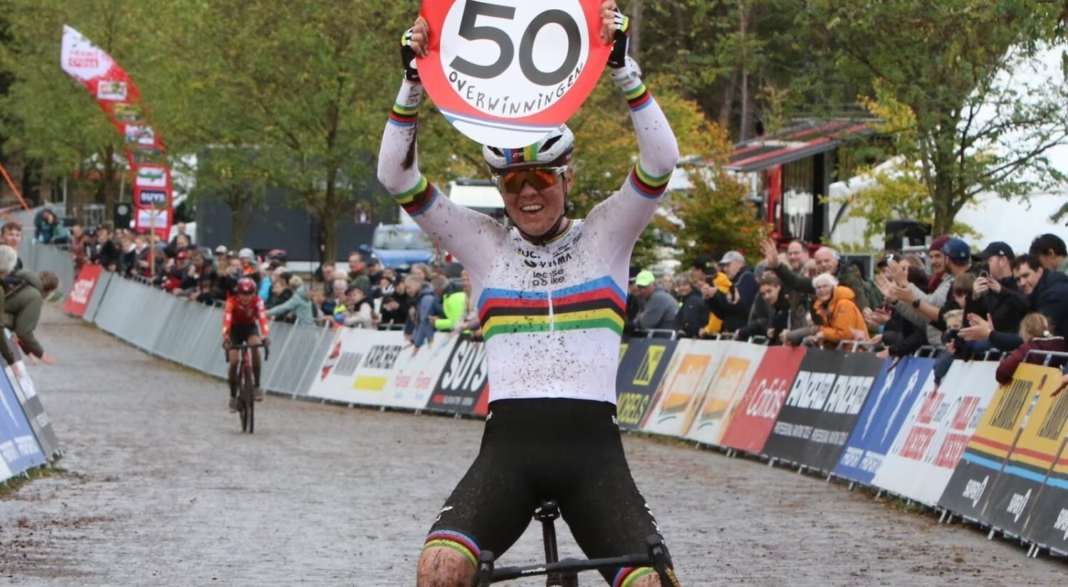
The Heerderstrand international event is still comparatively young, which makes its recent winners especially useful in a preview. Bakker won the women’s edition in 2023, Alvarado followed in 2024 and Van Empel took the 2025 race for her 50th cyclocross career victory. These are three different examples of riders managing the same distinctive landscape, though changes in the precise lap mean that the results are not directly interchangeable.
Van Empel’s 2025 success came ahead of Aniek van Alphen and Leonie Bentveld. It was one of the last victories before she stepped away from cyclocross later that autumn. Her return to Meulebeke in October 2026 gives that earlier Heerde win fresh historical relevance, but the circumstances of her comeback make it especially important not to assume a race programme beyond what has been publicly confirmed.
Alvarado’s 2024 win and Bakker’s 2023 success establish that the sand does not dictate a single ideal physical profile. A rider needs sufficient power to accelerate repeatedly, but an ability to run, remount and regain speed can save energy that would otherwise be spent compensating for errors. A favourite who is very strong on a smooth course can find herself under pressure when the bike is being carried through several stretches each lap.
For a closer look at last year’s result, ProCyclingUK’s 2025 Heerde women’s race report covers Van Empel’s milestone victory. The wider 2026–27 cyclocross calendar also places Saturday’s race between Meulebeke and the next day’s Superprestige fixture at Overijse.
The tactical contest: starting position, lines and the last lap
The early race is likely to be defined by the order in which the favourites reach the first serious sand section. At the front, a rider can decide whether to ride or run without reacting to somebody else’s hesitation. Further back, the choices narrow. A competitor who stops in a rut can slow everyone behind, and the resulting gap may remain open through the next corners even if the fastest riders have similar legs.
Alvarado may try to use her handling to force an early selection, making competitors work to hold her wheel before the most awkward obstacles. Van der Heijden’s best response may be to avoid the temptation to follow an unnecessarily risky line and instead use steady lap times to keep the pressure on. Bakker knows where the surface becomes less predictable, and could use that information to make ground after others have been caught in traffic.
Cyclocross tactics at Heerde are partly a question of how much energy to spend saving a second. A forceful acceleration can close a gap after the sand, but doing that repeatedly makes the following dismount and run more difficult. A rider who seems temporarily slower through the first obstacle may recover the time by finding better grip and changing pace more cleanly at the next one. A few seconds between leading riders should not be treated as decisive early in the race.
In a closely matched contest, the last lap may reward somebody prepared to run an obstacle she rode earlier, or to take a different line to pass a rival. Equally, the winning move could come well before the final lap if one rider repeatedly exits the technical sections at greater speed. The most useful signs for viewers are whether the leading group can reform between sand stretches and whether the same rider is always the first to accelerate out of them.
When to watch and practical information for spectators
Saturday’s timetable begins with amateurs and masters at 10:00 local time, youth racing at 11:15 and junior men at 12:30. The elite women’s race starts at 13:45 in the Netherlands, 12:45 BST, with the elite men following at 15:00 local time, or 14:00 BST. The clocks change the following day, Sunday 25 October, so UK viewers should use British Summer Time rather than GMT for Saturday’s start.
The organiser advertises live broadcasts of both elite races on Sporza and Eurosport, and continental television listings include VRT and HBO Max coverage. Coverage rights differ by country, so viewers in Britain should confirm the event in their own provider’s guide rather than relying on a Netherlands-only channel schedule. Live pictures often give a better indication of which lines riders are choosing than the timing graphics alone.
Spectators can enter Heerderstrand without paying admission. The venue opens at 09:00, and the organisers ask visitors driving to use the parking area at the MSV-NOV motocross circuit by Kamperweg, with a €15 charge payable in cash and a free shuttle to the course. Those arriving by bicycle can use the access at Ossenbergweg. The combination of a free race and several earlier categories gives visitors the chance to study the course before the elite women line up.
The race is easiest to understand from a position where both the end of a sand stretch and the next acceleration are visible. Watch how much speed each rider carries back onto firm ground, how long a remount takes, and whether a small gap survives the following series of bends. Heerde rewards competitors who avoid small losses as effectively as those capable of one large acceleration.