Spending £250 on a GPS bike computer buys far more than a speed readout. At this level you can find colour mapping, turn-by-turn directions, power-meter compatibility and batteries capable of lasting several long rides. The complication is choosing the right combination. A tiny navigation device can be perfect for commuting and frustrating for structured training; a huge screen can be excellent for touring but unnecessarily cumbersome on a road race bike.
This guide compares six specific models available in the UK market or sold through UK-facing suppliers in October 2026. Prices are checked against named listings, not assumed discounts, and availability can change. The assessment is based on manufacturer specifications, established independent reviews and practical use cases, not six ProCyclingUK hands-on tests. Where independent reviewers have found weaknesses, those limitations matter as much as the claimed features.
For most riders who want dependable maps without a flagship price, the Garmin Edge Explore 2 is an accessible starting point. The iGPSPORT BiNavi makes the strongest case if you want a large touchscreen and richer training connectivity. For endurance riders, the COROS DURA has a battery advantage, while the Beeline Velo 2 prioritises uncluttered directions over training data.
Six GPS bike computers under £250: quick comparison
| Model | UK price checked | Best suited to | Key trade-off |
|---|---|---|---|
| Beeline Velo 2 | £99.99 listed | City riding and simple route guidance | Not a full mapping or training computer; stock uncertain |
| Magene C606 Pro | £209.00 | Data screens, sensors and training features | Independent test found weak rerouting |
| iGPSPORT BiNavi | £219.90 | Large-screen navigation on a budget | Interface and screen have some rough edges |
| Garmin Edge Explore 2 | £209.99 at Tredz | Simple touring and accessible maps | Fewer advanced training functions |
| Bryton Rider S810 | £237.00 at Sigma Sports | Long rides and big-screen data | Reported software and syncing issues |
| COROS DURA | £249.00 at Sigma Sports | Bikepacking and battery endurance | Navigation interface warrants checking |
These are device-only figures rather than sensor bundles, except where a listing says otherwise. The £250 ceiling is applied to the checked UK price, so a model may move above it if a promotion ends. A claimed battery figure is not a promise of the same runtime with navigation, maximum brightness and several paired sensors enabled.
1. Garmin Edge Explore 2: the sensible navigation choice
The Edge Explore 2 concentrates on the parts of a GPS computer that recreational riders are likely to use most: a legible map, routing, turn instructions and a familiar touchscreen layout. The 3-inch colour display is large enough for junction details without occupying the entire cockpit. Preloaded Garmin Cycle Maps, off-course recalculation and compatibility with relevant e-bike systems make it attractive for touring and everyday riding.
Its battery claim is up to 16 hours under demanding conditions or 24 hours in saver mode. That is shorter than several alternatives here, although sufficient for many day rides. Garmin’s training functions are deliberately less comprehensive than those of the Edge 1050 and performance-focused Edge models. The trade-off is less complexity at a significantly lower price.
In Cyclingnews testing, the Explore 2 earned praise for mapping and usability but the touchscreen could be inconsistent in wet conditions or with thick gloves, and the unit did not include the mount the reviewer expected. Check the current retailer package rather than assume every listing has identical accessories. Tredz showed the standard computer at £209.99 during this price check.
Product listing: Garmin Edge Explore 2 at Tredz.
2. iGPSPORT BiNavi: most full-featured for the money
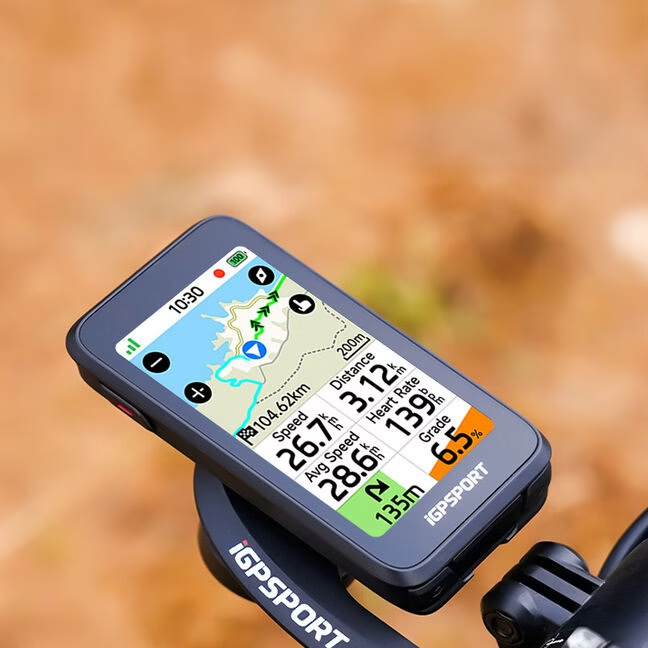
The BiNavi comes closer to an expensive flagship’s physical specification than its price suggests. It has a 3.5-inch colour touchscreen, offline maps, dual-band satellite positioning, 32GB storage and ANT+, Bluetooth and Wi-Fi connectivity. That provides room for routes, sensors and detailed ride data without crossing the £250 threshold.
iGPSPORT lists the standalone BiNavi at £219.90 through its UK store. The official claims include more than 35 hours of battery life, although actual results depend on navigation and accessory use. For cyclists moving from a simple speed-and-distance computer, the screen size and map presentation are the main step up.
Cyclingnews’ independent test covered more than 800 miles and was broadly positive about responsiveness and navigation prompts. The reviewer nevertheless found some software rough edges, limited map zoom control and occasionally unhelpful destination search. That is a useful warning: a strong specification does not guarantee the polish of a mature Garmin interface. Consider the BiNavi if you value features and can tolerate a little experimentation in the menus.
Product listing: iGPSPORT BiNavi UK.
3. COROS DURA: best for very long rides
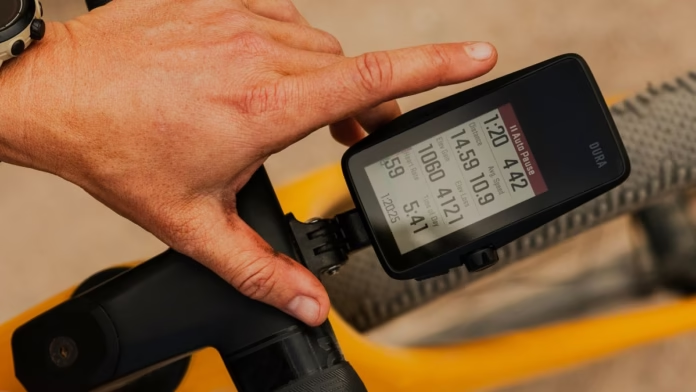
The COROS DURA is the most obvious choice for riders whose priority is not finding a socket every evening. COROS quotes 120 hours of GPS riding in its standard test configuration and offers solar assistance in suitable sunshine. The company’s more detailed battery guidance is particularly important: with dual-frequency GPS, navigation, connected accessories and a bright display, its estimates fall substantially below that headline. They are still impressive for an endurance-focused computer.
The DURA uses a 2.7-inch colour memory-in-pixel screen, touchscreen interaction, a digital dial and a physical button. Dual-frequency positioning, global offline maps and turn guidance make it a real GPS navigator rather than merely a battery-saving ride recorder. The dial has an advantage when riders wear gloves or do not want to repeatedly swipe a wet screen.
There are compromises. COROS’ cycling interface may be unfamiliar to Garmin or Wahoo users, and a smaller display is less comfortable when inspecting a dense town map than the 3.5-inch alternatives. Solar gains also depend heavily on exposure, not just riding duration: winter in Britain cannot be assumed to deliver the manufacturer’s ideal charging conditions. Sigma Sports listed the standalone DURA at £249, exactly within this guide’s upper limit.
Product listing: COROS DURA.
4. Bryton Rider S810: large screen and long claimed runtime
The Rider S810 is unusually well equipped at its checked £237 price. Bryton lists a 3.5-inch colour touchscreen, mapping, climb information, ANT+ sensor support and up to 50 hours of battery life. That combination sounds ideal for riders who want a large navigation screen without paying flagship money. The standard unit and sensor bundle are different products; Sigma Sports listed the device alone for £237, while its bundle exceeded £250.
Physical buttons complement the touchscreen and a built-in light sensor adjusts illumination. Bryton’s climbing and workout tools also make the S810 relevant for sportive and training riders rather than only tourers. It is a plausible alternative to the Garmin Explore 2 if battery endurance and a larger display take priority over the latter’s relatively simple software environment.
There is an important qualification from independent testing. Road.cc praised the battery and basic functions but described software bugs, slow satellite acquisition and reliance on the phone app for parts of the experience. Those are not trivial concerns if you are buying a computer principally to navigate reliably every weekend. The S810 has attractive hardware for the money, but it is better suited to someone prepared to learn its interface and keep software updated.
Product listing: Bryton Rider S810 at Sigma Sports.
5. Magene C606 Pro: plenty of metrics, qualified recommendation
The C606 Pro costs £209 from Magene’s UK-facing range and offers a 2.8-inch colour touchscreen, climb-related tools, route support, Strava segment features and connections for cycling sensors. It sits close to the Explore 2 on price but takes a more training-oriented approach. The Pro designation matters: it is not interchangeable with the older C606 or the newer C606 V2, and their reviews, software behaviour and prices should not be conflated.
A particularly useful current independent test came from road.cc in October 2026. The reviewer liked the battery endurance, USB-C charging and ease of planning routes in the companion app, but had substantial problems with on-device maps, rerouting and touchscreen response. The unit functioned much better as a data display than as a navigation aid during that test. That changes the recommendation materially.
If you mostly follow established club routes and want speed, power and gradient fields on screen, the C606 Pro remains an option. If your main use is discovering unfamiliar lanes, a similarly priced Explore 2 or BiNavi is easier to recommend based on the evidence available. Do not buy solely because the feature list mentions rerouting; you need that particular function to work when the road is closed.
Product range: Magene C606 Pro UK.
6. Beeline Velo 2: simple navigation for commuting
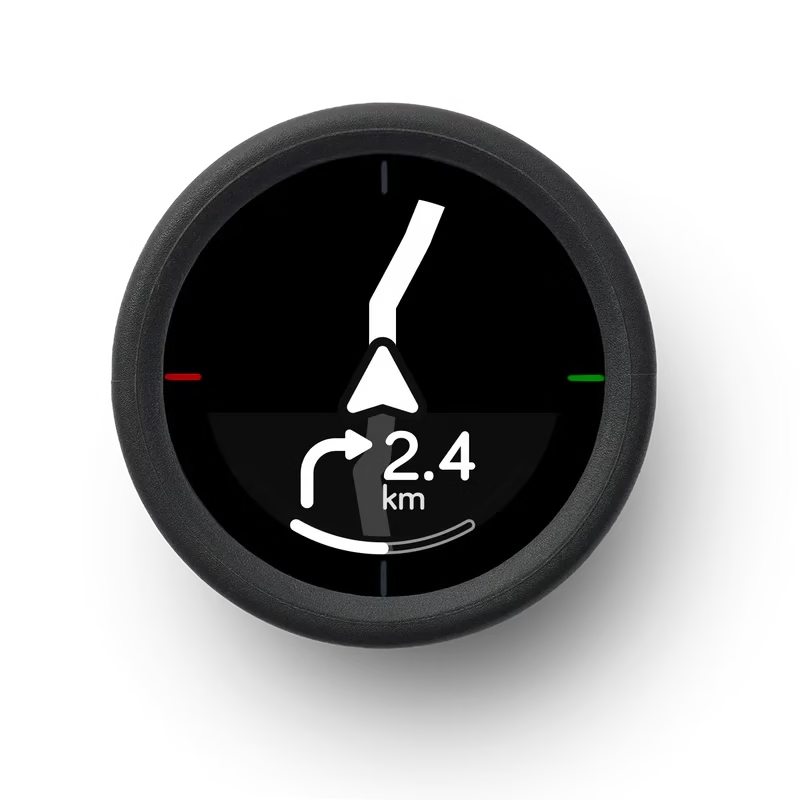
The Velo 2 takes a different approach from the other five. Rather than displaying a detailed map and a dozen training fields, it concentrates on an easily read direction display, a planned route and core ride statistics. Routes are prepared through the Beeline phone app or imported from compatible services. The lightweight device suits people who would rather glance at directions than study a complex dashboard.
At a listed £99.99, it is the cheapest selection and a sensible fit for urban riders, leisure cyclists and anyone who dislikes complicated electronics. It is not a close alternative to an ANT+ training head unit: serious power-meter analysis, extensive on-device maps and advanced workouts are not its purpose. Its appeal is simplicity, portability and reducing the need to carry a phone visibly on the handlebars.
Availability needs checking before making a purchase. Beeline’s individual product page displayed a £99.99 listing, but its UK collection marked the Velo 2 sold out during this research. Do not assume that a visible Add to cart button means dispatch is available. If stock is unavailable, wait for a confirmed restock or buy from a verified retailer rather than moving to an unrelated motorcycle Beeline product.
Product listing: Beeline Velo 2.
What to check before buying a budget GPS computer
Start with how often you will navigate rather than counting functions. If you regularly take turns you have not ridden before, favour clear maps, early alerts, dependable rerouting and a screen that is usable in poor weather. If you rarely leave familiar training loops, reliable speed and power data, battery life and sensor compatibility may matter more than sophisticated mapping.
Look carefully at the physical package. Some retailers sell just the head unit, some include a mount and others add sensors. Handlebar and out-front mounting standards are not universally interchangeable, especially with integrated cockpits. A £10 difference between listings becomes meaningless if one needs an expensive extra mount.
Battery figures are especially easy to misread. COROS’ 120-hour standard GPS claim, Bryton’s 50-hour estimate and Garmin’s 24-hour saver mode reflect different usage profiles. The more realistic question is how long the device lasts with your normal screen brightness, satellite setting, navigation and sensors. For winter riding, consider whether you can operate the controls with full-finger gloves.
Finally, check software support and navigation compatibility before paying. Routes from Komoot, Strava, GPX files and third-party planning apps do not necessarily synchronise identically across brands. If you already have a radar, power meter or electronic drivetrain, confirm the exact data and alert features you require, not merely a broad statement that ANT+ is supported.
Which GPS bike computer should you buy for under £250?
The Garmin Edge Explore 2 is the straightforward recommendation for a rider who wants mapping and little fuss, while the iGPSPORT BiNavi gives buyers more screen and training capability for similar money. The COROS DURA stands apart for endurance use, provided its smaller display and battery claims are understood in context. The Bryton S810 offers a big screen at an attractive price but comes with software caveats; the Magene C606 Pro is better approached as a data computer than a first-choice navigator on the available independent evidence.
The Beeline Velo 2 remains the appealing minimalist option, although current availability is uncertain. None of the six is an unqualified winner, and paying more within this budget does not automatically bring better navigation. Buy for the journeys you ride now, with enough capacity for the rides you genuinely plan to do next. This guide is a research-led comparison of documented products and independent assessments; it does not represent hands-on testing of all six devices by ProCyclingUK.