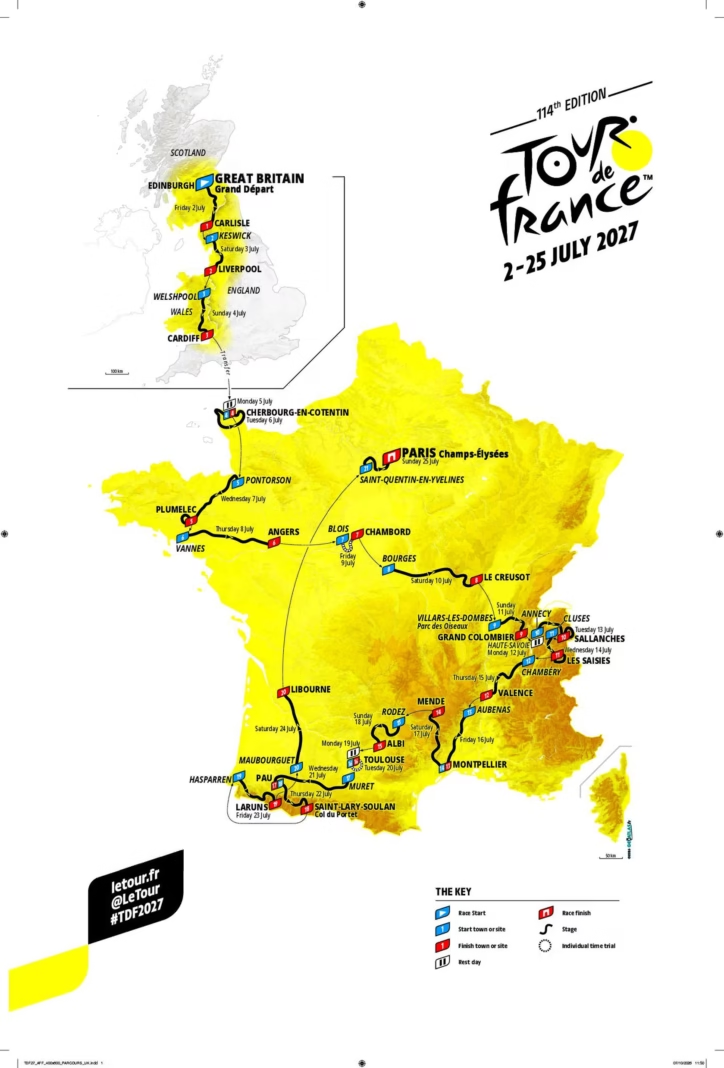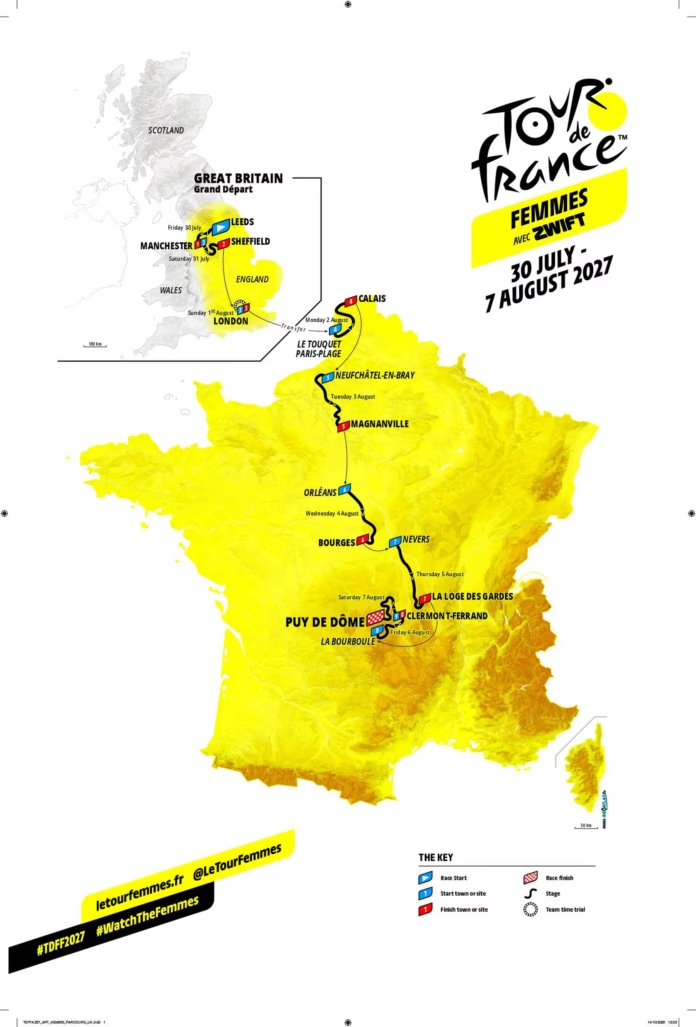
The 2027 Tour de France Femmes will begin in Leeds on 30 July and finish with a decisive climb of the Puy de Dôme on 7 August, after organisers unveiled a nine-stage route that combines a British Grand Départ with a difficult final weekend in France. Its first visit to Britain includes a stage across the Peak District and the race’s first team time trial, held through central London.
Across nine consecutive days, the riders will cover 1,156 kilometres and climb 17,665 metres, according to the official A.S.O. press kit. Four stages are classified as flat, two as hilly, two as mountain stages and one as a team time trial. The course avoids the Alps and Pyrenees but replaces them with short, steep climbs in Yorkshire and an increasingly demanding journey into the Massif Central.
The final three stages look particularly important. The first summit finish at La Loge des Gardes comes on stage 7, followed by 3,000 metres of climbing around Clermont-Ferrand on stage 8 and a 170-kilometre final stage containing 3,840 metres of ascent. The Puy de Dôme itself provides the finishing test, climbing for 11.3 kilometres at an average gradient of 7.8%.
Demi Vollering will head towards the new season as the reigning champion after winning the 2026 Tour de France Femmes. The route gives stage-race specialists plenty of ground on which to attack, but the short London time trial and the difficult opening weekend mean the yellow jersey contenders cannot afford to wait until the final ascent.
2027 Tour de France Femmes route and stage dates
| Stage | Date | Route | Distance |
|---|---|---|---|
| 1 | Fri 30 July | Leeds – Manchester | 86km |
| 2 | Sat 31 July | Manchester – Sheffield | 154km |
| 3 | Sun 1 August | London – London (team time trial) | 18km |
| 4 | Mon 2 August | Le Touquet-Paris-Plage – Calais | 123km |
| 5 | Tue 3 August | Neufchâtel-en-Bray – Magnanville | 161km |
| 6 | Wed 4 August | Orléans – Bourges | 138km |
| 7 | Thu 5 August | Nevers – La Loge des Gardes | 155km |
| 8 | Fri 6 August | La Bourboule – Clermont-Ferrand | 151km |
| 9 | Sat 7 August | Clermont-Ferrand – Puy de Dôme | 170km |
The distances are provisional pending final route homologation. The three British stages precede the transfer across the Channel, with racing resuming in northern France on Monday 2 August without a rest day. The opening stage and 2027 British Grand Départ were first outlined earlier in the year; the complete route now shows how the race will reach its final summit finish.
2027 Tour de France Femmes stage-by-stage route analysis
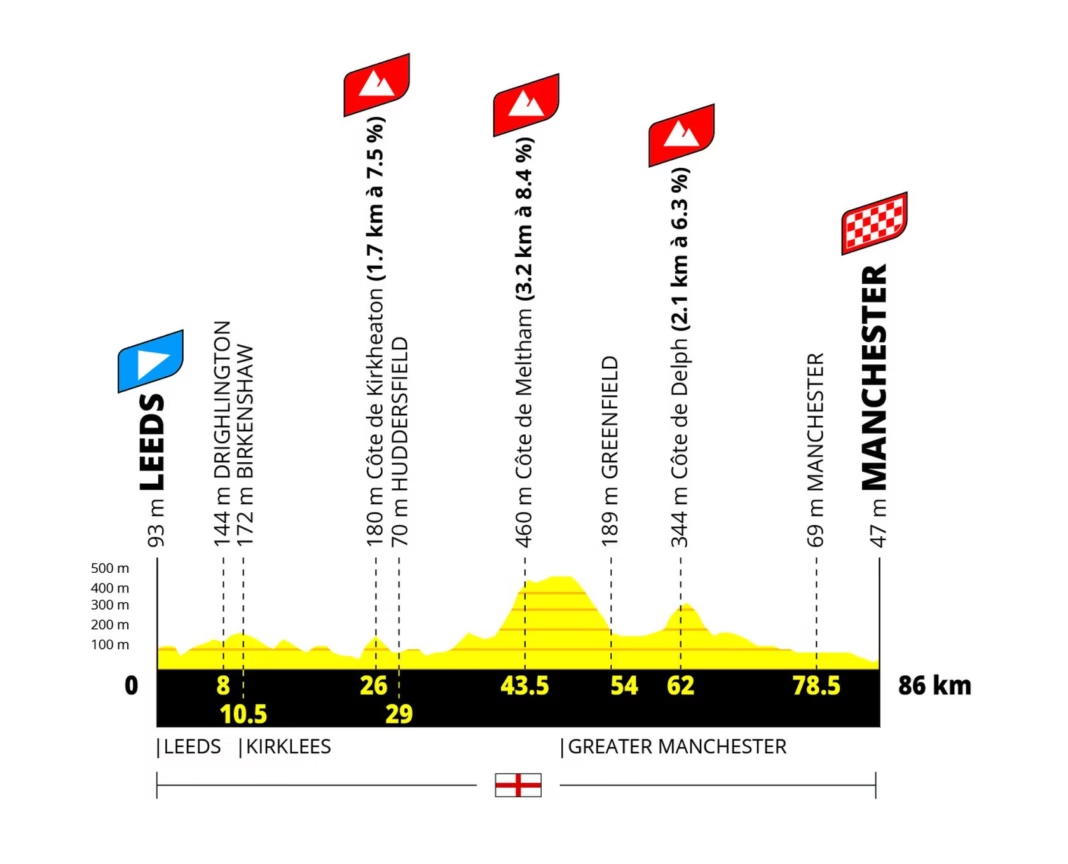
Stage 1, Friday 30 July: Leeds to Manchester, 86km
The first yellow jersey is up for grabs on a short opening stage that looks easier on paper than it will be on the road. The route tackles the Côte de Kirkheaton (1.7km at 7.5%), the Côte de Meltham (3.2km at 8.4%) and the Côte de Delph (2.1km at 6.3%). Wind on the exposed roads after Meltham could split the peloton, but the final 20km give organised sprint teams a chance to bring the race back together before the finish on Deansgate.
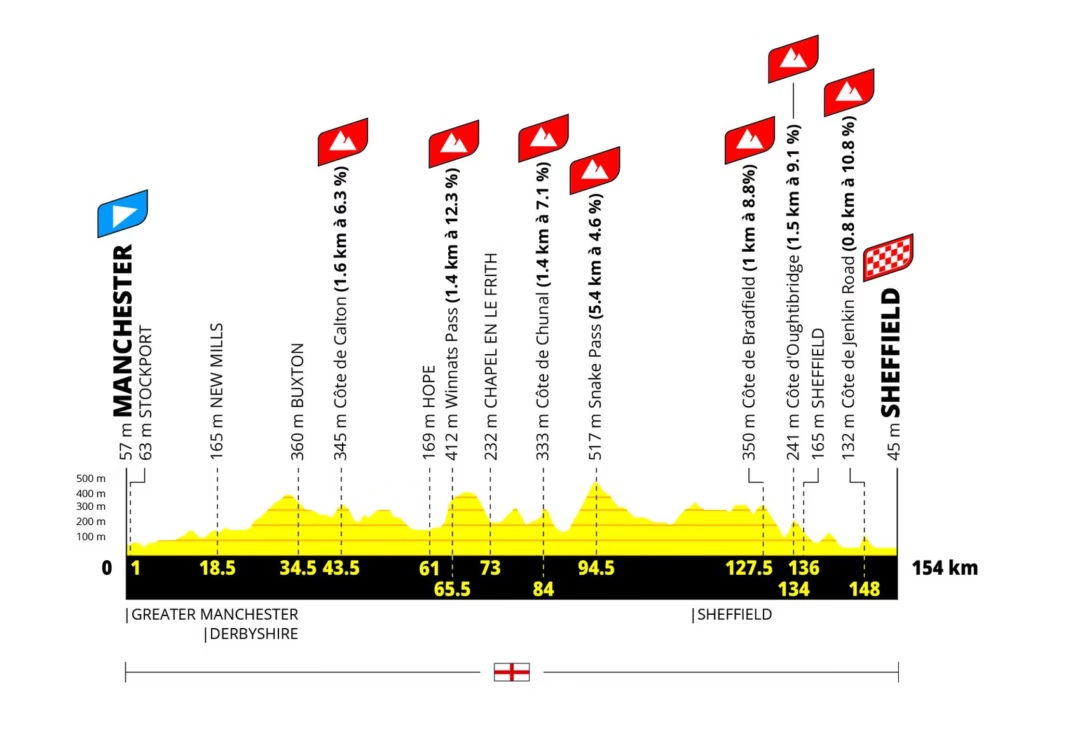
Stage 2, Saturday 31 July: Manchester to Sheffield, 154km
A much sterner test follows immediately, with around 2,800 metres of climbing through the Peak District. The route includes Winnats Pass (1.4km at 12.3%), Snake Pass (5.4km at 4.6%) and the late Côte d’Oughtibridge (1.5km at 9.1%), before Jenkin Road delivers 800 metres at 10.8% just 6km from the finish. Those final climbs echo the route on which Vincenzo Nibali won the 2014 men’s Tour stage into Sheffield. A contender caught on the wrong side of a split could lose time before the race even leaves England.
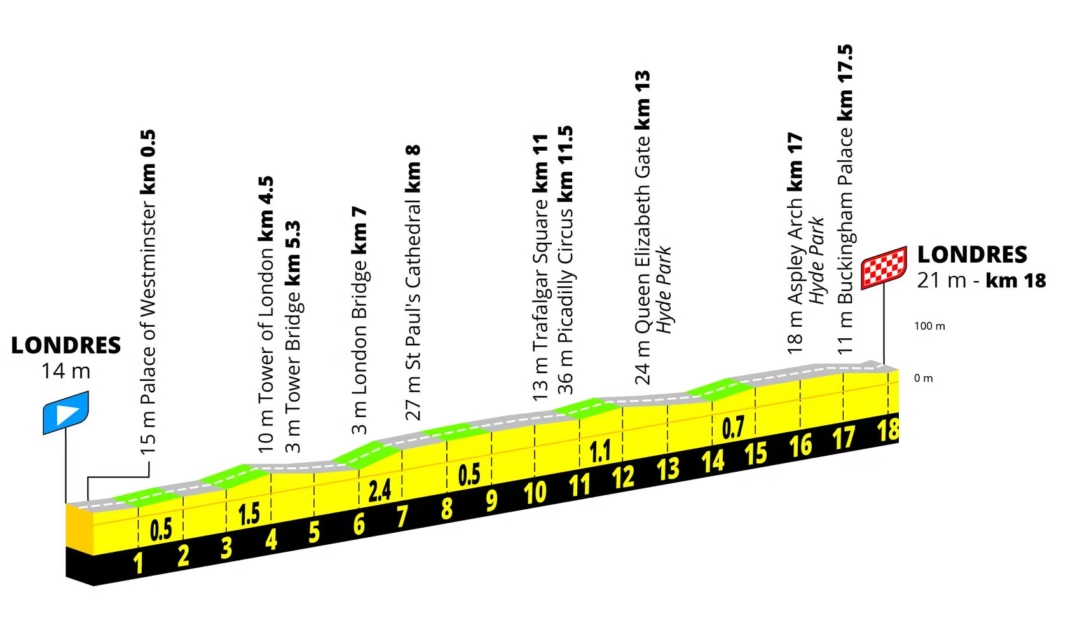
Stage 3, Sunday 1 August: London team time trial, 18km
The Tour de France Femmes holds its first-ever team time trial on an 18km circuit through the capital. Starting near Westminster, the route passes Tower Bridge, London Bridge, St Paul’s Cathedral, Trafalgar Square, Piccadilly Circus, Hyde Park and Buckingham Palace before finishing on The Mall. There is little climbing, but frequent corners and changes of direction will reward teams with disciplined formation riding and smooth accelerations. The result may leave some overall contenders chasing gaps created by team strength rather than individual climbing form.
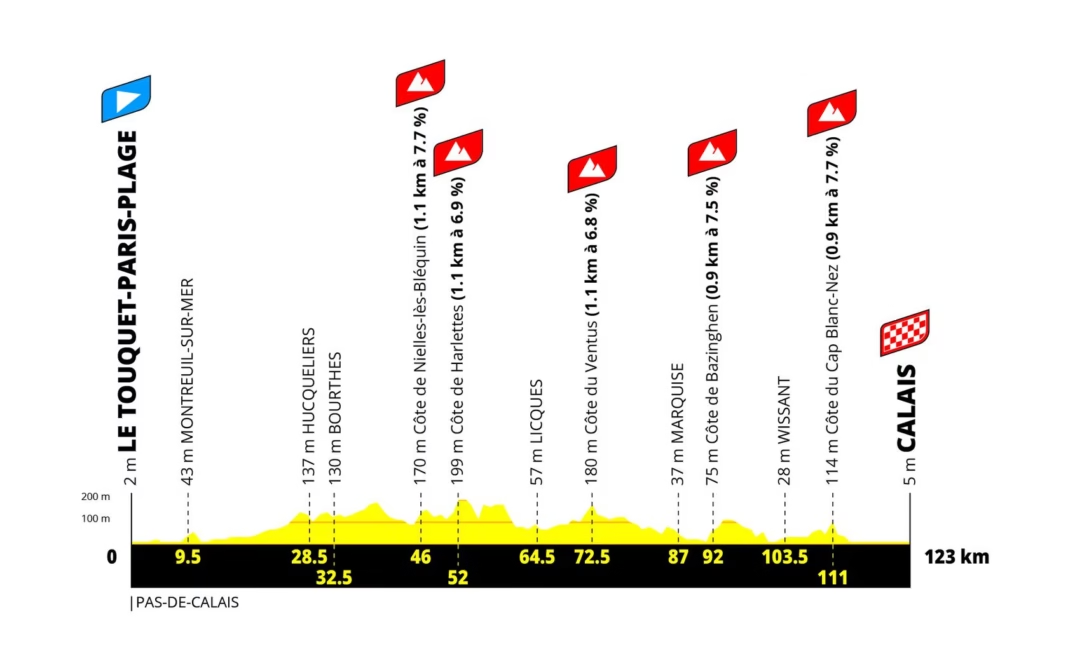
Stage 4, Monday 2 August: Le Touquet-Paris-Plage to Calais, 123km
The first French stage follows the Opal Coast, with the possibility of crosswinds an obvious threat. Several short climbs interrupt the route, most notably the Côte du Cap Blanc-Nez (900m at 7.7%) with 12km remaining, where a late attack could unsettle the sprint trains. There is enough road left for a chase, but exposed coastal sections make this a dangerous day for any rider who loses position.
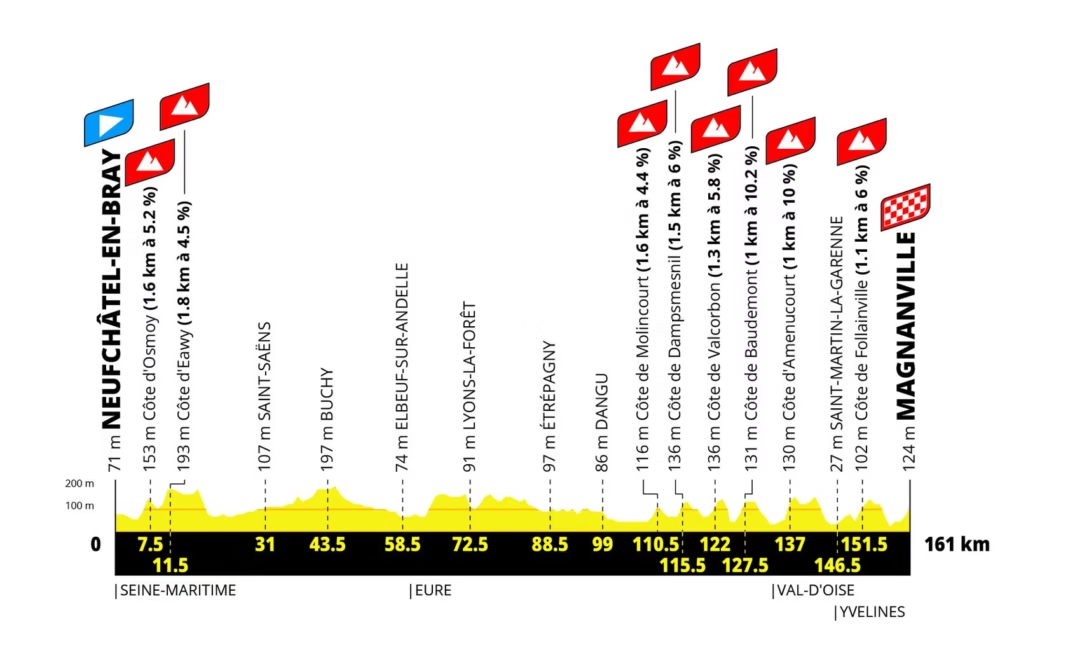
Stage 5, Tuesday 3 August: Neufchâtel-en-Bray to Magnanville, 161km
The longest stage so far is far from straightforward. After the opening hills around the Pays de Bray and Eawy Forest, six successive short climbs come inside the final 50km on twisting roads through the Yvelines. Even if a reduced peloton reaches Magnanville together, the last kilometre climbs at about 5%, favouring a powerful uphill finisher over a pure sprinter. This looks a genuine opportunity for an opportunistic breakaway or late attack.
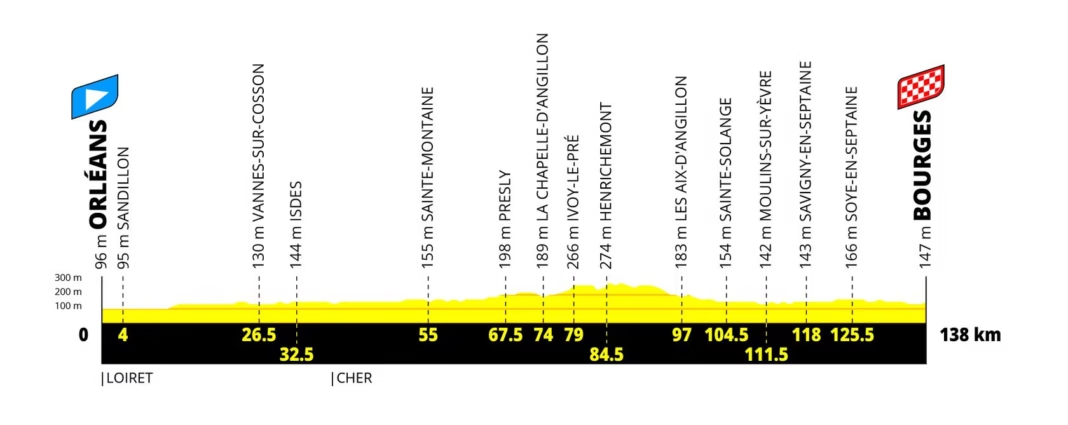
Stage 6, Wednesday 4 August: Orléans to Bourges, 138km
The clearest sprint opportunity of the French stages runs through the forests of the Sologne and the Berry countryside with no major classified difficulties. The finish in Bourges rises gently for the final 900 metres at around 2%, so positioning should still matter. It may be one of the last realistic opportunities for the fastest riders before the race moves towards the Massif Central.
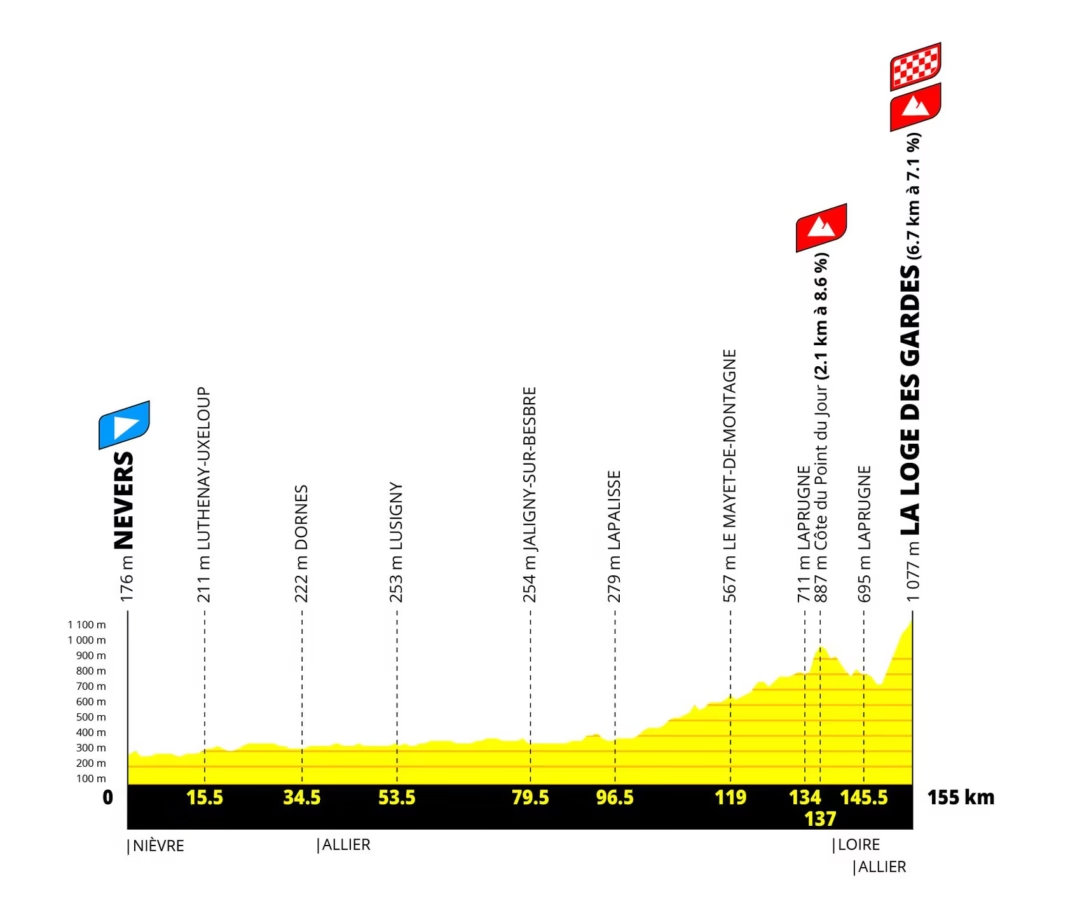
Stage 7, Thursday 5 August: Nevers to La Loge des Gardes, 155km
The first summit finish begins the general classification showdown. A relatively manageable opening leads to the Côte du Point du Jour (2.1km at 8.6%), followed by roughly 12km of descending before the final ascent of La Loge des Gardes, 6.7km at 7.1%. The stage contains around 2,200 metres of climbing. The final mountain is familiar from Paris-Nice, where Tadej Pogačar won in 2023 and João Almeida in 2025, and should establish a much clearer hierarchy among the contenders.
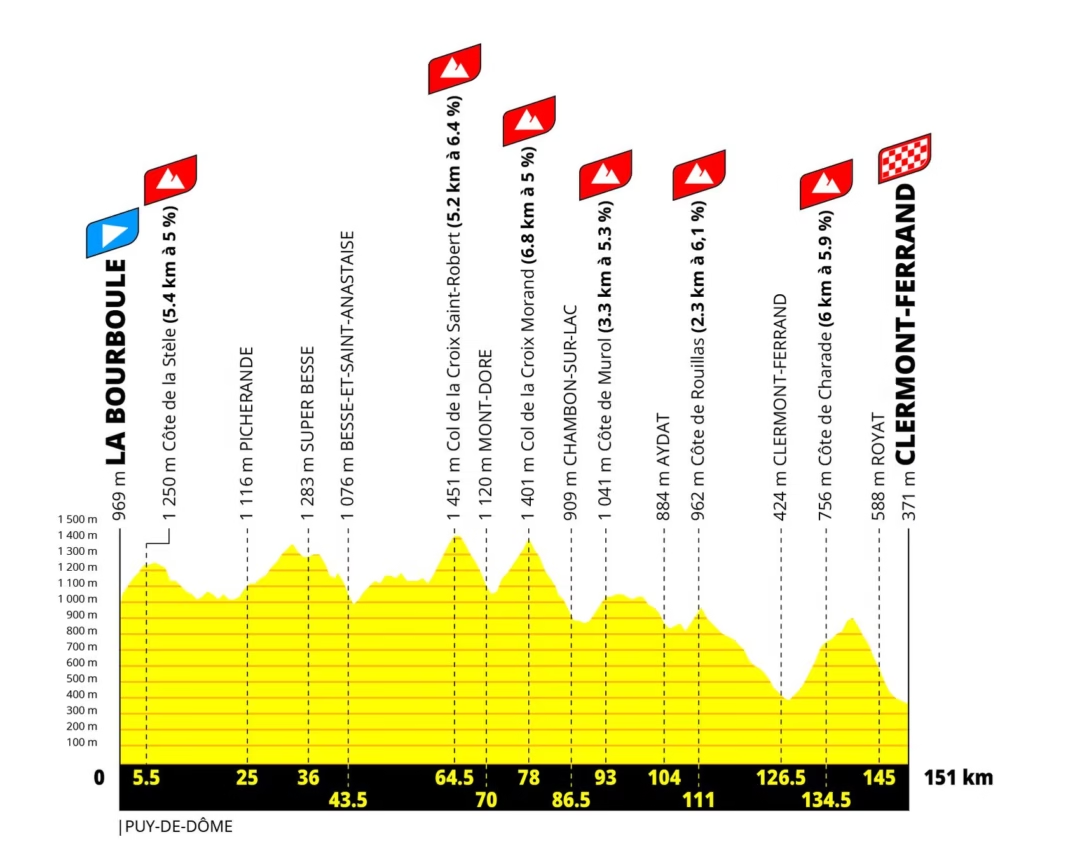
Stage 8, Friday 6 August: La Bourboule to Clermont-Ferrand, 151km
There is little respite on the penultimate day, which carries around 3,000 metres of climbing. The Côte de la Stèle (5.4km at 5%) comes early, with the Col de la Croix Saint-Robert bringing the race to its highest altitude of 1,451 metres. After more difficult roads through the Auvergne, the Côte de Charade (6km at 5.9%) sets up a short, steep run towards Clermont-Ferrand. The repeated climbs create room for tactical attacks, particularly if a team has several riders capable of making the final selection.
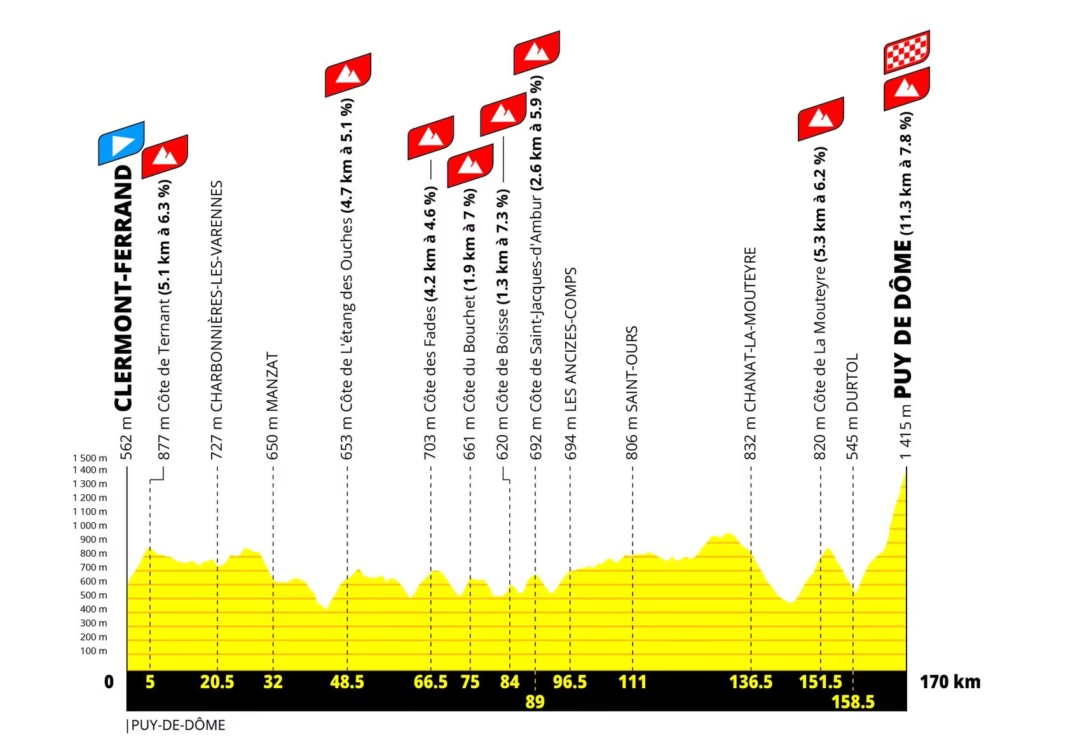
Stage 9, Saturday 7 August: Clermont-Ferrand to Puy de Dôme, 170km
The final day is both the longest stage and the one with the most climbing: 3,840 metres of vertical gain. The Côte de Ternant (5.1km at 6.3%) is only the first meaningful obstacle in a succession of climbs through the Sioule gorges. The Côte de la Mouteyre (5.3km at 6.2%) comes late on narrow, rough roads and may leave the leading riders isolated before the final mountain.
The decisive ascent of the Puy de Dôme is 11.3km at 7.8%, finishing at 1,415 metres. Riders who have misjudged their efforts across the previous eight stages could lose minutes here, while those with enough support after the Mouteyre may be able to save energy for the steepest sections. A final-day reversal of the overall classification is a real possibility.
Where will the 2027 Tour de France Femmes be won?
There are three likely pressure points. The Manchester–Sheffield stage offers the first chance to put rivals under stress, with steep ramps that demand good positioning and the potential for splits among contenders. The London team time trial then introduces an unusual variable for the women’s race: riders with comparably strong climbing records could reach France separated by their teams’ performance against the clock.
The title should nevertheless be decided in the Massif Central. La Loge des Gardes is the first major summit finish, but the more subtle threat may be the following day’s rolling terrain, where repeated accelerations can isolate a leader. The Puy de Dôme is an obvious final judge, yet the long accumulation of climbing before its foot means a team that races aggressively could shape the result well before the last 11.3km.
With 17,665 metres of climbing and no scheduled rest day, consistency and recovery will matter as much as one exceptional summit performance. The absence of the Alps and Pyrenees does not make this a gentle route. Instead, the 2027 race offers a mix of punchy British roads, exposed northern French terrain, an innovative London time trial and a final mountain sequence capable of producing large time gaps.
The full route also provides home opportunities for British riders such as Zoe Backstedt, Cat Ferguson and Anna Henderson, although start lists will not be confirmed until much closer to the race. The 2026 Tour de France Femmes final classification provides the immediate backdrop to what should be another closely contested yellow jersey battle.