The Eneco Tour Women moves into the Limburg hills on Friday 16 October, with Stage 3 taking the riders from Sittard to an uphill finish at Watersley. The women race 87.8km across four laps of a rolling circuit, with short climbs repeated throughout the morning and gradients reaching double figures on the run to the line.
For viewers in Britain, the race starts at 08:45 BST, with live coverage on TNT Sports 3 and HBO Max from 09:30 BST. The finish is scheduled for around 11:00 BST. The timings mean the stage is already underway by the time television coverage starts, but the broadcast should include the decisive laps and the steep finish at Watersley.
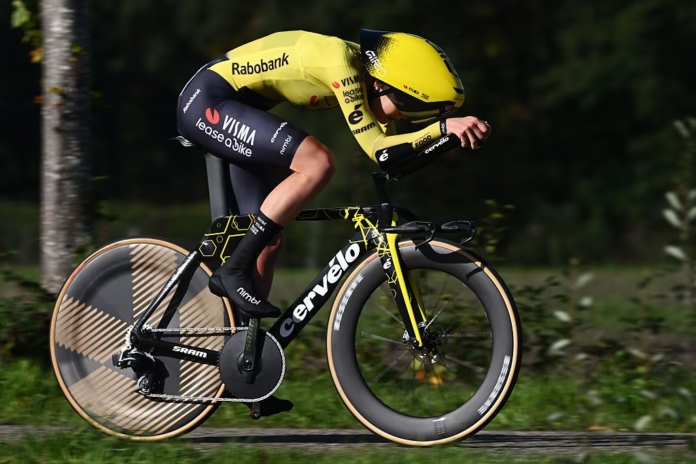
Lieke Nooijen goes into the first hilly road stage wearing the orange leader’s jersey after an impressive individual time trial in Tilburg. She won Thursday’s 13.6km test by 20 seconds from Nienke Vinke and took the race lead back from Sandrine Tas, who finished third. Nooijen’s advantage in the general classification is now 20 seconds over Tas and 31 seconds over Vinke, creating a clear incentive for her rivals to attack.
Eneco Tour Women Stage 3: UK start time and how to watch
Date: Friday 16 October 2026. Women’s stage: Sittard to Watersley, Netherlands. Distance: 87.8km. Race start: 09:45 CEST / 08:45 BST. UK live TV: TNT Sports 3 from 09:30 BST. Online streaming: HBO Max. Expected finish: around 12:00 CEST / 11:00 BST, depending on race speed. These are the women’s timings, not those for the men’s event later in the day.
TNT Sports 3’s Friday listings show live coverage of the women’s third stage from 09:30 to 11:30 BST, following a programme reviewing the previous day’s racing at 08:30. The live broadcast window extends beyond the organisers’ estimated finish to allow for the run-in and post-stage coverage. Viewers can use the main channel or look for the women’s Eneco Tour Stage 3 listing on HBO Max.
The event has men’s and women’s races on the same roads at different times. The men start from Sittard at 13:15 local time, or 12:15 BST, and ride a longer 110.5km stage. That later broadcast is not the one to select if you want to follow Nooijen, Vinke and the women’s general-classification contest. Check that the schedule specifically identifies the women’s race, particularly in streaming menus where both stages may appear alongside each other.
Anyone joining in the final hour should aim for 10:00 BST, when the peloton will be working through the second half of the circuit race if it is running close to the expected schedule. For the full televised finale, 09:30 BST is the safer option. The precise gaps between the leaders and the remaining distance matter more than a fixed estimate once the attacks begin.
The Watersley circuit: fifteen climbs in under 90 kilometres
Stage 3 starts at the Tom Dumoulin Bike Park in Sittard and takes the peloton through South Limburg towards Watersley Sports & Talent Park. The women complete four laps, passing the finish location three times before their final arrival. The course passes places including Oirsbeek, Merkelbeek, Bingelrade and Schinveld, with narrow and twisting roads repeatedly bringing riders back towards the climbs.
There is no long mountain ascent, but the climbing is concentrated into short, sharp efforts that reward riders who can accelerate repeatedly. Across the stage there are fifteen short uphill sections. The total climbing is substantial for such a short race, and the number of times the group returns to familiar roads should make it easier for teams to recognise where they can attack.
The Sittarderweg rises for around 600 metres at an average of 4.6 per cent, with pitches touching 10 per cent. The Schatsberg is approximately 700 metres at 4.4 per cent, again with a steeper section. Those gradients sound manageable in isolation, but the first attacks may come precisely because the climbs are too short for a steady, organised chase to settle immediately behind the front riders.
The Windraak climb is the last major rise before the finish, around 470 metres at 5.5 per cent and roughly 2km from the line. Its positioning makes it useful for a rider who wants to force a smaller group onto the run towards Watersley. An attack here could create the separation needed to avoid a conventional sprint, although the roads still allow a short chase before the final ascent.
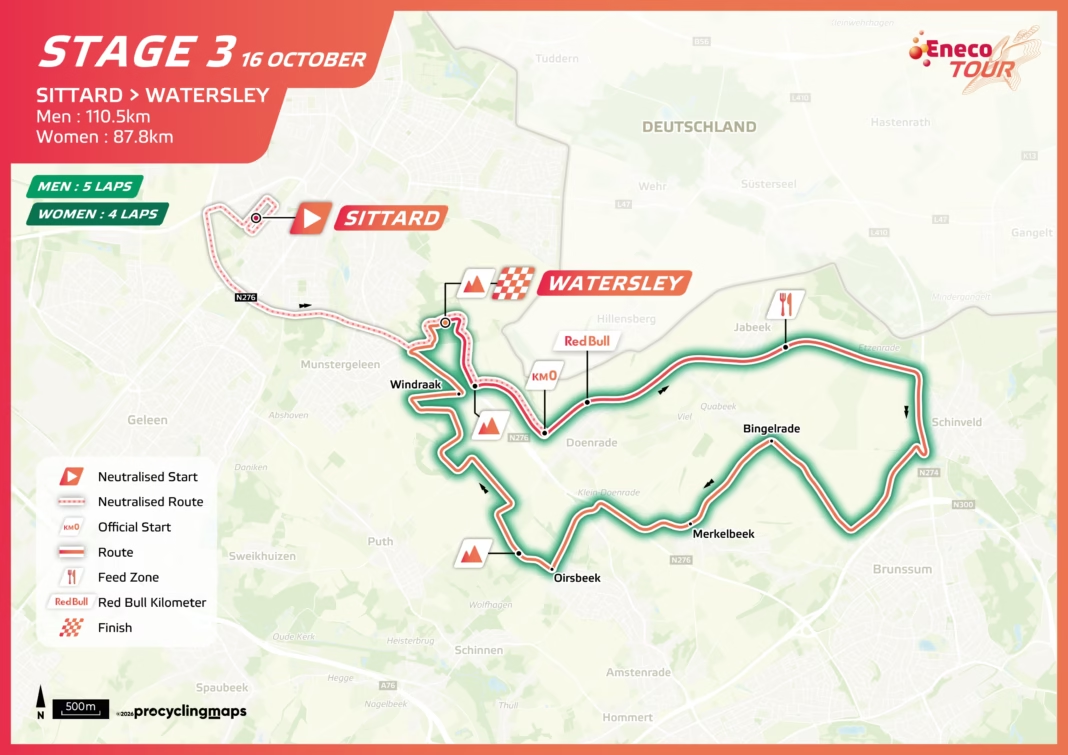
The finish itself is the most important piece of the route. Watersley rises for approximately 750 metres at a 4.2 per cent average, but that figure conceals the steeper middle section. The central 300 metres include ramps of up to 12 per cent, while the beginning and final part are much less demanding. The winning move may be launched before the last bend or made through acceleration on the steepest metres rather than through a long climb.
Positioning at the foot of Watersley is particularly important. Riders further down the group can find themselves blocked by someone losing momentum just as the gradient increases, forcing them to ride around others on a narrow section. A strong puncheur who starts near the front can put several bike lengths into rivals before they have space to respond. The complete Eneco Tour Women route guide also covers Saturday’s VAMberg stage.
Nooijen’s lead faces a different examination
Nooijen has been the standout rider against the clock. She won Tuesday’s short prologue in The Hague, lost the lead after Tas took the sprint in Ede, then regained it emphatically in Tilburg. Her time-trial victory on Thursday came in 16:56, with Vinke at 20 seconds and Tas a further second back. It was enough to put her firmly back at the head of the standings before the route turned hillier.
Her advantage gives Visma | Lease a Bike options. Nooijen does not need to win Stage 3 to keep the jersey; following the right attacks and preventing Tas or Vinke from gaining time would do the job. But the repeated climbs may force the team to use its support riders early, and riders who sit close behind Nooijen in the overall classification have little reason to help control the stage.
Tas begins 20 seconds down. A successful attack would narrow that gap, and the stage offers bonus seconds at an intermediate sprint and at the finish. The stated allocations are six, four and two seconds at the sprint, with ten, six and four for the first three riders across the line. A rider who takes a stage victory and an intermediate bonus can make a meaningful reduction without needing to open a large time gap on the road.
Vinke starts 31 seconds behind Nooijen, close enough to remain in contention but far enough back that simply finishing in the same group will not change much. She finished second in Tilburg and has the endurance to be dangerous if an attacking move forms on the repeated climbs. Quinty Ton and Femke de Vries are also well positioned in the general classification, and both could use the circuit to move up if they can exploit a tactical hesitation.
The Stage 2 time-trial report gives the full result behind Nooijen’s second win, while the pre-race contenders analysis explains the riders who came into the week with overall ambitions.
Where the stage could be won
A reduced-group sprint remains possible, especially if the strongest GC teams mark one another over the earlier climbs. The last 750 metres are long enough to stretch the front group, but the average gradient is not so severe that only a pure climber can win. Riders with a good finishing kick after a hard circuit may prefer to keep their effort until the steep central ramp rather than spend it on the Windraak.
Letizia Borghesi is one rider with the climbing and finishing strength to contest a selective arrival. Femke Markus can handle repeated accelerations, while Tas has already shown she can deliver under pressure in a fast finish. Nooijen, meanwhile, has a chance to win a third stage but is more likely to make the leader’s jersey her first priority if a rival attacks from a little further down the standings.
Charlotte Kool’s speed makes her a threat whenever a larger group stays together, but Friday’s route is substantially less accommodating than Ede. The cumulative climbing may remove many of the pure sprinters before the final passage. That could shift the contest towards riders who can sprint after a sequence of short climbs, rather than those who need a full lead-out through the closing kilometre.
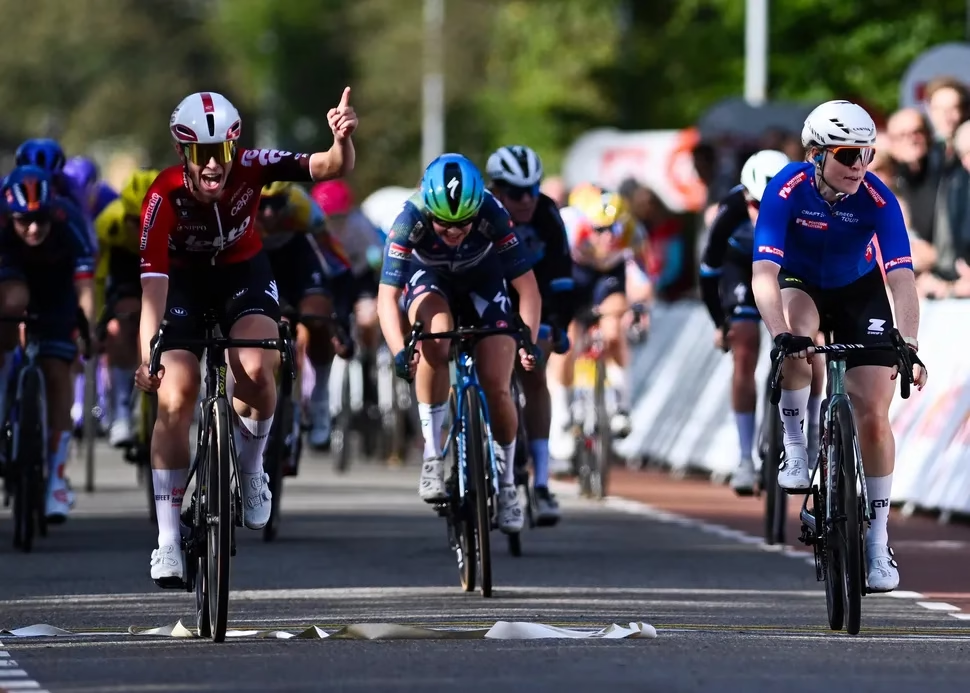
A breakaway can also work, but the general-classification situation creates a useful constraint. If a dangerous rider gets clear, Visma cannot afford to give away several minutes. Conversely, a group containing riders without an immediate claim on the top of the overall standings might be allowed more room. Team composition is therefore worth watching whenever the front group forms, not simply the size of its advantage.
The repeated finish passages are another tactical feature. By the final lap, the riders will have ridden the Watersley climb three times at race speed. They can judge the steepest point, the line through each turn and exactly how long the effort lasts. That familiarity favours a carefully timed acceleration, although fatigue may make the last ascent feel very different from the first.
Why Friday matters for the overall race
The time trial put Nooijen into the strongest position, but it also made the intentions of her rivals clearer. A rider more than half a minute behind after Tilburg cannot rely on the remaining flat sections to recover that deficit. Watersley offers a realistic opportunity to attack without waiting for Saturday’s Col du VAM circuit, which contains another series of steep, short efforts.
At 87.8km, Stage 3 is short enough for aggressive racing from the opening laps. There is limited distance to recover if the favourites split, and riders can use repeated climbs to force weaker teammates out of the front group. On the other hand, chasing too hard on Friday could leave a GC contender short of energy when Saturday’s uphill finish arrives.
The final three days will have a strong influence on whether Nooijen can convert her time-trial form into an overall victory. Friday’s Watersley circuit is the first real test of climbing and positioning. Saturday’s repeated VAMberg ascents are another chance for attacks, and Sunday finishes the tour on a rolling circuit around Arnhem. Nooijen has to defend her lead across different types of terrain rather than simply produce another fast ride against the clock.
For viewers, the decisive signals are the numbers of teammates around Nooijen, the gap to any attackers containing Tas or Vinke, and which riders are still in contact over the Windraak on the last lap. When the peloton reaches the foot of Watersley for the final time, the balance between stage victory and the general classification could produce more than one contest on the same climb.
-
 Photo Credit: François Terrier
 -
Photo Credit: Getty