The Superprestige is the oldest of cyclocross’s major season-long series, but its appeal is not simply its age. Across a compact set of Belgian races, riders have to combine outright speed with the ability to keep scoring when a course, a start or a mechanical problem works against them. Winning one round is valuable. Winning the overall competition usually requires months of reliable performances.
The 2026–27 Telenet Superprestige began at Overijse on 25 October 2026 and runs through to Gullegem on 2 January 2027. There are eight rounds for elite men and elite women, with 15 points available for a victory at each. The calendar mixes established circuits with very different demands, from technical climbs to fast sections, sand and winter mud.
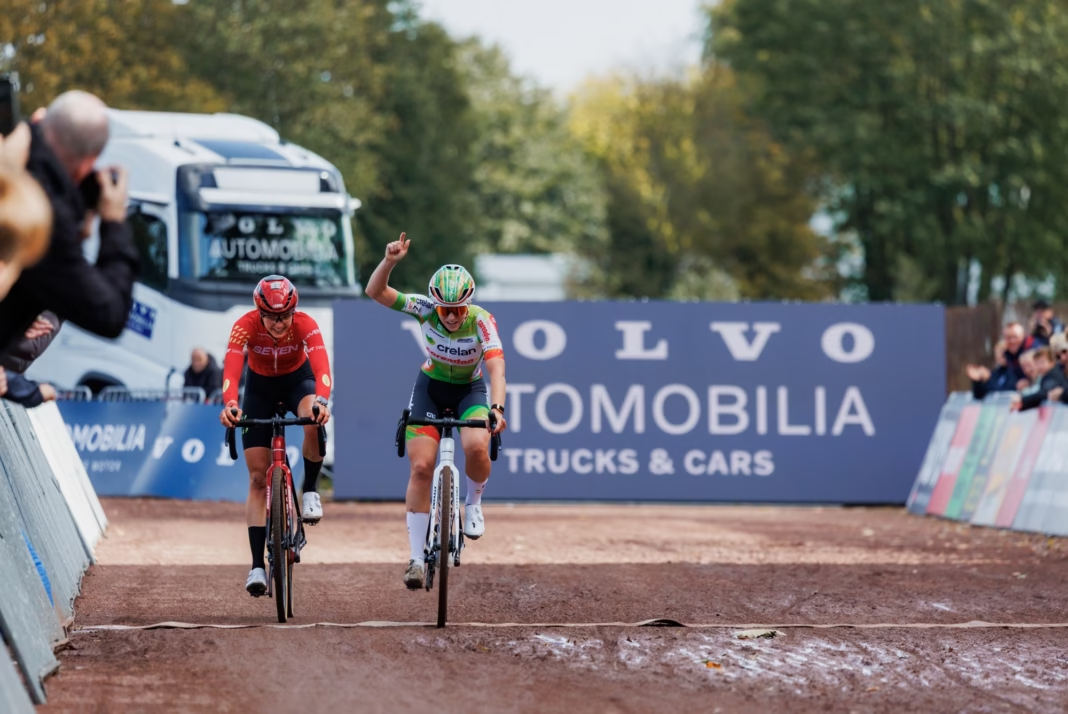
For someone following the series for the first time, the distinction between a race winner and the overall leader is essential. Michael Vanthourenhout and Lucinda Brand won the opening men’s and women’s races at Overijse, but one victory does not settle the title. The series rewards what happens across all eight rounds. Our full 2026–27 cyclocross calendar shows where the Superprestige sits alongside the World Cup and other winter competitions.
How the Superprestige started and why it matters
The first Superprestige season was held in 1982–83, with Dutch rider Hennie Stamsnijder winning the inaugural overall classification. The competition grew during a period when Belgian and Dutch cyclocross was developing a powerful calendar of high-profile events. Rather than asking riders to peak for one national or world championship, it created a prize for performing repeatedly on courses that changed with the weather.
The historical benchmark in the men’s competition is Sven Nys, who won 13 overall titles. That record captures something that a list of individual race wins cannot: the ability to remain near the front across several seasons, adapt to the changing composition of the field and recover quickly enough to race again. Nys became closely associated with the Superprestige because consistency was as important to his record as individual domination.
The women’s overall competition arrived much later. Sanne Cant won the first women’s Superprestige title in 2015–16 and went on to collect four overall victories, the women’s record according to the series’ own archive. That makes the historical comparisons unequal in length: men’s results stretch back to the early 1980s, while the official women’s classification began more than three decades later.
Modern Superprestige racing is organised by Flanders Classics and sits alongside the UCI World Cup and other Belgian competitions. The series is not the same as a national championship or a World Cup ranking. It has its own calendar, points system and overall winners, which is why a rider can lead one competition while being well down the standings in another.
How the Superprestige points system works
The scoring is straightforward at the front and unforgiving outside the top 15. The winner of each elite race receives 15 points, second place receives 14 and the allocation drops by one point for each finishing position down to 15th, which earns a single point. Riders below 15th do not add to their Superprestige total for that round. The official UCI-regulation race classification determines the allocation.
| Finishing position | Superprestige points |
|---|---|
| 1st | 15 |
| 2nd | 14 |
| 3rd | 13 |
| 4th | 12 |
| 5th | 11 |
| 6th | 10 |
| 7th | 9 |
| 8th | 8 |
| 9th | 7 |
| 10th | 6 |
| 11th to 15th | 5 down to 1 |
At the end of the eight rounds, the rider with the most points in each elite classification wins the series. Participation in every race is not compulsory, which allows a rider to balance Superprestige starts against World Cups, championships, training blocks and recovery. There is a cost to missing rounds, however: a rider absent from a race cannot score, while an opponent can take up to 15 points.
The tie-break rules matter more than they first appear. If riders finish level on points, the first advantage goes to the rider who started the most Superprestige races. If they remain tied, the number of race victories decides. If that still does not separate them, the better result in the final round is used. That order is different from the assumption that wins automatically settle every tie.
The 2025–26 women’s classification provided a particularly clear example. Aniek van Alphen and Amandine Fouquenet both finished with 92 points, but Van Alphen took the overall title on the series’ tie-break rules. A single missed start can therefore become as important as a late-season win. When the standings are close, checking the number of appearances is just as necessary as counting victories.
The 2026–27 Superprestige calendar and the courses
All eight rounds in 2026–27 take place in Belgium. Overijse opened the competition on 25 October, followed by Middelkerke, Niel and Merksplas in November. December brings Ruddervoorde, Heusden-Zolder on Christmas Day and the floodlit Diegem race on 30 December, before Gullegem closes the series in early January.
| Round | Date | Venue |
|---|---|---|
| 1 | 25 October 2026 | Overijse |
| 2 | 5 November 2026 | Middelkerke |
| 3 | 11 November 2026 | Niel |
| 4 | 14 November 2026 | Merksplas |
| 5 | 6 December 2026 | Ruddervoorde |
| 6 | 25 December 2026 | Heusden-Zolder |
| 7 | 30 December 2026 | Diegem |
| 8 | 2 January 2027 | Gullegem |
The calendar’s compactness creates a particular rhythm. The early rounds establish who is likely to fight for the classification, but December can alter everything. A rider who arrives with a healthy lead may find that illness or an unsuitable course removes the advantage in two starts. Someone who has been steadily scoring second and third places can suddenly be in control without having won many rounds.
Overijse is a useful example of how the Superprestige differs from a flat points exercise. The Druivencross circuit is known for its demanding slopes and technical terrain, with the precise balance changing with the conditions. Our history of Overijse cyclocross looks at its place in the calendar and the riders who have shaped the event.
For 2026, the opening round also supplied two distinct races. Vanthourenhout’s men’s victory came from a late solo move, while Brand established control of the women’s race with a mid-race attack. Both performances produced the maximum 15 points, but their real importance will only become clear when the riders return for the subsequent rounds. The two race reports are available in our men’s Overijse report and women’s Overijse report.
Recent overall winners: men and women
The recent results show how quickly the balance can change even when a few names remain prominent. Eli Iserbyt won the men’s overall title in 2023–24, before Niels Vandeputte won back-to-back titles in 2024–25 and 2025–26. Vandeputte’s latest victory was close: his 105 points left him only two clear of Michael Vanthourenhout.
The women’s standings have changed hands more frequently. Ceylin del Carmen Alvarado won in 2023–24, Lucinda Brand took the title in 2024–25 and Aniek van Alphen followed in 2025–26. Brand’s 114 points in 2024–25 were a particularly commanding return, while Van Alphen’s tie-break victory a year later was decided by a very different sort of consistency.
| Season | Men’s overall winner | Women’s overall winner |
|---|---|---|
| 2025–26 | Niels Vandeputte | Aniek van Alphen |
| 2024–25 | Niels Vandeputte | Lucinda Brand |
| 2023–24 | Eli Iserbyt | Ceylin del Carmen Alvarado |
| 2022–23 | Lars van der Haar | Ceylin del Carmen Alvarado |
| 2021–22 | Eli Iserbyt | Lucinda Brand |
| 2020–21 | Toon Aerts | Lucinda Brand |
These are the overall series champions, not the winners of every individual race. The distinction is important when looking back at a season. A rider may take a memorable victory at a famous circuit without appearing near the top of the final standings, particularly if their schedule concentrates on the World Cup or the European and world championships.
The same point applies when comparing the modern women with the long history of the men’s series. Cant’s four overall victories remain the women’s record, while Nys’s 13 stand apart on the men’s side. Both records reward repeated performance, but the two competitions were established in different periods and should be discussed on their own terms.
What makes a good Superprestige rider?
A rider with the fastest single lap is not necessarily the best Superprestige prospect. Starts matter because getting trapped in traffic can turn a likely podium into sixth or seventh, costing several points. Technical consistency matters because a small mistake on a muddy descent can have a larger effect than a short burst of extra power. Recovery matters because the calendar does not wait for a rider to be completely fresh.
The strongest contenders usually have several ways to finish near the front. On a heavy circuit they can run efficiently and keep the bike moving through mud. On a faster one they can produce repeated accelerations, hold position and avoid unnecessary errors. The ability to choose the right line under pressure is particularly valuable when a race changes from dry to wet during the afternoon.
Mechanics and pit crews are part of that equation. Riders may change bikes when mud builds up or when a mechanical issue makes the current setup slower, but a poorly timed change can cost positions. A season-long series punishes those losses even when they do not decide the race winner. The practical details are covered in our cyclocross rules guide.
There is also the problem of overlapping objectives. Riders targeting a national championship, the European championships or the world title cannot necessarily build their winter around all eight Superprestige rounds. A rider aiming for the overall needs to be clear about that ambition early enough to protect the schedule. Missing a race for a training block may be sensible in one programme and costly in another.
How the Superprestige differs from the World Cup and X²O Trofee
The UCI World Cup is an international series with its own points and ranking, while the Superprestige is a separate eight-round Belgian competition. The X²O Trofee also runs across multiple races but uses a time-based overall format rather than the Superprestige’s simple 15-to-one points allocation. A good result in one series does not automatically change a rider’s position in either of the others.
This is why cyclocross results need context. A rider finishing fourth at a Superprestige race has earned 12 points towards that competition; the same placing at a World Cup has a different value in a different table. Treating all winter events as interchangeable obscures how riders plan their programmes and why some of the biggest names appear selectively.
The European championship is different again: one race, national colours and one title. The European Cyclocross Championships history explains how that event developed and what awaits riders at Zeddam in November. The World Cup and Superprestige reward long-term planning; the European championship rewards whoever gets the race right on the day.
What to follow as the 2026–27 title race develops
The opening Overijse results provide the first standings, not a forecast of the final podium. After each round, the most useful numbers are the points gap to the leader, the number of starts completed and the remaining courses. The race winner deserves attention, but a contender collecting 13 or 14 points repeatedly may be building a stronger overall position than a rider alternating victories with absences.
The decisive stretch may come over Christmas, when Heusden-Zolder and Diegem fall just five days apart before the final in Gullegem. At that point the tie-break rules can influence decisions. A rider level on points may need to start the final race even if an outright win looks unlikely, while someone trailing can be forced to attack for maximum points.
For viewers in the UK, race availability varies by broadcaster and event. The UK guide to watching cyclocross in 2026–27 provides the broader broadcast context, while individual race guides can confirm the relevant platform and start time. The Superprestige title itself will be settled by the results of the eight races, not by a separate final championship.
-
 Photo Credit: Brecht Steenhouwer
-
 Photo Credit: Luc Claessen/Getty Images