Eight seconds separated Greg LeMond and Laurent Fignon after three weeks of racing in 1989. No Tour de France has finished closer. It remains the defining example of a race in which every positioning error, missed split and second against the clock ultimately mattered. But the narrowest Tour finishes are not all variations on the same story. Some were settled in final-day time trials, others in the mountains, and one of the closest was rewritten after a doping disqualification.
The ten smallest official winning margins in the men’s Tour de France, measured between the first two riders in the final general classification, are listed below. The ranking uses the final recognised results, rather than the provisional classification on the road. That distinction is essential for understanding 2006 and 2010.
The ten closest Tour de France finishes
| Year | Winner | Runner-up | Margin |
|---|---|---|---|
| 1989 | Greg LeMond | Laurent Fignon | 8 seconds |
| 2007 | Alberto Contador | Cadel Evans | 23 seconds |
| 2006 | Óscar Pereiro | Andreas Klöden | 32 seconds |
| 1968 | Jan Janssen | Herman Van Springel | 38 seconds |
| 1987 | Stephen Roche | Pedro Delgado | 40 seconds |
| 1977 | Bernard Thévenet | Hennie Kuiper | 48 seconds |
| 2017 | Chris Froome | Rigoberto Urán | 54 seconds |
| 1964 | Jacques Anquetil | Raymond Poulidor | 55 seconds |
| 2008 | Carlos Sastre | Cadel Evans | 58 seconds |
| 2020 | Tadej Pogačar | Primož Roglič | 59 seconds |
These are margins of victory, not the gaps between riders at an intermediate stage. The 2006 result reflects the classification after Floyd Landis was stripped of his victory; the original finish in Paris produced a different winner and a different gap. The list also concerns the men’s Tour, not the complete history of Tour de France winners across changing race formats.
1989: LeMond overturns 50 seconds in Paris
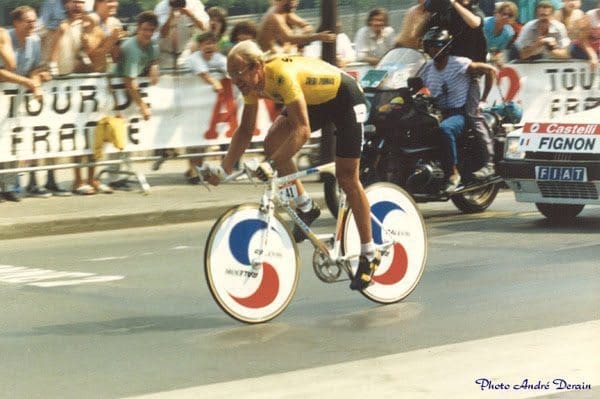
Fignon entered the final stage with a 50-second advantage. The last test was a short individual time trial from Versailles into Paris, an unusual ending that meant the yellow jersey was still vulnerable on the final afternoon. LeMond arrived with an aggressive aerodynamic position and produced a ride that changed both the result and the way racing against the clock was discussed.
LeMond took 58 seconds from Fignon on the stage. Subtract the Frenchman’s previous 50-second lead and the final difference was eight seconds. That calculation captures only the final act of a race in which both riders repeatedly took the initiative. Across more than 3,000 kilometres, the entire Tour was decided by a margin smaller than many riders lose taking a poor line through a corner.
The 1989 finish is sometimes reduced to a story about aerobars, but that misses the sustained contest that brought the riders to Paris so closely matched. Fignon had already won the Tour twice. LeMond was rebuilding his career after a serious hunting accident and had not won the race since 1986. Both had held yellow during the edition. Their last confrontation mattered because neither had been able to put the race decisively beyond the other’s reach.
LeMond’s winning margin remains the smallest officially recorded in the Tour’s history. It is also a reminder that a leader’s advantage before the last stage is not the same thing as a completed victory when the route still contains a competitive time trial.
2007: Contador survives Evans by 23 seconds
The 2007 race was less a single dramatic reversal than a prolonged struggle that left three riders exceptionally close together. Alberto Contador ultimately finished 23 seconds ahead of Cadel Evans, with Levi Leipheimer initially classified just 31 seconds behind the winner. Leipheimer was subsequently disqualified from that result following his admission of doping. The on-road top three had been separated by little more than half a minute, but the official classification no longer records that podium.
The final individual time trial between Cognac and Angoulême was central to the result. Evans needed to make up substantial time on Contador and rode strongly, but not strongly enough to take yellow. Leipheimer won the stage, adding another complication to the podium battle. Contador’s advantage survived, although the final classification barely separated the three leading riders.
The race also carried a complication that a simple margins table cannot show. Michael Rasmussen had been leading the race before his team withdrew him amid controversy over his whereabouts reporting. That changed the competitive landscape before the decisive final days. Contador’s victory is the official outcome, but it should not be presented as a straightforward duel untouched by the wider turmoil of the 2007 Tour.
2006: A 32-second margin after the result was rewritten
Óscar Pereiro’s 2006 victory occupies an unusual place in any record of close Tours. Floyd Landis reached Paris in yellow, 57 seconds ahead of Pereiro, and initially stood on the podium as champion. Following the doping case and Landis’s disqualification, the official general classification was revised. Pereiro became the winner, with Andreas Klöden second, 32 seconds behind.
That makes 2006 the third-closest official finish, but not the third-closest first-versus-second battle as spectators understood it on the day. It is precisely why historical lists need to distinguish the provisional result from the final recognised classification. Leaving out the explanation would create a misleading account of how that Tour was decided.
The racing behind that amended classification was chaotic in its own right. Pereiro gained nearly half an hour in a successful breakaway, then defended his position through the Alps against rivals with very different strengths. Landis produced a remarkable solo mountain-stage performance before taking the lead in the final time trial. The eventual record book cannot be separated from the subsequent disciplinary decision.
1968 and 1987: Final time trials decide the champion
Jan Janssen’s victory over Herman Van Springel in 1968 came by 38 seconds, the closest margin at the time. Van Springel entered the final stage in yellow, but Janssen overturned the deficit in the last time trial. The Dutch rider became the first Tour winner from the Netherlands. It was an early example of a last-day test against the clock producing a change of champion.
Stephen Roche’s 40-second victory over Pedro Delgado in 1987 was different in its tactical shape. The Irishman’s Tour is remembered for the brutal mountain contest, including his effort on La Plagne, and for the way the general classification remained unsettled deep into the final week. Roche used his time-trial strength to secure the overall victory. Forty seconds was all that remained between two riders who had attacked each other across very different terrain.
In each edition, the time trial’s position on the route mattered as much as its distance. A specialist who reaches the final weekend within striking distance has a clear target. Conversely, a leader with weaker time-trial ability must either build a buffer beforehand or accept that yellow remains at risk.
1977 and 1964: Close racing without a last-day upset
Bernard Thévenet beat Hennie Kuiper by 48 seconds in 1977. The margin reflected a hard-fought mountain contest rather than a famous Paris reversal. Thévenet’s second Tour victory came after a race in which neither rider established the kind of commanding advantage associated with more one-sided editions.
Jacques Anquetil’s 55-second victory over Raymond Poulidor in 1964 is one of the sport’s defining rivalries. Their confrontation on the Puy de Dôme has become shorthand for the contrast between Anquetil’s controlled calculation and Poulidor’s persistence. But the Tour was not decided on that climb alone. Anquetil’s ability against the clock, including the concluding time trial, helped him defend a slender advantage and take his fifth title.
Poulidor never won the Tour, despite repeatedly challenging its greatest champions. The 1964 result helps explain why: his proximity to Anquetil was genuine, yet proximity was not enough. Fifty-five seconds after three weeks still meant second place, and there was no tactical consolation in how narrow the gap had become.
2017, 2008 and 2020: Three modern finishes under a minute
Chris Froome’s fourth Tour victory came in 2017, when Rigoberto Urán finished 54 seconds behind. Froome did not dominate the race through a string of overwhelming mountain attacks. Instead, his consistency, defensive riding and time-trial performance enabled him to preserve a narrow but durable advantage. Urán’s result was a career-defining Grand Tour performance.
Carlos Sastre’s 2008 win over Cadel Evans was settled by 58 seconds. Sastre’s attack on Alpe d’Huez established the foundation of his victory, while the final time trial left him just enough margin to hold off Evans. It was a clear illustration of how a successful mountain attack can be worth more than the advantage a rival later claws back against the clock.
The 2020 Tour delivered another striking time-trial reversal. Primož Roglič approached the penultimate stage in yellow, seemingly well placed to secure his first Tour title. Tadej Pogačar overturned the deficit on the climb to La Planche des Belles Filles and won the overall classification by 59 seconds. The final stage into Paris did not change the result. Pogačar’s performance transformed the Tour in one afternoon, even though the winning margin was larger than in 1989.
The parallel with 1989 lies in the reversal of the expected winner, not the size of the eventual margin. In 1989 the leader lost the race by eight seconds on the final day. In 2020 the decisive move came on the penultimate day, and Pogačar finished almost a minute clear.
Why some Tour de France margins are so small
A narrow final gap can emerge through several different routes. Two riders may be genuinely evenly matched over three weeks, or a stronger climber may lose time to a superior time triallist. A late attack may dramatically reduce an apparently safe lead. In some editions, bonuses, splits and tactical hesitation accumulate into a difference that looks tiny only when the final results are printed.
The course design changes the equation. A late mountain stage rewards climbing form and team support. A final individual time trial isolates the contenders and makes the clock unavoidably visible. A largely ceremonial final road stage, by contrast, generally leaves the preceding classification intact. That is why 1989, 1968 and 2020 occupy such a prominent place in discussions of late Tour reversals.
A narrow margin at the finish does not mean the race felt uncertain on every stage. A rider can control a race defensively while retaining only a modest advantage, as Froome did in 2017. Equally, a race can look settled until one exceptional performance, mechanical problem or collapse changes everything. The final margin records the outcome; the route and the tactical story explain how it happened.
How the records should be read
Comparisons across the Tour’s full history require care. Early editions did not always use the modern cumulative-time general classification. From 1905 to 1912, for example, the overall ranking was determined by points rather than elapsed time. A list of the closest time-based finishes cannot simply insert those editions alongside modern results as though the same measurement applied.
Disqualifications also matter. Alberto Contador originally finished the 2010 Tour 39 seconds ahead of Andy Schleck, but his later disqualification meant that the official winner became Schleck and the final recognised classification changed. The 39-second on-road gap is therefore not included as an official winning margin in the table. The same principle explains the revised 2006 result.
Two figures tell different stories: the official winning margin and the point in the race when the eventual champion seized control. LeMond’s eight seconds answers both with a final-day reversal. Contador’s 23 seconds in 2007 answers the first, but the broader circumstances of the edition are more complicated. The distinction makes the history more accurate and considerably more interesting.