
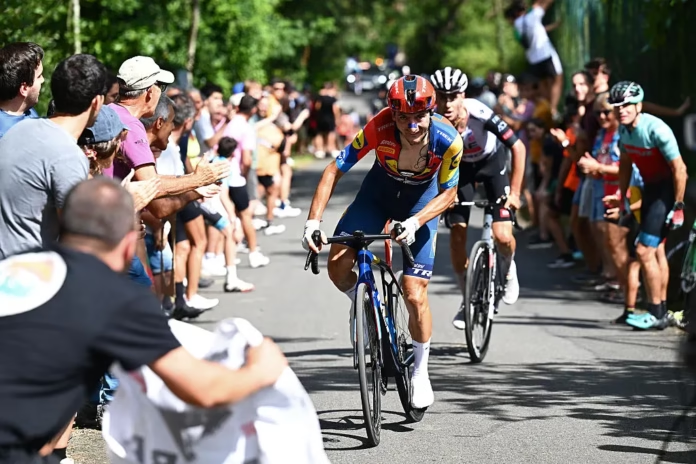
The Donostia San Sebastian Klasikoa returns on Saturday 1 August with one of the strongest post-Tour fields of the season and a route that gives teams several very different ways to approach the race.
The 221.1km course contains more than 4,150 metres of climbing and seven categorised ascents, with Jaizkibel, Erlaitz and Murgil Tontorra forming the decisive final sequence before the run back into San Sebastián. Our Donostia San Sebastian Klasikoa 2026 route guide goes into the details of those climbs, but the important point for the teams is that this is not a race where everyone can simply wait for the same final attack.
Remco Evenepoel is chasing a fourth victory, Giulio Ciccone returns as defending champion and Primož Roglič gives Red Bull-Bora-Hansgrohe another route to the win. Ben Healy, Jan Christen, Felix Gall, Pello Bilbao, Mikel Landa, Oscar Onley and Marc Hirschi broaden the contender pool considerably.
The start list also contains teams whose chances depend almost entirely on making the race unpredictable before the biggest favourites take control. That contrast should shape the 2026 edition. Some squads want a highly selective battle between the strongest riders. Others need to prevent exactly that from happening.
For anyone coming to the race for the first time, our beginner’s guide to the Men’s Donostia San Sebastian Klasikoa 2026 explains how the Basque Classic normally develops and why Tour de France form matters so much six days after Paris.
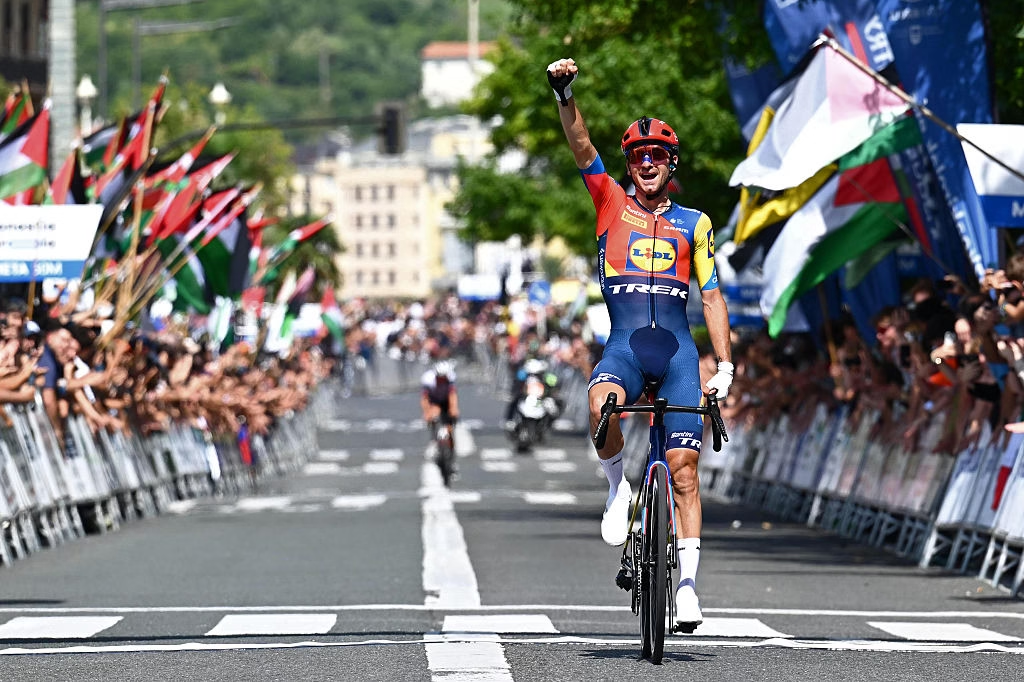
Alpecin-Premier Tech
Alpecin-Premier Tech do not arrive with the obvious headline favourite possessed by several rival teams, which should encourage them to approach San Sebastián aggressively rather than trying to control the race.
Waiting until the final showdown on Murgil Tontorra would give them relatively few options against riders such as Evenepoel, Ciccone and Roglič. Their better route is to place riders into moves earlier, particularly during the middle climbing section when the strongest teams are still deciding how much responsibility they want to take.
That freedom can be useful in San Sebastián. A rider already ahead when Jaizkibel begins can force the favourites to spend teammates chasing rather than preserving everyone for the final climbs. Alpecin-Premier Tech may not dictate the race, but they can make it much less comfortable for the teams who want to.
Bahrain Victorious
Bahrain Victorious have one of the strongest tactical combinations in the race through Pello Bilbao and Santiago Buitrago, with enough climbing support around them to avoid committing everything to one leader too early.
Bilbao is particularly well suited to San Sebastián. His Basque experience, descending ability and speed from a reduced group mean he does not necessarily need to be the strongest climber to win. If he survives the final selection alongside riders who would prefer to arrive alone, his sprint becomes a genuine problem.
Buitrago gives Bahrain a more direct climbing option. He can respond if the race becomes highly selective and offers the team someone capable of attacking rather than simply waiting for Bilbao’s finish. That combination allows Bahrain to respond to several different race scenarios, and they should expect to have at least one rider involved deep into the finale.
Decathlon CMA CGM Team
Felix Gall gives Decathlon CMA CGM a clear leader and a straightforward tactical objective: make the race hard enough that finishing speed matters as little as possible.
Gall is unlikely to want a sizeable group reaching the final kilometres together. His strongest scenario is a race where Jaizkibel and Erlaitz remove most of the supporting riders before Murgil Tontorra reduces the favourites even further.
The team can help create that scenario rather than merely waiting for it. Matthew Riccitello and Léo Bisiaux provide climbing depth and can be used either to enter moves before Gall attacks or to increase the pressure ahead of the decisive climbs. If Gall reaches Murgil in a group of only a handful of riders, Decathlon have put him in the race they want.
EF Education-EasyPost
Ben Healy is one of the riders most capable of changing how everybody else has to race.
Healy’s threat comes from distance. He does not need to wait for Murgil Tontorra, and probably should not. If the obvious favourites arrive at the final climb with full teams and fresh legs, riders such as Evenepoel and Ciccone have a natural advantage.
Healy can attack much earlier, bridge towards an existing move or use Erlaitz to turn the finale into a chase rather than a straightforward favourites’ battle. His willingness to commit makes him especially difficult to control because rival teams cannot always assume an attack is simply tactical preparation for somebody else.
EF’s best version of the race is one where Healy forces the strongest teams to start making decisions before they planned to.
Groupama-FDJ United
Groupama-FDJ United are another team who gain more from an open race than a controlled one.
Without the single overriding favourite of Red Bull-Bora-Hansgrohe or Lidl-Trek, their opportunity comes through numbers and timing. A rider in the right breakaway can remain relevant surprisingly late because the course contains enough climbing to allow a strong move to maintain momentum once weaker riders begin disappearing.
That means the French team should not be afraid to move early. Waiting until the final climb and attempting to follow the strongest specialists creates a much narrower route to a major result.
The aim should be to have representation both ahead of the race and inside the favourites’ group when Jaizkibel begins.
Lidl-Trek
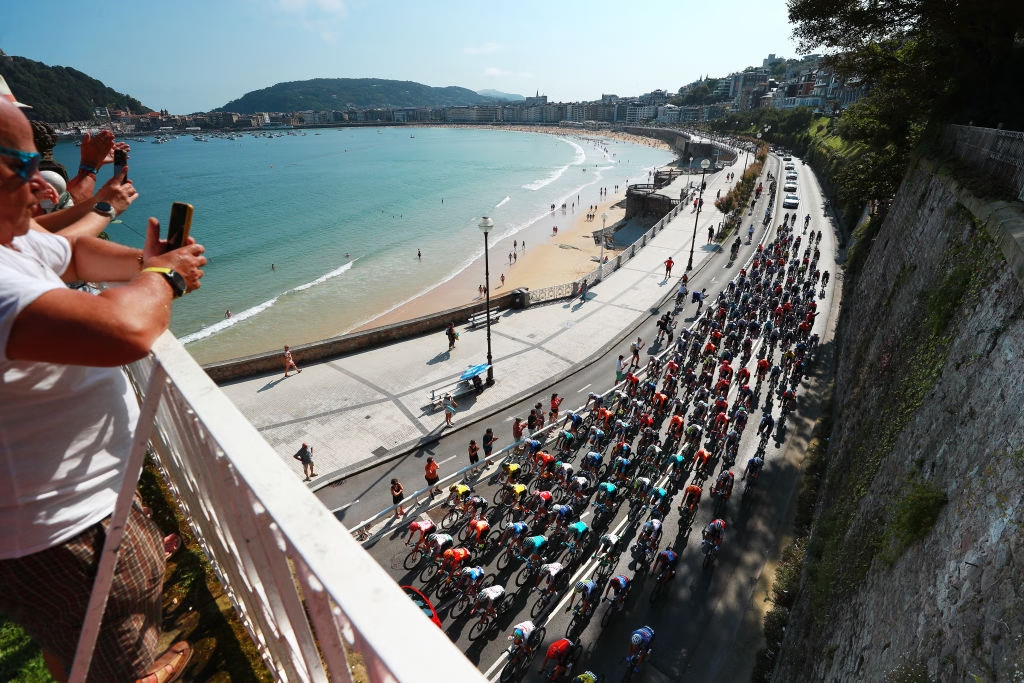
Lidl-Trek start with the defending champion and one of the clearest leaders in the field.
Giulio Ciccone won in 2025 after the race became sufficiently selective for his climbing strength and attacking instinct to decide it. Twelve months later, nobody will allow him the same degree of freedom.
That changes how Lidl-Trek need to race. Ciccone can still win through a direct attack, but the team may need to use its supporting riders earlier to prevent every rival from simply waiting for him to move. San Sebastián rewards riders who can climb after more than 200km of repeated effort, and Ciccone has already shown that this particular race suits him.
The defending champion belongs among the main favourites. The challenge is winning when everybody else now treats him that way.
For more on how the race developed into one of the most prestigious one-day events outside the Monuments, our history of the Donostia San Sebastian Klasikoa covers the winners and climbs that have shaped it since 1981.
Lotto-Intermarché
Lotto-Intermarché should be looking to make themselves relevant before the strongest teams reduce the race.
A straightforward final-climb contest against the deepest collection of climbing talent on the start list offers little advantage. An aggressive middle section gives them much more.
That can mean placing a rider into the break, following counter-attacks or using the periods between climbs when the major teams are reluctant to chase every move. San Sebastián often produces those windows because nobody wants to use too many domestiques before Jaizkibel.
Lotto-Intermarché need to exploit them rather than wait for the race to come to them.
Movistar Team
Movistar bring a team capable of influencing the GC-style climbing battle rather than simply hoping for a breakaway.
Enric Mas provides the most obvious leadership option, while Cian Uijtdebroeks and Nairo Quintana give Movistar enough climbing depth to attack the race in several ways.
Mas should be highly competitive if San Sebastián becomes a sustained endurance contest, but he does not necessarily want to arrive at the Boulevard with riders carrying much stronger finishing speed. That makes an attacking race essential.
Uijtdebroeks and Quintana can help create it. Movistar can send one rider ahead, force rivals to react and preserve Mas for a later move. Racing in Spain and on terrain this suitable to the squad’s strengths, there is little reason for them to adopt a purely defensive approach.
Netcompany INEOS Cycling Team
Oscar Onley and Thymen Arensman give Netcompany INEOS two credible options with slightly different strengths.
Onley is increasingly well suited to this type of one-day race. He has the climbing strength to survive the accumulated elevation but enough acceleration to respond when the race becomes more explosive late on.
Arensman offers a more endurance-focused option. A long, attritional race suits him better than a short sequence of punchy accelerations, so the harder the earlier climbs are ridden, the more valuable he can become.
INEOS do not need to decide between them from kilometre zero. Keeping both involved into the final third gives the team tactical flexibility at precisely the point where other squads may already be reduced to one leader.
NSN Cycling Team
NSN Cycling Team have little to gain from waiting for the elite favourites to take over.
Their opportunity sits further from the finish.
A rider entering the decisive 50km with an advantage can remain tactically relevant even if the strongest teams eventually close the gap. That forces others to spend energy and gives NSN a route towards a high finish that does not depend on matching the outright favourites climb for climb.
The repeated ascents make an early move difficult to sustain, but they also mean a strong breakaway can shed weaker riders and remain competitive much longer than on a flatter Classic.

Red Bull-Bora-Hansgrohe
Red Bull-Bora-Hansgrohe have the most powerful tactical hand in the race.
Remco Evenepoel, Primož Roglič and Maxim Van Gils provide three different routes to victory, and Evenepoel’s record makes him the obvious centre of attention. He has already won San Sebastián three times and can move ahead of Marino Lejarreta as the race’s outright record holder if he wins a fourth.
Evenepoel’s history here is built around the characteristics that make him so difficult to race against. He does not need to wait for the final wall. If he sees an opportunity on Erlaitz or even earlier, he can make a sustained move and force everyone else into pursuit.
Roglič changes the tactical equation completely. If rivals concentrate entirely on Evenepoel, Roglič has the climbing ability and finishing kick to exploit it. Van Gils gives the team another rider comfortable on steep one-day terrain and dangerous from a reduced group.
The rest of the peloton cannot simply identify the strongest Red Bull rider and mark him. That is the team’s biggest advantage.
Soudal-Quick-Step
Mikel Landa gives Soudal-Quick-Step a leader whose relationship with Basque cycling adds another layer to a race already well suited to him.
Landa wants a genuinely selective finale. Taking Bilbao, Roglič or other riders with strong finishes towards the Boulevard gives him an increasingly difficult problem, so the climbs need to do more than simply reduce the peloton.
That should encourage Soudal to make the race hard before Murgil. If Landa reaches the final climb in a small group of pure climbers, his prospects improve significantly.
There is also no shortage of motivation. A Basque victory in San Sebastián carries a significance that goes beyond another WorldTour win, and Landa has both the experience and climbing ability to make it realistic.
Team Jayco AlUla
Jayco AlUla’s chances improve as the race becomes less predictable.
They do not arrive with the overwhelming favourite around whom the entire team needs to organise, so their best strategy is likely to involve attacks before the final selection rather than following it.
San Sebastián gives teams several points to try that. The roads between the classified climbs are often as tactically important as the climbs themselves because a counter-attack can establish itself while the favourites’ teams hesitate over who should chase.
Jayco should be looking for those moments. Entering Murgil with one isolated rider behind Evenepoel, Ciccone and Roglič is unlikely to be enough.
Team Picnic-PostNL
Picnic-PostNL face a similar calculation.
The route is too difficult for a conventional sprint strategy and the depth of the favourite group makes a patient approach relatively low percentage. They need to create a race where the final selection is already missing some of the obvious names or where their rider begins it with an advantage.
That makes the middle climbing section important.
A well-timed move there can force the larger teams to use riders they were hoping to save for Jaizkibel. Even if the attack does not survive, the team can influence the shape of the finale rather than simply becoming part of it.
Team Visma | Lease a Bike
Visma | Lease a Bike arrive only days after the Tour de France, which makes freshness one of the hardest variables to judge.
That is true across much of the start list, but particularly for squads whose best riders have just spent three weeks working within a tightly controlled Tour hierarchy.
San Sebastián offers a complete reset. There is no GC to protect and no next stage to consider. Riders who spent July working for somebody else can suddenly attack for themselves.
Visma’s strength should come through keeping several options in the race rather than building everything around one obvious favourite. If they can place a rider ahead before Red Bull begin dictating the pace around Evenepoel and Roglič, they can force the race into a much more favourable tactical shape.
UAE Team Emirates XRG
Jan Christen gives UAE Team Emirates XRG one of the most exciting attacking options in the field.
Christen has already shown that San Sebastián suits him, and his combination of climbing ability and aggression makes him particularly dangerous if the race becomes fragmented before the final climb. He does not need to wait for Murgil to make his move.
Igor Arrieta gives UAE another strong climbing option and allows them to avoid simply protecting Christen throughout the day. One rider can attack while the other remains behind, creating exactly the kind of tactical uncertainty that becomes valuable late in a long Classic.
Christen has already shown that he can reach the decisive part of this race with the best. In 2026, the question is whether he can turn that into victory.
Uno-X Mobility
Uno-X Mobility need to be proactive.
Waiting for the best climbers to attack on the final climbs gives them few ways to improve their position, while moving earlier allows them to use the unpredictability that defines San Sebastián.
That means entering breakaways, following dangerous counter-attacks and retaining enough numbers to use more than one rider when the race begins fragmenting.
A high finish is achievable if they make the right move. A victory probably requires the favourites behind to hesitate at precisely the wrong moment.
XDS Astana Team
XDS Astana should look to use the depth of the squad rather than place everything behind one isolated rider.
San Sebastián is difficult to win once a team is reduced to a lone leader too far from the finish. Having representation in the breakaway while retaining someone in the favourite group creates a much stronger position.
The course suits climbing depth and repeated attacks. If Astana can reach Jaizkibel with more than one rider still tactically useful, they can contribute to shaping the finale rather than responding to what Red Bull, Lidl-Trek and the other major teams decide to do.
Pinarello-Q36.5 Pro Cycling Team
Pinarello-Q36.5 have earned their place among the WorldTour teams and San Sebastián is the type of race where the difference between divisions matters less than it might elsewhere.
There is no sprint train to match and no three-week squad depth to compare. Once the race reaches the decisive climbs, individual strength and tactical position become much more important.
That gives Q36.5 a realistic opportunity to race beyond breakaway visibility. The ideal scenario is to place one rider ahead while keeping another capable of following the favourites.
If they manage that into the final 40km, a major result is possible.
Cofidis
Ion Izagirre and Alex Aranburu give Cofidis one of the most useful combinations among the ProTeams.
Izagirre brings extensive experience of Basque roads and the climbing strength required to remain competitive after more than 4,000 metres of elevation. Aranburu offers something very different through his speed from a reduced group.
That allows Cofidis to attack without sacrificing every route to the finish.
Izagirre can move earlier and force the race to become selective. If it comes back together, Aranburu becomes increasingly dangerous as the group gets smaller.
It is exactly the type of two-pronged strategy that can disrupt teams focused on protecting one leader.
Tudor Pro Cycling Team
Tudor arrive with two riders who understand how to win difficult one-day races.
Julian Alaphilippe and Marc Hirschi make the Swiss team one of the most serious threats outside the WorldTour.
Alaphilippe can destabilise the race through attacks on steep gradients, aggressive descending and an instinct for moving before the obvious moment. Hirschi offers a different problem because he can survive a hard race and still sprint effectively from a reduced group.
That combination creates tactical pressure.
If Alaphilippe attacks, rivals cannot rely on Hirschi helping with the chase. If Hirschi survives with the favourites, stronger pure climbers may become reluctant to tow him towards the Boulevard.
A podium would not be a surprise. Victory is entirely realistic.
Burgos BH Burpellet
Burgos BH Burpellet should treat their invitation as a reason to attack rather than an opportunity to ride anonymously inside the peloton.
The race’s climbing means a strong breakaway can survive deep into the afternoon, particularly if the WorldTour favourites hesitate over who should take responsibility for the chase.
That is the situation Burgos need to create.
A victory would require plenty to fall into place, but putting a rider ahead into the closing climbs can turn visibility into a genuinely strong result.
Caja Rural-Seguros RGA
Caja Rural-Seguros RGA also need to race before the favourites.
Waiting for Evenepoel, Ciccone, Roglič and the strongest WorldTour climbers to make their moves is unlikely to leave much opportunity afterwards.
The Spanish team should therefore look for the main breakaway and be prepared to attack again if the first move comes back. Familiarity with Spanish racing and the willingness to commit riders aggressively can be valuable on a route where the favourite teams will want to avoid chasing everything.
The aim is to force somebody else to spend energy.
Equipo Kern Pharma
Kern Pharma have repeatedly shown that invitations to major Spanish races do not need to be treated purely as exposure exercises.
The terrain in San Sebastián suits their usual willingness to race aggressively, and the amount of climbing gives strong riders an opportunity to remain relevant long after the early breakaway would normally have been caught.
Kern Pharma should be looking beyond simply getting someone onto television.
If they can carry a rider into the final 30km around the main selection, the tactical focus among the biggest favourites could create an opportunity for a much higher result.
Euskaltel-Euskadi
No invited team has a stronger emotional connection to the race than Euskaltel-Euskadi.
The orange jerseys racing the biggest one-day event in the Basque Country will inevitably receive attention, but the team’s challenge is converting that local significance into a sporting opportunity.
Waiting for the WorldTour favourites is unlikely to do it.
Euskaltel need to race aggressively, put riders into the important moves and use their familiarity with Basque roads to anticipate where the race may change before the television favourites attack.
A rider ahead as the race approaches Jaizkibel would put the team exactly where it wants to be: visible, tactically relevant and forcing the strongest squads to chase on home roads.
Which teams have the strongest hand in San Sebastián?
Red Bull-Bora-Hansgrohe have the clearest tactical advantage because Evenepoel, Roglič and Van Gils give them multiple ways to win. Evenepoel’s extraordinary history at the race makes him the obvious rider to watch, but focusing too heavily on him risks giving Roglič the freedom to use his own climbing and finishing strength.
Lidl-Trek have the defending champion in Ciccone, while UAE Team Emirates XRG have an aggressive young contender in Christen who already knows he can perform here. Bahrain Victorious can use Bilbao and Buitrago in different ways, while Movistar and Netcompany INEOS have enough climbing depth to remain tactically relevant rather than simply protecting one leader.
Then come the riders capable of destroying any neat team plan. Healy can attack before the favourites want to race. Alaphilippe and Hirschi give Tudor two dangerous one-day specialists. Bilbao can win if the race comes back together. Landa has both the terrain and local motivation to attack when the climbing becomes hardest.
That is why the 2026 route matters so much. Jaizkibel, Erlaitz and Murgil Tontorra reward different types of move, and a rider who lacks the finishing speed for the Boulevard does not have to wait for the same climb as everyone else.
The strongest rider does not automatically win San Sebastián. The winner usually needs enough climbing strength to survive more than 220km of Basque terrain, but also the tactical judgement to understand when waiting has become more dangerous than attacking.
With Evenepoel chasing history, Ciccone defending his title and several teams carrying more than one genuine winning option, the 2026 Klasikoa should be decided as much by who forces the race onto their terms as by who produces the biggest numbers on Murgil Tontorra.
UK viewers can find the broadcast details, timings and streaming options in our guide to how to watch Donostia San Sebastian Klasikoa 2026 in the UK.

