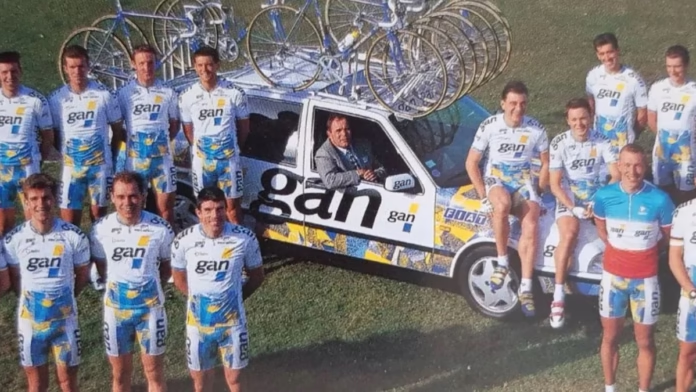
Gan occupied an unusual place in the professional peloton of the 1990s. The French insurance company appeared on the jersey for only a little over five seasons, yet the team underneath it carried a much longer lineage and several distinct strands of cycling history. It inherited the structure that had raced as Z, retained Roger Legeay at the centre of the operation, saw the final season of Greg LeMond’s career and gave Chris Boardman his first professional home after the Barcelona Olympics.
That makes Gan difficult to treat as an isolated team. It was a sponsorship chapter in an organisation whose roots ran through Peugeot, Z and eventually into Crédit Agricole, but the Gan years developed an identity of their own. Boardman’s precision against the clock sat alongside a strong French core, experienced Classics riders and a generation that included Stuart O’Grady and Jens Voigt before they became established names elsewhere.
From Peugeot and Z to Gan
The lineage matters because Gan did not begin from scratch in 1993. Peugeot’s long-running professional operation had moved into the Z-Peugeot era in the late 1980s before racing simply as Z. Under Legeay, that team had already reached the highest level, most famously with LeMond’s victory at the 1990 Tour de France. The American’s third Tour win therefore belonged to the same organisational family, even though it came three years before the Gan name arrived.
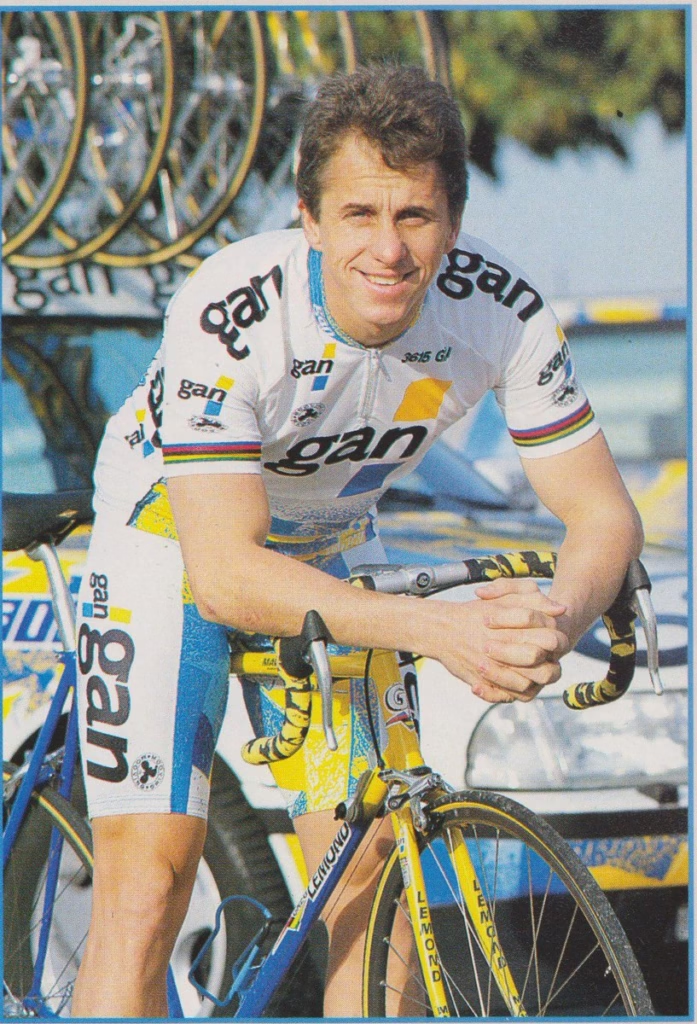
LeMond remained with the structure when Gan became title sponsor in 1993, but by then his career was moving towards a difficult conclusion. His earlier story, including the extraordinary recovery that preceded his Tour victories, is covered in more detail in ProCyclingUK’s Greg LeMond rider history. For Gan, his presence gave the new sponsor continuity and stature, even if he could no longer reproduce the level that had made him the outstanding stage racer of the turn of the decade.
Gan’s arrival also needs separating from an earlier team carrying the same sponsor in the 1970s. The 1993-98 operation was the successor to Z and was managed by Legeay. It was not simply a revival of the older Gan-branded squad. That distinction is important when following team histories through an era in which sponsorship names often changed more quickly than the organisations behind them.
Chris Boardman changes the team’s profile
The most important new signing of the Gan era was Chris Boardman. He joined for 1993 after winning Olympic individual pursuit gold in Barcelona and immediately gave the team a rider whose specialist qualities were unusually clear. Boardman was not built around the conventional expectation that a leading professional had to become a Grand Tour contender. His value lay in extracting enormous speed from short stage races, prologues and time trials, while steadily broadening his road programme.
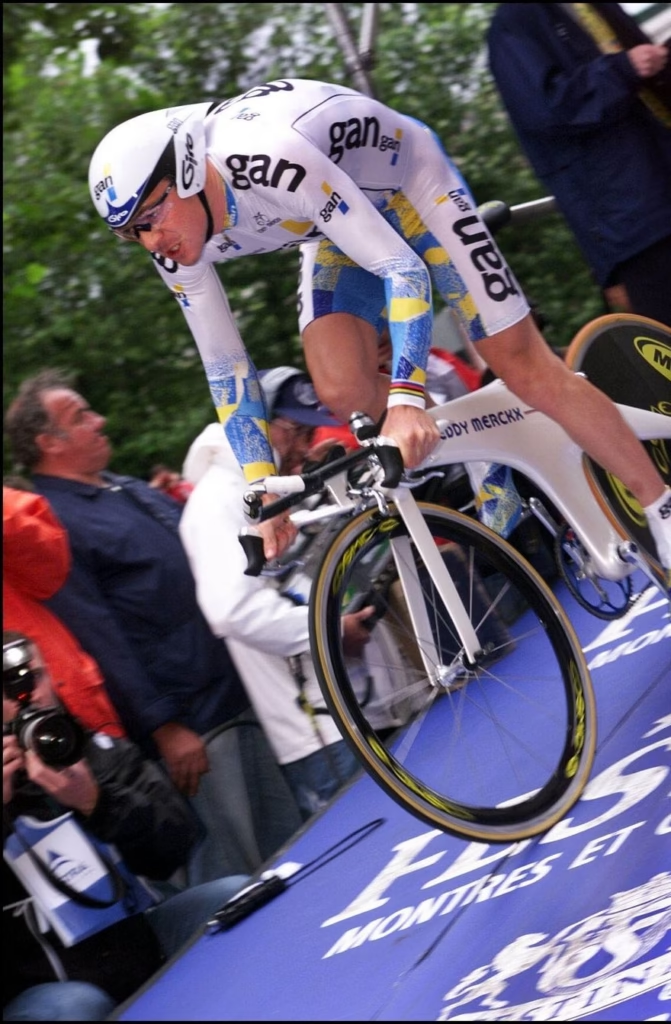
By 1994 that approach was producing results at WorldTour-equivalent level. Boardman won time trials at the Dauphiné and Tour de Suisse before taking the Tour de France prologue in Lille. He then won the inaugural elite men’s world time-trial championship later that summer. Gan consequently had one of the most recognisable specialists in cycling at precisely the moment when aerodynamics, position and increasingly sophisticated time-trial preparation were becoming more visible parts of the sport.
His Tour prologue wins became the most memorable recurring image of the team. Boardman took yellow on the opening day of the 1994 Tour and did so again in 1997. In 1998 he won the Dublin prologue, although a crash three days later forced him out. Those successes were short in duration but enormous in exposure: a sponsor could begin the Tour with its jersey on the race leader and on front pages across Europe.
A team with more depth than the Boardman headlines
Boardman’s performances can make Gan look like a team organised around a single specialist, but the roster was broader. Gilbert Duclos-Lassalle brought enormous experience and had won Paris-Roubaix twice with the preceding Z structure. His long career and late peak are explored in ProCyclingUK’s Gilbert Duclos-Lassalle profile. Eddy Seigneur supplied further time-trial strength and won the final stage of the 1994 Tour on the Champs-Élysées, while Frédéric Moncassin developed into one of the team’s quickest finishers.
The team was particularly effective on the French calendar. Gan won the Coupe de France team classification in 1993, 1995 and 1996, evidence of an operation that could collect results throughout the season rather than waiting for July. That domestic consistency mattered for a French sponsor, while the Tour remained the event that defined international visibility.
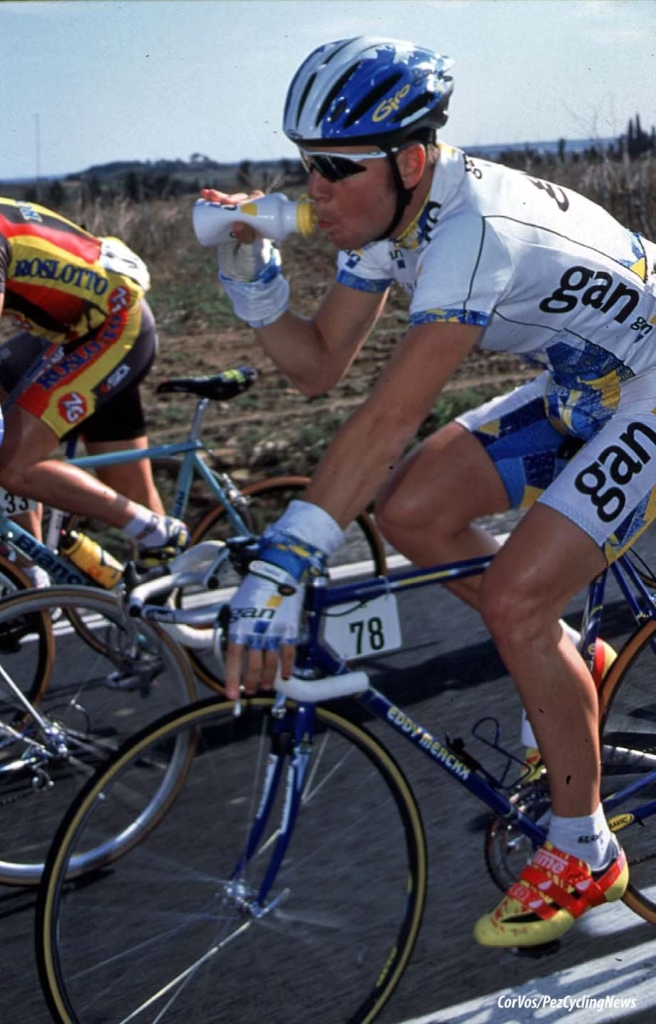
The roster also became a staging point for riders whose biggest results came later. Australian Stuart O’Grady turned professional with Gan in 1995 and stayed with Legeay’s organisation into the Crédit Agricole period. Jens Voigt also passed through the structure before becoming one of the most familiar attacking riders of the following decade. The mixture of French professionals, experienced road captains and developing international riders gave Gan a recognisable shape without making it dependent on a single Grand Tour leader.
LeMond’s final chapter
LeMond’s final seasons were very different from the victories that had defined him. He struggled through 1993 and returned to the Tour in 1994, but abandoned during the first week. He retired at the end of that season. For Gan, the transition was stark: the rider who had provided the structure with its greatest result under Z was disappearing just as Boardman was becoming its most marketable current rider.
There was no direct replacement in the sense of another Tour-winning GC leader. Gan instead became a team capable of winning specific high-value days. Boardman could take yellow in a prologue, sprinters could hunt stages, and the wider roster could target French stage races and one-day events. It was a pragmatic model for a team operating in a decade increasingly shaped by heavily funded Grand Tour projects.
The 1997 and 1998 Tours
The final two Gan Tours showed the model at its most visible. Boardman won the 1997 prologue in Rouen and wore yellow for a day. The following year in Dublin he repeated the trick, giving Gan the race lead at the start of what would become one of the most consequential Tours in cycling history. O’Grady later took yellow during that 1998 race, while the team accumulated stage success even as the Festina affair transformed the atmosphere around the event.
The era cannot be separated completely from cycling’s doping history. In 1996 Gan dismissed Laurent Desbiens and Philippe Gaumont, along with team doctor Patrick Nédelec, after positive tests for nandrolone. Years later O’Grady admitted using EPO in the build-up to the 1998 Tour while riding for Gan. Those facts sit alongside the results rather than outside them. They are part of the context required to understand a professional team operating through the 1990s.
At the same time, the sponsor change was already settled. Gan had intended to finish its backing, and an agreement allowed Crédit Agricole to take over after its commitments around the 1998 football World Cup. The handover took effect in August 1998. It was unusually orderly by professional cycling standards: the management and much of the sporting structure continued while the branding changed.
From Gan to Crédit Agricole
Crédit Agricole’s arrival makes the end of Gan less dramatic than the disappearance of many 1990s teams. There was no sudden collapse or wholesale dispersal. Legeay remained in charge and the organisation continued for another decade, developing riders and winning major races under the green-and-white colours of its new sponsor.
That continuity is central to Gan’s place in cycling history. The team connected several eras: Peugeot’s old institutional weight, Z and LeMond’s Tour-winning years, Boardman’s highly specialised approach to performance, and the Crédit Agricole squad that later featured riders such as O’Grady and Thor Hushovd. It was less a self-contained dynasty than a highly visible bridge between them.
For British followers in particular, Gan is difficult to detach from Boardman. His yellow jerseys arrived at a time when British success in the men’s Tour was still sporadic, and his ability to turn a few kilometres of racing into a precisely controlled performance made the opening day of the Tour unusually important. Yet the team history around him is richer than those prologues. Gan’s five-and-a-half seasons capture a professional sport changing its sponsors, methods and international reach while carrying much older structures underneath the new colours.