
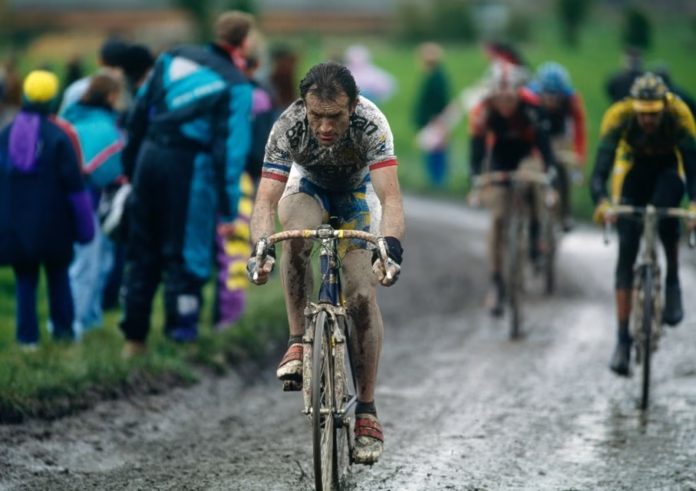
Gilbert Duclos-Lassalle was 37 when he finally won Paris-Roubaix and 38 when he returned to the Roubaix velodrome a year later and did it again. His defining victories arrived at an age when most professionals were already contemplating retirement, but describing him simply as a late bloomer understates the career that came before them.
Duclos-Lassalle had already won Paris-Nice, Bordeaux-Paris, the Grand Prix du Midi Libre and two editions of GP Ouest-France. He had twice finished second at Paris-Roubaix itself and remained a major winner into his late thirties. The breakthrough in 1992 was not an ageing rider suddenly finding a race that suited him. It was the eventual resolution of a relationship with Roubaix that had lasted for more than a decade.
His place in the history of Paris-Roubaix therefore rests on more than the unusual age of his victories. Few riders spent so long learning the race, coming close to winning it and then returning strongly enough to master it twice.

A career built around endurance rather than an early peak
Duclos-Lassalle was born in Lembeye in south-west France on 25 August 1954 and turned professional with Peugeot in 1977. He would remain within the same sporting structure for the rest of his career as Peugeot became Z and later GAN, finally retiring at the end of 1995.
His reputation developed steadily rather than through one explosive first season. Duclos-Lassalle could perform across stage races and long one-day events, but the common quality was endurance. The harder a race became through distance and accumulated fatigue, the more useful his strengths tended to be.
That made northern Classics particularly suitable. Paris-Roubaix demands enormous physical power, but it also punishes wasted effort. Positioning before the cobbles, choosing lines, deciding which attacks matter and remaining tactically functional after five or six hours all become part of the result.
Duclos-Lassalle spent years acquiring that knowledge while retaining enough physical strength to use it.
Winning Paris-Nice showed the breadth of his ability
His victory at Paris-Nice in 1980 came 12 years before the first Roubaix win and remains important when assessing the type of rider he actually was.
Paris-Nice required consistency across several stages and changing terrain. It was not a race a cobbled specialist could win simply through toughness. Duclos-Lassalle had to manage a general classification over a week, protect his position and remain competitive day after day.
The same season brought his first near miss at Paris-Roubaix. Francesco Moser won, with Duclos-Lassalle finishing second. Three years later he would occupy the same position again behind Hennie Kuiper.
Those results established two things early. Duclos-Lassalle was a much broader rider than his later reputation might suggest, and Paris-Roubaix had already become the race capable of defining his career.
He simply had no idea how long he would have to wait to win it.

Roubaix kept giving him reasons to come back
Second in 1980 and second again in 1983 would have been enough for many riders to accept that Paris-Roubaix was one of the great victories that had escaped them.
Duclos-Lassalle kept returning.
That persistence becomes more impressive because he was not spending those years getting progressively closer. There were seasons when Roubaix went badly, seasons when other riders were simply stronger and years when crashes, mechanical problems or race circumstances removed the opportunity altogether.
That is part of what makes the race so difficult to master. Even riders perfectly suited to the cobbles cannot guarantee that fitness and opportunity will coincide on the same April Sunday.
Duclos-Lassalle still finished fourth in 1989 and sixth in 1990, evidence that he remained capable of reaching the decisive stages long after those first podiums. By then, however, the idea that he might eventually win was becoming less obvious rather than more.
He was entering his late thirties. The race had already denied him for more than a decade.
Bordeaux-Paris explained why age did not remove him so quickly
Duclos-Lassalle’s 1983 victory at Bordeaux-Paris fitted his abilities almost perfectly.
The old Classic was an extreme endurance event, raced over distances well beyond normal one-day racing. The character of the competition changed as the kilometres accumulated. Producing power remained essential, but so did the ability to continue eating, thinking and making sensible tactical decisions when fatigue had become overwhelming.
Duclos-Lassalle excelled in that environment.
The connection with Paris-Roubaix is not exact, but the overlap is clear. Both races rewarded riders whose effectiveness deteriorated more slowly than everyone else’s. Roubaix added cobbles, mechanical risk and violent changes of pace, but the underlying requirement remained an ability to function deep into an exhausting day.
Duclos-Lassalle’s greatest quality was never based solely on explosive acceleration. That helped him remain competitive later in his career than riders whose results depended more heavily on raw speed.
Plouay became another important part of his record
The years between his early Roubaix podiums and eventual victories contained plenty of success elsewhere.
Duclos-Lassalle won GP Ouest-France at Plouay in 1981 and again in 1987. The race now known as Bretagne Classic has undergone major changes since then, but its rolling Breton roads have always rewarded riders capable of handling distance and repeated efforts.
His two victories place him among the notable multiple winners covered in our history of Bretagne Classic.
He also won the Tour of Sweden in 1986, Route du Sud in 1989 and continued collecting stage victories across the French calendar. These were not the results of a rider whose career had become a long wait for Roubaix.
Then, in 1991, came one of the clearest indications that the usual ageing curve was not applying cleanly.
Duclos-Lassalle won the Grand Prix du Midi Libre overall at 36. It was a major stage-race victory achieved more than a decade after Paris-Nice and only months before the season that would change how his career was remembered.

Paris-Roubaix 1992 finally ended the wait
On 12 April 1992, Duclos-Lassalle returned to Paris-Roubaix at 37.
This time nothing stopped him.
The race covered 267km and eventually produced the performance he had been chasing since those early podiums. Duclos-Lassalle escaped his remaining rivals and reached the Roubaix velodrome alone, 34 seconds ahead of Olaf Ludwig. Johan Capiot finished third.
The size of the gap gave the victory a particular finality. After years of near misses and failed attempts, there would be no sprint and no final tactical complication. He could enter the velodrome knowing the race was his.
His equipment added another layer to the performance. Duclos-Lassalle used a RockShox suspension fork, technology borrowed from mountain biking at a time when teams were experimenting aggressively with ways of reducing the punishment of the pavé.
That detail fits his career better than an image of an ageing traditionalist relying solely on accumulated wisdom. Experience did not make him resistant to change. He was prepared to use new equipment if he believed it gave him an advantage in the race he most wanted to win.
At 37, after 15 professional seasons, Duclos-Lassalle had his Paris-Roubaix.
Had he stopped there, the story would already have been remarkable.
The 1993 defence changed how the first victory looked
Duclos-Lassalle returned as defending champion in 1993 and discovered a very different route to the same result.
Punctures and a crash complicated his afternoon, but he remained in contention and eventually found himself alongside Franco Ballerini in the decisive phase. Ballerini was 10 years younger and would later become one of the outstanding Paris-Roubaix specialists of the decade.
The two reached the velodrome together.
Nothing about the finish resembled 1992. Duclos-Lassalle could not enjoy a solitary final lap because Ballerini remained alongside him all the way to the sprint. The difference at the line was so small that the Italian initially thought he had won.
The photograph showed otherwise.
Duclos-Lassalle had successfully defended Paris-Roubaix at 38.
That second victory removed any temptation to treat 1992 as one perfectly timed late-career performance. He had returned 12 months later and won the same Monument in completely different circumstances.
The rider he narrowly beat would eventually take Paris-Roubaix himself in 1995 and 1998. Our profile of Franco Ballerini follows his journey from that painful 1993 defeat to becoming one of the race’s defining riders and later Italy’s national coach.
For Duclos-Lassalle, beating a future double winner made the defence look stronger with time.

The two victories required different versions of the same rider
The contrast between 1992 and 1993 is one reason Duclos-Lassalle’s Roubaix story remains so distinctive.
The first victory was built on separation. He escaped, created enough distance and entered the velodrome without needing to worry about a sprint.
The second depended on survival and judgement. He had to recover from problems, stay in contact with Ballerini and then make the correct decisions inside the velodrome after more than six hours of racing.
Those performances make a useful case for the value of experience without pretending age itself was an advantage.
Duclos-Lassalle still needed exceptional physical condition. No amount of knowledge can help a rider who no longer has the power to reach Carrefour de l’Arbre with the front group. What years of racing could do was make him more efficient with the strength he retained.
He knew where panic wasted energy. He knew where position could decide whether a rider survived the next cobbled sector. He understood that not every acceleration deserved an immediate response and that the ability to remain calm when Roubaix began producing mechanical chaos was a competitive skill in itself.
The physical margin between riders near the end of a Classic can be small. Duclos-Lassalle had spent 15 years learning how not to waste his.
His longevity was not confined to Paris-Roubaix
One danger with Duclos-Lassalle’s story is treating everything after 1993 as an epilogue.
He kept producing results.
He won a stage of the Critérium du Dauphiné later in 1993, took a Route du Sud stage in 1994 and was still capable of winning at the Tour of the Basque Country during his final professional season in 1995.
That matters because the Roubaix double was not followed by immediate collapse. Duclos-Lassalle remained a functioning professional winner into his forties.
His continuity with Peugeot, Z and GAN helped. He knew the organisation, had spent almost his entire adult life within its racing structure and had evolved from leader into one of the experienced figures around younger generations of riders.
The team itself changed substantially during those years. Sponsorship changed, cycling became increasingly international and riders such as Greg LeMond arrived within the Z era. Duclos-Lassalle remained.
His value eventually stretched beyond his own results. A rider with that much experience of Grand Tours, French stage races and the northern Classics inevitably became a road captain as well as a competitor.
The unusual part is that he kept being capable of winning while performing that role.
Paris-Roubaix did not create his career
Two victories in one of cycling’s five Monuments naturally overwhelm everything else when a palmarès is condensed into a few lines.
Duclos-Lassalle’s deserves more space.
There was Paris-Nice and the Grand Prix du Midi Libre. Bordeaux-Paris represented one of the great endurance races of its era. Two Plouay victories showed his quality in one-day racing away from the cobbles. He won stage races and individual stages across nearly two decades.
Most revealingly, he had already finished second at Paris-Roubaix twice before eventually winning it twice.
The cobbles did not suddenly uncover a previously ordinary professional in 1992. They provided the clearest expression of qualities that had been visible for years.
Endurance, patience, tactical judgement and an unusually slow decline combined at exactly the right race.
-
 Photo Credit: David Pintens / BELGA MAG/AFP via Getty Images
 -
Photo Credit: BELGA MAG/AFP via Getty Images
Duclos-Lassalle became part of Roubaix itself
Paris-Roubaix has a habit of absorbing particular riders into its mythology.
Roger De Vlaeminck became Monsieur Paris-Roubaix through four victories. Johan Museeuw, Tom Boonen and Fabian Cancellara became defining figures of later eras. Others built a connection with the race through one extraordinary performance or years of repeated near misses.
Duclos-Lassalle’s place is different.
Two wins do not put him at the top of the outright record, but the journey towards them makes his name inseparable from the race. He had been runner-up 12 years before his first victory, kept returning through his thirties and then won consecutive editions when conventional sporting logic suggested his opportunity should already have disappeared.
His nickname, Gibus, was later attached to the Pont Gibus near the Arenberg sector, embedding his connection with the race into the geography of Paris-Roubaix itself.
His name also appears in the famous showers at the Roubaix velodrome, where plaques commemorate the winners of each edition. Few places in professional cycling connect past and present so directly.
For more profiles of the riders, races and teams that shaped those eras, ProCyclingUK’s Men’s Cycling History Hub brings the wider archive together.
Why his late peak still stands out
Modern professional cycling increasingly identifies elite talent early. Riders arrive in the WorldTour as teenagers, win major races in their early twenties and can already carry years of expectation before reaching what was once considered a conventional sporting peak.
Gilbert Duclos-Lassalle’s career followed almost the opposite pattern.
He was already a major winner at 25. He was already good enough to finish second at Paris-Roubaix. What he did not have was the victory that would ultimately define him.
More than a decade later, he was still physically capable of contesting the same race and had acquired years of additional knowledge about how to do it. The combination finally worked in 1992 and then worked again in 1993.
His career is not evidence that riders simply become better with age. Most do not. Nor does persistence guarantee that a missing Monument will eventually arrive.
Duclos-Lassalle remained unusual because his decline was slow enough for experience to keep adding value while his physical level remained elite.
He did not become a great rider at 37. By then he had already spent 15 seasons proving what kind of rider he was.
At 37, Paris-Roubaix finally stopped refusing him.

